Collisions
Collision Calculus
Move one dot and a sampling error reverses. A new book develops the boundary and energy calculations behind interacting signals, growing grids and the half-cell carry limit.
Move one dot and a sampling error reverses. A new book develops the boundary and energy calculations behind interacting signals, growing grids and the half-cell carry limit.
A table of whole-number counts usually looks more and more like the curve behind it as the table grows. In digit-collision energy the two end up exactly one unit apart, and that whole unit comes from a single entry.
Sawtooth waves can be stacked to imitate a perfectly flat line, and every added wave lets the imitation come closer. This article measures what each new wave contributes after the part it shares with the others is taken away.
Change the base and one fifth can repeat every one, two or four digits, never three. That missing three keeps the golden crossing tied to a single repeating digit.
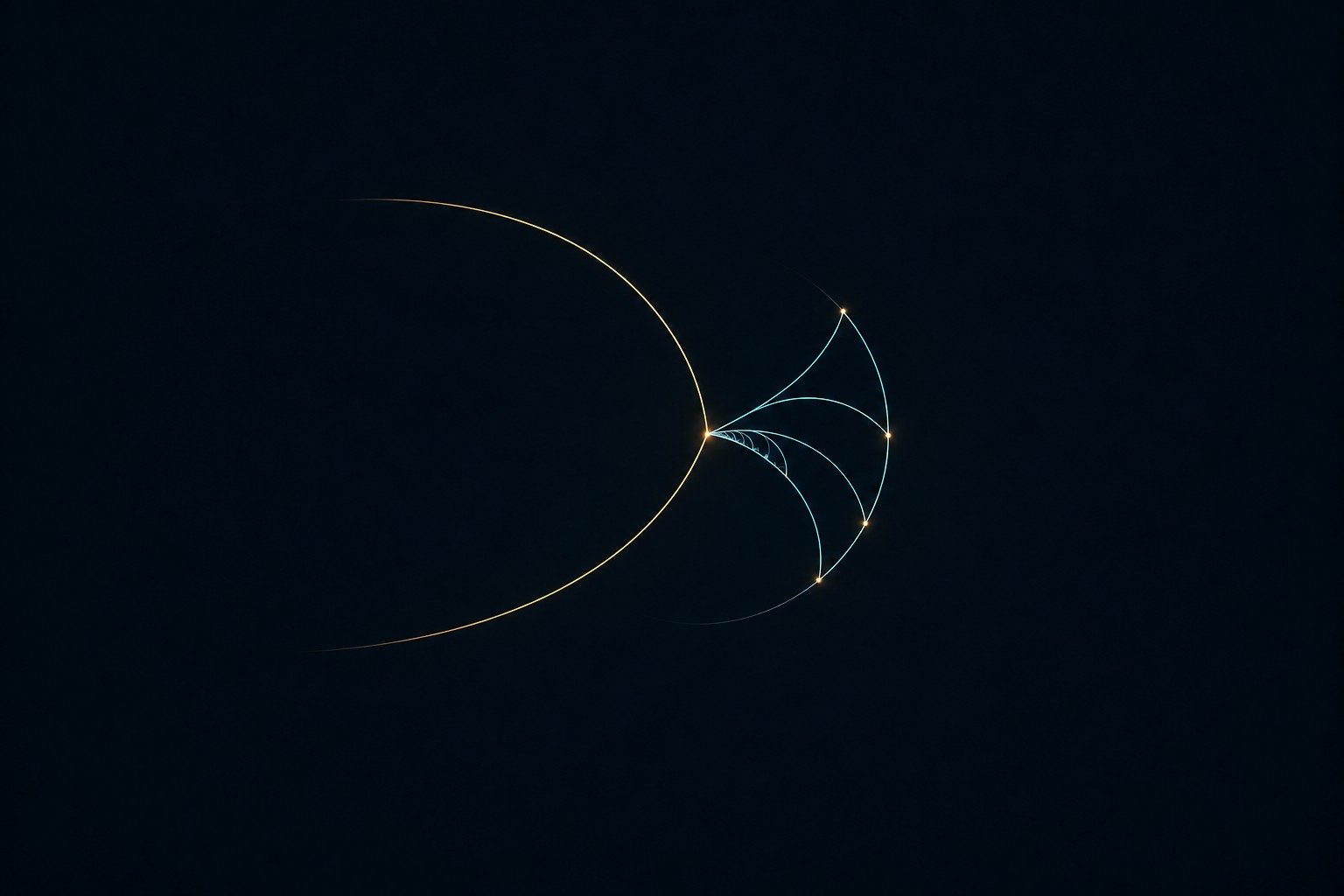
Carrying the one when a column overflows splits a pair of numbers just as the classic tree of fractions does. That split decides the weights of the repeating cycles in the digit tables, a quarter, a sixth, a twelfth and so on, adding up to exactly one.
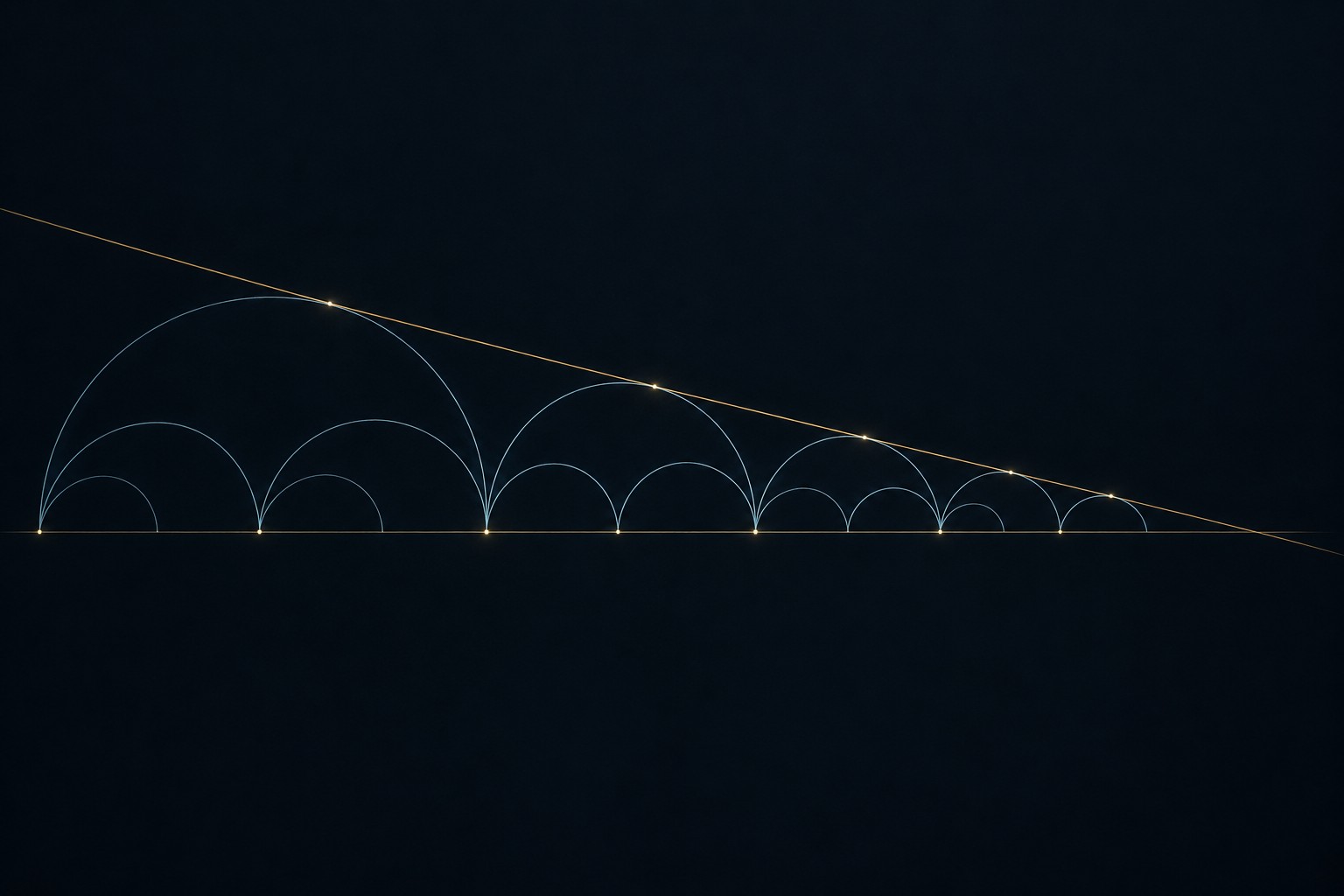
The clock model behaves perfectly on average and fails at every integer we count with. The fault lies in how the readings are taken, and once that bias is removed the integers follow the clocks after all.
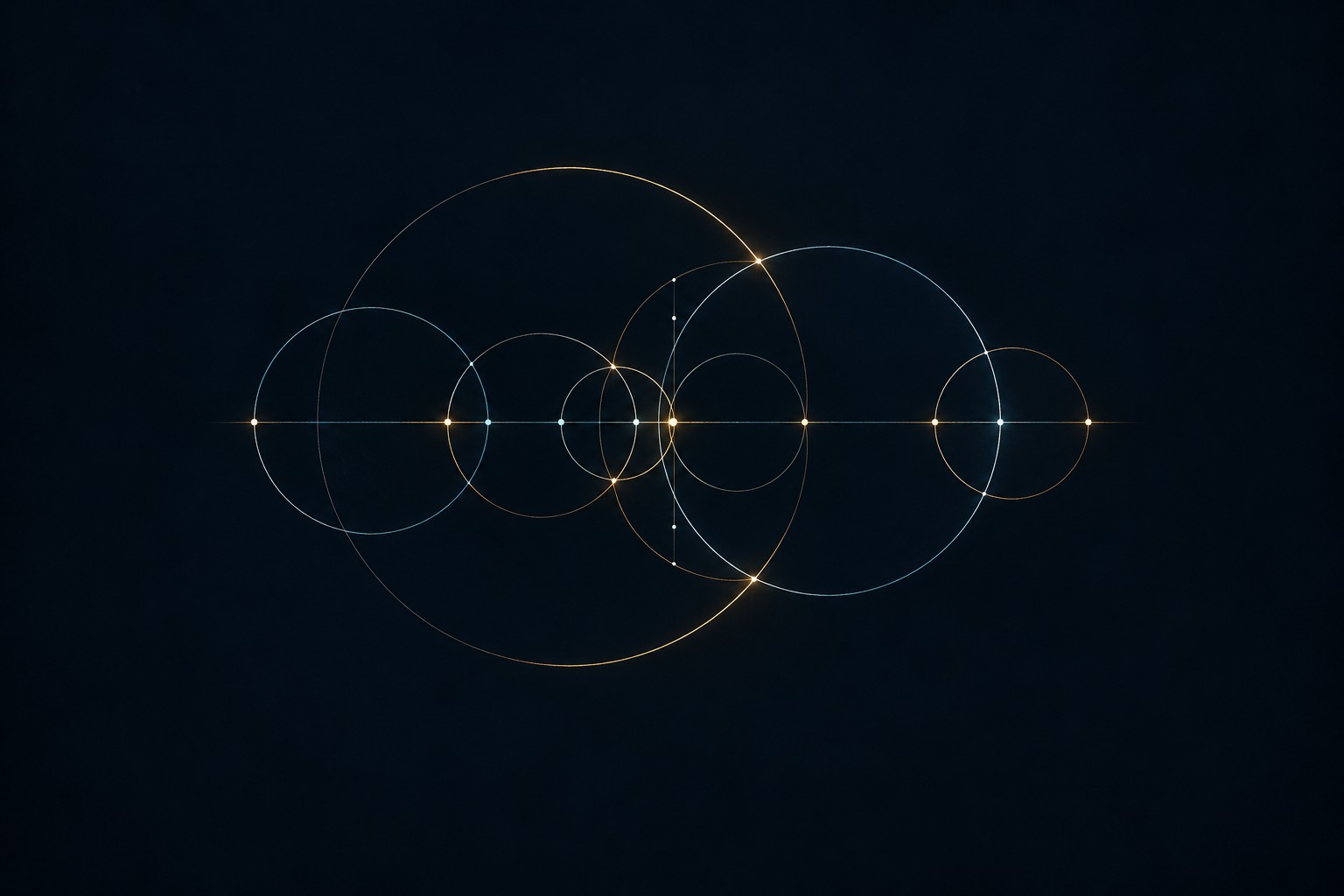
Raise the resolution from five to six and the collision deficit goes down. The reason is a set of remainder clocks with fixed weights adding to one, and three of them reset at six.
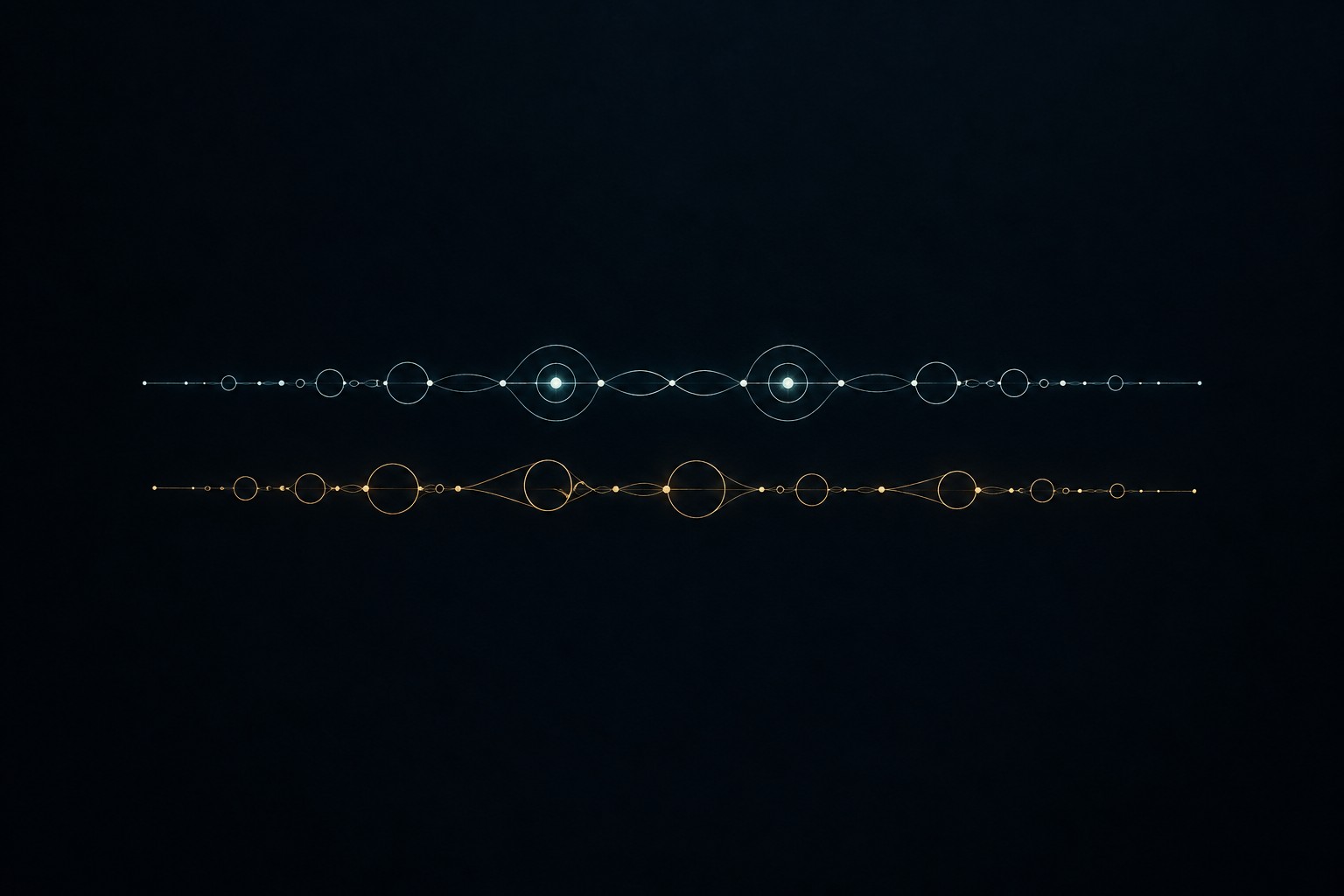
Correlation can miss a relation completely, since a number and its square have none. Two magnitudes in the collision spectrum drift to zero correlation, yet breaking their pairs still costs a factor of three.
Legendre fitted a constant to his prime tables and it was wrong. The cubic law's next term carries a pi and has to survive the same danger, a finite table that can invent patterns of its own.
Prime reciprocals look so random that their digits were once proposed as codes. Measure how far their agreements stray from fair and the total grows exactly like the cube of the base, with coefficient one.
In binary, one over 243 repeats every 162 digits, a long and busy cycle. Its edge is plain, switching off at every multiple of three, while a small two-digit rule in base fifteen has a deeper one.
Ask any question about the first two digits of a fraction and it reduces to a small table of carries. The floor function supplies the same factor every time, and the question only gets to choose its edges.
A count can change while the structure beneath it holds. A short essay on that difference, and on why the work takes its name from it.

Eight L-values stand behind the base-five collision table, infinite sums no one can finish. Twenty fractions from long division still fix an exact average of their squared sizes, 6π²/25.

The collision scores come from a forty-number table that favors some endings before any prime arrives. Remove those preferences exactly and the primes decide the rest, down to which L-function zeros could stop the sum.
Line up a prime's repeating decimal with itself shifted one place and count the matches. The count looks as if it should depend on everything about the prime, yet in decimal its deviation is fixed by the last two digits.

The base-five collision coefficient carries the size of an L-value. Let the exponent move and the coefficient becomes a function whose digit boundary never changes, while its channels inherit the zeros of their L-functions.
Twenty fractions from long division in base five fix an exact average of fourth powers of L-values, 192π⁴/625. An infinite analytic quantity comes straight out of a finite digit count.

At base five the collision weights and the prime weights very nearly avoid each other. Shuffled pairings overlap far more in every test I ran, though whether the avoidance lasts is still open.

Read collision tables in two bases at once and the weights seem to swallow each other. Over a whole table nothing is lost, since tables from coprime bases don't interfere and each can be pulled back out intact.

Keep only the primes ending in 01 or 51 and the collision sum starts to tilt. The general theorem finds exactly which selections stay balanced, and it comes down to keeping whole centered groups.
Two sums growing in opposite directions can add up to one that converges. Split the collision sum by remainder mod three and each half settles on its own, so nothing is cancelling by accident.
Count the fractions of each prime that start with a doubled base-three digit and add the counts over the primes. How heavily the large primes can be weighted before the sum stops settling comes down to the zeros of one L-function.

No one will ever write out the fractions of a thousand-digit prime, yet how many begin with a doubled digit is known exactly. It is a tenth of the prime, rounded down, plus a correction read from its last two digits.
The decimal collision table leans by last digit, with primes ending in 1 averaging minus 1.7 and those ending in 9 plus 0.7. Take out each family's own lean and the sum settles, with the finer differences intact.

All the primes below ten million add up to only about 3.04 in reciprocals. The weighted collision sum drifts like minus nine tenths of log log x, at a rate fixed before any prime is added.

Shift a prime's repeating decimal one place and count the matches. Exactly seven primes past ten give none, 11, 13, 19, 23, 37, 41 and 73, and nine subtractions prove the list is complete.

Chebyshev noticed in 1853 that some kinds of primes run ahead of others. The collision sum hides a race like that by last digit, and four character weights pull the runners apart.

Multiply every remainder of thirteen by one number and ask whether any keeps its first digit. For exactly nine multipliers none does, and the count stays nine at twenty-nine, eighty-three and a thousand and nine.

Ramanujan's 1918 sums take just two values at a prime. They turn up exactly in long division, counting how many remainders keep their digit when every remainder is multiplied by the same number.
Long division runs on two kinds of arithmetic at once, size for the digits and multiplication for the remainders. Sliding a decimal against itself is where they meet, and one frequency table per prime answers it exactly.
Change the base and the fractions of thirteen sort their remainders into different bins. The frequency spectrum of those bins has an exact formula, and at thirteen just two neighboring pairs of remainders make it rise and fall.
Write the fractions of 127 in binary and you get 126 different rows. Every agreement between them fits into just eight independent directions, and a plain fact about long division accounts for the other 118.

The mileage chart at the back of a road atlas is enough to redraw the map. Keep every agreement between fractions in one grid and the same idea redraws their structure, which a single average throws away.

Grading tests against an answer key mixes two things, agreement with the key and agreement the students already share. The same split runs through every alignment score, and the golden crossing needs both halves.
As a musician I kept hearing that the golden ratio explains music, and the explanations never held up. Repeating decimals led somewhere better, to octaves, fifths and a major scale built on one lattice of prime ratios.
Batting averages land on almost every value, and alignment is an average too. Yet no denominator scores between 0.600 and 0.636, and the golden line runs right through that gap.
Halving a third parks a 1 in front of the repeating 3s and changes nothing that lasts. At fifty-three the same move picks between two different limits, depending on which cycle the remainders follow.
Stack the elevenths and every column uses every digit, the nine times table running down the page. For primes like eleven a digit names its remainder, and repeating tails match at every place or at none.

The golden ratio gets credit for a lot it never did. When it turned up in my table of twelfths I checked, and it really is there, at a crossing only the prime three can reach.