Unity, Refinement, and Signed Capture
Abstract
Unity remains the fixed target as arithmetic resolution increases. Readings at different resolutions can overlap or cancel. Turning them into an improvement of a clock approximation requires their joint cost and complete signed response. In the classical weighted approximation of unity by fractional-part clocks, we construct an admissible detector family between cutoffs N and 4N. Its response vector b_N and Gram matrix K_N give the exact gain J_N=b_N^TK_N^\dagger b_N\le D_N-D_{4N} within the selected span, where D_N is the optimal squared error. The total detector cost is at most two, independently of the number of eligible levels, and tends to zero with increasing cutoff. The binary current tree separately forces at least D_N^2/4 energy into its first \lceil\log_2(4/D_N)\rceil spine levels. For signed masks copied at any integer scale ratio q\ge2, the optimal universal synthesis bound is (\sqrt q+1)/(\sqrt q-1), obtained from a classical geometric Gram estimate. Palindromic digit blocks supply masks whose torsional readings join into a radial increment, with all energy cross terms retained. Exact response identities account for conditioning and the transported old fit. They distinguish visible energy from the part an admissible correction can capture. For a prescribed Möbius packet, a complete energy bound comes with a proved limitation: its envelope cannot attain the growth rate sufficient for convergence. Enough cumulative signed capture, or a sharper estimate of the actual packet energy, remains open.
October 4, 2026
2020 Mathematics Subject Classification: Primary 11A63; Secondary 41A30, 46C05, 47A20
Unity under arithmetic refinement
Unity remains fixed as arithmetic resolution increases. The collision measure assigns every address a share of one total; larger addresses receive smaller shares. The finite clock space determines which descriptions of that whole are available. Its residual records what those clocks have not represented.
A remainder clock records the fractional position of an integer within a fixed period. The first such clock has period two. Doubling its values gives one at every odd address and zero at every even address. It reproduces unity on one part of the integer sequence and leaves the other part unresolved. Admitting further periods gives more freedom to account for what remains. All earlier clocks remain available, and the carry and dilation identities relate descriptions at different resolutions.
A reading of that unresolved part becomes useful when it supplies a combination of new clocks that reduces the approximation error. Several readings may see the same direction. Adding their individual gains can then count the same improvement twice. The cost of their combined correction is its squared norm, with those overlaps retained. Two prescribed families below have costs bounded independently of the number of refinement levels. Their complete readings give explicit coefficients for an improving clock combination.
The primitive collision kernel in Conservation and Profinite Dynamics in Digit-Collision Energy and Finite Generation of Collision Capacity [10, 11] supplies a natural observation measure at the integer origin. Its reciprocal address weights include every row, giving the approximation a fixed meaning as the clock cutoff changes. Proposition 2 derives these weights from the unit mass.
Binary refinement gives a place to look. It places unity on one chain of orthogonal currents, and the normal equations force a definite amount of residual energy onto an initial part of that chain. A visible current need not itself be a combination of admitted clocks. Making its reading admissible introduces a coarse component, which can cancel the visible detail. The response identities retain that cancellation and the part of the fit already made.
The distinction is between locating unresolved energy and capturing it with a permitted correction. The location theorem and the uniform cost bounds hold at every cutoff. They give a finite improvement whenever a complete reading survives. The final open problem asks whether enough of these improvements must accumulate through an unbounded sequence of refinements.
Use the real Hilbert space \mathcal H=\ell^2(\mathbb N,\omega),\qquad \omega_m=\frac1{m(m+1)},\qquad \phi_j(m)=\{m/j\}. Let V_N=\operatorname{span}(\phi_2,\ldots,\phi_N), let P_N be its orthogonal projection in the complete infinite norm, and put p_N=P_N\mathbf{1},\qquad r_N=\mathbf{1}-p_N. D_N=\|r_N\|^2=\langle r_N,\mathbf{1}\rangle,\qquad \mathcal C_N=D_N^{-1}. The space, clocks and constant target in (1) are the discrete Nyman–Beurling–Báez-Duarte approximation setting described by Bagchi [1]. In this setting, D_N\to0 is equivalent to the Riemann hypothesis. Conditioning primitive collision mass gives another route to these same weights. The question pursued here concerns specified finite observations, their admissible corrections and the gain they can certify within that established approximation problem.
We call \mathcal C_N the native approximation capacity. It measures recovery of unity in the conditioned collision norm. It is distinct from the aggregate affine collision capacity, which sums a prescribed family of rows before squaring. Both arise from the collision structure; their definitions and gains are different. The binary lift T copies a parent value to addresses 2m and 2m+1 and is zero at address one. Set U=\sqrt2\,T and d_1=\sqrt2\,\delta_1, where \delta_m is the point mass at m. The paired native weights determine this normalization. All depth indices are nonnegative integers.
The shallow horizon and eligible depths are fixed by H_N=\left\lceil\log_2(4/D_N)\right\rceil,\qquad M_h=\lfloor N/2^h\rfloor. I_N=\{h\in\mathbb Z:0\le h<H_N,\ M_h\ge2\}. Prescribe the detector family by g_M=(P_{4M}-P_M)d_1,\qquad w_{N,h}=(I-P_N)U^hg_{M_h}. Its response and complete cost are b_{N,h}=\langle r_N,w_{N,h}\rangle,\qquad K_{N,hk}=\langle w_{N,h},w_{N,k}\rangle. The joint capture is J_N=b_N^T K_N^\dagger b_N. Here K^\dagger denotes the Moore–Penrose inverse. The joint quotient computes projection onto the prescribed detector space.
Theorem 1 (Unity forcing and admissible cost). For every integer N\ge2, the residual satisfies \sum_{h<H_N}|\langle r_N,U^hd_1\rangle|^2\ge D_N^2/4. The prescribed probes belong to V_{4N}\cap V_N^\perp, and 0\le J_N\le D_N-D_{4N}. Their costs satisfy K_{N,hh}\le\|g_{M_h}\|^2\le1,\qquad \lambda_{\max}(K_N)\le\operatorname{tr}K_N\le2. At every eligible depth, the reading is the spine coefficient less an explicit signed terminal pairing, given in (43).
Theorem 10 proves the forcing statement, Proposition 3 gives the capture certificate, and Theorem 14 proves the cost bounds. The horizon is intrinsic to the actual error. A shallow level is used by the prescribed family only when its clock cutoff is admissible.
The exact span gain has a direct constructive form. Solve y_N=K_N^\dagger b_N and set \widetilde p_N=p_N+\sum_{h\in I_N}y_{N,h}w_{N,h}\in V_{4N}. Proposition 3 gives D_N-D_{4N}\ge D_N-\|\mathbf{1}-\widetilde p_N\|^2 =J_N. This finite solve accounts for every overlap between depths. A nonzero reading gives J_N>0; the estimate permits J_N=0 and supplies no uniform positive lower bound. The forced spine energy cannot replace the complete signed readings in this formula.
The cost ceiling also allows the simpler coefficients b_N/2, without solving the detector system. Proposition 5 then certifies an improvement of at least \|b_N\|_2^2/2. That certificate depends on the scale of the detectors. Indeed, Cauchy–Schwarz and Theorem 14 give \frac12\|b_N\|_2^2\le\frac12D_N\operatorname{tr}K_N \le\frac12T_ND_N=o(D_N), where the last step follows from Corollary 16. The gain J_N is unchanged by rescaling the individual detectors.
Orthogonal projection, generalized inverses and the Wold decomposition are classical [8, 9]. The shallow forcing argument uses the residual’s norm and mean; the finite correction rule is a general Hilbert-space estimate. The arithmetic content lies in the selected detectors and their complete clock responses. In particular, Proposition 13 exhibits exact cancellation of visible detail by a coarse component, and Theorem 18 retains the old fit in every descendant reading. For copied masks, a classical geometric Gram estimate supplies the upper cost; the arithmetic pattern determines the reading. The finite calculations in Section 9 illustrate these symbolic results.
Digit-ending closures supply the second family. Their geometry has three named operations. Palindromic reflection reverses the last two digits within an ending block. Torsional readings follow changes between neighboring residue spokes. A radial increment advances to the next address on the same spoke. Sections 13 and 14 define these operations and their weighted energies. The names describe the arithmetic geometry; telescoping and the weighted mean–difference identity give their elementary accounting.
Projection into a new clock band makes the polarity readings admissible. Their family is distinct from (4), whose definition and cost bound remain fixed. Proposition 5 uses either bound to turn the measured response into an improving clock combination. The update needs no inverse of the detector Gram and allows uncertainty in the readings. Constructing the band projections still uses the native clock geometry.
Collision measure and the native approximation
The unity slice
On ordered coprime positive pairs define \mathscr K(a,b)=\frac1{2ab(a+b)}.
Proposition 2 (Primitive mass and the unity observation). The kernel \mathscr K has total mass one. Conditioning on the first coordinate being one gives the weights in (1). The period-weighted mass \mathscr M(a,b)=(a+b)\mathscr K(a,b)=1/(2ab) obeys \mathscr M(a,b)=\mathscr M(a,a+b)+\mathscr M(a+b,b).
Proof. Let p_n=\sum_{(n,b)=1}\mathscr K(n,b) and let q_n=\sum_{a+b=n,\,(a,b)=1}\mathscr K(a,b). Telescoping on each reduced residue class gives p_1=\tfrac12,\qquad p_n=\frac1{2n^2}\sum_{\substack{1\le r<n\\(r,n)=1}}\frac1r \quad(n\ge2),\qquad q_n=2p_n\quad(n\ge2). Writing \mathsf H_n=\sum_{r=1}^n1/r, the estimate p_n\le\mathsf H_{n-1}/(2n^2) for n\ge2 proves summability. If the common marginal total is T, then T=\sum_{n\ge2}q_n=2(T-p_1), so T=1. Conditioning on a=1 gives exactly \frac{\mathscr K(1,m)}{p_1}=\frac1{m(m+1)}. Adding the two child fractions proves (10). ◻
The probability kernel and the period-weighted mass are different. For example, direct subtraction gives \mathscr K(a,b)-\mathscr K(a,a+b)-\mathscr K(a+b,b) =\frac3{2(a+b)(2a+b)(a+2b)}>0. Equation (1) is the native unity slice of collision mass. Its address weights differ from uniform Haar weights on a residue group. They also have a direct interval interpretation. The reciprocal intervals I_m=(1/(m+1),1/m] partition (0,1] and have length \omega_m. Assigning the value F(m) on I_m is an isometric embedding of \mathcal H into L^2(0,1). In particular \sum_{m\ge L}\omega_m=1/L. Large addresses occupy short intervals, while the full norm continues to account for all of them.
Normal equations and error increments
The clocks are linearly independent. Indeed, with \phi_j(0)=0, \phi_j(m)-\phi_j(m-1)=\frac1j-\mathbf{1}_{j\mid m}. If a finite clock combination vanishes, evaluate its difference first at m=1 and then successively at m=2,\ldots,N to recover every coefficient as zero. A finite combination is periodic and vanishes at common multiples of its clock periods, so it cannot equal \mathbf{1}. Consequently 0<D_N\le1 and the finite Gram matrix is positive definite.
The classical lower bound.
The reciprocal-interval embedding \mathcal I, extended by zero on (1,\infty), sends unity to \chi_{(0,1]} and satisfies \mathcal I\phi_j(x)=\{1/(jx)\}-j^{-1}\{1/x\}. Indeed, if 1/x=m+\theta with 0\le\theta<1, the two fractional parts on the right have the same \theta/j term. Let \mathcal B_\lambda be the span in L^2(0,\infty) of \{\vartheta/x\} for \lambda\le\vartheta\le1, and let d(\lambda) be the distance from \chi_{(0,1]} to that space. Since \mathcal IV_N\subset\mathcal B_{1/N}, Burnol’s theorem [4] gives D_N\ge d(1/N)^2,\qquad \liminf_{N\to\infty}D_N\log N \ge\sum_{\rho}\frac{m_\rho^2}{|\rho|^2}>0. The sum is over distinct nontrivial zeta zeros, with multiplicities m_\rho. The conclusion is unconditional; if RH fails, the limiting distance is positive and the left side is infinite. Thus D_N\ge c/\log N for all sufficiently large N, and \mathcal C_N=O(\log N). This constrains how fast the optimized error can disappear. It supplies neither convergence nor a lower bound for a selected reading.
Proposition 3. For M>N, \begin{aligned} D_N-D_M&=\|(P_M-P_N)\mathbf{1}\|^2,\\ \mathcal C_M-\mathcal C_N&=\frac{D_N-D_M}{D_ND_M}. \end{aligned} For any finite family v_i\in V_M\cap V_N^\perp, put b_i=\langle r_N,v_i\rangle and K_{ij}=\langle v_i,v_j\rangle. Then b^TK^\dagger b=\|P_{\operatorname{span}(v_i)}r_N\|^2\le D_N-D_M.
Proof. Nested orthogonal projections give r_N=r_M+(P_M-P_N)\mathbf{1} with orthogonal summands. This proves (13); subtraction of reciprocals gives (14). If W synthesizes the vectors v_i, their range projection is W(W^*W)^\dagger W^*. Pairing with r_N proves (15), including dependent families. ◻
Remark 4 (The first admitted clock). At cutoff two, \phi_2 is 1/2 on odd addresses and zero on even addresses. The alternating harmonic sum gives \sum_{m\ {\rm odd}}\omega_m=\log2,\qquad \langle \mathbf{1},\phi_2\rangle=\frac{\log2}{2},\qquad \|\phi_2\|^2=\frac{\log2}{4}. Hence p_2=2\phi_2, and r_2 is the indicator of the even addresses. The full error is D_2=1-\log2.
| Address m | 1 | 2 | 3 | 4 | 5 | 6 |
|---|---|---|---|---|---|---|
| \omega_m | 1/2 | 1/6 | 1/12 | 1/20 | 1/30 | 1/42 |
| p_2(m) | 1 | 0 | 1 | 0 | 1 | 0 |
| r_2(m) | 0 | 1 | 0 | 1 | 0 | 1 |
The six displayed addresses illustrate an infinite observation, not a truncated fit. Here H_2=4 but I_2=\{0\}. The forced shallow horizon and the depths at which the prescribed clock probes are admissible already differ in this first example.
The next estimate is a general consequence of a Gram ceiling. It supplies a correction rule once the arithmetic has supplied admissible readings.
Proposition 5 (A correction from uncertain readings). Let integers M\ge N\ge2 be given, and let v_i\in V_M\cap V_N^\perp be a finite family with Gram matrix 0\le K\le CI, where C>0. Write b_i=\langle r_N,v_i\rangle. Suppose a measured vector \widehat b satisfies \|\widehat b-b\|_2\le\varepsilon. Put R=\|\widehat b\|_2 and \alpha= \begin{cases} C^{-1}(1-\varepsilon/R),&R>\varepsilon,\\ 0,&R\le\varepsilon. \end{cases} Then \widetilde p=p_N+\alpha\sum_i\widehat b_i v_i belongs to V_M, and \|\mathbf{1}-\widetilde p\|^2 \le D_N-\frac{(R-\varepsilon)_+^2}{C}. Consequently both the joint gain b^TK^\dagger b and D_N-D_M are at least (R-\varepsilon)_+^2/C. The conclusion permits linearly dependent or zero probes.
Proof. If M=N, every probe is zero and the conclusion is immediate. Assume M>N. If R\le\varepsilon, the update is zero. Otherwise, Cauchy–Schwarz gives b^T\widehat b\ge R^2-\varepsilon R. Expanding the new squared error yields D_N-\|\mathbf{1}-\widetilde p\|^2 =2\alpha b^T\widehat b-\alpha^2\widehat b^TK\widehat b \ge2\alpha R(R-\varepsilon)-\alpha^2CR^2 =\frac{(R-\varepsilon)^2}{C}. The optimum over the detector span improves by at least this amount. Proposition 3 bounds that optimum by the full band gain. ◻
With exact readings, the coefficients are simply b_i/C and the guaranteed gain is \|b\|_2^2/C. The proposition also gives a stopping rule for numerical observation. A reading norm no larger than its error allowance cannot certify a positive update through this bound. The joint error allowance and the proved cost bound determine how far the update can move. Correlated readings are charged together, so their overlap cannot inflate the certified gain.
Carry resolution and admitted refinement
A remainder can be read to increasing digit depth without admitting a new clock. These two operations have different effects. Carry resolution reduces the error in describing a fixed row. Admitted refinement enlarges the space in which unity is approximated.
Proposition 6 (Mixed carry reconstruction). Fix n\ge1, j\ge2 and integer factors b_1,\ldots,b_T\ge2. Set B_0=1, B_t=b_1\cdots b_t, and m_t=\lceil B_tn/j\rceil,\qquad \eta_t=m_t-B_tn/j. For 0\le t<T, put c_t=b_{t+1}m_t-m_{t+1}. Then 0\le c_t<b_{t+1} and \eta_0=\sum_{t=0}^{T-1}\frac{c_t}{B_{t+1}}+\frac{\eta_T}{B_T}. The resolved row \widetilde\phi_j(n)=1-\mathbf{1}_{j\mid n} -\sum_{t=0}^{T-1}\frac{c_t}{B_{t+1}} satisfies 0\le\widetilde\phi_j(n)-\phi_j(n)=\eta_T/B_T<1/B_T. These statements include T=0 with the empty-sum convention.
Proof. Subtract the real quotients to obtain b_{t+1}\eta_t=c_t+\eta_{t+1}. Since 0\le\eta_t<1 and c_t is an integer, the carry has the stated range. Divide by B_{t+1} and telescope to prove (17). Finally \phi_j(n)=1-\mathbf{1}_{j\mid n}-\eta_0, including exact divisibility. Substitution proves (18). ◻
For a signed combination v=\sum_{j=2}^M\alpha_j\phi_j, resolve row j with a word product B_j and put \varepsilon=\sum_j|\alpha_j|/B_j. The observation weights sum to one, so (18) gives \|\widetilde v-v\|\le\varepsilon,\qquad \big|\|\widetilde v\|^2-\|v\|^2\big| \le2\|v\|\varepsilon+\varepsilon^2. The first assertion follows from a uniform pointwise bound; the second expands \|v+(\widetilde v-v)\|^2. Thus every fixed signed energy can be resolved with a controlled error in the complete norm. The resolved vector need not belong to the original clock space. This estimate does not itself improve its approximation to unity.
To describe admitted refinement, extend a sequence by zero at zero and define, for an integer b\ge2, (T_bf)(n)=f(\lfloor n/b\rfloor),\qquad e_b=\mathbf{1}_{\{1,\ldots,b-1\}}. After normalization by \sqrt b, this is Bagchi’s isometric dilation under the reciprocal-interval identification. The clock identity below is the corresponding identity in his proof of Theorem 7 [1].
Proposition 7 (Native dilation). For every f\in\mathcal H and j\ge2, \|T_bf\|^2=b^{-1}\|f\|^2,\qquad \langle \mathbf{1},T_bf\rangle=b^{-1}\langle \mathbf{1},f\rangle. Moreover, T_b\phi_j=\phi_{bj}-j^{-1}\phi_b,\qquad T_bV_N\subset V_{bN}, and \mathbf{1}=e_b+T_b\mathbf{1} with \|e_b\|^2=1-b^{-1}.
Proof. For m\ge1, the complete observation mass of one child block is \sum_{n=bm}^{b(m+1)-1}\omega_n =\frac1{bm}-\frac1{b(m+1)}=\frac{\omega_m}{b}. Grouping by these blocks proves both assertions in (20); Cauchy–Schwarz justifies the mean pairing. Writing n=bm+r, 0\le r<b, proves (21). The initial block gives the target identity and its squared norm. ◻
For F,G\in\mathcal H, put \eta=G-TF. Expanding the square and using (20) with b=2 gives \|G\|^2=\tfrac12\|F\|^2+\|\eta\|^2+2\langle TF,\eta\rangle. The last two terms are the signed source work. Refinement retains the source square and its interaction with the copy. Halving the copied energy does not estimate their sum.
The transported old fit and the new optimum give a useful energy account without discarding their interaction.
Proposition 8 (Energy beyond the transported fit). Let v_{b,N}=p_{bN}-T_bp_N. Then \|v_{b,N}\|^2=(1-D_{bN})-b^{-1}(1-D_N), and therefore D_N-D_{bN}=\|v_{b,N}\|^2-(1-b^{-1})(1-D_N). The residual obeys r_{bN}=(I-P_{bN})(T_br_N+e_b).
Proof. Since T_bp_N\in V_{bN}, the normal equations and (20) give \langle p_{bN},T_bp_N\rangle=b^{-1}(1-D_N). Expanding the squared norm proves (22) and then (23). Apply I-P_{bN} to \mathbf{1}=T_b(p_N+r_N)+e_b for the last identity. ◻
The baseline in (23) is essential. A positive transported energy need not give an improvement of comparable size. Carry reconstruction can evaluate that energy more accurately; the signed excess over its baseline is a different quantity.
The dyadic current tree
Specialize to T=T_2, so (Tf)(1)=0,\qquad (Tf)(2m)=(Tf)(2m+1)=f(m),\qquad U=\sqrt2T. The paired weights satisfy \omega_{2m}+\omega_{2m+1}=\omega_m/2. Therefore U^*U=I, and (U^*F)(m)= \frac{(m+1)F(2m)+mF(2m+1)}{\sqrt2(2m+1)}. Write Q=I-UU^*. For odd q\ge3, put d_q=\frac{(q+1)\delta_q-(q-1)\delta_{q-1}}{\sqrt2}, \qquad d_1=\sqrt2\delta_1. For q\ge3 the vectors have unit norm, disjoint pair supports, and weighted mean zero in each pair. Together with d_1, they form an orthonormal basis of Q\mathcal H.
Theorem 9 (Native Wold decomposition). The isometry U is pure, and \mathcal H=\bigoplus_{h\ge0}U^hQ\mathcal H,\qquad \|F\|^2=\sum_{h\ge0}\sum_{\substack{q\ge1\\q\ {\rm odd}}} |\langle F,U^hd_q\rangle|^2. The coordinates c_{h,q}(F)=\langle F,U^hd_q\rangle obey c_{h,q}(U^*F)=c_{h+1,q}(F).
Proof. Every vector in \operatorname{ran}U^h vanishes below 2^h, so the intersection of these ranges is zero. The projections U^h(U^*)^h decrease strongly to zero. Telescoping their differences gives I=\sum_{h\ge0}U^hQ(U^*)^h in the strong topology. Orthogonality and (26) prove the basis and energy assertions. The shift identity follows by adjunction. ◻
The coordinates read the boundary current through \langle F,d_q\rangle=\frac{F(q)-F(q-1)}{\sqrt2\,q}\quad(q\ge3\text{ odd}). For s=2^h the exact pullback is ((U^*)^hF)(m)= \sqrt{s}\,m(m+1) \sum_{n=sm}^{s(m+1)-1}\frac{F(n)}{n(n+1)}. Repeated pullback expresses the same current through weighted blocks. The affine denominators record their boundaries. At the next level, the current reads the difference of the normalized neighboring blocks.
Unity forces shallow spine energy
Directly, Q\mathbf{1}=\delta_1 and U^*\mathbf{1}=2^{-1/2}\mathbf{1}. More explicitly, U^hd_1 equals 2^{(h+1)/2} on [2^h,2^{h+1})\cap\mathbb N and is zero elsewhere. Hence \boxed{\mathbf{1}=\sum_{h\ge0}s_hU^hd_1,\qquad s_h=2^{-(h+1)/2}.} Unity has no transverse coordinate q>1. Its spine is the closed span of the U^hd_1.
Theorem 10 (Shallow unity forcing). If F is real and \|F\|^2=\langle F,\mathbf{1}\rangle=D\in(0,1], let S_H=\sum_{h<H}|\langle F,U^hd_1\rangle|^2 for H\ge1. Write [x]_+=\max\{x,0\}. With t=2^{-H}, S_H\ge \left[D\sqrt{1-t}-\sqrt{tD(1-D)}\right]_+^2. Equality is attainable under the two stated scalar constraints. For the actual residual and H=H_N in (3), \boxed{\sum_{h<H_N}|c_{h,1}(r_N)|^2 \ge\frac{D_N^2}{4(1-2^{-H_N})}\ge\frac{D_N^2}{4}.} In particular some h<H_N has |c_{h,1}(r_N)|^2\ge D_N^2/(4H_N).
Proof. Write F=D\mathbf{1}+u with u\perp\mathbf{1} and \|u\|^2=D(1-D). Let e be the normalized first H terms of (30). Then \langle \mathbf{1},e\rangle=\sqrt{1-t} and \|e-\sqrt{1-t}\mathbf{1}\|=\sqrt t. It follows that \langle F,e\rangle\ge D\sqrt{1-t}-\sqrt{tD(1-D)}. Projection onto the head spine proves (31). When D>t, equality follows by taking u opposite e-\sqrt{1-t}\mathbf{1} with the prescribed norm. When D\le t, a vector in the tail spine can have norm squared and unity pairing both equal to D, and zero head, since the squared norm of the tail target is t.
For the simpler constant, (30) and the normal equations give D_N=\sum_hs_hc_{h,1}(r_N). The tail from H onward has absolute pairing at most \sqrt{2^{-H}D_N}, while the head is at most \sqrt{1-2^{-H}}\sqrt{S_H}. Consequently S_H\ge\frac{(D_N-\sqrt{2^{-H}D_N})_+^2}{1-2^{-H}}. At H_N, 2^{-H_N}\le D_N/4, proving (32). ◻
The theorem forces D_N^2-scale energy correlated with unity onto the shallow spine. The full residual has energy D_N. The intrinsic horizon satisfies 4/D_N\le2^{H_N}<8/D_N. No estimate relating D_N to N is used here. For h<H_N, M_h>ND_N/4-1. Thus ND_N\ge8 is a sufficient condition for every shallow depth to be eligible. All subsequent detector statements retain the definition of I_N whether or not this condition holds.
Visible detail and canceled admissible readings
The odd-divisor shifts approximate the root in the wandering space. Their admissible lifts show how visible detail can be canceled by a coarse response. For odd j set R_jd_q=d_{jq} and define z=\sum_{q\ {\rm odd}}\frac{d_q}{\sqrt2q},\qquad \kappa=\frac{\pi^2}{16},\qquad A_M^{\rm ar}=\sum_{\substack{m\le M\\m\ {\rm odd}}} \frac{\mu(m)^2}{J_2(m)}, where \mu is the Möbius function and J_2(m)=m^2\prod_{p\mid m}(1-p^{-2}). For odd j\le M put a_j=\frac{j}{A_M^{\rm ar}} \sum_{\substack{m\le M,\ m\ {\rm odd}\\j\mid m}} \frac{\mu(m/j)\mu(m)}{J_2(m)},\qquad q_M=\sqrt2\sum_{j\le M,\ j\ {\rm odd}}a_jR_jz. The divisor-matrix factorization used below is the classical incidence factorization of a gcd matrix, with J_2 obtained by Möbius inversion of m^2; see [5]. Its constrained quadratic minimization is the Selberg sieve optimization [6], here with divisor weight J_2 and odd support. It computes the cost of approximating the root detail by the odd-divisor shifts.
Proposition 11 (Arithmetic detail approximation). For M\ge2, a_1=1, \langle q_M,d_1\rangle=1, and \|q_M-d_1\|^2= \frac{\pi^2/8-A_M^{\rm ar}}{A_M^{\rm ar}}\le\frac{\zeta(2)}M. The vector F_M=\sqrt2\left(2\phi_2- \sum_{\substack{3\le j\le M\\j\ {\rm odd}}} a_j(j\phi_j-2\phi_2)\right) belongs to V_M and satisfies QF_M=q_M.
Proof. The common odd multiples of j,k give the complete Gram \langle R_jz,R_kz\rangle=\kappa\,\frac{\gcd(j,k)^2}{jk}. On the divisor-closed odd cutoff, let E_{jd}=\mathbf{1}_{d\mid j}, \mathsf D_{jj}=1/j and \mathsf J_{dd}=J_2(d). The identity \gcd(j,k)^2=\sum_{d\mid j,k}J_2(d) gives G=\kappa\mathsf D E\mathsf J E^T\mathsf D,\qquad (E^{-1})_{jd}=\mathbf{1}_{d\mid j}\mu(j/d). Consequently (G^{-1})_{j1}=\frac j\kappa \sum_{\substack{m\le M,\ m\ {\rm odd}\\j\mid m}} \frac{\mu(m/j)\mu(m)}{J_2(m)}. Minimizing a^TGa under a_1=1 gives a=G^{-1}e_1/(G^{-1})_{11} and minimum 1/(G^{-1})_{11}. Here (G^{-1})_{11}=A_M^{\rm ar}/\kappa. Only the j=1 translate pairs with d_1, so \langle q_M,d_1\rangle=a_1=1. This proves (34) and the error 2\kappa/A_M^{\rm ar}-1. The Euler product is A_\infty^{\rm ar}=\prod_{p\ {\rm odd}}(1-p^{-2})^{-1}=\pi^2/8. Since J_2(m)\ge m^2/\zeta(2) and A_M^{\rm ar}\ge1, its tail gives (36). Finally adjacent clock differences give Q(2\phi_2)=z and Q(j\phi_j-2\phi_2)=-R_jz for odd j. Using a_1=1 proves the asserted lift. ◻
Proposition 12 (The transverse collision covariance). Let \mathcal B_j(x)=\{jx\}-1/2 on the unit interval. For odd positive j,k and depths h,h'\ge0, \langle U^hR_jz,U^{h'}R_kz\rangle =\mathbf{1}_{h=h'}\,\frac{3\pi^2}{4} \int_0^1\mathcal B_j(x)\mathcal B_k(x)\,dx.
Proof. Write j=ga and k=gb, where (a,b)=1. The Fourier series of the centered sawtooth converges in L^2. Matching the common frequencies in its inner product gives \int_0^1\mathcal B_j(x)\mathcal B_k(x)\,dx =\sum_{\ell\ne0}\frac1{4\pi^2ab\ell^2} =\frac{\gcd(j,k)^2}{12jk}. The divisor Gram in Proposition 11 is \pi^2\gcd(j,k)^2/(16jk). Different Wold depths are orthogonal. Combining these identities proves (39). ◻
The affine collision covariance therefore gives the transverse arithmetic form at each depth, with the displayed normalization. Transfer between depths is governed by the moving clock projection. The covariance identity does not identify native dilation with translation on the profinite completion.
For L\ge N, H=H_N and M_h=\lfloor L/2^h\rfloor\ge2 at every 0\le h<H, set d_h^{\rm read}=\langle r_N,U^h q_{M_h}\rangle and c_h=c_{h,1}(r_N). Write M_{\min}=\min_{0\le h<H}M_h. The errors U^h(q_{M_h}-d_1) are mutually orthogonal and perpendicular to the full unity spine. The projection of r_N onto that spine has energy at least D_N^2, since \langle r_N,\mathbf{1}\rangle=D_N and \|\mathbf{1}\|=1. Bessel’s inequality therefore yields \|d^{\rm read}-c\|_2^2 \le\frac{\zeta(2)}{M_{\min}}D_N(1-D_N). Thus M_{\min}\ge16\zeta(2)/D_N implies \|d^{\rm read}\|_2\ge D_N/4.
The exact lift identity is U^h\phi_j=\sqrt{s}\,(\phi_{sj}-j^{-1}\phi_s), \qquad s=2^h,\qquad\phi_1=0. It follows by writing each address as sm+r, 0\le r<s. For L=4N, all lifts U^hF_{M_h} are therefore admissible in V_{4N}. The sufficient visibility conditions can be written entirely in the native variables, ND_N\ge2,\qquad ND_N^2\ge32\zeta(2). Indeed M_{\min}>ND_N-1\ge ND_N/2 under the first condition, and the second then gives M_{\min}\ge16\zeta(2)/D_N. The detail part remains only one component of the lift.
Proposition 13 (Coarse cancellation on admitted clocks). Whenever 2^hM\le N, \langle r_N,U^hq_M\rangle+\langle r_N,U^{h+1}U^*F_M\rangle=0. This sum is the full reading \langle r_N,U^hF_M\rangle. With M_h=\lfloor N/2^h\rfloor at all h<H_N, the detail readings have joint norm at least D_N/4 whenever ND_N\ge8 and ND_N^2\ge128\zeta(2). Every full reading is nevertheless zero.
Proof. Equation (41) puts the full lift in V_N. Split F_M=QF_M+UU^*F_M and use the normal equations. Here M_{\min}>ND_N/4-1\ge ND_N/8 when ND_N\ge8. The second stated condition gives M_{\min}\ge16\zeta(2)/D_N, so (40) proves the final assertion. ◻
The lift F_M exhibits cancellation within the admitted clock space. We retain (4) as the prescribed new-clock family.
Admissible detectors with uniformly bounded cost
The new-clock family removes the part of each probe already represented by the old clock space. What remains is available for an actual correction. Its reading still contains the terminal contribution omitted by a spine-only observation. By (41), w_{N,h}\in V_{4N}\cap V_N^\perp for each eligible depth. Also f_h=(U^*)^hr_N\perp V_{M_h}, so b_{N,h}=\langle f_h,g_{M_h}\rangle =c_{h,1}(r_N)-\tau_{N,h},\qquad \tau_{N,h}=\langle f_h,(I-P_{4M_h})d_1\rangle. The tail remains in the signed response. Proposition 3 gives J_N\le D_N-D_{4N}.
Theorem 14 (Uniform detector cost). Let B_{N,h}=\|g_{M_h}\|^2 and \mathcal T_N=\sum_{h\in I_N}B_{N,h}. For every integer N\ge2, \boxed{K_{N,hh}\le B_{N,h}\le1,\qquad \lambda_{\max}(K_N)\le\operatorname{tr}K_N\le\mathcal T_N\le2.} The same bounds hold for any subset of eligible depths. With a(m)=\|P_md_1\|^2 and M_{\min}=\min_{h\in I_N}M_h, \mathcal T_N\le2[a(4N)-a(M_{\min})]. In particular \mathcal T_N\to0 along any sequence for which M_{\min}\to\infty.
Proof. P_{4M}-P_M is an orthogonal projection, and \|d_1\|=1. Isometry of U and contraction of I-P_N give the individual bounds. Nestedness gives B_{N,h}=a(4M_h)-a(M_h). Exactly, M_{h+2}=\lfloor M_h/4\rfloor, so 4M_{h+2}\le M_h. The projection bands (M_h,4M_h] within either parity of h are disjoint. Their ranges are orthogonal, and each parity sums to at most one. Summing the two parities proves \mathcal T_N\le2. Every such band lies within (M_{\min},4N], giving (45). A positive semidefinite Gram has largest eigenvalue at most its trace. Finally a(m) is bounded and increasing, so the right side of (45) tends to zero under the stated condition. ◻
When the cost trace vanishes, that fact leaves recovery of unity unresolved. The estimate uses convergence of the root projection, which does not determine the limit of D_N.
Corollary 15 (Single-depth and joint certificates). Assign value zero to a zero-cost scalar quotient. Then J_N\ge\max_h\frac{b_{N,h}^2}{K_{N,hh}} \ge\max_h\frac{b_{N,h}^2}{B_{N,h}} \ge\frac{\|b_N\|_2^2}{\mathcal T_N} \ge\tfrac12\|b_N\|_2^2 when \mathcal T_N>0. For every prescribed coefficient vector y with y^TK_Ny>0, J_N\ge\frac{|b_N^Ty|^2}{y^TK_Ny}.
Proof. A single detector, or its linear combination with coefficients y, lies in the joint span. Apply (15). The raw cost is at least the conditioned cost. The middle quotient in (46) is the weighted average of b_{N,h}^2/B_{N,h} with weights B_{N,h}/\mathcal T_N. Zero cost means the vector and its reading vanish. ◻
The joint Gram retains the cross terms between readings. Adding individual gains would lose them. Equation (46) also allows a single surviving depth to furnish the lower bound.
Corollary 16 (Eventual eligibility and vanishing detector cost). For all sufficiently large N, every shallow depth is eligible: I_N=\{0,\ldots,H_N-1\}. Moreover, \begin{gathered} H_N=O(\log\log N),\\ \mathcal T_N\longrightarrow0,\qquad \operatorname{tr}K_N\longrightarrow0. \end{gathered} The two size conditions in Proposition 13 also hold for all sufficiently large N.
Proof. Burnol’s lower bound (12) gives ND_N\to\infty and ND_N^2\to\infty, while the definition of H_N gives H_N=O(\log\log N). By (33), M_h>ND_N/4-1 for every h<H_N. Thus every such depth eventually has M_h\ge2, and M_{\min}\to\infty. Apply (45) and \operatorname{tr}K_N\le\mathcal T_N. The limits of ND_N and ND_N^2 give the final assertion. ◻
The detector cost therefore shrinks through all sufficiently fine resolutions. Its readings can shrink as well. A lower bound for their gain relative to D_N^2 still requires control of the complete signed response.
Logarithmic conditioning and transported response
The native moments are \mu_j=\langle \mathbf{1},\phi_j\rangle=\frac{\log j}{j},\qquad \sigma_j=\langle d_1,\phi_j\rangle=\frac1{\sqrt2j},\qquad \mu=\sqrt2 L\sigma. For the first identity, summation by parts with (11) reduces the cutoff sum to j^{-1}(\mathsf H_K-\mathsf H_{\lfloor K/j\rfloor}) and a vanishing endpoint. The second is the origin coordinate. Here L is diagonal with entries \log j.
Bagchi notes that the complete clock Gram can be written using finite sums of the logarithmic derivative of the gamma function [1]. Explicitly, for \ell=\operatorname{lcm}(i,j) and \Psi=\Gamma'/\Gamma, G_{ij}=\frac1{ij\ell}\sum_{r=1}^{\ell}(r\bmod i)(r\bmod j) \left[\Psi\!\left(\frac{r+1}{\ell}\right)- \Psi\!\left(\frac r\ell\right)\right]. The bracket divided by \ell equals the full residue weight \sum_{t\ge0}1/[(r+t\ell)(r+t\ell+1)]. The residue sum therefore includes the full infinite observation tail.
Let \Phi_N\alpha=\sum_{j=2}^N\alpha_j\phi_j be clock synthesis. With a_N=G_N^{-1}\mu_N, the actual squared error is D_N=1-\mu_N^Ta_N. For arbitrary raw columns F_h, set v_h=\Phi_N^*F_h. Their conditioned Gram and residual response are \langle F_h,F_k\rangle-v_h^TG_N^{-1}v_k,\qquad \langle \mathbf{1},F_h\rangle-a_N^Tv_h. Taking F_h=U^hg_{M_h} recovers (5) with every signed cross term retained. The finite interval calculations in Section 9, performed with nfield [16], evaluate the rational digamma arguments with controlled analytic remainder [12] and enclose the positive Gram solves.
At a coarse cutoff M, partition the clocks through 4M into O=\{2,\ldots,M\} and B=\{M+1,\ldots,4M\}. Let G_{ij}=\langle \phi_i,\phi_j\rangle and set \begin{aligned} A_M&=G_{BO}G_O^{-1},& S_M&=G_{BB}-G_{BO}G_O^{-1}G_{OB},\\ v_M&=\sigma_B-A_M\sigma_O,& u_M&=\mu_B-A_M\mu_O,\\ C_M&=L_BA_M-A_ML_O. \end{aligned} The Schur complement S_M is positive definite by clock independence.
Proposition 17 (Conditioning commutator). For a new index n_i and old index o_j, \begin{aligned} (C_M)_{ij}&=(A_M)_{ij}\log(n_i/o_j),\\ u_M&=\sqrt2(L_Bv_M+C_M\sigma_O). \end{aligned} Define \mathfrak m_M=(L_Bv_M)^TS_M^{-1}v_M,\qquad \mathfrak e_M=(C_M\sigma_O)^TS_M^{-1}v_M. Then \langle \mathbf{1},g_M\rangle=\sqrt2(\mathfrak m_M+\mathfrak e_M), \qquad \|g_M\|^2=v_M^TS_M^{-1}v_M.
Proof. Substitute (48) in u_M and add and subtract \sqrt2L_BA_M\sigma_O. This proves both identities for C_M. The new columns after projection away from V_M have Gram S_M and root moments v_M. Their root projection has coefficient S_M^{-1}v_M, so its target pairing is u_M^TS_M^{-1}v_M and its norm squared is v_M^TS_M^{-1}v_M. ◻
Theorem 18 (Conditioned response at every eligible depth). For s=2^h and M=M_h, \boxed{b_{N,h}=\sqrt{2/s}(\mathfrak m_M+\mathfrak e_M) -\mathfrak t_{N,h},\qquad \mathfrak t_{N,h}=\langle (U^*)^hp_N,g_M\rangle.} At depth zero \mathfrak t_{N,0}=0. It need not vanish at greater depth. If a_N=G_N^{-1}\mu_N are the actual optimizer coefficients and \eta_j=\langle (U^*)^hp_N,\phi_j\rangle, then \begin{aligned} \eta_j&=\sqrt{s}\sum_{i=2}^N(a_N)_i (G_{i,sj}-j^{-1}G_{i,s}),\\ \mathfrak t_{N,h}&=(\eta_B-A_M\eta_O)^TS_M^{-1}v_M. \end{aligned} Use G_{i,1}=0 when s=1.
Proof. Since (U^*)^h\mathbf{1}=s^{-1/2}\mathbf{1}, f_h=s^{-1/2}\mathbf{1}-(U^*)^hp_N. Pair with g_M and use (55). At h=0, g_N\perp V_N. Equation (57) follows by adjunction from (41); pairing against the conditioned columns proves (58). In particular \eta_O=s^{-1/2}\mu_O because f_h\perp V_M, while the new moments are s^{-1/2}u_M-(\eta_B-A_M\eta_O). ◻
In (56), conditioning changes the logarithmic relation through C_M. Descent also transports the admitted approximation, contributing \mathfrak t_{N,h}. Replacing that descendant by a newly optimized r_M would change the source.
Nor does positive definiteness force \mathfrak m_M to be positive by algebra alone. For example, W=\begin{pmatrix}1&-3/4\\-3/4&9/16+1/100\end{pmatrix},\quad L=(\log2)\operatorname{diag}(1,2),\quad v=(1,1)^T has \det W=1/100>0 but (Lv)^TWv=-21\log2/200<0. This matrix refutes a positivity inference from positive definiteness alone. It is not a native Schur inverse.
Finite response illustrations
The following calculations illustrate the response identity and gain bounds. They were performed with nfield [16]; the uniform theorems above follow from their symbolic proofs. Five cutoffs N=25,35,42,48,89 were separately enclosed with 192-bit ball arithmetic and independently regenerated complete analytic Grams. At N=25,h=1, with s=2 and M=12, the enclosures give the signs shown below.
| Quantity | Abbreviated enclosure center |
|---|---|
| \sqrt{2/s}\,\mathfrak m_M | 0.08229551644126888 |
| \sqrt{2/s}\,\mathfrak e_M | -0.07378835806682486 |
| \mathfrak t_{25,1} | 0.01224730494657876 |
| b_{25,1} | -0.003740146572134734 |
| B_{25,1} | 0.02856309767495334 |
| K_{25,11} | 0.02476758115237015 |
| b_{25,1}^2/K_{25,11} | 0.000564798649290488 |
The sum of the first two terms is positive, whereas the actual response is negative. The transported old fit changes the sign at this cutoff. The displayed decimals abbreviate interval enclosures; the sign comparison is a finite computation.
The prescribed panel consists of N=25,\ldots,400,\quad512,\quad800,\quad969,\quad1388,\quad1600. It has 381 cutoffs, 2675 eligible depth rows, and 19211 ordered joint Gram entries. Complete native Grams were evaluated before projection; the infinite observation space was not truncated. Floating joint capture ranged from 89.19\% to 99.19\% of the actual N to 4N error decrease. The depth-zero detector was the strongest individual detector at every cutoff in this panel, capturing between 65.38\% and 80.91\% of that decrease. Joint use of the depths added between 13.25 and 27.26 percentage points. These comparisons use the saved floating readings and costs; they do not assert that each depth is necessary. The simpler certificate \|b_N\|_2^2/2 gives between 0.3294\% and 1.0198\% of J_N on this panel. This comparison favors using the complete detector Gram when measuring capture.
At the first cutoff, the interval calculation gives D_{25}-D_{100}\ge J_{25}>19D_{25}^2. The larger panel uses floating arithmetic. The added logarithmic splits reproduced the original depth, summary and full Gram outputs without changing the detectors. Their maximum floating discrepancies were 1.78\times10^{-16} for the native split and 3.67\times10^{-15} after lifting.
The calculations in nfield [16] also include 147620 exact integer or rational checks of the spine, detail and transfer identities. A separate audit checks the cutoff indices and separation of same-parity bands, together with a rational two-dimensional example showing that positivity alone does not control the logarithmic pairing. Those indexing and abstract-matrix checks do not evaluate a native Gram. The finite calculations supplement the symbolic proofs; they do not establish the uniform lower constant in Problem 25.
The moving projection and the limits of conservation
Let \mathcal W be the unitary Wold coordinate map, let \mathsf S be the forward depth shift, and let \Phi_L synthesize clocks through L. Let e_{0,1} denote the unit vector at depth zero and odd address one. In those coordinates the actual clock projection is \mathcal P_L=\mathcal A_LG_L^{-1}\mathcal A_L^*,\qquad \mathcal A_L=\mathcal W\Phi_L. The exact residual recurrence is \boxed{\mathcal Wr_{2N}=(I-\mathcal P_{2N}) \left(2^{-1/2}\mathsf S\mathcal Wr_N+ 2^{-1/2}e_{0,1}\right).} Indeed \mathbf{1}=T\mathbf{1}+\delta_1 and TV_N\subset V_{2N} by (41), so r_{2N}=(I-P_{2N})(Tr_N+\delta_1). Conjugation gives (61). Raw pullback shifts depth; the moving projection uses the full clock columns and couples depth to the transverse odd-address coordinates. There is no uniform finite bandwidth even for a fixed small clock space. Indeed P_2d_1=(\sqrt2/\log2)\phi_2, whose root coordinate is positive at every depth. A depth-zero input therefore acquires arbitrarily deep coordinates in one projection.
The terminal current cancels the head
Put \psi=2\delta_1-\mathbf{1} and \rho=2^{-1/2}. Its spine coefficients and generating function are p_0=\rho,\quad p_j=-\rho^{j+1}\ (j\ge1),\qquad P(z)=\rho\,\frac{1-\sqrt2z}{1-\rho z}. For the lower triangular H by H convolution matrix P_H, the inverse coefficients are \sqrt2 at zero and 2^{(j-1)/2} at j\ge1. Its first column and its Frobenius norm give 2^{H-1}+1\le\|P_H^{-1}\|^2\le2^H+H-1. For F\in\mathcal H and c_h=\langle F,U^hd_1\rangle the full readings satisfy (\langle F,U^h\psi\rangle)_{h<H} =P_H^Tc_{<H}-v_Ht_H,\qquad (v_H)_h=\rho^{-h},\quad t_H=\sum_{k\ge H}\rho^{k+1}c_k. This follows by splitting \rho c_h-\sum_{j\ge1}\rho^{j+1}c_{h+j} at H. For F=\mathbf{1}, every reading is zero, although c_h=\rho^{h+1} and t_H=2^{-H}. The terminal column exactly cancels the head. In fact ((P_H^T)^{-1}v_H)_h=2^H\rho^{h+1}. The inverse cost in (62) leaves this terminal response uncontrolled.
Root visibility and admissibility
For any finite L, e=(I-P_L)d_1 is nonzero, since d_1 is not a periodic finite clock combination. It is orthogonal to every clock through L, yet \langle e,d_1\rangle=\|e\|^2>0. A statement for arbitrary Hilbert vectors cannot infer admissible visibility just from a nonzero root coordinate. Proposition 13 gives the stronger old-clock cancellation statement for the actual residual.
There is also a conditional obstruction within the actual optimizer sequence. Let V_\infty=\overline{\bigcup_NV_N}, let P_\infty be its orthogonal projection, and set D_\infty=\lim_ND_N. Suppose D_\infty>0. Nested projections then give r_N\to r_\infty=(I-P_\infty)\mathbf{1} in norm. Equation (41) puts U^hg_M in V_\infty. Since \|g_M\|\le1, |b_{N,h}|\le\|r_N-r_\infty\|\longrightarrow0. If D_\infty>0, the number of eligible depths stays bounded, so their readings vanish jointly while Theorem 10 retains positive shallow energy. This is consistent with the normal equations and with the cost theorem. It is not an assertion that D_\infty>0 occurs. The missing arithmetic theorem must exclude precisely such persistent signed cancellation.
Transport of the same admissible probe
Fourfold refinement admits a direct comparison without selecting new detector coefficients. An eligible probe at depth h and cutoff N has the same coarse source as the probe at depth h+2 and cutoff 4N. Conditioning changes, but the source is held fixed.
Proposition 19 (Fourfold transport of prescribed probes). Suppose h\in I_N and h+2\in I_{4N}. Then the two probes use the same coarse cutoff M=\lfloor N/2^h\rfloor, and \begin{aligned} w_{4N,h+2}&=(I-P_{4N})U^2w_{N,h},\\ b_{4N,h+2}&=\tfrac12 b_{N,h}+\langle E_N,w_{N,h}\rangle,\\ E_N&=(U^*)^2r_{4N}-\tfrac12r_N =\tfrac12p_N-(U^*)^2p_{4N}. \end{aligned} For any collection of such paired depths, let W synthesize the old w_{N,h} and set A=P_{4N}U^2W. Their new conditioned Gram satisfies K_{\rm next}=K_{\rm old}-A^*A.
Proof. The floors agree exactly. Also U^2V_N\subset V_{4N} by (41). Consequently the old projected part of U^hg_M is annihilated by (I-P_{4N})U^2, proving (64). Pair with r_{4N} and apply the adjoint to obtain (65). Since (U^*)^2\mathbf{1}=\mathbf{1}/2, the unity terms cancel to give (66). Finally U^2 is an isometry and P_{4N} is orthogonal, so the Gram of (I-P_{4N})U^2W equals W^*W-A^*A. ◻
Since H_{4N}\ge H_N, all eligible old depths h<H_N-2 have a paired successor. The last two shallow depths require explicit boundary bookkeeping; no new depth is admitted to avoid that boundary. Equation (65) places the change in reading in the signed optimizer drift. A block estimate must control that drift together with the boundary readings. Their costs descend by (67); a lower bound on their combined response is still required.
The optimal cost of copied signed masks
Copying an observation to finer scales creates a family of readings that may overlap. The useful estimate bounds the cost of the whole family independently of how many copies are made. It applies to any signed indicator pattern, using the native dilation of Proposition 7 and the identity |f|=|f|^2 for a mask with values in \{-1,0,1\}. Digit endings will supply one such family.
Theorem 20 (Signed masks at arbitrary integer scale ratios). Let f:\mathbb N\to\{-1,0,1\} with 0<\|f\|^2\le B. Fix integers q\ge2 and a_0\ge1, and put a_k=a_0q^k,\qquad h_k=\sqrt{a_k/B}\,T_{a_k}f,\qquad \rho=q^{-1/2},\qquad C_q=\frac{1+\rho}{1-\rho}. Then |\langle h_k,h_l\rangle|\le\rho^{|k-l|},\qquad \left\|\sum_k\lambda_kh_k\right\|^2\le C_q\sum_k|\lambda_k|^2 for every finitely supported coefficient sequence. Synthesis extends to \ell^2, and \sum_k|\langle u,h_k\rangle|^2\le C_q\|u\|^2 for u\in\mathcal H. The constant C_q=(\sqrt q+1)/(\sqrt q-1) is optimal over this class of masks, independently of the number of scales. In particular C_4=3.
Proof. For l\ge k, the equality |f|=|f|^2 gives |\langle h_k,h_l\rangle| \le\frac{\sqrt{a_ka_l}}B\sum_{n\ge1}\omega_n|T_{a_l}f(n)| =\frac{\|f\|^2}B\sqrt{\frac{a_k}{a_l}} \le\rho^{l-k}. Each absolute Gram row sums to at most 1+2\sum_{d\ge1}\rho^d=C_q. Apply 2|\lambda_k\lambda_l|\le|\lambda_k|^2+|\lambda_l|^2 and sum. Completion gives the synthesis operator, and its adjoint gives the final inequality.
For optimality, take f=\mathbf{1} and B=1. The vector T_{a_k}\mathbf{1} is the indicator of n\ge a_k, whose native mass is 1/a_k. Thus \langle h_k,h_l\rangle=\rho^{|k-l|}. Equal coefficients \lambda_k=L^{-1/2} for 0\le k<L have squared synthesis norm 1+2\sum_{d=1}^{L-1}\left(1-\frac dL\right)\rho^d \longrightarrow 1+2\sum_{d\ge1}\rho^d=C_q. No smaller bound can hold uniformly in L. ◻
The extremal Gram is the Kac–Murdock–Szegő matrix [\rho^{|k-l|}], a classical covariance form [7]. The calculation above includes its norm argument and identifies a native mask attaining the limiting bound. It does not assert that each particular mask, or its projection onto a clock band, has norm C_q.
For three fourfold copies of unity, the Gram and the equal-coefficient cost are already explicit: \begin{pmatrix} 1&1/2&1/4\\1/2&1&1/2\\1/4&1/2&1 \end{pmatrix}, \qquad \frac{\|h_0+h_1+h_2\|^2}{3}=\frac{11}{6}. The ratio tends to three as more copies are admitted. Other scale ratios give \begin{array}{c|cccc} q&2&4&9&16\\ C_q&3+2\sqrt2&3&2&5/3. \end{array} Larger separation reduces this universal cost by reducing overlap between copies. It also omits intermediate scales; the table supplies no claim of improved capture.
For r prescribed masks with these normalizations, Cauchy–Schwarz across the r families gives the common bound rC_q. Projection of every vector into the same admissible band can only decrease its synthesis norm. Proposition 5 therefore gives a finite improvement of at least (\|\widehat b\|_2-\varepsilon)_+^2/(rC_q) from uncertain readings. The arithmetic patterns determine the readings, while the copying theorem supplies their cost.
Palindromic blocks and carry polarity
Digit endings give signed masks whose changes are tied to carry resets. Their signs depend on the whole integer prefix as well as the final two digits. Retaining that prefix keeps the observation aligned with successive ending blocks.
Fix an integer base b\ge2 and write n=b^2h+bu+v, where 0\le u,v<b and h is the whole integer prefix. At fixed prefix and ending sum t=u+v, the complete ending block is \{b^2h+t+(b-1)u:\ \max(0,t-b+1)\le u\le\min(b-1,t)\}. Reversing the last two digits reverses this block. We call this its palindromic reflection. The block is symmetric under digit reversal; its individual addresses need not be palindromic numbers. Its reflection constant is 2b^2h+(b+1)t. The spoke of an address is its residue modulo b-1, namely h+t\pmod{b-1}. Consecutive addresses move between neighboring spokes, and an advance of b-1 returns to the same spoke at a new address. The polarity retaining this prefix is \begin{split} \varsigma_b(n)&=(-1)^{\lfloor(h+u+v)/(b-1)\rfloor}\\ &=(-1)^{\lfloor n/(b-1)\rfloor-\lfloor n/b\rfloor-\lfloor n/b^2\rfloor}. \end{split} Indeed n=(b-1)((b+1)h+u)+(h+u+v) proves the floor identity. On canonical spoke r, the number of preceding blocks at prefix h is 2h+\lfloor(h+b-2-r)/(b-1)\rfloor. Adding the within-prefix ordinal \lfloor t/(b-1)\rfloor gives the parity in (70). Successive complete blocks therefore alternate. The canonical spokes are the b-1 residue classes. Their seam advances to the next address on the first spoke; it does not repeat the starting address. The shifts b^2(b-1) and 2b^2(b-1) reverse and restore the polarity; in decimal they are 900 and 1800.
Define the clock bits by \vartheta_j(n)=2\phi_{2j}(n)-\phi_j(n) =\lfloor n/j\rfloor-2\lfloor n/(2j)\rfloor\in\{0,1\}, \qquad \phi_1=0. Then \varsigma_b=(1-2\vartheta_{b-1})(1-2\vartheta_b) (1-2\vartheta_{b^2}). With x=\vartheta_{b-1}, y=\vartheta_b and z=\vartheta_{b^2}, the pair and triple interactions combine into the binary carry c_b=xy+xz+yz-2xyz =\left\lfloor\frac{x+y+z}{2}\right\rfloor =\mathbf{1}_{\{x+y+z\ge2\}}. Checking the four possible values of x+y+z proves this identity. Consequently \begin{split} \varsigma_b&=1-2(x+y+z)+4c_b,\\ \langle r_N,\varsigma_b\rangle&=D_N+4\langle r_N,c_b\rangle\qquad(N\ge2b^2). \end{split} The second equality is the actual normal equation. A positive carry does not impose a sign on its pairing with the residual.
Proposition 21 (Disagreement cost). Put \eta_b=(x-y)^2(1-2z) and B_b=(\mathsf H_{b-1}+1)/(b(b-1)). Then \eta_b=x+y-2c_b,\qquad \varsigma_b=1-2z-2\eta_b,\qquad \|\eta_b\|^2\le B_b. For N\ge2b^2 this gives |\langle r_N,\varsigma_b\rangle-D_N|\le2\sqrt{D_NB_b}.
Proof. The algebra uses x^2=x, y^2=y and z^2=z. Below b(b-1) the first two bits disagree precisely on [j(b-1),jb-1], 1\le j\le b-1. Each interval has native mass 1/[jb(b-1)]. The entire remaining tail has mass 1/[b(b-1)]. Since \eta_b^2=\mathbf{1}_{\{x\ne y\}}, summing proves its cost bound. The response bound follows by Cauchy–Schwarz and the normal equations. ◻
This estimate does not force D_N to vanish. Since \varsigma_b(n)=1 for n<b-1, the polarity itself approaches unity in the native norm as the base grows. Its reading can approach D_N while that error remains positive.
Palindromic pair energy
For observations u,v at reflected addresses, their palindromic pair energy is the complete weighted sum on the left below. The standard weighted mean–difference identity separates its shared mean from its disagreement. For p,q>0, pu^2+qv^2=\frac{(pu+qv)^2}{p+q} +\frac{pq}{p+q}(u-v)^2. Here the native choices of p,q are the weights of the two addresses. They are generally unequal even though the ending block is symmetric. Let R reverse the last two decimal digits, and let M be a positive multiple of 100. If v is supported on n\ge M and v(Rn)=-v(n), then |\langle \mathbf{1},v\rangle|\le81M^{-3/2}\|v\|. For a pair n\le m=Rn, its displacement is at most 81, and |\omega_n-\omega_m|/(\omega_n+\omega_m)\le(m-n)/n\le81/M. Cauchy–Schwarz over the pairs, with \sum_{n\ge M}\omega_n=1/M, proves (78). The complementary weighted means in (77) remain.
Torsional readings and radial energy
Use the native dilation T_a of Proposition 7, with T_1=I and zero extension at address zero. In this section put a_k=a_0\,4^k. Polarization and the clock identity give \langle T_af,T_ag\rangle=a^{-1}\langle f,g\rangle,\qquad T_a\vartheta_j=\vartheta_{aj}. The copied carry c_{a,b}=T_ac_b therefore satisfies \|c_{a,b}\|^2=\frac{m_b}{a}\le\frac1{ab}, \qquad m_b=\|c_b\|^2>0. Here c_b vanishes before b, and is nonzero at b for b\ge3 and at 3 for b=2. Once the two shorter bits are admitted, \begin{gathered} (I-P_N)T_a\eta_b=-2(I-P_N)c_{a,b},\\ \|(I-P_N)c_{a,b}\|^2\le\frac{B_b}{4a}\qquad(N\ge2ab). \end{gathered} Thus carry and disagreement yield the same conditioned direction; they must not be counted as independent probes.
The normalized carries \xi_k=\sqrt{a_kb}\,c_{a_k,b} also have the exact interaction law \langle \xi_k,\xi_l\rangle =b\,2^{l-k}\langle c_b,T_{4^{l-k}}c_b\rangle\qquad(l\ge k). This follows from T_aT_d=T_{ad} and (79). It depends only on scale separation; (68) applies with B=1/b.
Neighboring spokes and the advancing seam
For decimal polarity define the nine torsional readings \psi_s(n)=\frac{\varsigma_{10}(n+s+1)-\varsigma_{10}(n+s)}2, \qquad 0\le s\le8. Each reading is half the signed polarity change between neighboring spokes. After nine address steps, the spoke is the same and the address has advanced by nine. This gives the radial increment along that spoke. Telescoping yields 2\sum_{s=0}^8\psi_s(n)=\varsigma_{10}(n+9)-\varsigma_{10}(n). This identity holds for any sequence in place of the polarity. The specific arithmetic lies in which carry boundaries cause the signed changes. Figure 1 shows the address path without identifying its two endpoints.
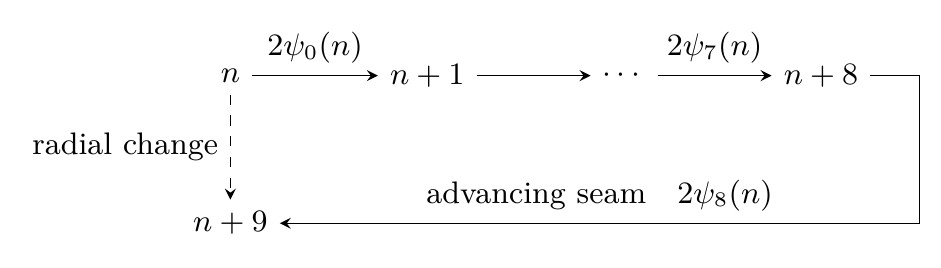
Write \Delta_{\rm rad}(n) for the right-hand side of (85). Define the torsional energy of these readings and the radial energy of their total by \begin{split} E_{\rm tor}&=\sum_{s=0}^8\|\psi_s\|^2,\\ E_{\rm rad}&=\|\Delta_{\rm rad}\|^2 =4\sum_{s,t=0}^8\langle \psi_s,\psi_t\rangle. \end{split} Both use the complete native norm. Radial energy retains the interactions between torsional readings; it is not an additional orthogonal portion of their energy. The radial direction is already in their span.
In every base the signed reset formula is \begin{split} \epsilon_b(m)&= (\mathbf{1}_{b-1\mid m}+\mathbf{1}_{b\mid m}+\mathbf{1}_{b^2\mid m})\bmod2,\\ \varsigma_b(m)-\varsigma_b(m-1)&=-2\varsigma_b(m-1)\epsilon_b(m). \end{split} Thus \psi_s takes values in \{-1,0,1\}; a product of two readings keeps both reset indicators and their signs.
Corollary 22 (Nine-family synthesis). Choose B_s\ge\|\psi_s\|^2>0 and put h_{k,s}=\sqrt{a_k/B_s}\,T_{a_k}\psi_s. Then \left\|\sum_{k,s}\lambda_{k,s}h_{k,s}\right\|^2 \le27\sum_{k,s}|\lambda_{k,s}|^2 independently of the number of scales.
Proof. Apply Theorem 20 with q=4 to each s and then \|\sum_{s=0}^8u_s\|^2\le9\sum_{s=0}^8\|u_s\|^2. ◻
The choice B_s=1 is valid. The same theorem applies to address indicators, so it does not favor polarity masks. It is an upper cost bound, not a lower detection bound. If \psi_s^{\rm per} is the period-1800 extension of (84), the zero extension used by dilation gives T_a\psi_s(n)=\psi_s^{\rm per}(\lfloor n/a\rfloor) -\psi_s^{\rm per}(0)\mathbf{1}_{\{1\le n<a\}}. Only s=8 has \psi_s^{\rm per}(0)\ne0. This initial correction belongs to the complete vector.
Directional clock interactions and capture
To use a mask for recovery, take the part that the newly admitted clocks can express. Computing that projection requires the complete weighted overlap of the mask with each clock. Initial boundaries and unfinished periods contribute to that overlap.
For a bounded periodic probe f with period P, put L=\operatorname{lcm}(P,j). Its complete native clock pairing is \langle f,\phi_j\rangle=\sum_{r=1}^Lf(r)\frac{r\bmod j}{j}\Omega_{L,r}, \qquad \Omega_{L,r}=\sum_{t\ge0}\frac1{(tL+r)(tL+r+1)}. Absolute convergence justifies grouping, and (49) evaluates the residue masses. Copied masks use period 1800a and the finite subtraction in (91).
Finite intervals also retain unfinished cycles. If g is L-periodic, set \bar g=L^{-1}\sum_{n=1}^Lg(n) and A(t)=\sum_{n=1}^t(g(n)-\bar g)=A(t\bmod L). For integer endpoints 1\le u\le v, summation by parts gives \begin{split} \sum_{n=u}^v w_ng(n) ={}&\bar g\sum_{n=u}^v w_n+w_vA(v)-w_uA(u-1)\\ &+\sum_{n=u}^{v-1}(w_n-w_{n+1})A(n). \end{split} The cutoff residues and moving weights remain together. For N<p\le2N prime and 2\le d\le2N, d\ne p, one has \operatorname{lcm}(p,d)=pd>2N. There is no completed common period through address 2N for this pair; its unfinished overlap cannot be replaced by a completed-period mean.
For a finite selection of the normalized masks, put \begin{gathered} v_i=(P_M-P_N)h_i,\qquad d_i=\langle r_N,v_i\rangle,\\ \mathsf K_{ij}=\langle v_i,v_j\rangle,\qquad \mathcal J_{N,M}=d^T\mathsf K^\dagger d. \end{gathered} This is a second detector family; it does not redefine the fixed J_N in (6).
Proposition 23 (Conditioned directional gain). For M>N, \frac{\|d\|_2^2}{27}\le\mathcal J_{N,M}\le D_N-D_M. For one copied mask the constant 27 can be replaced by 3.
Proof. The same orthogonal projection acts on all the masks, so (90) gives 0\le\mathsf K\le27I. If \mathsf K\lambda=0, the combination \sum_i\lambda_iv_i vanishes; hence \lambda^Td=0 and d\in\operatorname{ran}\mathsf K. Proposition 3 gives the exact gain and upper bound. The trial coefficients d/27 yield improvement 2\|d\|_2^2/27-d^T\mathsf Kd/27^2\ge\|d\|_2^2/27. ◻
The exact middle quantity must be retained. If v=\varepsilon u with \|u\|=1 and \varepsilon\ne0, then |\langle r_N,v\rangle|^2/\|v\|^2=|\langle r_N,u\rangle|^2 even as the raw reading tends to zero. The Schur construction in (50) implements these corrections. For a raw probe f, let h_j=\langle f,\phi_j\rangle. On the chosen old and new index sets, t=h_B-G_{BO}G_{OO}^{-1}h_O gives coefficients S^{-1}t in the conditioned new clocks. The response is u^TS^{-1}t and its cost is t^TS^{-1}t. No product probe has been added as a free clock.
Finite directional controls
The reported calculations use double precision and the complete native Gram. Entries are percentages of the available gain D_N-D_M captured by the projected nine masks, the address indicators \delta_1,\ldots,\delta_9, and their joint span. Every probe uses the same band projection P_M-P_N.
| Clock band | Nine masks | Nine addresses | Joint span |
|---|---|---|---|
| 20\to48 | 77.5899\% | 91.4437\% | 95.0376\% |
| 48\to100 | 39.0480\% | 95.7508\% | 96.0086\% |
| 100\to200 | 64.4084\% | 98.5642\% | 98.6975\% |
At the last band, the masks reduce the error from 0.010201919284 to 0.009383196948, while the full optimum is 0.008930777788. The address probes are projected into the same clock band using the complete norm; the observation space is not restricted to nine addresses. The joint span has up to eighteen directions.
An independent double-precision recomputation from the displayed definitions reproduces every table entry at the stated precision. These values are not interval-certified. They concern the unscaled masks, not the multiscale family of Corollary 22. The equal-dimension comparison favors the address probes at each tested band. Adding the masks after them contributes only 0.1333 percentage points on the last band. Neither a favorable gain fraction nor bounded cost proves that the remaining error tends to zero.
Signed capture across scales
A bounded cost turns measured responses into usable gains at each cutoff. Recovery of unity depends on their accumulation. The remaining question is whether the prescribed shallow readings can stay too small relative to their full costs through an unbounded sequence of refinements.
Fix an integer N_*\ge2 and set N_k=N_*4^k. The following implication expresses cumulative recovery entirely in native approximation variables.
Theorem 24 (Divergent capture and recovery). For the fixed family (4), if \sum_{k\ge0}\frac{J_{N_k}}{D_{N_k}^2}=\infty, then \mathcal C_N\to\infty and D_N\to0.
Proof. Equations (14) and (15) give \mathcal C_{4N}-\mathcal C_N \ge\frac{J_N}{D_ND_{4N}}\ge\frac{J_N}{D_N^2}. The increments on the fixed chain telescope. Thus the capacity tends to infinity on that chain and the squared error tends to zero. Monotonicity gives the same limits along all integer cutoffs. ◻
A concrete sufficient rate is described by F(N)=(1+\log N)[1+\log(1+\log N)].
Open problem 25 (Signed collision capture). For at least one fixed N_*\ge2, do there exist constants a>0 and k_0 such that J_{N_k}\ge\frac{aD_{N_k}^2}{F(N_k)}\qquad(k\ge k_0)? The family, the actual residual and the complete cost are those of (4)–(6).
This lower bound remains open. On the fixed fourfold chain, the series \sum_k1/F(N_k) diverges by comparison with \sum_{k\ge2}1/(k\log k). The rate is one choice of a divergent budget; no particular logarithmic rate is necessary in Theorem 24. The problem concerns the prescribed detector family. Its affirmative resolution would imply the Riemann hypothesis through the classical approximation criterion [1]. The divergence criterion and the finite cost bounds do not assert that this particular rate holds.
With \mathcal T_N>0, a stronger sufficient response estimate is \sum_{h\in I_N}|b_{N,h}|^2\ge\frac{a\mathcal T_N D_N^2}{F(N)}. Here each b_{N,h} retains all three terms of (56). Corollary 15 proves the implication to (99). The raw costs remain in the denominator even when they decrease. The full joint quotient may give a larger gain than this scalar estimate. A single depth may suffice, or the response may survive only when several depths are read together.
A further sufficient relaxation permits recovery over adjacent scales. For a fixed integer L\ge1, it is enough to prove \sum_{j=k}^{k+L-1}\frac{J_{N_j}}{D_{N_j}^2} \ge\frac{a}{(k+1)\log(k+2)} at all sufficiently large k=k_0,k_0+L,k_0+2L,\ldots. The disjoint block series diverges. This condition is also open and retains every within-step cross term.
Fractions of the remaining error
The preceding reciprocal budget and a multiplicative ledger give two ways to account for admissible gain. The latter also applies to the directional family, with no requirement that each band contribute a fixed share.
Proposition 26 (Cumulative fractional capture). Let N_j=N_0\,4^{Lj}, with integers N_0\ge2 and L\ge1. Suppose \Gamma_j is an achievable family gain in the band V_{N_{j+1}}\cap V_{N_j}^{\perp}. Then \sum_{j\ge0}\frac{\Gamma_j}{D_{N_j}}=\infty \quad\Longrightarrow\quad D_N\longrightarrow0. The unnormalized gains satisfy \sum_j\Gamma_j\le D_{N_0}.
Proof. Finite errors are positive by the common-period argument. Since 0\le\Gamma_j\le D_{N_j}-D_{N_{j+1}}, the fractions \gamma_j=\Gamma_j/D_{N_j} lie in [0,1) and D_{N_m}\le D_{N_0}\prod_{j<m}(1-\gamma_j) \le D_{N_0}\exp\!\left(-\sum_{j<m}\gamma_j\right). The stated divergence forces convergence on the chain; monotonicity covers every cutoff. Summing the actual band-gain inequalities gives the unnormalized budget. ◻
The proposition applies to \Gamma_j=\mathcal J_{N_j,N_{j+1}} for any chosen finite selection of the copied masks. For a detector subfamily this is a sufficient condition only. For L=1 and \Gamma_j=J_{N_j}, its premise implies the reciprocal-budget premise in (98), since 0<D_N\le1. The fractional formulation does not strengthen that earlier convergence criterion. When \Gamma_j is the entire band gain, the product is exact and divergence of the fractional sum is also necessary. Indeed a finite sum makes \gamma_j\to0, and eventually -\log(1-\gamma_j)\le2\gamma_j, so the product stays positive.
The uniform cost bound (90) supplies no divergence in (102). Quiet bands are permitted, but the actual signed readings must still give a divergent fractional budget. The unresolved task concerns this response, with the original weights, initial boundary and all later addresses retained.
Complete energy under refinement
The capture criteria ask whether the residual produces enough admissible gain. The copy identity from Section 3 leads to a complementary approach. Prescribe the clock coefficients arithmetically, follow their signed response under refinement, and bound the energy of that response. This uses the same clocks and observation norm. The coefficients are fixed by a divisor identity, so the packet energy and the optimized error D_N require separate estimates.
The construction below first reproduces unity on an expanding prefix. Combining its copies leaves a fixed boundary and a packet supported beyond that prefix. We bound the packet in the complete observation norm, then determine how much stronger that bound would need to be to force recovery.
Coefficients, copying and the boundary
Let \mu be the Möbius function, characterized by \sum_{d\mid n}\mu(d)=\mathbf{1}_{n=1}, and put A(m)=\sum_{j\le m}\frac{\mu(j)}j,\qquad M(m)=\sum_{j\le m}\mu(j),\qquad A(0)=0. For an integer s\ge2, set \begin{aligned} \tau_s(j)&=\min\{1,\max\{0,(2s-j)/s\}\},\\ \beta_{s,j}&=-j[\tau_s(j)A(j)-\tau_s(j-1)A(j-1)] \quad(2\le j\le2s), \end{aligned} with all other coefficients zero. Define F_s=\sum_{j=2}^{2s}\beta_{s,j}\phi_j,\qquad \varepsilon_s(n)=F_s(n)-1\ (n\ge1),\qquad\varepsilon_s(0)=0. This precursor is a block average of Báez-Duarte’s classical approximants [2]. In the present notation those approximants are B_n(x)=\sum_{j=1}^n\mu(j)\left\{\frac1{jx}\right\} -nA(n)\left\{\frac1{nx}\right\}. Under the reciprocal-interval isometry \mathcal I, \mathcal I F_s=-\frac1s\sum_{n=s+1}^{2s}B_n. Indeed, the reciprocal coefficient sum in each B_n is zero, so the \{1/x\} terms cancel on rewriting it in clocks. Averaging then gives coefficient -\mu(j) for 2\le j\le s. For s<j\le2s it gives \begin{aligned} &-\frac{2s-j+1}{s}\mu(j)+\frac js A(j)\\ &\qquad=-\tau_s(j)\mu(j)+\frac js A(j-1)\\ &\qquad=\beta_{s,j}. \end{aligned} The packet below applies a fixed signed copying stencil to this average.
Telescoping gives \sum_j\beta_{s,j}/j=1. For 2\le j\le s, \beta_{s,j}=-\mu(j), and the divisor identity gives \sum_{j\le n}\mu(j)\lfloor n/j\rfloor=1. Hence F_s(n)=1\quad(1\le n\le s),\qquad F_s(0)=0. Using the copy operator T from Section 3, put a_t=3T\varepsilon_{2t}-2T^2\varepsilon_t-\varepsilon_{4t}, \qquad E_t=\|a_t\|^2\qquad(t\ge2). The finite clock combination \pi_t=3TF_{2t}-2T^2F_t-F_{4t} belongs to V_{8t}. The exact prefixes above show \pi_t=b+a_t,\qquad b=-\delta_1+2\delta_2+2\delta_3,\qquad a_t(n)=0\quad(n\le4t). All these sequences have zero extension at address zero. In particular, the fixed boundary has not been discarded from the clock identity.
The whole observation norm
Define the infinite arithmetic envelope and its transfer by \begin{aligned} d_s&=\sup_{m\ge s}\max\{|A(m)|,|M(m)|/m\},\\ \alpha_s&=d_s(1+\log(1/d_s)),\qquad U_s=54s\alpha_s^{4/3}+9\alpha_s^{2/3}. \end{aligned} The floor identity gives |A(m)|\le1, and |M(m)|\le m, so 0<d_s\le1. The supremum covers every later integer.
Proposition 27 (Complete packet bound). For every integer s\ge2, \|\varepsilon_s\|^2\le U_s,\qquad U_{qs}\le qU_s \quad(q\in\mathbb N). For \eta_t=a_{2t}-Ta_t and S_t=\|\eta_t\|^2+2\langle Ta_t,\eta_t\rangle, one has E_{2t}=\tfrac12E_t+S_t,\qquad E_t\le36U_t,\qquad -18U_t\le S_t\le72U_t. For every fixed B>0, both E_t and S_t^+=\max\{S_t,0\} are O_B(t/(\log t)^B). More strongly, for some c>0, E_t+S_t^+\ll t\exp\!\left[-c\, \frac{(\log(2t))^{3/5}}{(\log\log(3t))^{1/5}}\right].
Proof. Put v_s=1-\tau_s. The coefficient definition and divisor identity give the joined floor expression \varepsilon_s(n)=-\sum_{j=s+1}^{n}j\lfloor n/j\rfloor [v_s(j)A(j)-v_s(j-1)A(j-1)]. For Q_j=j\lfloor n/j\rfloor, its positive variation between s and n is at most \sum_{j=s+1}^n\lfloor n/j\rfloor. Since Q_n\ge Q_s, its total variation is at most twice that sum. Abel summation therefore gives |\varepsilon_s(n)|\le nd_s(1+2\log(n/s))\quad(n>s). For any integer R\ge2, the initial part of the native norm obeys \sum_{n\le sR}\omega_n|\varepsilon_s(n)|^2 \le sRd_s^2(1+2\log R)^2.
For the tail, retain the periodic mean h_s of F_s-1 and its centered period variance V_s. This periodic extension has value -1 at zero; it is used only for period statistics, not for copying. Summing the coefficients by parts gives h_s=-1+\frac1{2s}\sum_{k=s}^{2s-1}[(k+1)A(k)-M(k)], \qquad |h_s|\le1+\tfrac32sd_s. The coefficient formula gives |\beta_{s,j}|\le2. Indeed, for s<j\le2s it is -\tau_s(j)\mu(j)+(j/s)A(j-1), and \tau_s(j)+j/s=2. The centered clock covariance over a common period is (\gcd(i,j)^2-1)/(12ij). To see this, condition a uniform residue modulo \operatorname{lcm}(i,j) on its residue modulo g=\gcd(i,j). The two remaining residue coordinates are independent; their conditional means vary by that common residue divided by i and j. Its variance is (g^2-1)/12. Consequently, with P=2s, V_s=\frac1{12}\sum_{i,j=2}^{P}\beta_{s,i}\beta_{s,j} \frac{\gcd(i,j)^2-1}{ij} \le\frac13\sum_{i,j\le P}\frac{\gcd(i,j)^2}{ij} \le\frac{10}{3}s. For the last inequality use \gcd(i,j)^2=\sum_{d\mid i,\ d\mid j}J_2(d), where J_2(d)=d^2\prod_{p\mid d}(1-p^{-2})\le d^2. The resulting sum is at most \sum_{d\le P}(1+\log(P/d))^2 \le\int_0^P(1+\log(P/x))^2\,dx=5P. The nonzero rational frequencies of g_s=F_s-1-h_s have reduced denominators at most P, hence spacing at least P^{-2} modulo one. The classical large sieve of Montgomery and Vaughan [14] gives \sum_{n=X+1}^{X+H}|g_s(n)|^2\le(H+P^2)V_s. Summation by parts in the native weights now gives \sum_{n>X}\omega_n|g_s(n)|^2 \le V_s\left(\frac1{X+1}+\frac{P^2}{(X+1)(X+2)}\right). Apply |h_s+g_s|^2\le2h_s^2+2|g_s|^2 with X=sR. Together with (109), this covers the entire norm: \|\varepsilon_s\|^2\le sRd_s^2(1+2\log R)^2+\frac{9sd_s^2}{R} +\frac9R+\frac{27s}{R^2}. Choose R=\max\{2,\lceil\alpha_s^{-2/3}\rceil\}. Then \alpha_s^{-2/3}\le R\le2\alpha_s^{-2/3} and 1+2\log R\le3(1+\log(1/d_s)). The four terms in (110) are at most 18s\alpha_s^{4/3}, 9s\alpha_s^{4/3}, 9\alpha_s^{2/3} and 27s\alpha_s^{4/3}, respectively. This proves the first bound in (106). Monotonicity of d_s and of x(1+\log(1/x)) on (0,1] proves the second. Since \|T\|=2^{-1/2}, \|a_t\|\le\frac3{\sqrt2}\sqrt{U_{2t}}+\sqrt{U_t} +\sqrt{U_{4t}}\le6\sqrt{U_t}. Expanding a_{2t}=Ta_t+\eta_t proves the work identity. Nonnegativity of E_t and E_{2t} then gives the stated work bounds.
Finally, the classical unconditional Mertens estimate gives M(x)/x=O_K((\log x)^{-K}) for every fixed K>0; for a stronger explicit version see Lee and Leong [13]. Partial summation yields convergence of A(m), with limit zero from \sum_n\mu(n)n^{-z}=1/\zeta(z) as real z\downarrow1. Thus A(m)=\frac{M(m)}m-\int_m^\infty\frac{M(x)}{x^2}\,dx. Using the Mertens bound with arbitrarily large fixed K shows that d_s, and hence \alpha_s, decay faster than every fixed reciprocal power of \log s. Substitution into U_s proves the final assertion. The constants can depend on the chosen logarithmic power. The stronger Mertens estimate in [13] is |M(x)|/x\ll\log x\,e^{-c_0\Psi(x)}, where \Psi(x)=(\log(2x))^{3/5}/(\log\log(3x))^{1/5}. The same tail integral, with u=\log x, is bounded by e^{-c_1\Psi(m)} for some c_1>0; polynomial factors in u are absorbed by decreasing the exponent constant. Hence \alpha_s\ll e^{-c_2\Psi(s)}, which proves (108) after decreasing the constant again. ◻
The growth still needed
The complete norm is now controlled. To determine whether that control can force recovery, we use the fixed boundary in (105). A hypothetical zeta zero to the right of the critical line would pair nontrivially with that boundary, forcing the packet energy to grow at a positive power rate. The Mellin pairing is the classical Nyman–Beurling obstruction [3]; here the fixed packet boundary gives its explicit nonzero value and growth exponent.
Proposition 28 (A sufficient packet growth rate). If, for one fixed integer t_0\ge2, \frac{\log(1+E_{2^kt_0})}{k}\longrightarrow0, then D_N\to0. Condition (111) is equivalent to the same limit with E_{2^kt_0} replaced by S_{2^kt_0}^+.
Proof. The work identity gives S_t^+\le E_{2t} and E_{2^Kt_0}=2^{-K}E_{t_0} +\sum_{k=0}^{K-1}2^{-(K-1-k)}S_{2^kt_0}. If S_{2^kt_0}^+\le C_\epsilon e^{\epsilon k}, the sum is at most 2C_\epsilon e^{\epsilon K}. This proves the equivalence of the two limits.
To prove the implication, for \Re z>0 and bounded f define \mathcal M_z f=\sum_{n\ge1}f(n)[n^{-z}-(n+1)^{-z}]. The series is absolutely convergent and locally holomorphic. The clock difference (11), first for \Re z>1 and then by analytic continuation, gives \mathcal M_z\phi_j=(j^{-1}-j^{-z})\zeta(z). If \rho is a zeta zero with 1/2<\sigma=\Re\rho<1, (105) therefore gives \mathcal M_\rho a_t=-\mathcal M_\rho b =(1-2^{-\rho})(1-2^{1-\rho})\ne0. Weighted Cauchy–Schwarz on each interval [n,n+1] shows \frac{|n^{-z}-(n+1)^{-z}|^2}{\omega_n} \le |z|^2\int_n^{n+1}u^{-2\Re z}\,du. Apply Cauchy–Schwarz again on the support n\ge4t+1 of a_t. It follows that E_t\ge(2\sigma-1) \left|\frac{(1-2^{-\rho})(1-2^{1-\rho})}{\rho}\right|^2 (4t+1)^{2\sigma-1}. This contradicts (111) along the fixed chain. The classical functional-equation symmetry of the nontrivial zeros [15] then gives RH, and Bagchi’s criterion [1] gives D_N\to0. ◻
Condition (111) remains open. Its converse from RH is not established here. The particular envelope U_s has a stronger limitation than an unclosed estimate.
Proposition 29 (A growth floor for the envelope). For every fixed integer t_0\ge2, \limsup_{k\to\infty} \frac{\log(1+U_{2^kt_0})}{k}\ge\frac{\log2}{3}. Thus E_t\le36U_t cannot establish (111) by an upper bound on U_t alone.
Proof. Write s_k=2^kt_0 and fix 0<\delta<1/4. If d_{s_k}\le s_k^{-1/2-\delta} for all sufficiently large k, then for every sufficiently large integer m, choosing s_k\le m<2s_k gives |M(m)|\le m d_{s_k}\le2m^{1/2-\delta}. Partial summation would then continue \frac1{\zeta(z)}=z\int_1^\infty M(x)x^{-z-1}\,dx holomorphically to \Re z>1/2-\delta. This contradicts the existence of zeros on \Re z=1/2 [15]. Hence d_{s_k}>s_k^{-1/2-\delta} infinitely often. Since \alpha_s\ge d_s, U_{s_k}\ge54s_kd_{s_k}^{4/3} >54s_k^{1/3-4\delta/3} on those indices. Taking the upper limit and then letting \delta\downarrow0 proves (112). ◻
This floor belongs to the envelope, not to E_t. Improving the Mertens input within this same envelope cannot supply the desired packet rate. A successful estimate must retain more of the assembled packet’s cancellation than the envelope does.
The actual packet can be evaluated in the complete norm without a tail estimate. Write \pi_t=\sum_{j=2}^{8t}c_{t,j}\phi_j using (105). Since a_t vanishes on the support of b and \|b\|^2=3/2, E_t=c_t^TG_{8t}c_t-\frac32. Complete Gram evaluations with rational coefficients give, rounded to six decimal places, E_2=0.300604,\qquad E_8=0.331745,\qquad E_{32}=0.271389. Across t\in\{2,3,4,6,8,12,16,24,32\} the values lie between 0.2637 and 0.3318. These finite calculations illustrate the gap between the packet and its envelope; they give no asymptotic rate.
Signed capture under continued refinement
Refinement changes the admitted descriptions of unity while retaining the complete observation measure. The prescribed readings have joint cost at most two, independently of the number of eligible levels. Burnol’s lower bound further makes every shallow depth eventually eligible and forces the total detector cost to tend to zero (Corollary 16). Equation (9) turns their complete signed response into an improvement from N to 4N, retaining the old fit and every overlap.
The shallow-spine theorem locates unresolved energy within a finite initial range of resolutions. Making that energy admissible introduces a terminal pairing that can cancel it. The response identity keeps that pairing, including the transported approximation. Visibility and capture remain distinct.
Copied signed masks have optimal universal cost (\sqrt q+1)/(\sqrt q-1) at scale ratio q. Palindromic blocks supply one arithmetic family, with every cross term retained in the radial energy. Projection into a common clock band preserves the cost bound. The finite comparisons favor simpler address probes in the tested bands; the geometry alone supplies no general capture advantage.
The prescribed packet gives a second way to use the same clocks. Proposition 27 bounds its complete energy, including the mean and infinite observation tail. For every fixed B>0, E_t\le C_B\frac{t}{(\log t)^B}\qquad(t\ge2). Here C_B may depend on the fixed B. Packet energy E_t, optimized error D_N and selected detector gain J_N are different quantities. This estimate and Burnol’s lower bound (12) do not squeeze one quantity to zero.
The packet route needs growth slower than every positive power along one fixed doubling chain (Proposition 28). Bound (113) still permits t^\alpha for 0<\alpha<1. More decisively, Proposition 29 shows that the displayed envelope itself exceeds a positive power infinitely often on every doubling chain. The packet route therefore needs a different estimate of its signed combination. A quantitative comparison with J_N also remains open.
For the detector family, the needed accumulation is expressed on a fixed fourfold chain. Divergence of the normalized capture sum in (98) forces the unresolved error to vanish. Problem 25 gives one sufficient rate, while (101) permits weak scales followed by stronger ones. The proved construction locates energy and bounds the cost of reading it. Whether the prescribed signed readings must capture enough through continued refinement is the open arithmetic problem.
References
[1]B. Bagchi, On Nyman, Beurling and Baez-Duarte's Hilbert space reformulation of the Riemann hypothesis, Proc. Indian Acad. Sci. (Math. Sci.) 116 (2006), no. 2, 137–146. https://arxiv.org/abs/math/0607733.
[2]L. Báez-Duarte, Arithmetical Aspects of Beurling's Real Variable Reformulation of the Riemann Hypothesis, 2000. https://arxiv.org/abs/math/0011254.
[3]M. Balazard and É. Saias, The Nyman–Beurling equivalent form for the Riemann hypothesis, ESI Preprint 623 (1998). https://www.esi.ac.at/preprints/esi623.pdf.
[4]J.-F. Burnol, A lower bound in an approximation problem involving the zeros of the Riemann zeta function, Adv. Math. 170 (2002), no. 1, 56–70. https://arxiv.org/abs/math/0103058.
[5]E. Altınışık, B. E. Sagan and N. Tuğlu, GCD matrices, posets, and nonintersecting paths, 2004. https://arxiv.org/abs/math/0406155.
[6]A. Selberg, Lectures on sieves, in Collected Papers, vol. II, Springer, Berlin, 1991, 65–247. https://link.springer.com/book/9783642410222.
[7]G. Fikioris, Spectral properties of Kac–Murdock–Szegő matrices with a complex parameter, 2018. https://arxiv.org/abs/1804.08140.
[8]P. R. Halmos, A Hilbert Space Problem Book, second edition, Graduate Texts in Mathematics 19, Springer, New York, 1982. Publisher edition.
[9]R. Penrose, A generalized inverse for matrices, Proc. Cambridge Philos. Soc. 51 (1955), no. 3, 406–413. https://doi.org/10.1017/S0305004100030401.
[10]A. S. Petty, Conservation and Profinite Dynamics in Digit-Collision Energy, 2026. https://doi.org/10.5281/zenodo.22682715.
[11]A. S. Petty, Finite Generation of Collision Capacity, 2026. https://doi.org/10.5281/zenodo.22682732.
[12]NIST Digital Library of Mathematical Functions, Chapter 5, Gamma Function, §5.11. https://dlmf.nist.gov/5.11.
[13]E. S. Lee and N. Leong, New explicit bounds for Mertens function and the reciprocal of the Riemann zeta-function, arXiv:2208.06141, version 5, 2026. https://arxiv.org/abs/2208.06141v5.
[14]H. L. Montgomery and R. C. Vaughan, The large sieve, Mathematika 20 (1973), no. 2, 119–134. https://doi.org/10.1112/S0025579300004708.
[15]NIST Digital Library of Mathematical Functions, Chapter 25, Zeta and Related Functions, §§25.2, 25.4, 25.10. https://dlmf.nist.gov/25.
[16]A. S. Petty, nfield, software repository. https://github.com/alexspetty/nfield.
Discussion
Sign in to join the discussion.