Alignment
The Alignment Limit for All Primes

Anyone who has taken a limit learns early that the first few terms don’t matter. Change the opening of a sequence however you like and where it ends up stays the same. Repeating decimals seem to follow the same rule, because a factor of 2 or 5 in the denominator only adds a few digits at the front before the repetition starts. At 53 that rule fails. Keep doubling the denominator, 53, 106, 212, 424 and on, and the alignment never settles on one value. It alternates between two limits that differ by exactly , and which one it heads for is decided by the few digits in front.
That matters for the question Three and the Golden Ratio started. Digit-Partitioning Primes and the Alignment Formula showed that among primes up to , only three can score above one over the golden ratio, about 0.618, but it relied on every remainder writing its own digit, which stops being true past that boundary. Partial matches then earn credit the old count never saw, and a large prime might collect enough of it to climb over the line. It never does, because the bins never get large enough, and from five on no prime reaches three fifths, in any base, whatever track the reference takes.
A sixth shows the harmless version of the choice. Most of us meet it in school as 0.1666…, a third cut in half. The repeating 3 turns into a repeating 6 with a 1 parked in front. Halving moves the division onto a different remainder, which writes a different digit, and since each remainder at three has a digit to itself, the alignment count can’t tell the difference.
Now do the same at 53.
 1/53 = 0.|0188679245283|
1/106 = 0.0|0943396226415|
The bars enclose the shortest repeating blocks. Both have thirteen digits, and no rotation of the first gives the second. Halving has put the tail on a different track through the remainders, and this time the track matters.
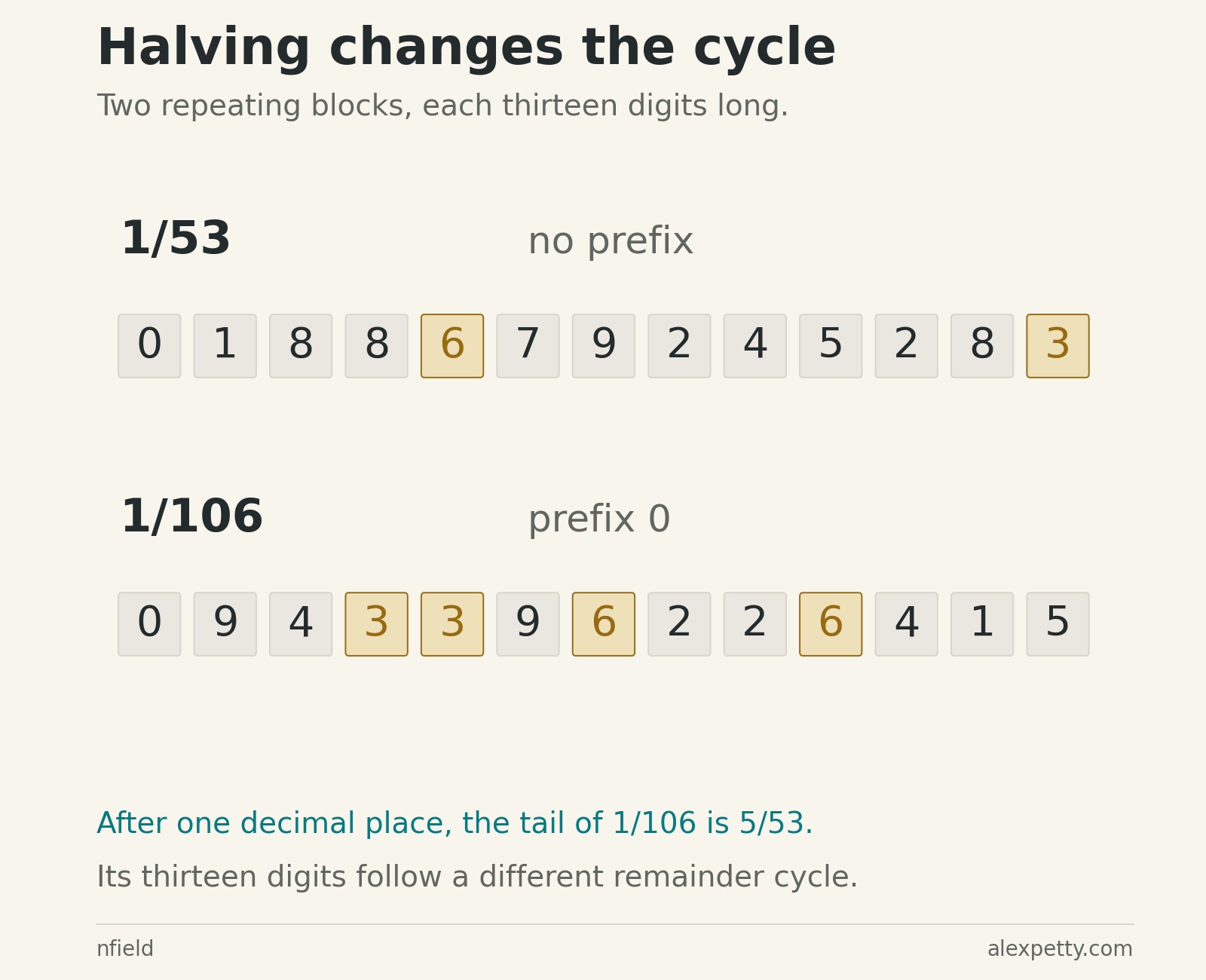
In Digit-Partitioning Primes and the Alignment Formula, tracks like this could be ignored. Every remainder wrote its own digit, and the alignment of every denominator came out to whichever way the reference went around. Fifty-three is far past that boundary. Its fifty-two remainders share ten digits, so rows can agree partway, and how much they agree depends on which digits the reference writes along its track.
Four cycles through 53
Long division advances by multiplying the remainder by ten and keeping the new remainder after division. At 7, starting from 1 gives
1 → 3 → 2 → 6 → 4 → 5 → 1Every nonzero remainder appears before the cycle closes. Starting elsewhere changes the entry point into the same loop.
At 53, the loop beginning at 1 contains thirteen remainders. The other thirty-nine form three more loops of thirteen. Multiplication by ten stays within the loop it enters. These four groups are the cosets of the subgroup generated by ten modulo 53. Their common length, thirteen, is the multiplicative order of ten.
Halving chooses a different group. After the first decimal place of , the remaining tail is . After the first two places of , it is . More generally, clearing the first places of leaves the starting remainder modulo 53. Successive doublings visit all four cosets, then repeat that order.
The factors we can clear this way are supported on the base. In decimal, they contain only twos and fives. Long division removes those factors from the tail denominator while leaving a particular starting remainder behind.
Follow the four remainder cycles
Each row below closes back onto its first entry. Together they contain every nonzero remainder modulo 53 exactly once.
 1 → 10 → 47 → 46 → 36 → 42 → 49
   → 13 → 24 → 28 → 15 → 44 → 16 → 1

52 → 43 →  6 →  7 → 17 → 11 →  4
   → 40 → 29 → 25 → 38 →  9 → 37 → 52

 2 → 20 → 41 → 39 → 19 → 31 → 45
   → 26 → 48 →  3 → 30 → 35 → 32 → 2

51 → 33 → 12 → 14 → 34 → 22 →  8
   → 27 →  5 → 50 → 23 → 18 → 21 → 51
The cycle containing 5 is the last row. Enter there to obtain the repeating digits of after its prefix.
Two extra visits
A digit bin contains all the remainders that write a given next digit. At 53, fifty-two nonzero remainders must fit into ten bins. Eight bins contain five remainders each. The bins for digits 3 and 6 contain six each.
The block for contains one 3 and one 6. It visits a bin of size six twice, and a bin of size five eleven times. Add the bin sizes encountered over the period and the total is
The block for contains two 3s and two 6s. Its total is
The second block makes two more visits to the larger bins than the first, and that is the whole source of the split.
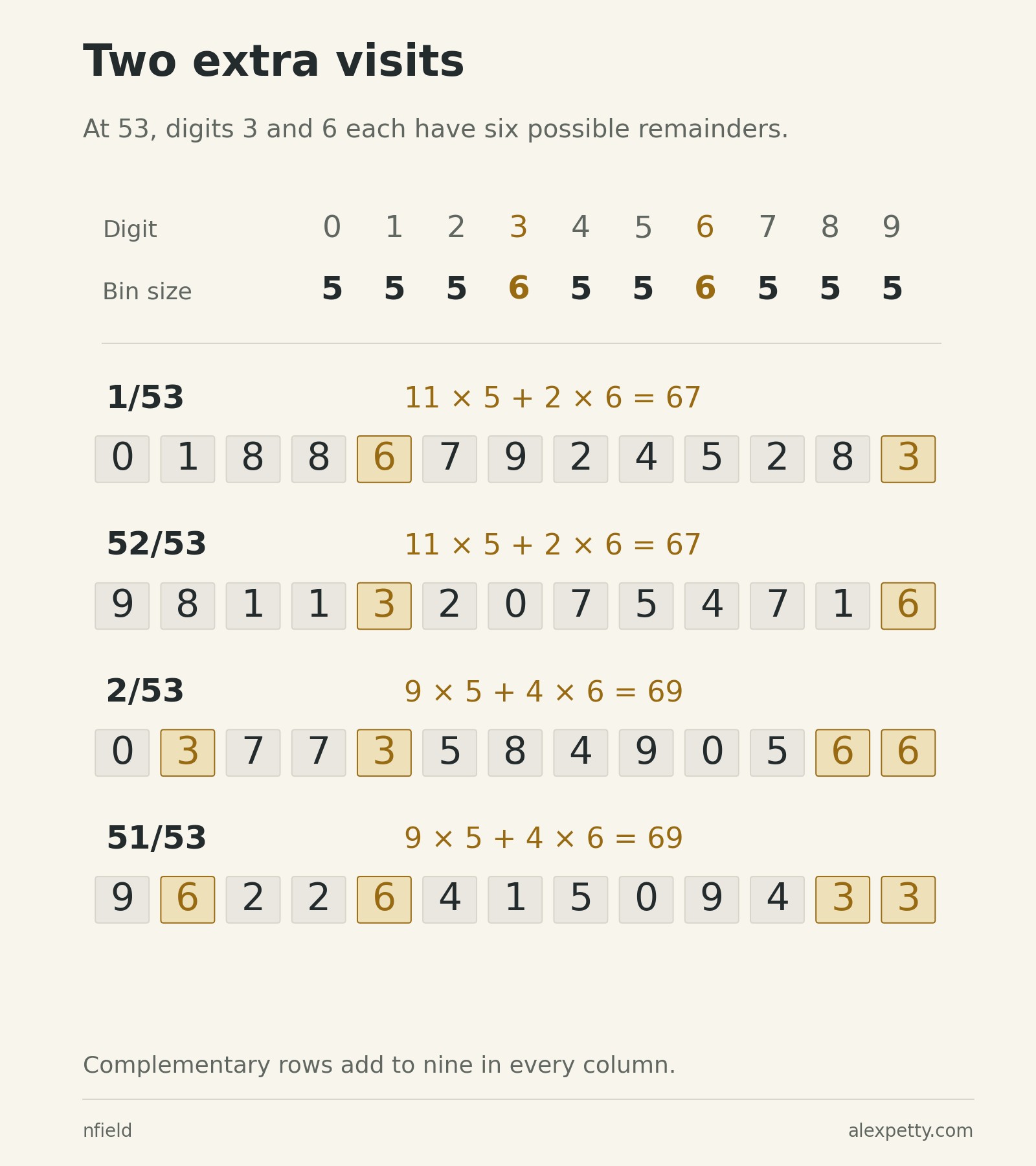
The four cycles come in complementary pairs. The fractions and add to one, and their periodic digits add to nine in every column. A 3 becomes a 6 and a 6 becomes a 3. The two crowded bins exchange places, so the total stays at 67. The pair and works the same way, with total 69.
The picture gives four cycles but only two totals. The block of is a rotation of the row for .
Count the 106ths
To measure alignment, write all 105 proper fractions with denominator 106. Compare each row with , starting after the first decimal place and continuing for thirteen positions. Each repeating row receives the fraction of positions in which it agrees with the reference. The terminating row, , receives score one by the definition of alignment.
Every row uses the same division clock. We do not rotate individual blocks to improve their scores.
Now read down a column. After the prefix clears, each nonzero remainder modulo 53 is represented by two rows. If the reference writes an ordinary digit, its bin of five remainders supplies ten matching rows. Add the one credited terminating row and the column contributes eleven.
If the reference writes 3 or 6, the bin has six remainders. Twelve repeating rows match, and the terminating row brings the column total to thirteen.
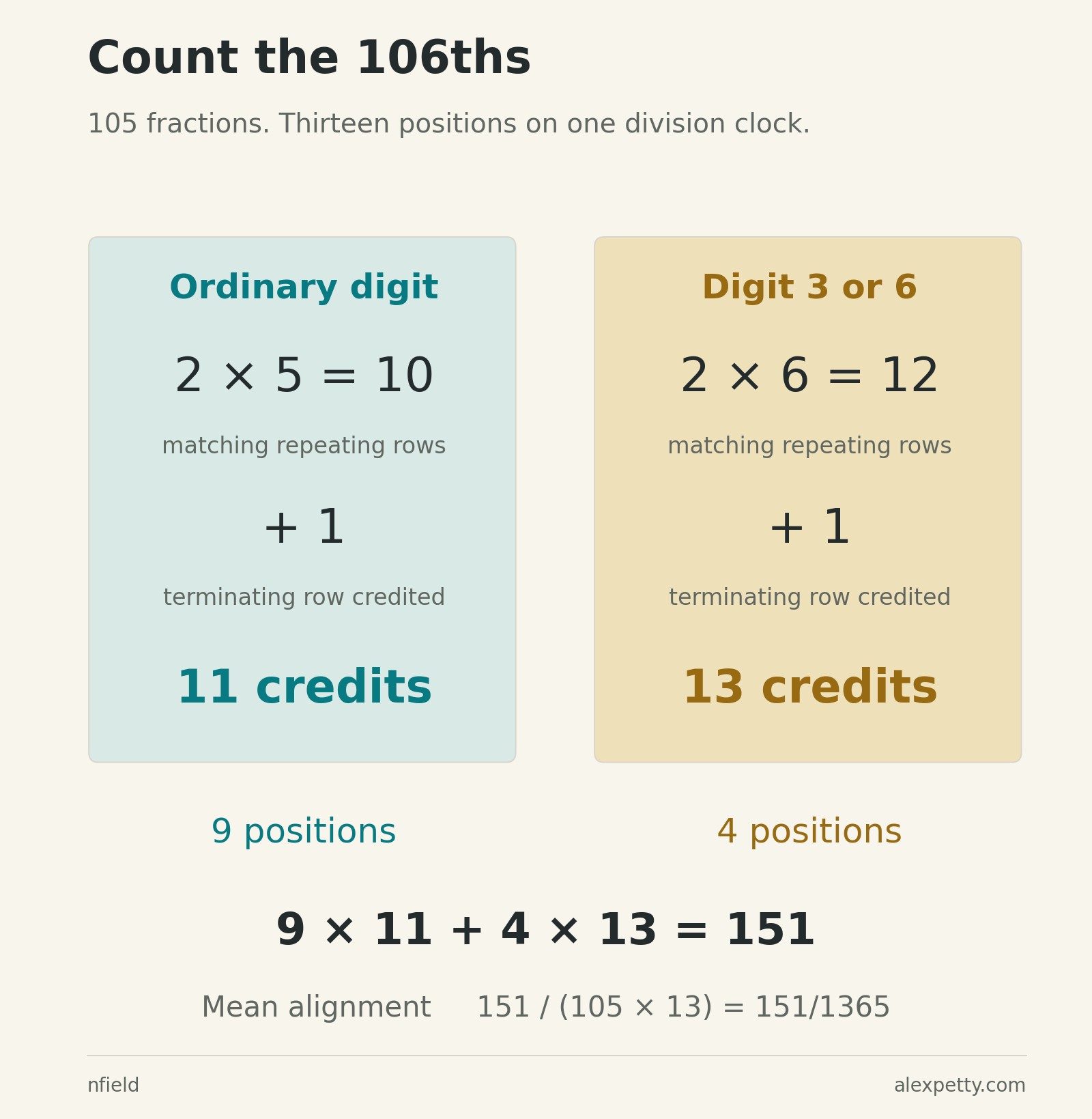
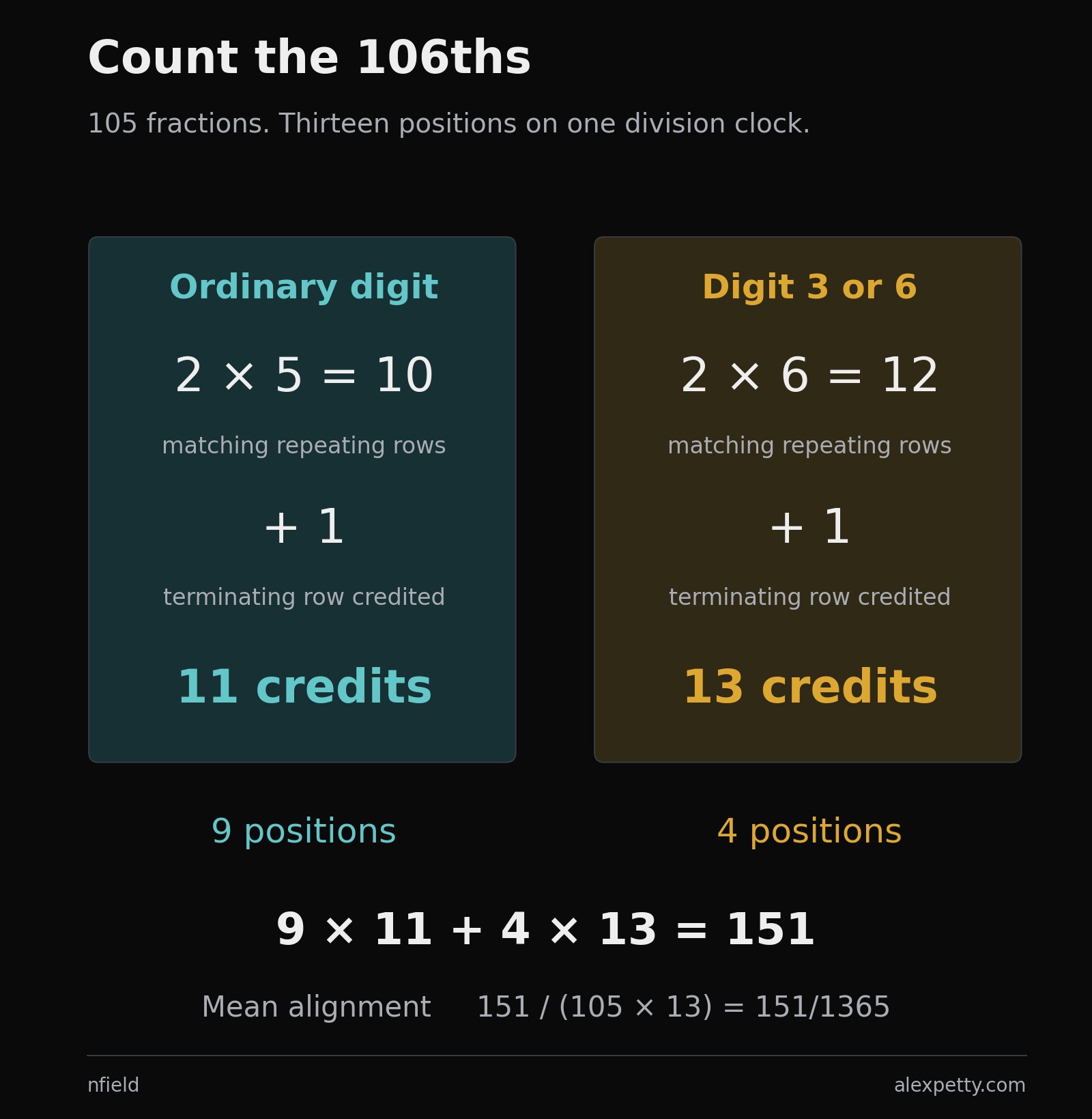
The reference period has nine ordinary positions and four crowded ones. The total credit across the table is therefore
There are 105 rows and thirteen positions. Dividing gives the exact mean alignment
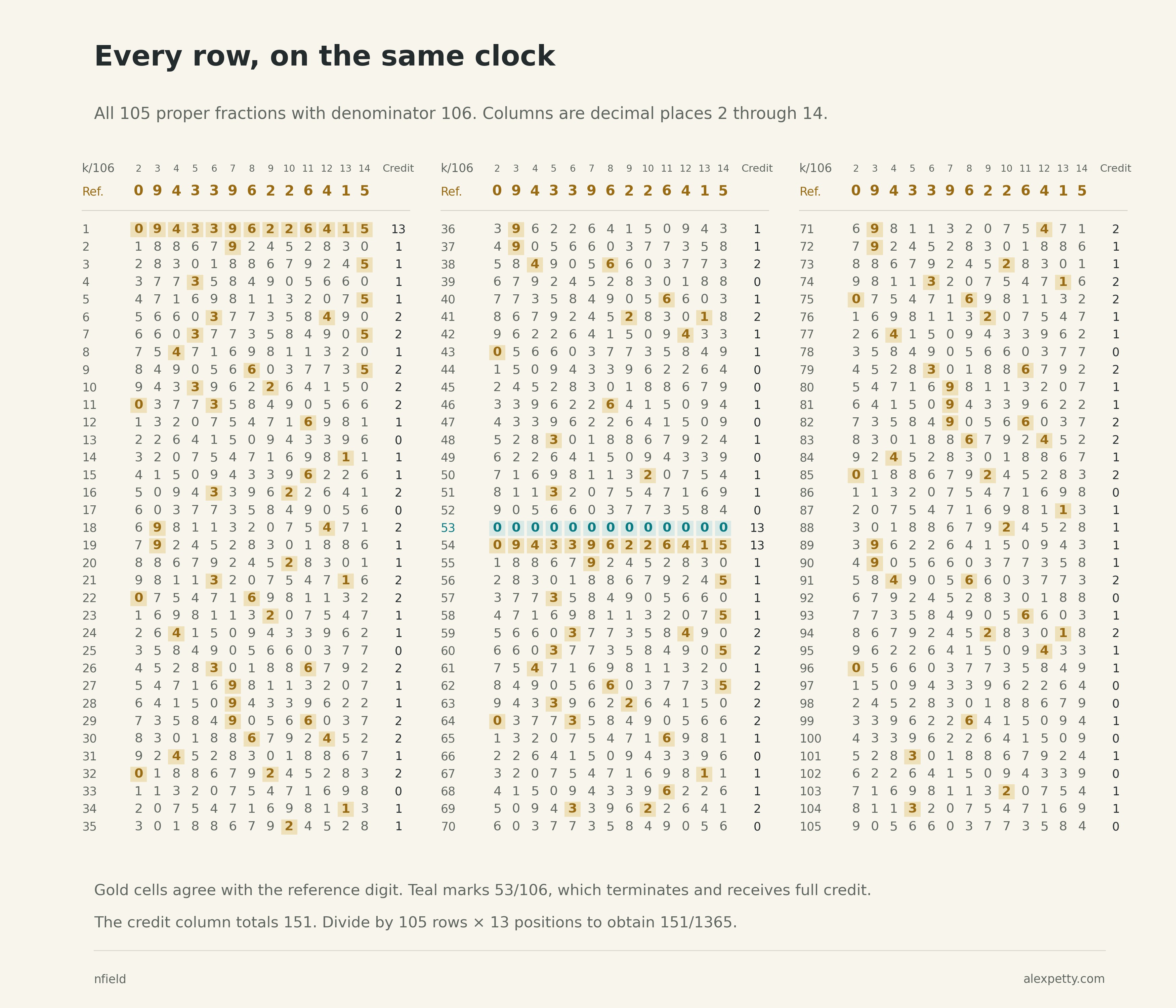
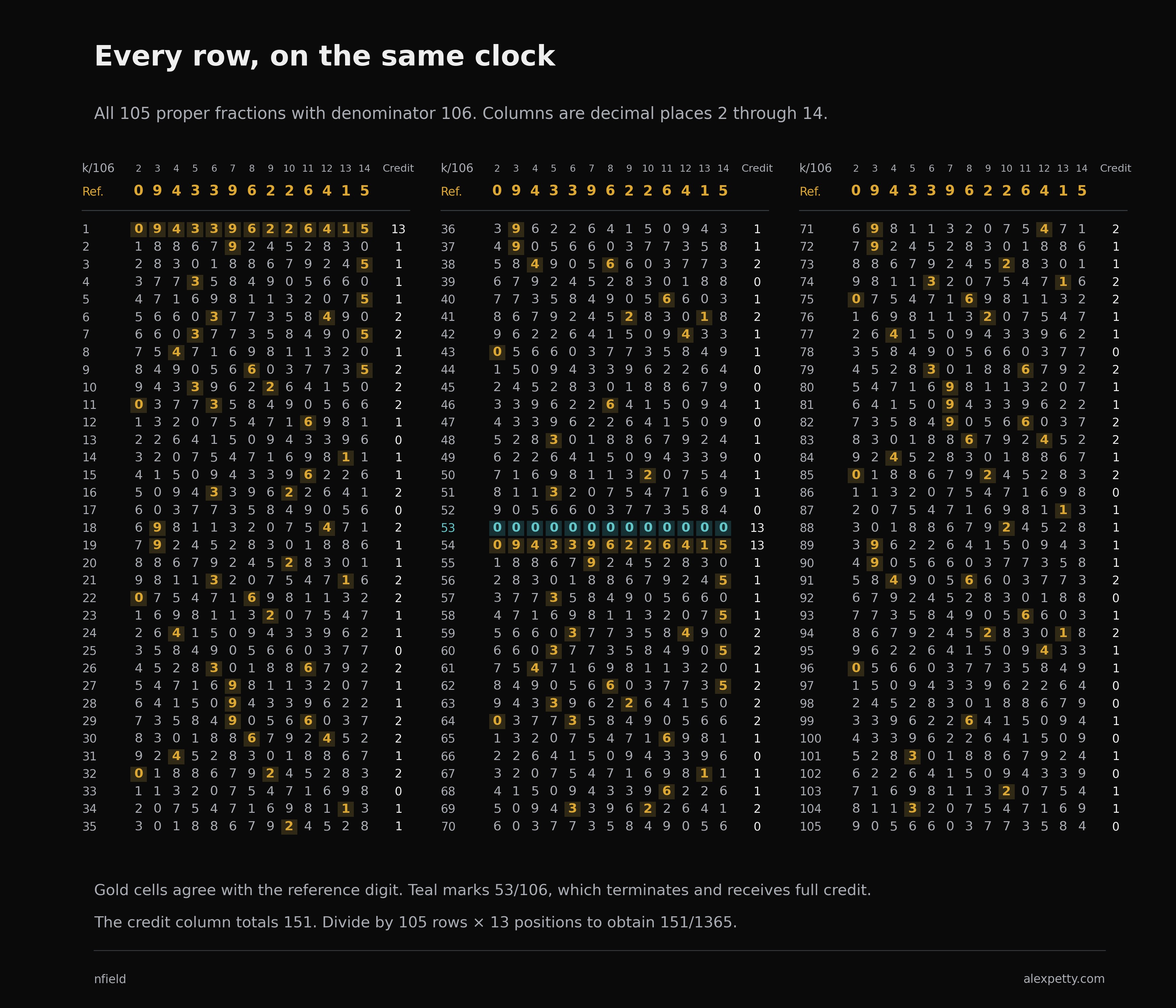
Inspect all 105 rows and their scores
This is the complete calculation. The three panels continue the numerator count from 1 through 105. Columns show decimal places 2 through 14, after the common prefix. Gold marks agreement with the reference digit. The teal row terminates and receives thirteen credits by convention, even where its zero digits differ from the reference.
The final column counts credited positions out of thirteen. Open the image and zoom to read individual rows.
The formula behind the count
Replace 53 by a prime that does not divide the base, and 2 by a supported factor . After clearing the common prefix, each nonzero remainder is represented by rows. There are also terminating rows.
Let be the period length and the sum of bin sizes along the reference cycle. Repeating rows contribute credits over the period. Terminating rows contribute . Divide by the number of rows and positions to obtain
The formula carries the reference cycle with it through . As grows through values selecting a fixed cycle, the limit is
At 53, the two possibilities are
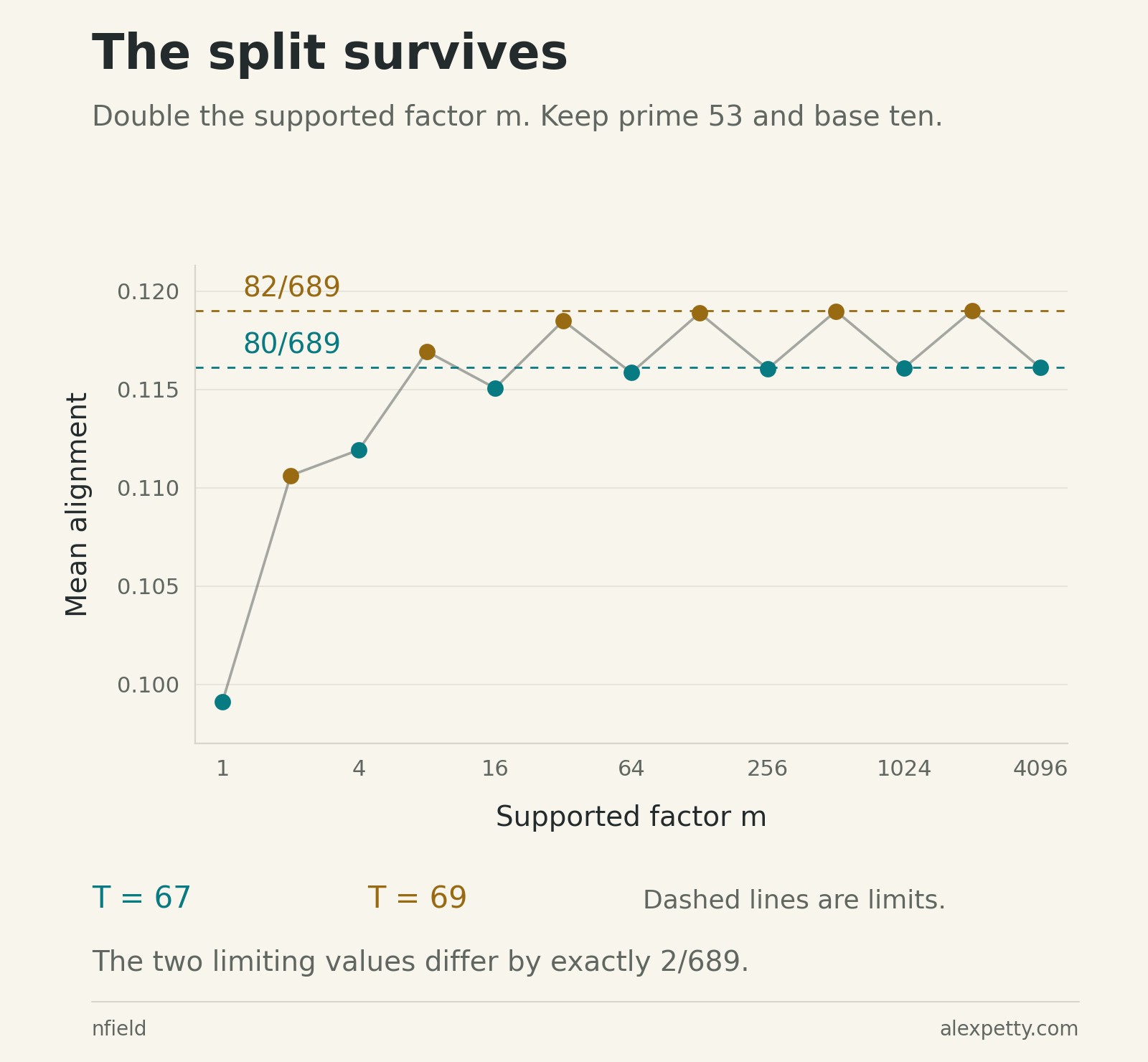
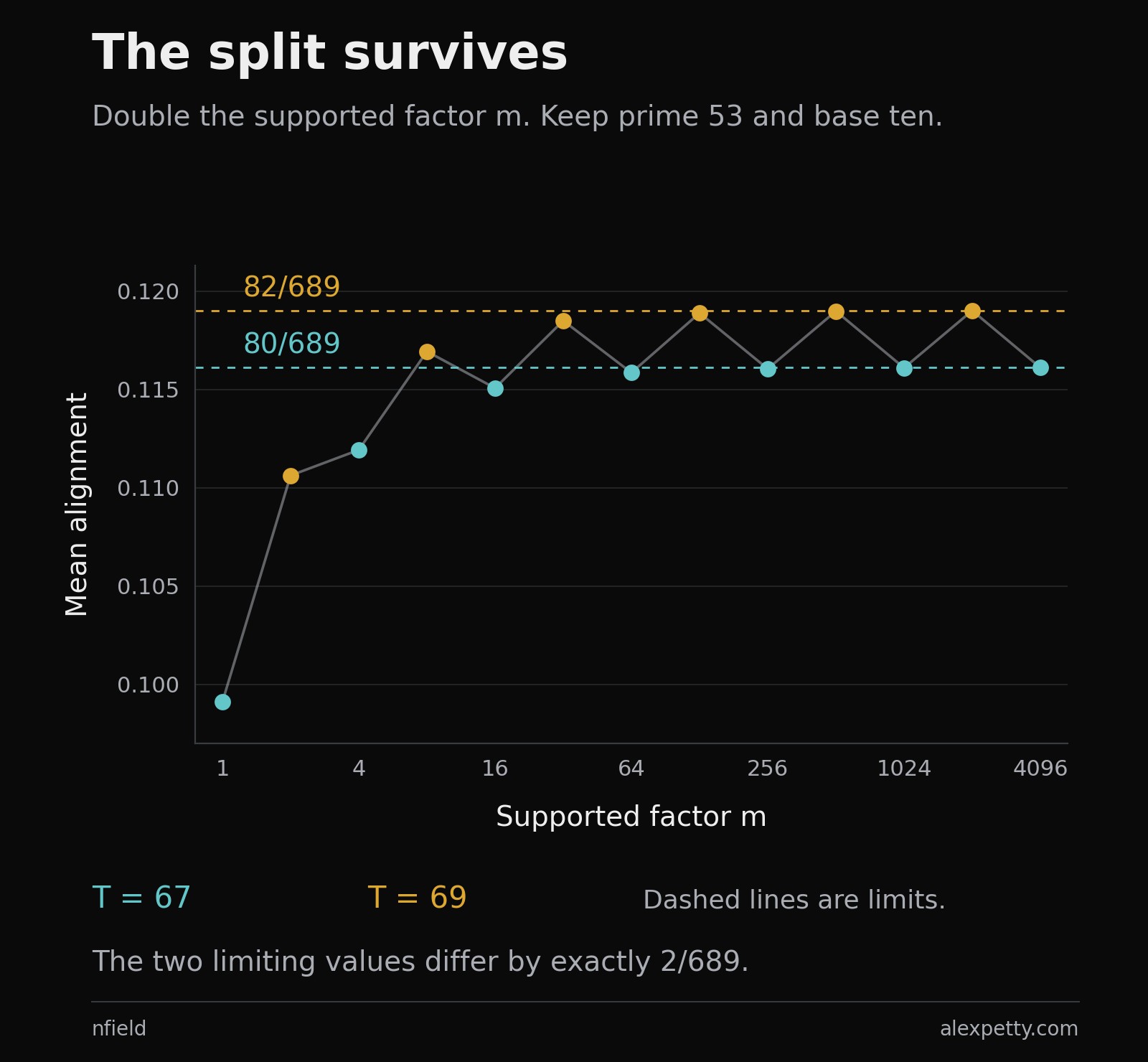
Their difference is exactly , and no amount of doubling closes it. Each cycle the reference can follow has its own limit, and the doubling family visits two of them forever.
For a digit-partitioning prime, every occupied bin contains one remainder. Then , and the formula reduces to the singleton-bin count
Beyond that case, subtracting the singleton-bin expression leaves
Every bin the reference visits contains at least the reference remainder itself, and each additional remainder in it adds a match. The correction counts exactly the agreement the singleton-bin calculation couldn’t see.
The whole table and the chosen cycle
There is another useful count hiding in the bins. A bin containing five remainders gives ordered pairs of remainders that write the same digit. A bin containing six gives 36. This includes pairing a remainder with itself.
Across all ten bins at 53, the total is
The same number appears if we add the four cycle totals
The bins count every matching pair at once. The cycle totals divide that count according to the route taken by the reference. Averaging across the four routes gives 68, halfway between 67 and 69, and an average of their limiting alignments equal to .
That middle value is a fair average over the four cycles, but the doubling sequence never goes near it. It keeps alternating between its two limits.
Pairs of remainders that write the same digit are collisions, and counts every one of them across the whole remainder set. A cycle total counts only the collisions a particular reference runs into. The bins fix once and for all, while the route decides how it is shared out.
Multiple cycles do not always split the limit. At 13 in decimal, the two cycles both have and give the same limit, . At 7 there is only one cycle, so no choice remains. In the decimal enumeration, 53 is the first prime whose cycle totals differ. Below 100 the others are 73, 79 and 89, and I don’t have a rule yet that picks them out.
Digits of 1/p in the literature
The digits of along a single multiplicative orbit have a well-developed theory. Girstmair related the variance of the digits over a full period to Dedekind sums and tied sums over selected positions to class number factors. Murty and Thangadurai handled digit means when the base is not a primitive root, and Kak and Chatterjee studied Hamming agreement between the digits of a reciprocal and their shifts. The Alignment Limit for All Primes averages a digit-equality count over every fraction with the same denominator instead, which is why the coset appears as a separate term. When the base is a primitive root there is only one coset, and the question of which one disappears.
Three fifths
The exact alignment depends on which bins the cycle visits. An upper bound needs only the size of the largest bin.
For a prime that does not divide the base, every digit bin contains at most remainders. Even if the reference spent its entire period in bins that large, the formula would give
This holds at every finite supported , in every base. Every subsequential limit is at most three fifths.
The bound is sharp. Take prime 5 in base two. Digit 0 has remainders 1 and 2; digit 1 has remainders 3 and 4. Both bins have size two, so every step contributes two to the bin sum. For ,
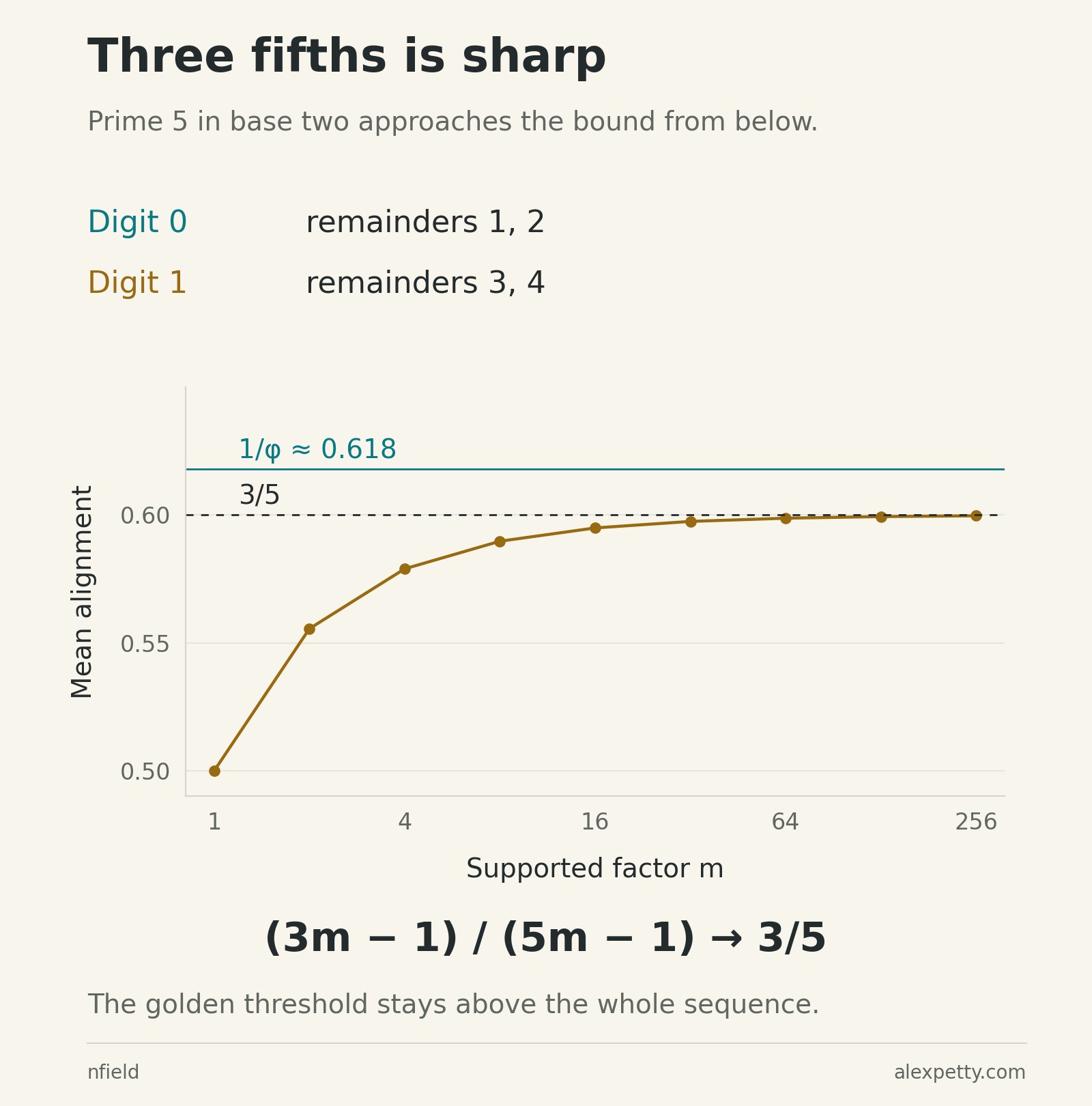
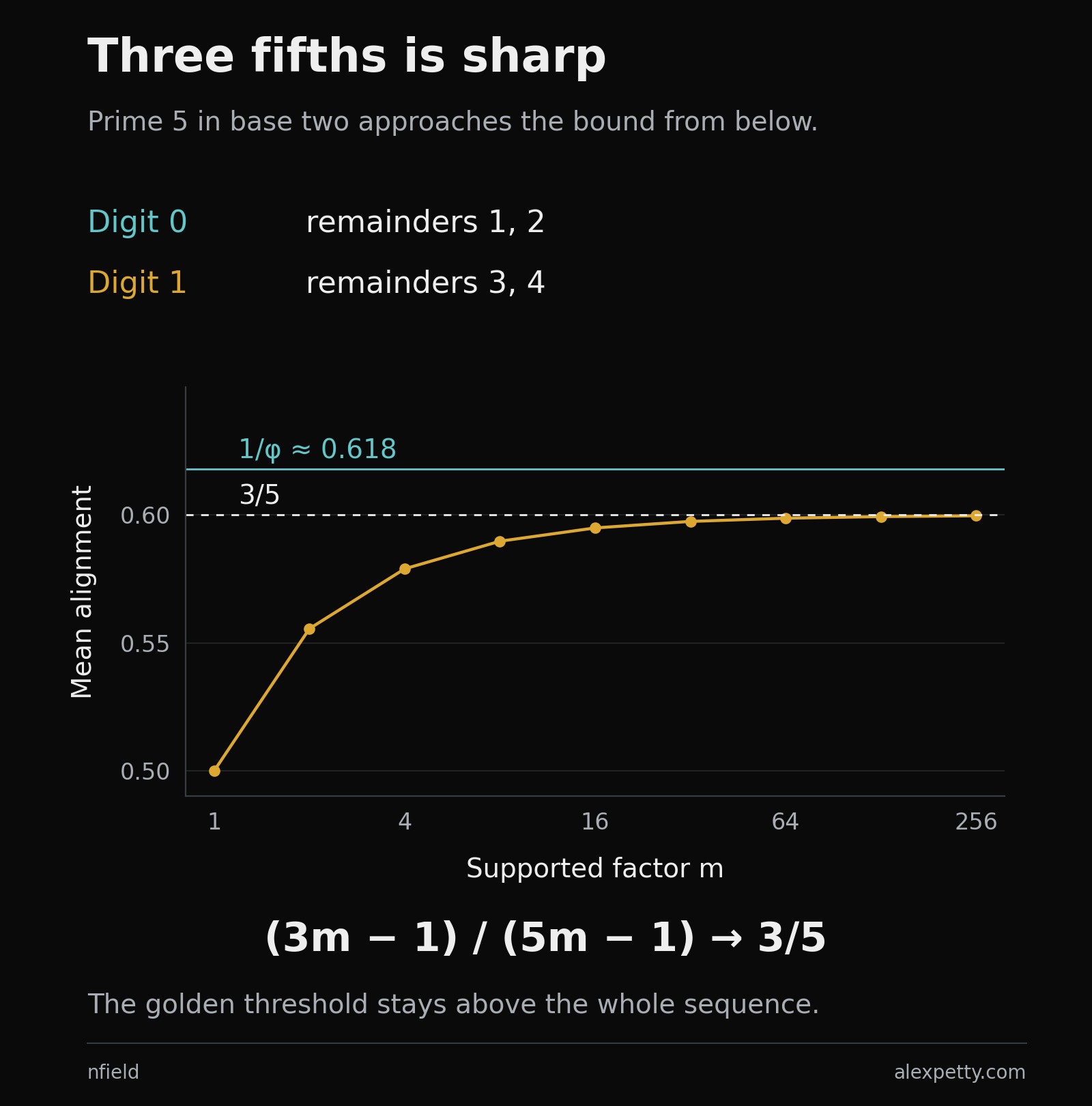
No finite member reaches three fifths, and since the family gets as close as you like, no smaller bound can hold every prime.
One over the golden ratio, the threshold from Three and the Golden Ratio, is about 0.618, just above 0.6. So among primes at least 3 that do not divide the base, only 3 can cross it. In decimal, denominator 12 already does, with alignment , while 3 and 6 stay below it at and .
The remaining denominator
The formula covers denominators whose part outside the base is exactly one prime. It applies to and . At , two primes remain after the supported factors have been removed. That requires a further argument.
Denominators supported entirely on the base are a separate, settled case. Every row terminates and receives score one. Decimal denominator 50 therefore has alignment one. The prime 2 also has alignment one in every base.
Long division clears the twos and fives out of the denominator in a few steps and leaves a starting remainder behind. At three that remainder only decides whether the tail repeats 3s or 6s, and the count can’t tell the difference. At 53 it decides which of two limits the alignment approaches.
Discussion
Sign in to join the discussion.