Spectra
The Coherence Decomposition

In Three and the Golden Ratio, the twelfths score , just above one over the golden ratio, and that crossing is what sets three apart from every other prime. But a score measured against one reference row mixes two things together. It is like grading a stack of tests against an answer key. Part of each score is agreement with the key, and part is agreement already present in the class, which a teacher who suspects copying would measure by checking how often the students agree with one another. Split the that way and it comes apart into and . Neither piece reaches the golden line. The crossing that made the twelfths interesting happens only when the two are added together.
I wanted to know how much of an alignment score is that background. For a whole family of denominators the answer is exact, and the background turns out to be worth knowing for its own sake. For a prime denominator it is zero precisely when no two remainders ever write the same digit.
The sevenths show what a table with no background looks like.
1/7 = 0.|142857|
2/7 = 0.|285714|
3/7 = 0.|428571|
4/7 = 0.|571428|
5/7 = 0.|714285|
6/7 = 0.|857142|
Every row uses the same six digits in the same cyclic order, and yet no column contains a digit twice. Graded against , the sevenths score , all of it from the reference agreeing with itself. Graded among themselves, they score zero.
Multiply the denominator by eleven and the rows start agreeing.
1/77 = 0.|012987|
2/77 = 0.|025974|
The first digits match, and so do the fourth, two matches in every six places, and plenty of other pairs in the table share digits too. Seventy-seven scores about 0.1009 against and about 0.0884 averaged over all 2,850 pairs of distinct rows. The Three-Tier Theorem puts seven and seventy-seven in the same low tier, but their tables are nothing alike.
A table without a reference
Call the average over distinct unordered pairs , the pairwise alignment. Each pair is counted once, and no row is paired with itself. This is the coherence in the title, agreement of digits at corresponding positions. We keep the tails on one common clock, without rotating individual rows to improve their matches.
Subtract this average from the reference alignment . I call the difference the focused alignment, .
That equation is true by definition, so on its own it says nothing. The content comes from counting the two averages separately and finding an exact relation between them. And is not simply the pairs that involve . It is the difference between an average over rows and an average over pairs, two different sets of comparisons.
The exact scores at seven and seventy-seven
| Quantity | Seven | Seventy-seven |
|---|---|---|
| Reference | ||
| Pairwise | ||
| Difference |
These pair averages exclude self-matches. The reference averages include them. Pairwise alignment is defined for , since the table at two has only one row.
Eleven rows, fifty-five pairs
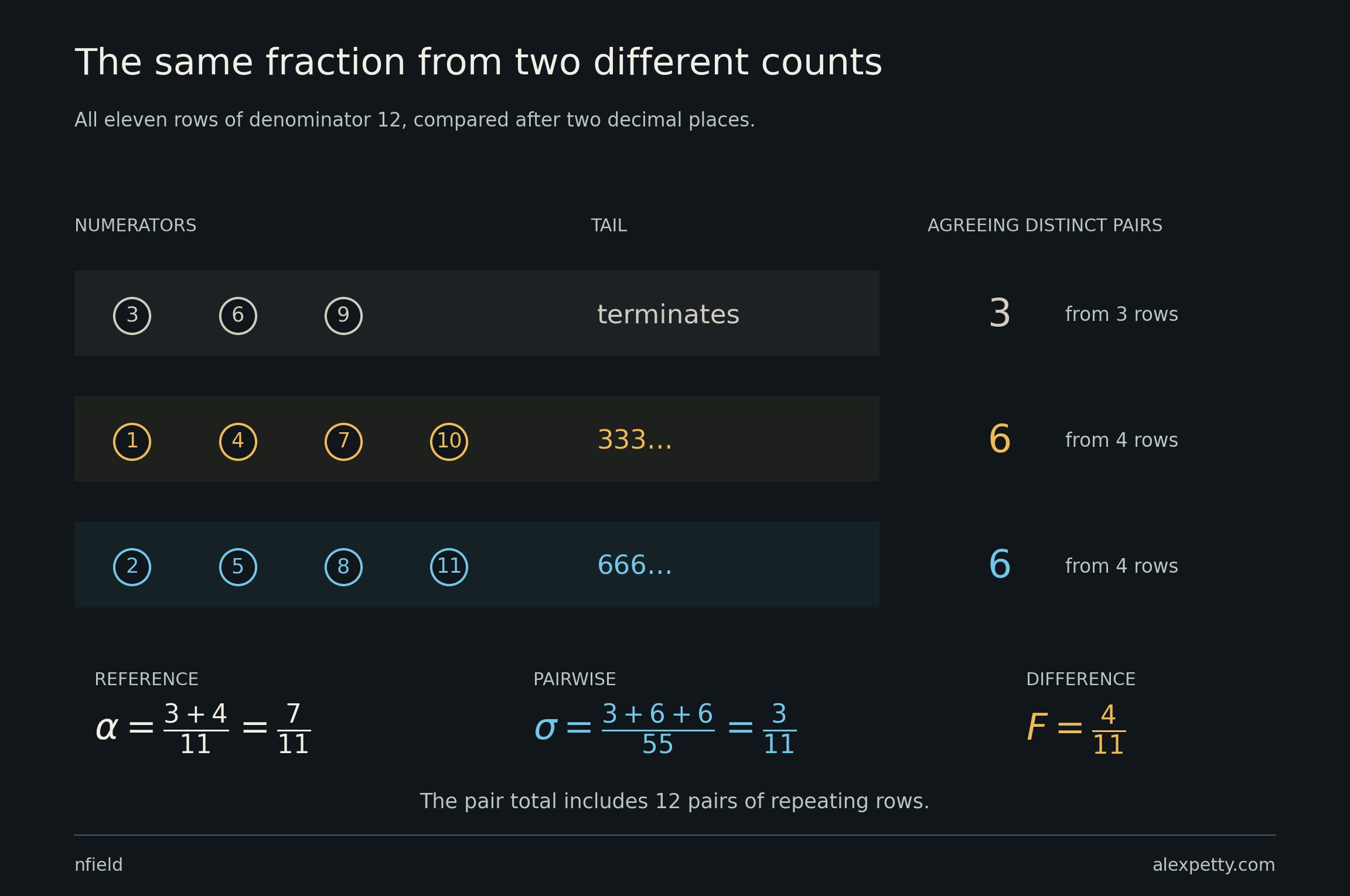
The twelfths are small enough to count in full. Past the second decimal place, the fractions with numerators 3, 6 and 9 have terminated, those with numerators 1, 4, 7 and 10 repeat 3, and those with 2, 5, 8 and 11 repeat 6.
Against the reference, the four repeating 3s match and the three terminating rows take full credit by convention, seven credited rows out of eleven.
Pairs need their own rule for terminating rows. Two terminating rows score one, a terminating row paired with a repeating row scores zero, and two repeating rows score the fraction of positions where their digits agree. That is stricter than the reference count, where every terminating row is credited automatically.
At twelve, then, a pair scores one exactly when both rows are in the same group and zero otherwise. The three terminating rows make three pairs and each group of four repeating rows makes six, fifteen agreeing pairs out of fifty-five.
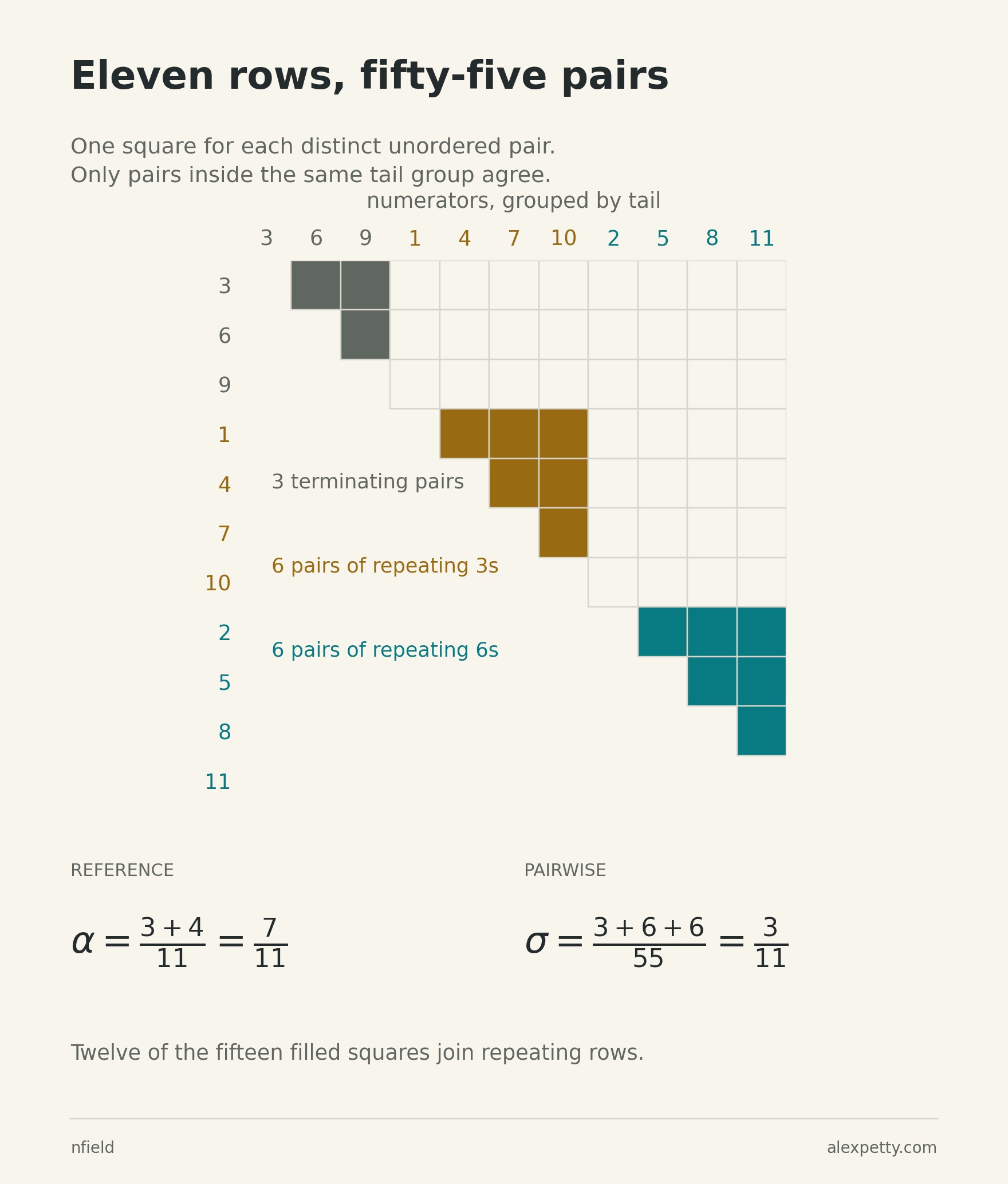
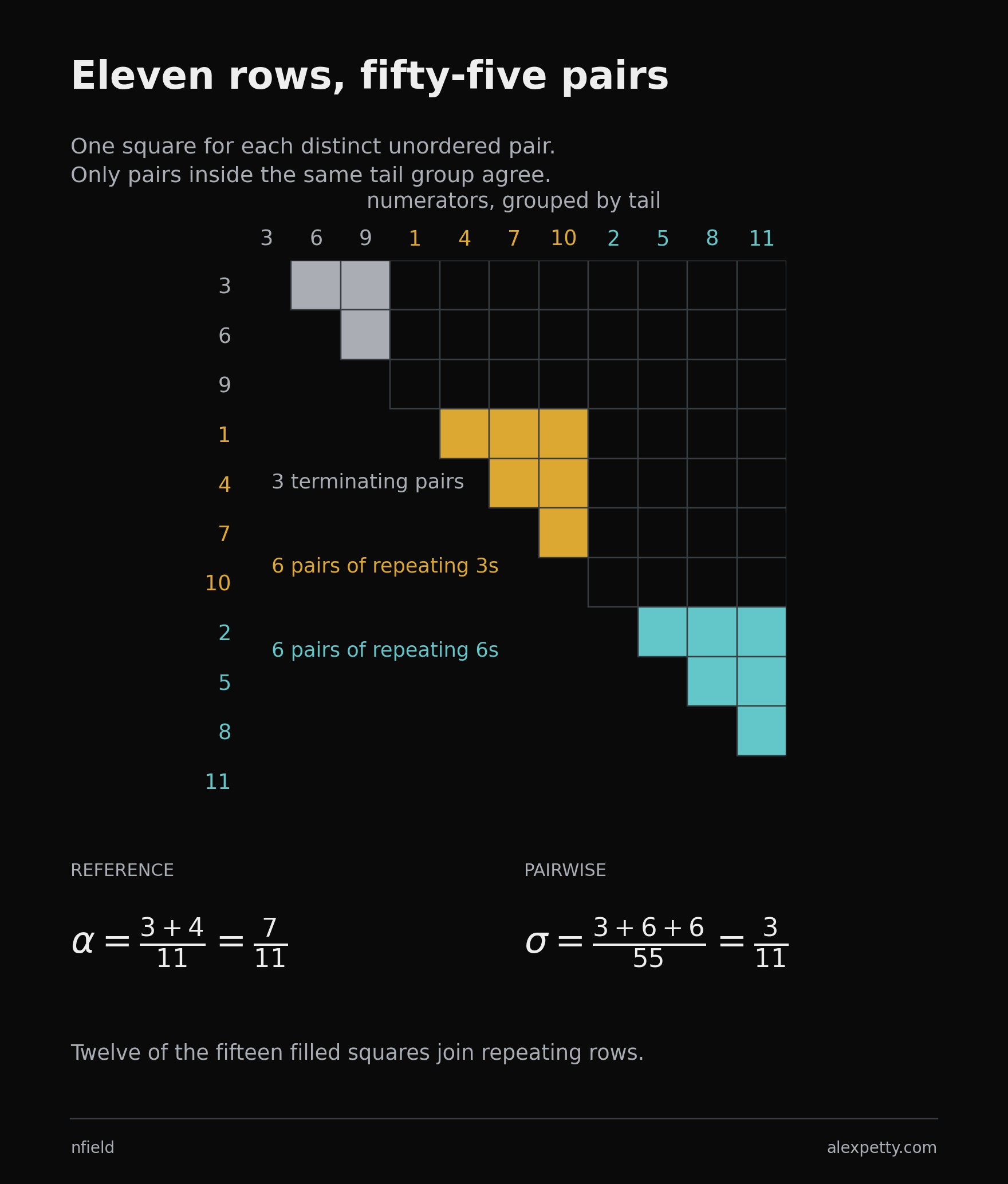
That is three elevenths again, the same share the three terminating rows contributed to the reference score. The coincidence is only in the totals, since twelve of the fifteen agreeing pairs are made of repeating rows.
Subtracting this pair average from the reference score leaves
Four elevenths is exactly the share of rows in the reference’s own group. So at twelve the two averages recover the two pieces of the alignment count, the terminating rows and the reference’s group. The question is whether that survives when the table grows.
The count that survives
Take , where is a digit-partitioning prime and every prime factor of divides the base. In decimal, can use twos and fives, while can be three, seven, or eleven. In base , the conditions are and .
Digit-Partitioning Primes and the Alignment Formula supplies what we need. Once every row has passed a common clearing depth, each nonzero remainder modulo has rows behind it. Rows with the same remainder agree forever. Rows with different remainders stay different as the division advances, and because is digit-partitioning they write different digits at every step.
There are repeating groups of rows, together with one terminating group of rows. We can count pairs within those groups exactly as we did at twelve. Dividing by the total number of pairs gives
This is the central result. For every denominator in the family, the average over all pairs comes out to exactly the terminating rows’ share of the reference score, and what is left over is the reference group’s share of the rows.
Follow the pair count through the cancellation
A group of rows contains distinct pairs. The number of agreeing pairs is
There are pairs altogether. Dividing cancels the factor and leaves . We require , so this denominator counts at least one pair.
Nothing in the calculation requires the base to visit every nonzero remainder in a single cycle. The rows may run through several cycles of any allowed length. The count needs only equal-sized remainder classes and a digit function that keeps those classes apart.
The entirely terminating tables have a simpler outcome. At ten, for example, every row receives reference credit and every pair consists of two terminating rows. Both averages are one, so .
The first shared digits
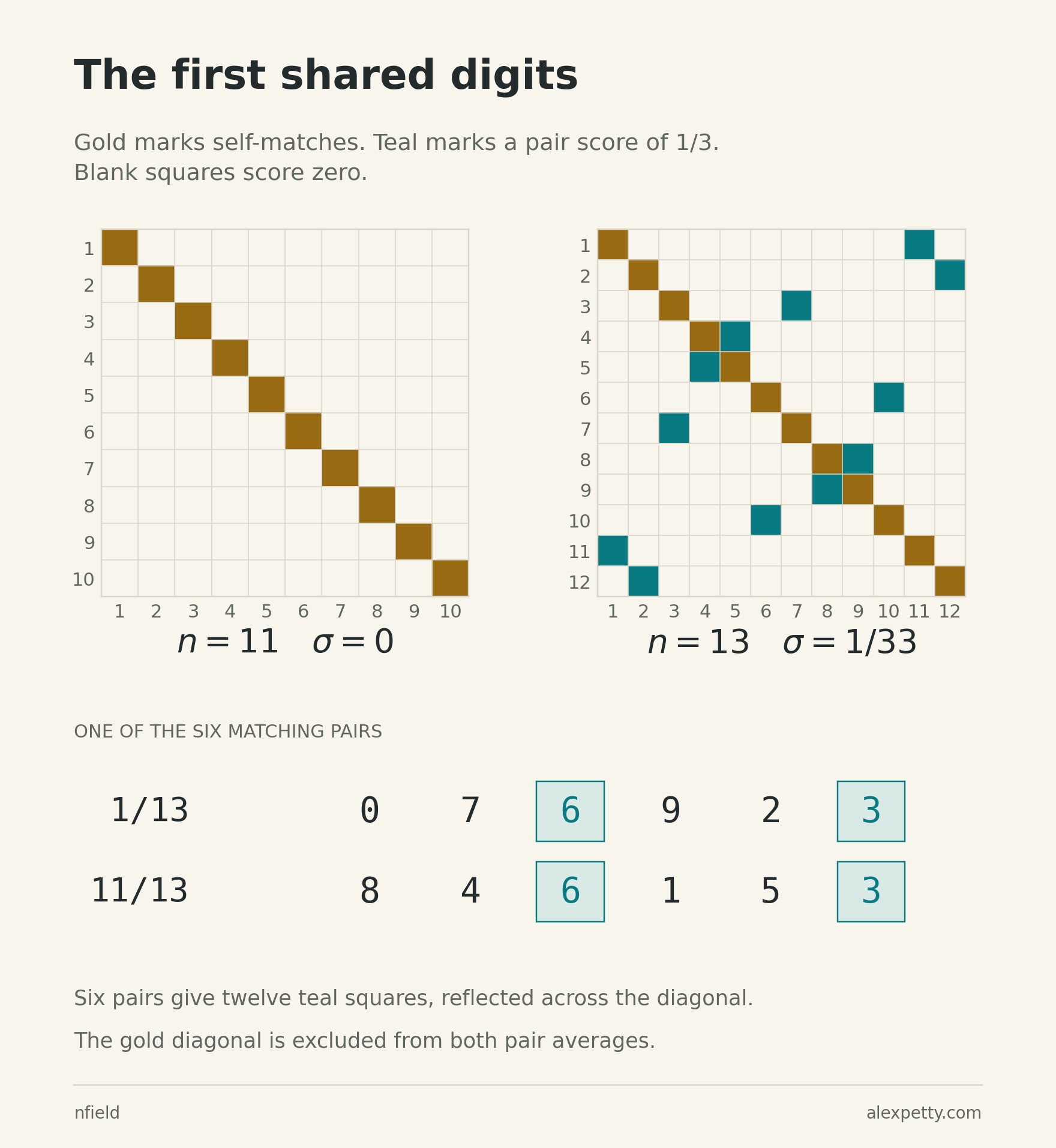
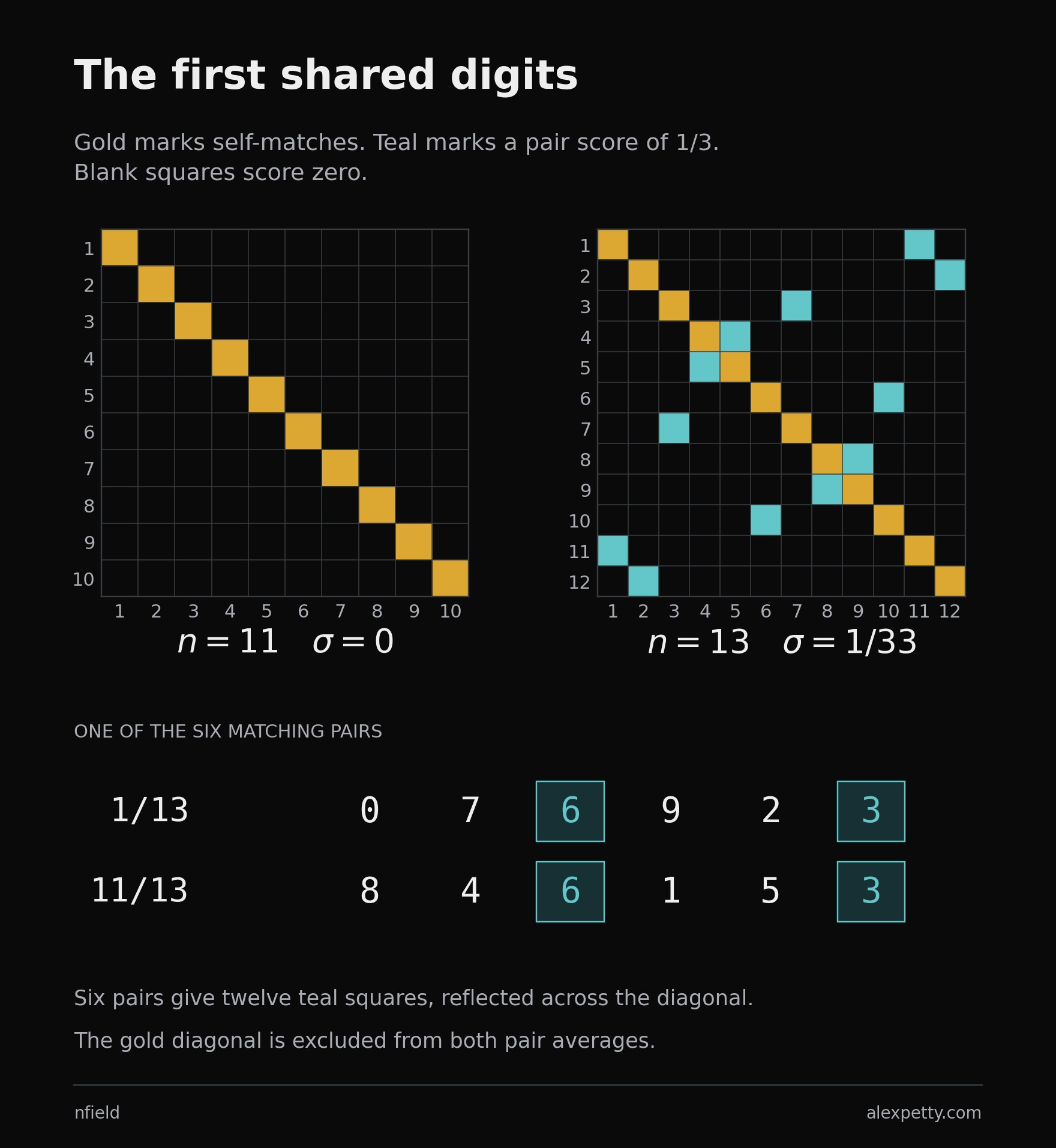
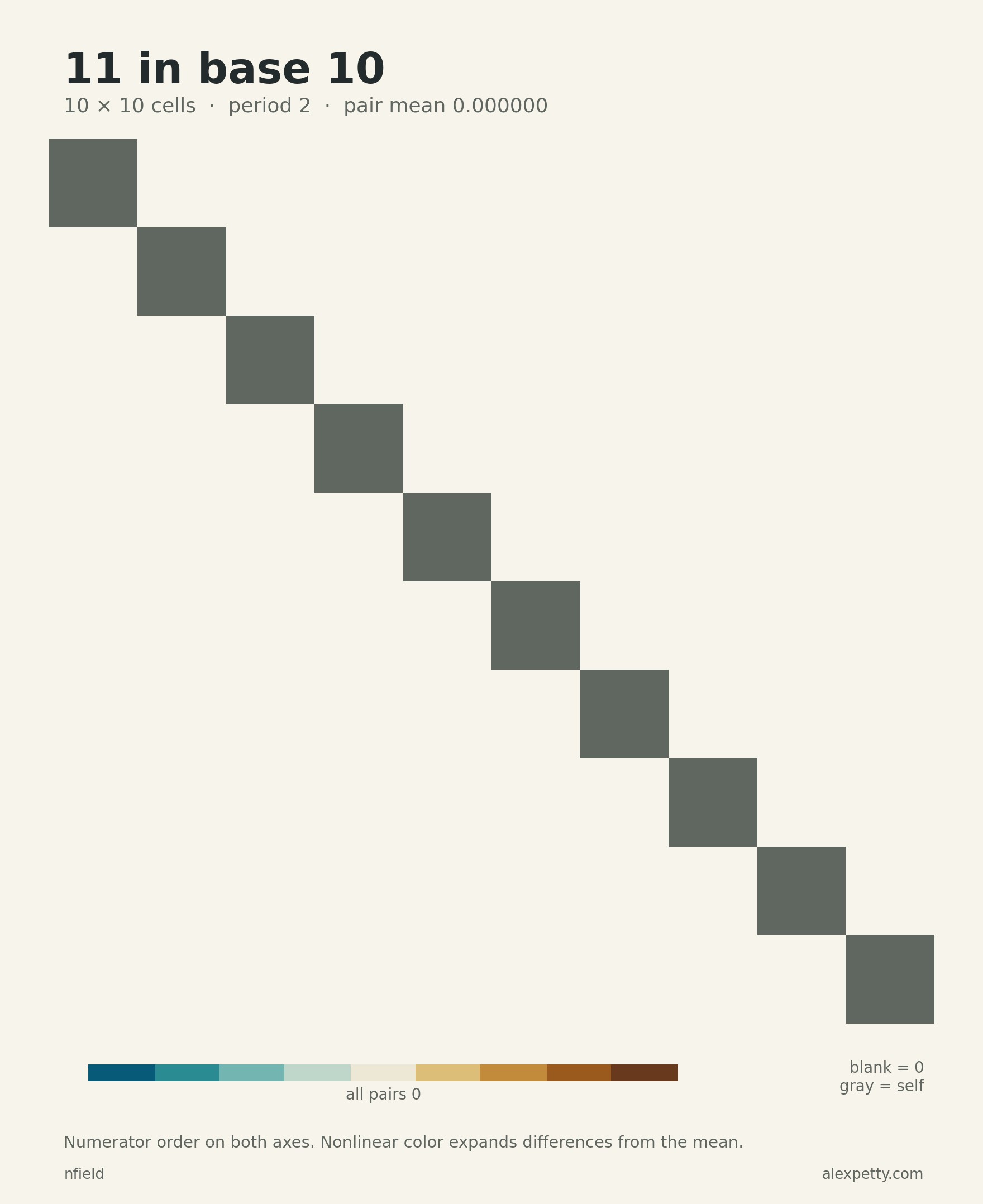
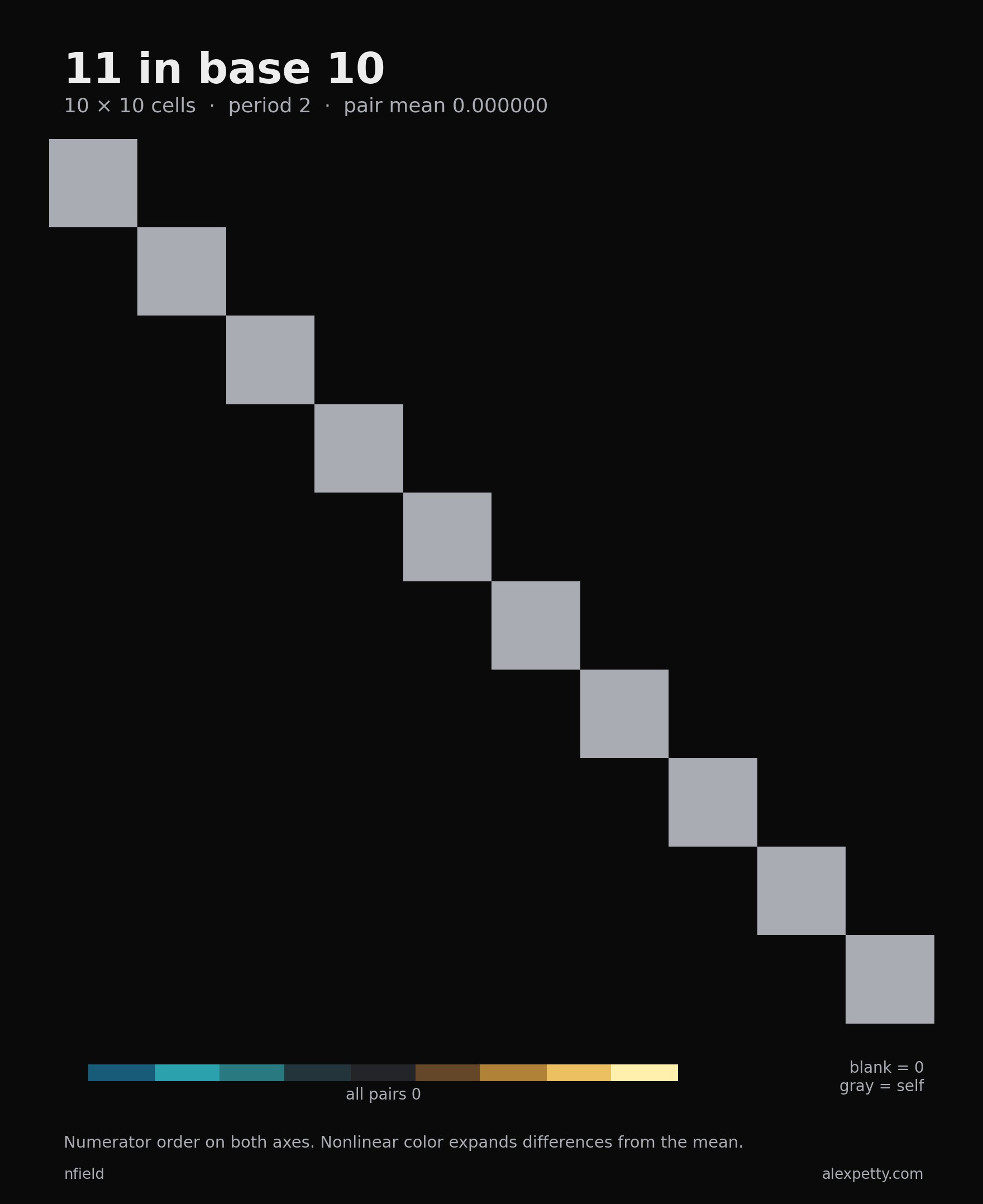
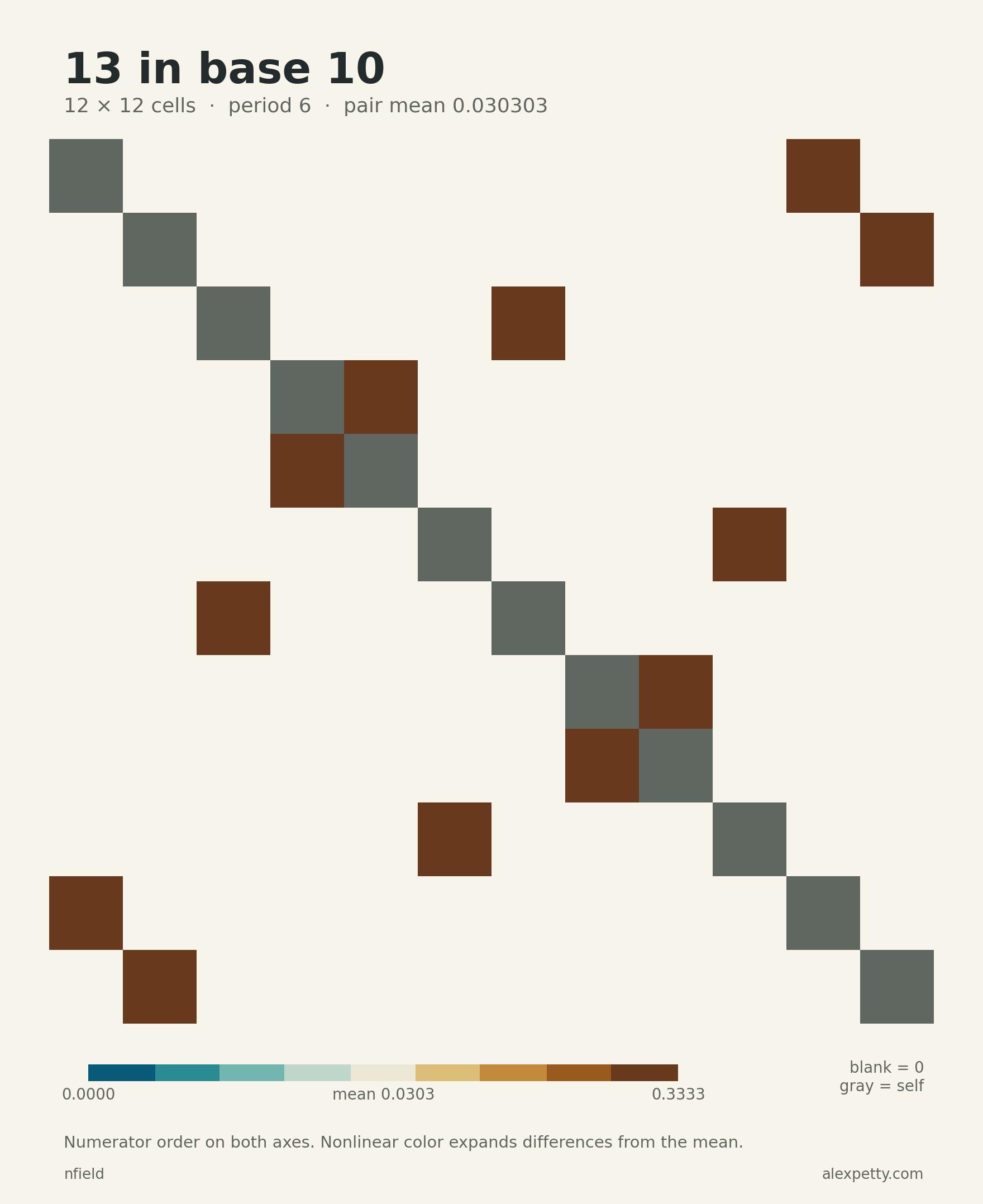
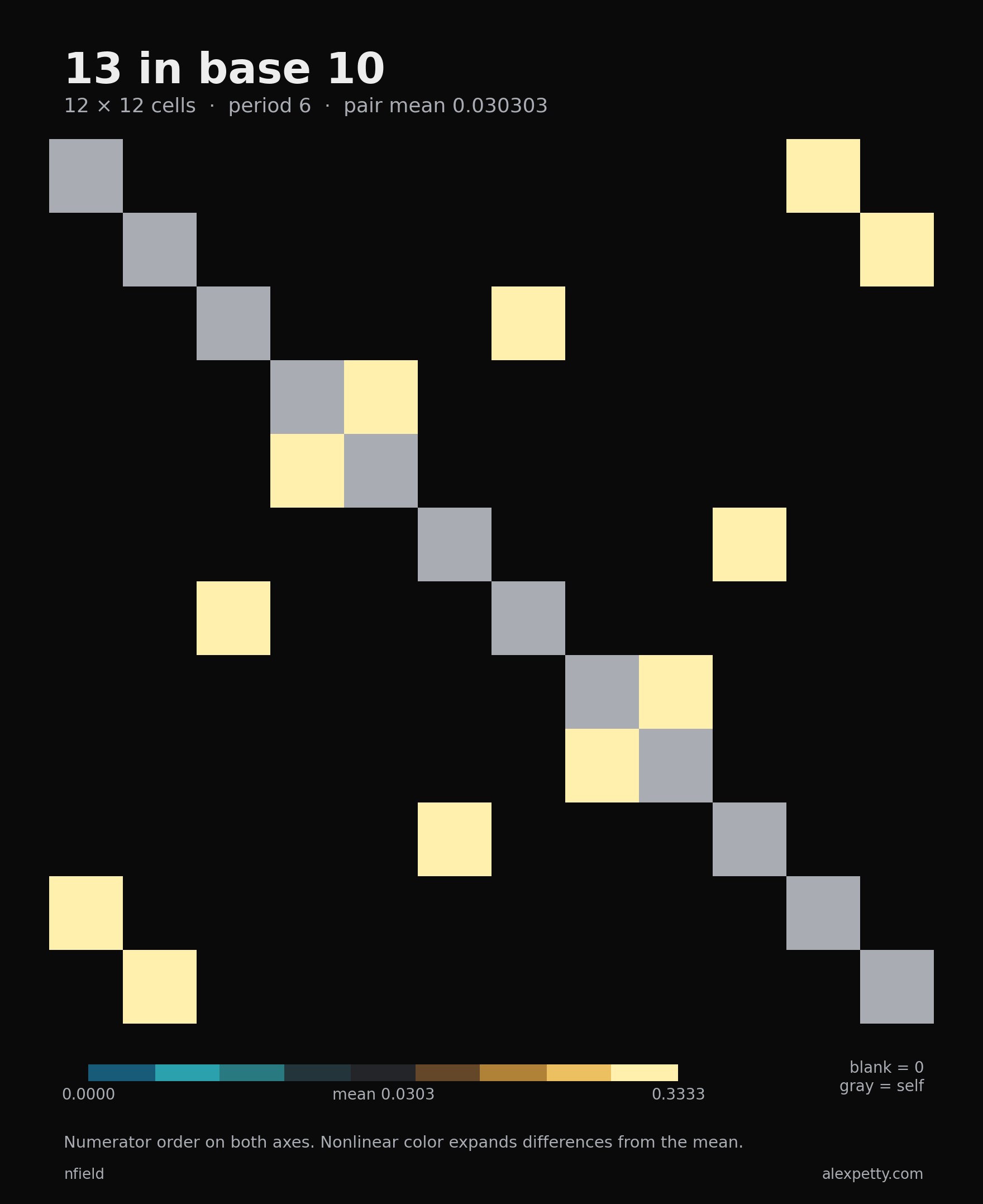
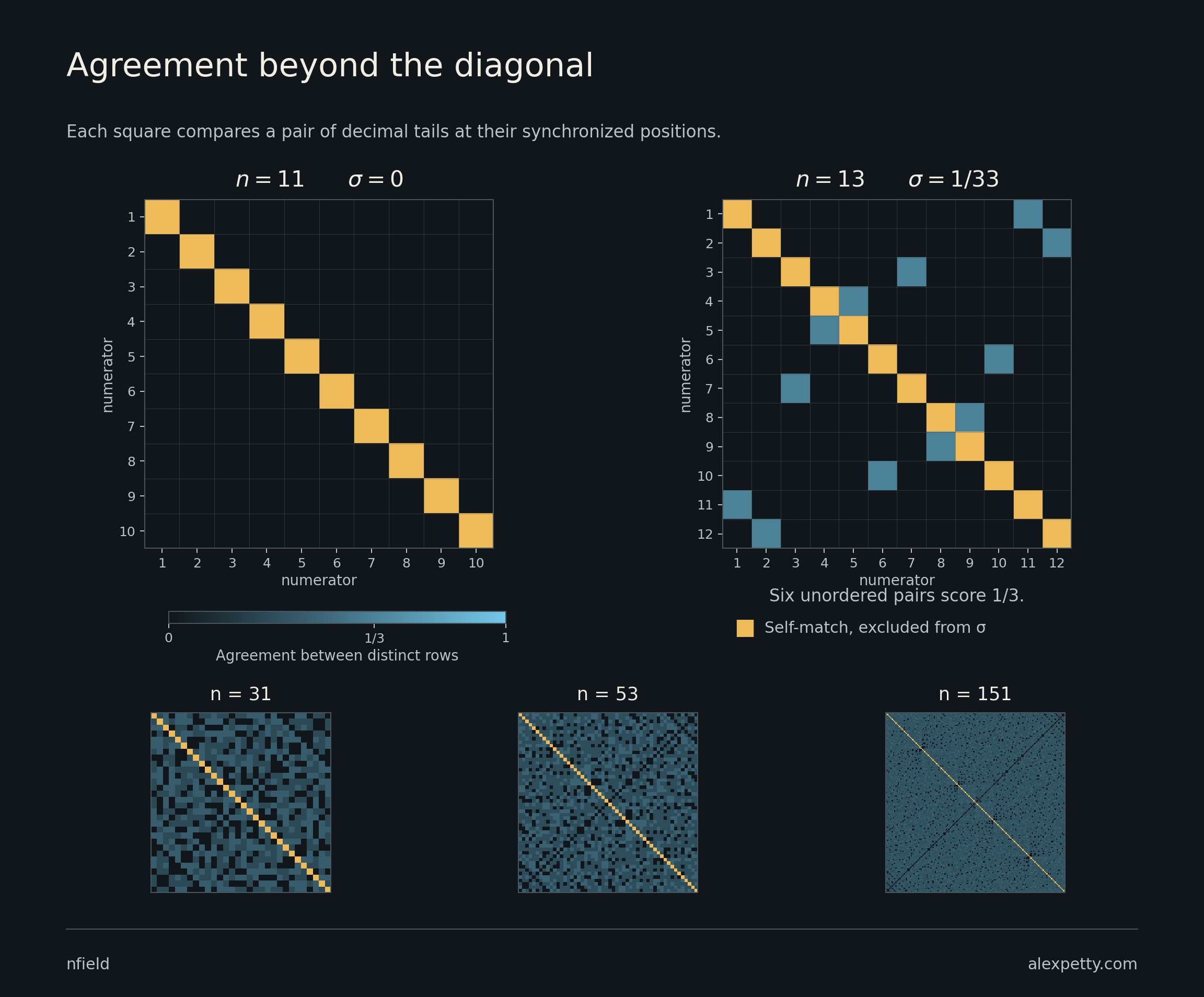
Put the pair scores in a square grid, with the fractions labeling both axes. The diagonal records self-matches and is left out of . The rest of the grid shows the comparisons we are averaging, with each unordered pair appearing twice by symmetry.
At eleven, every square away from the diagonal is empty. At thirteen, six distinct pairs score , and one of them is the pair that closes Digit-Partitioning Primes and the Alignment Formula.
 1/13 = 0.|076923|
11/13 = 0.|846153|
The third and sixth digits match, and both matches come back every six places, a pair score of .
There is an exact test behind this change in the picture. A prime that does not divide the base has zero pairwise alignment exactly when it is digit-partitioning, which means
When every nonzero remainder emits a different digit, distinct rows cannot agree in any column. Conversely, if two remainders emit the same digit, their fractions match in the first column. That match returns with the period, making their pair score positive. An average of nonnegative scores can be zero only when every one of them is zero.
So the pair statistic detects precisely the failure of digit separation. In decimal, three, seven, and eleven have . Every prime above eleven has a positive pair average. Five is outside this test because its decimal fractions terminate.
From a few rows to thousands
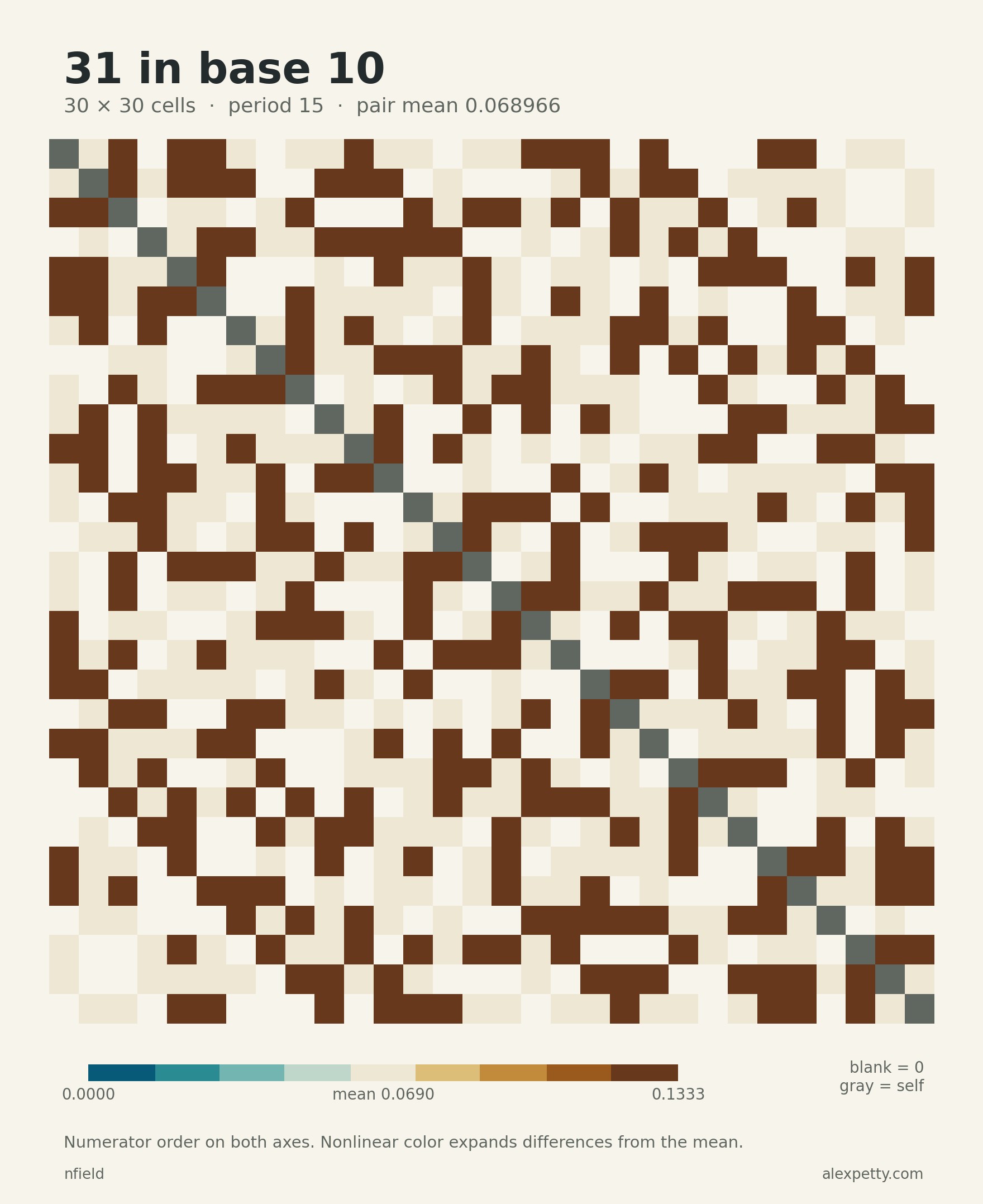
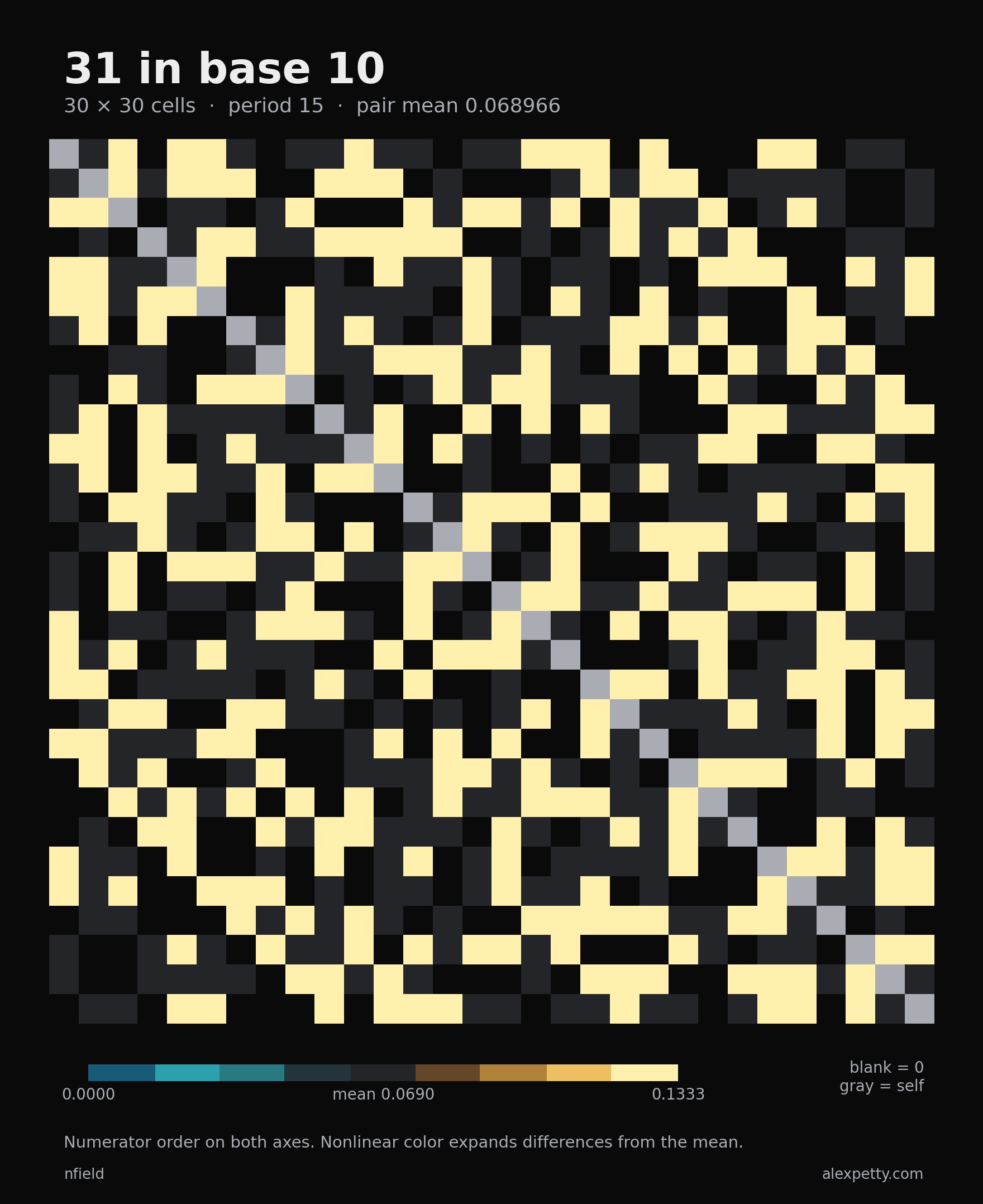
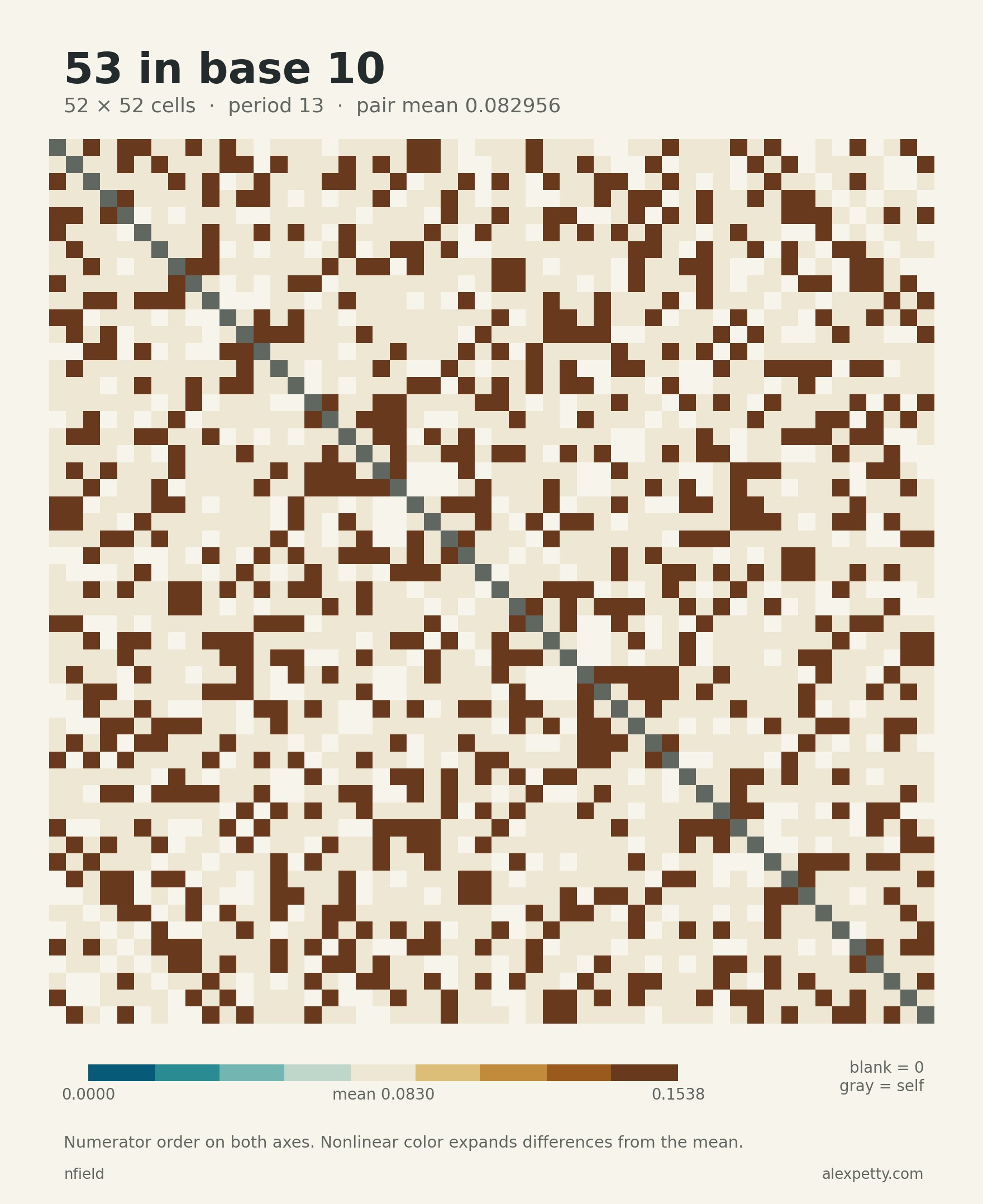
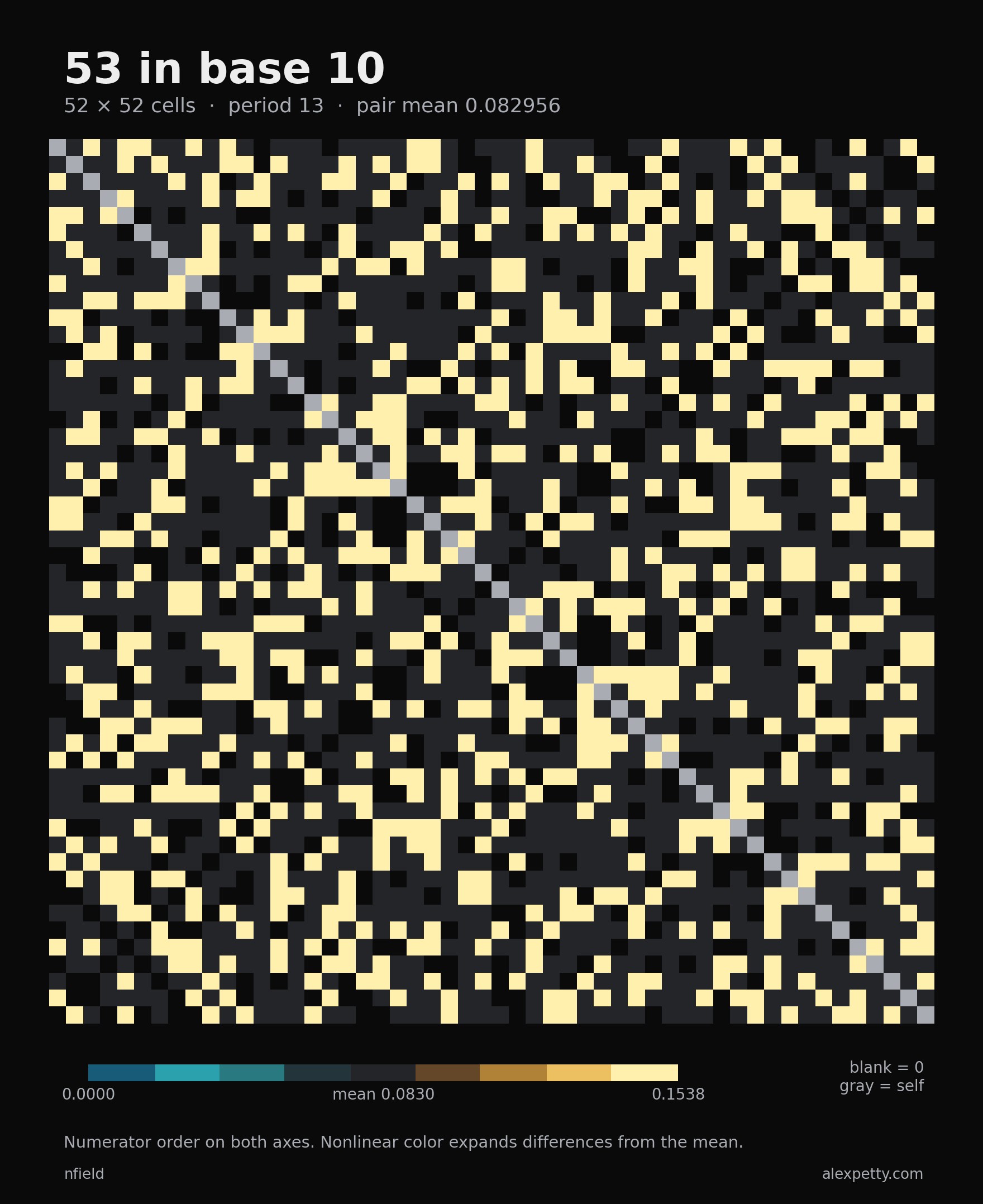
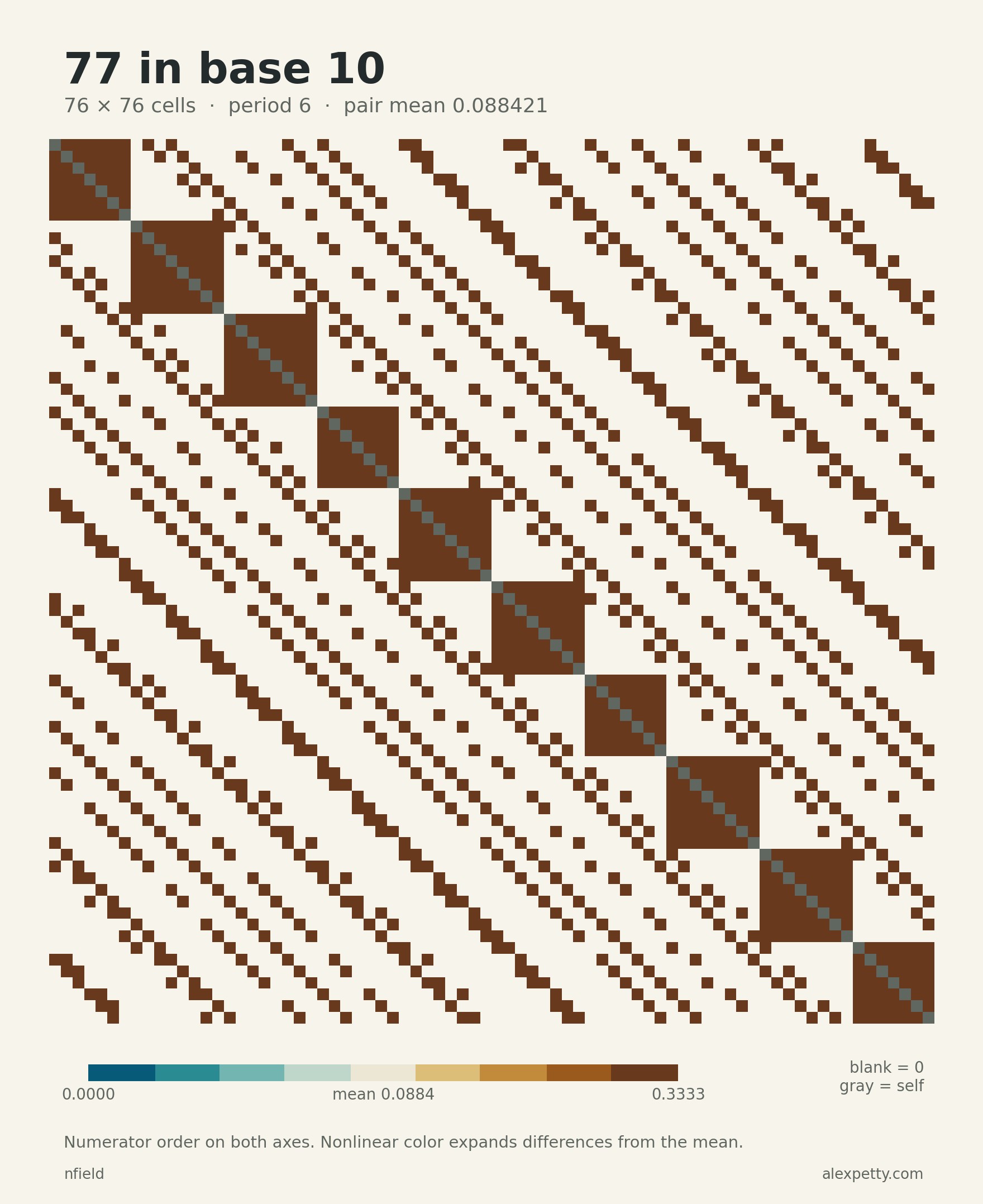
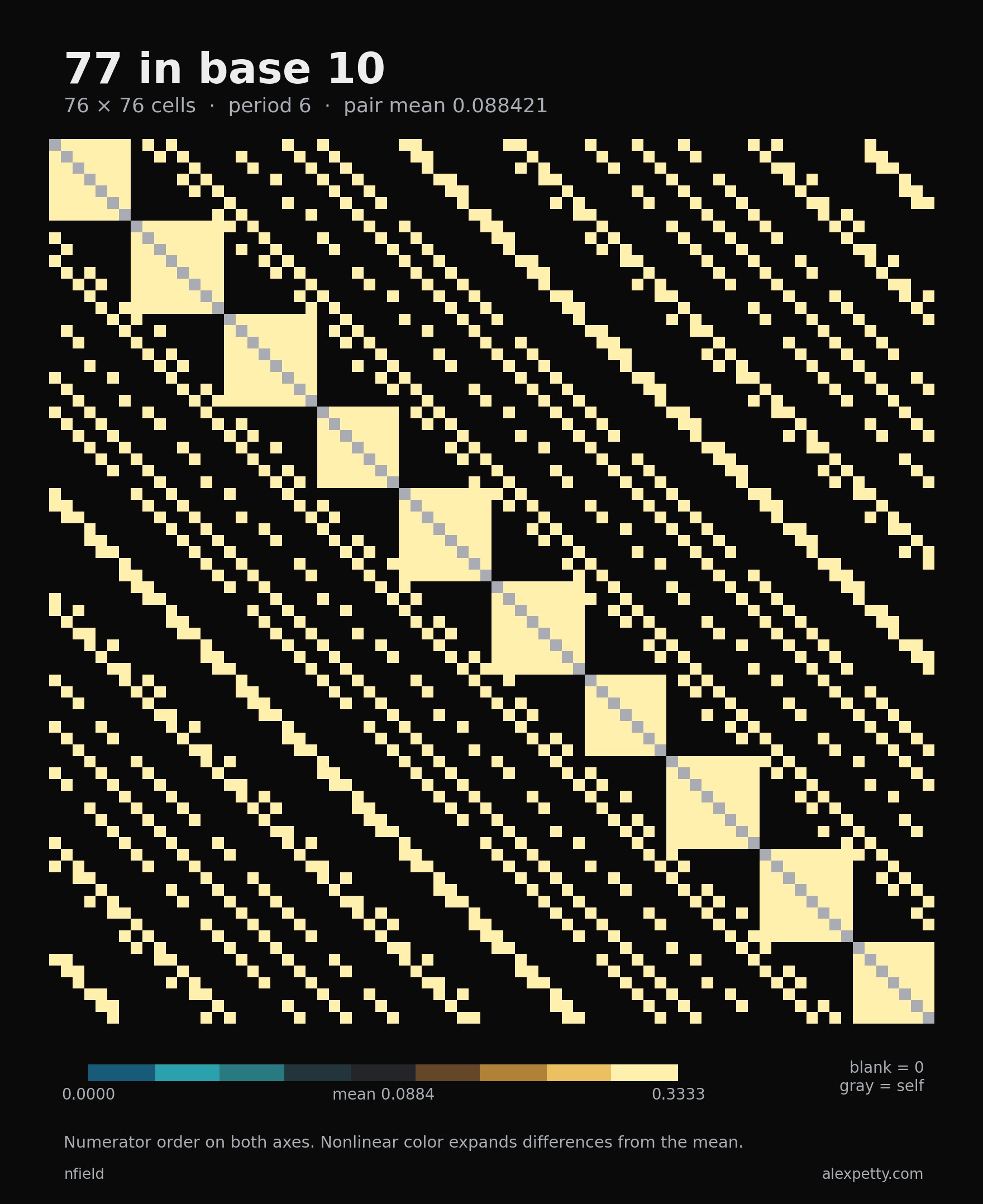
At thirteen we can point to every matching pair. Increase the denominator and those isolated squares give way to bands, crossings and fine-grained texture, although the rule behind each square never changes. It still asks how often two fractions show the same digit in the same position.
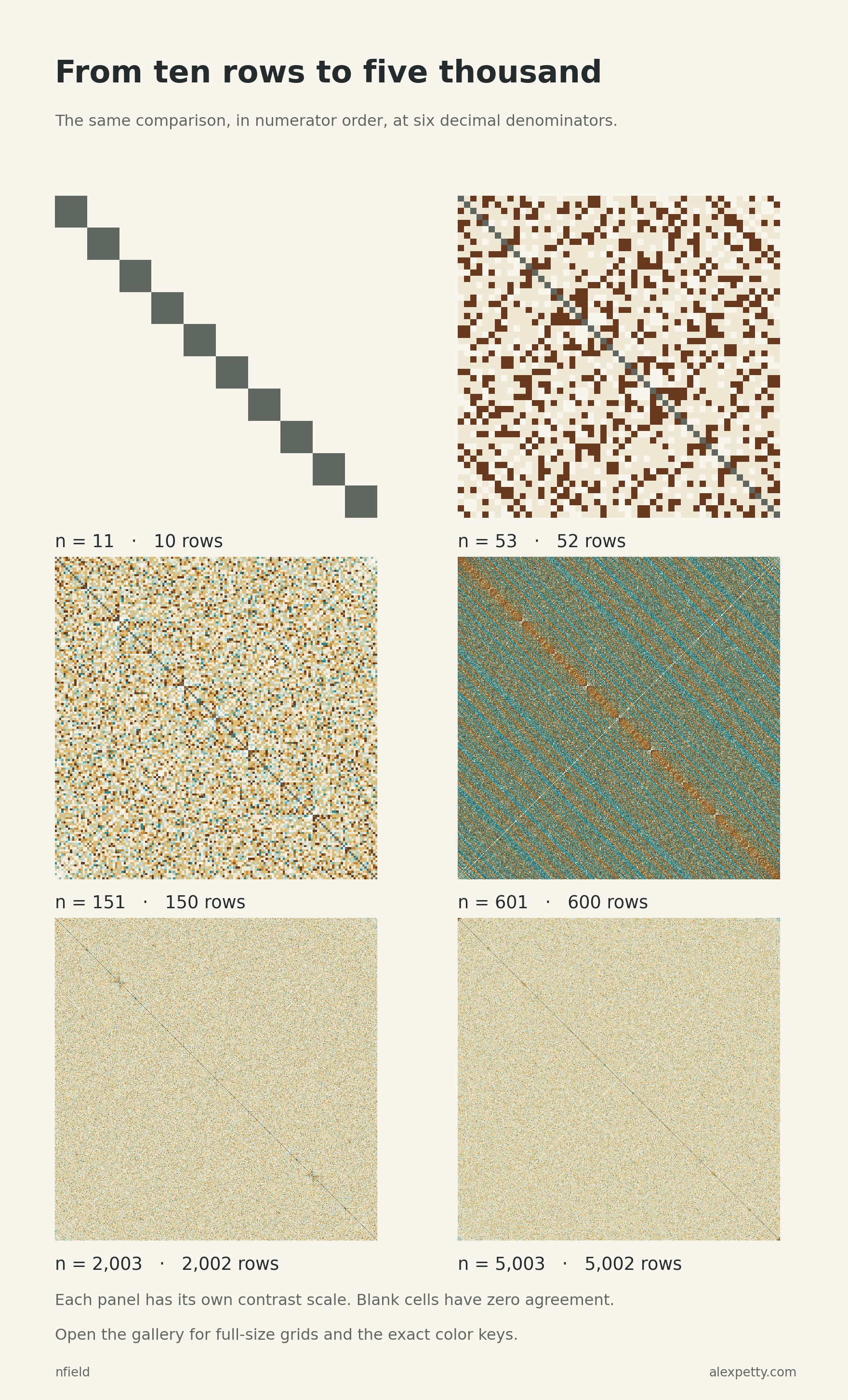
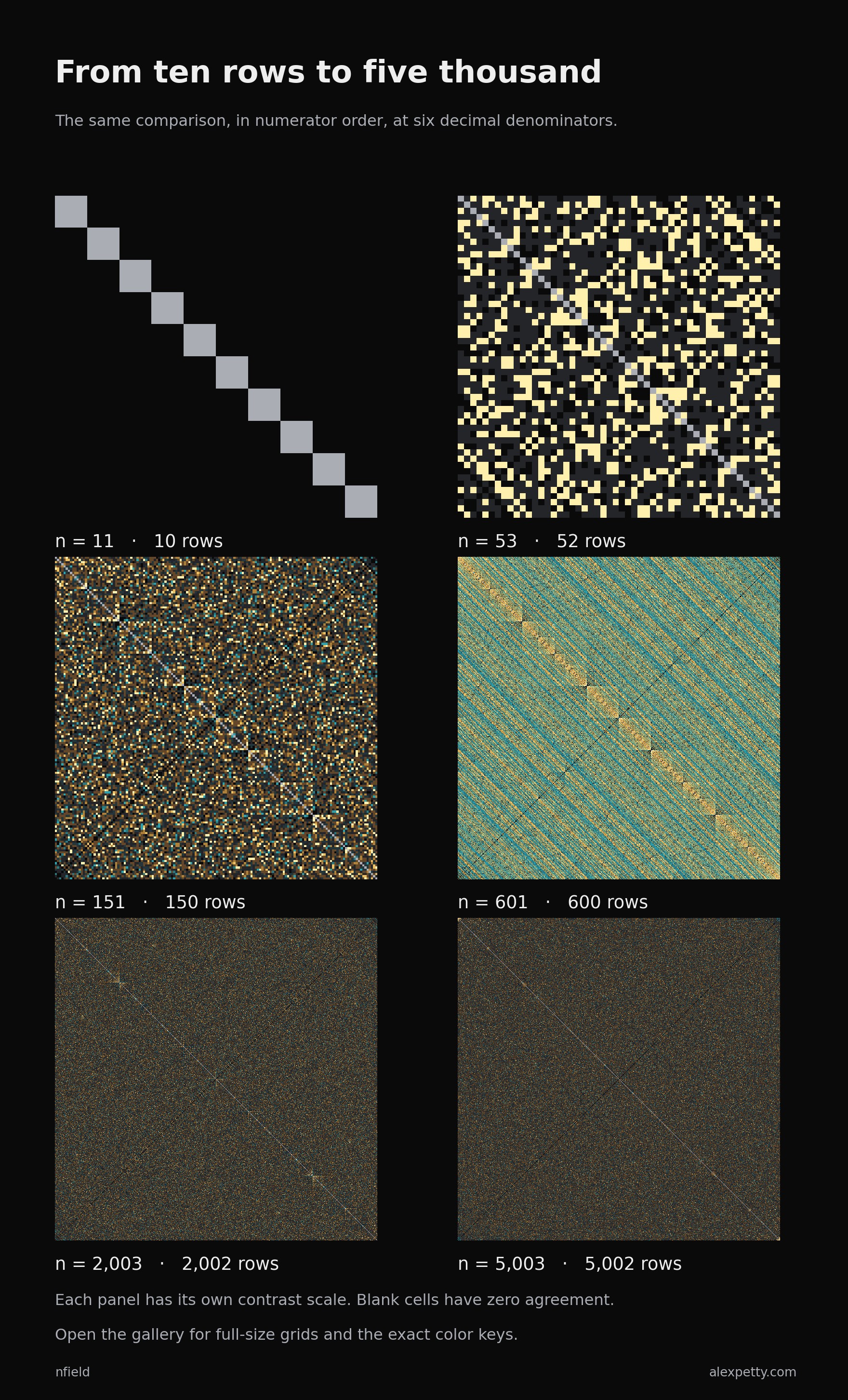
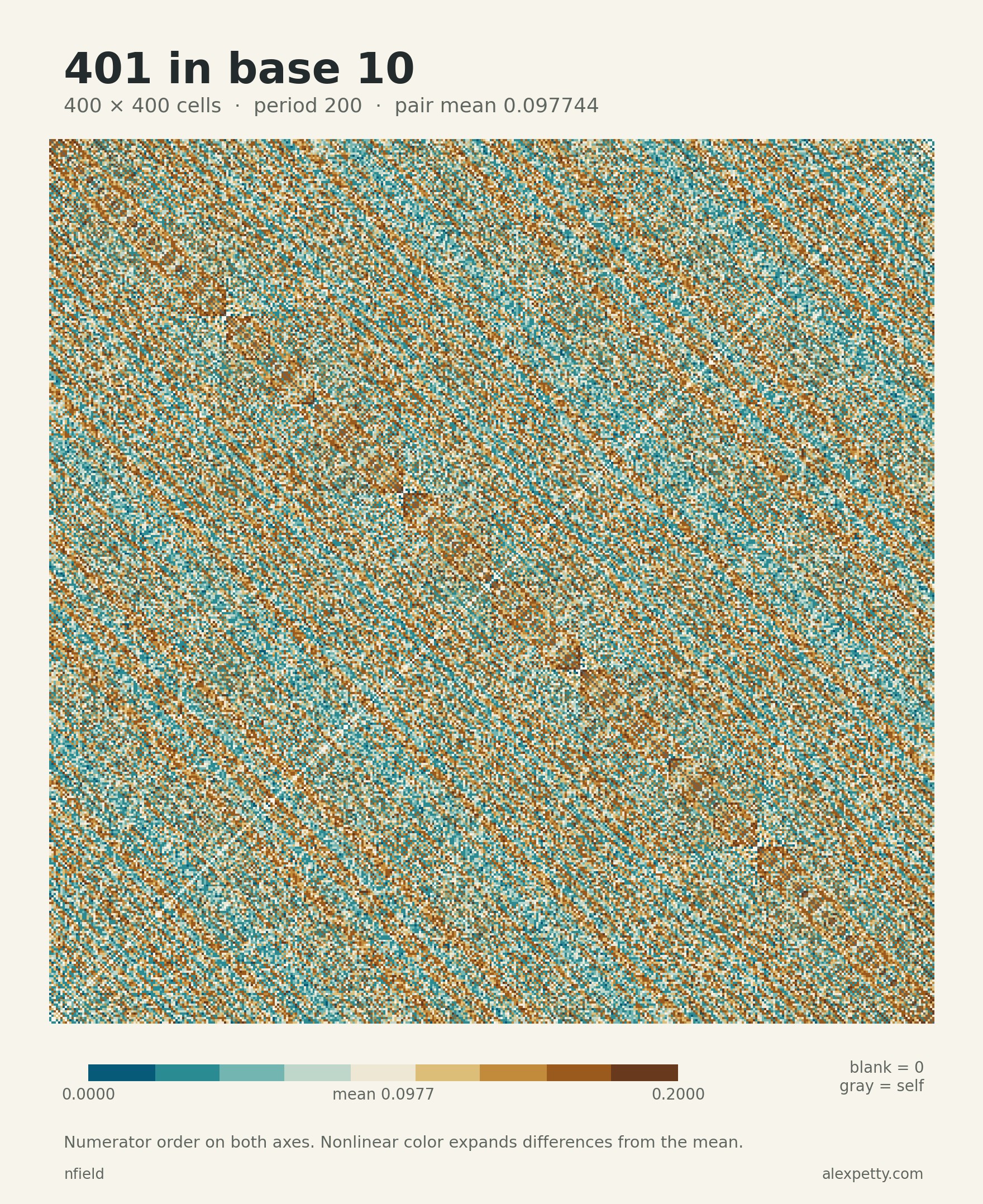
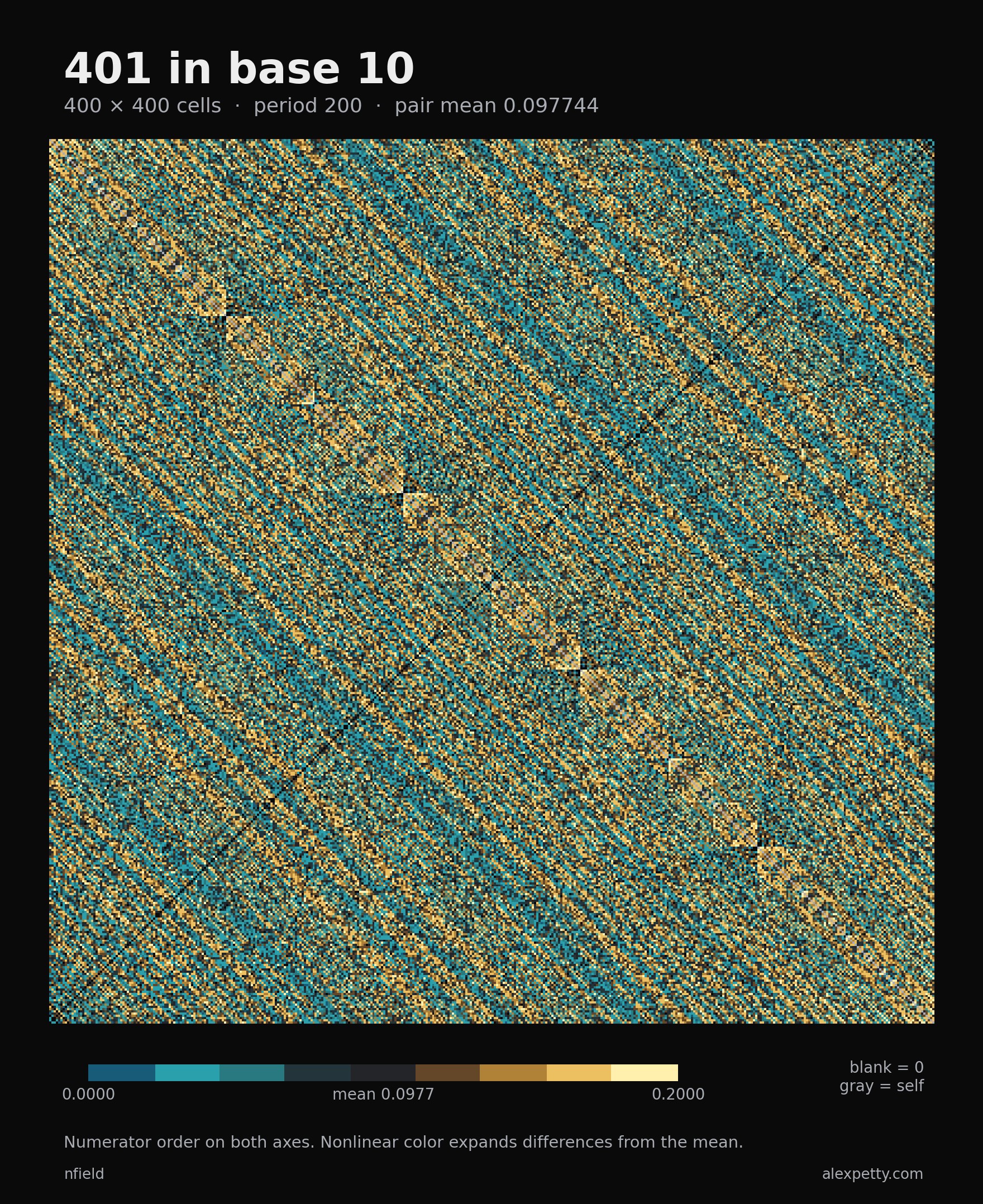
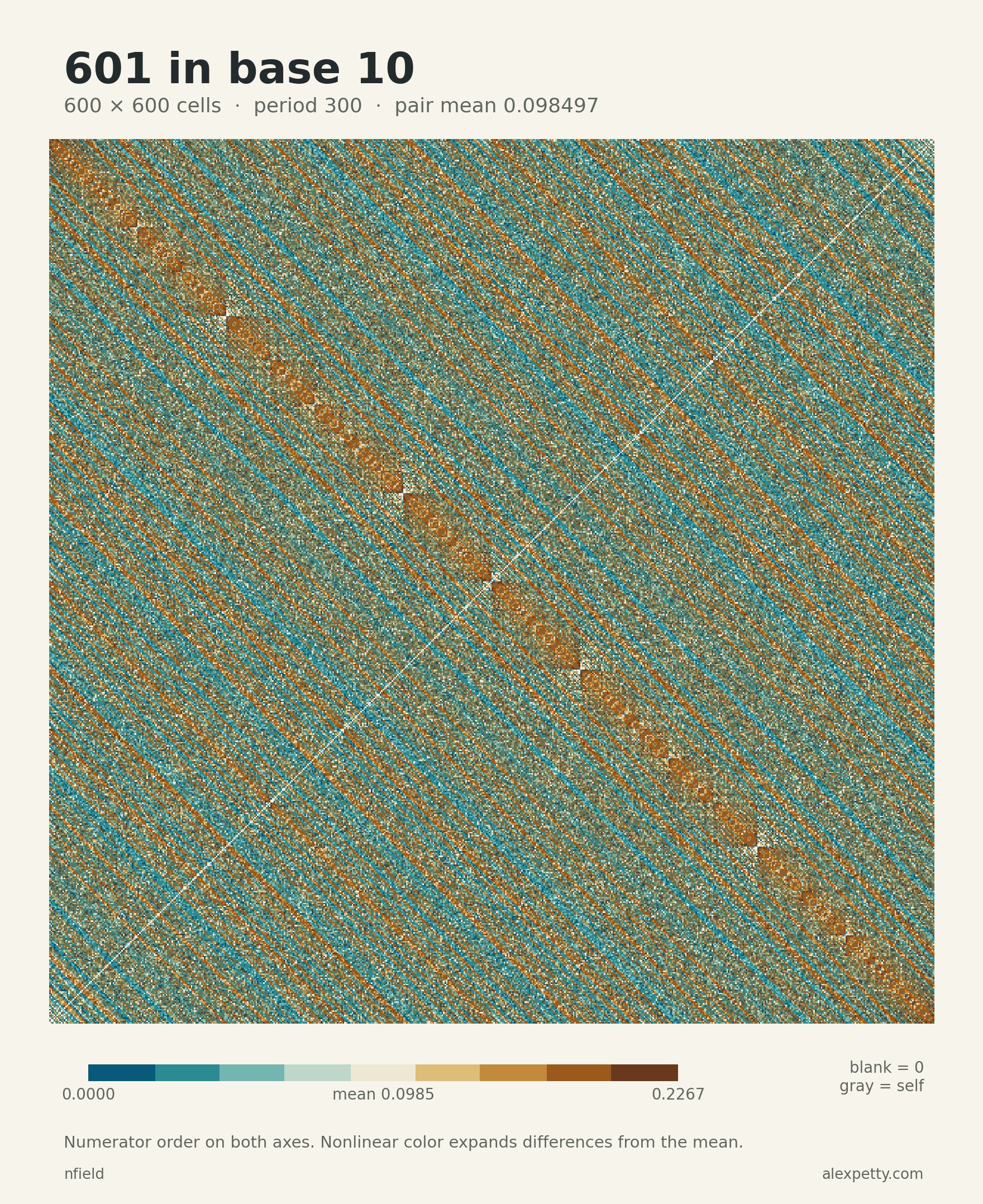
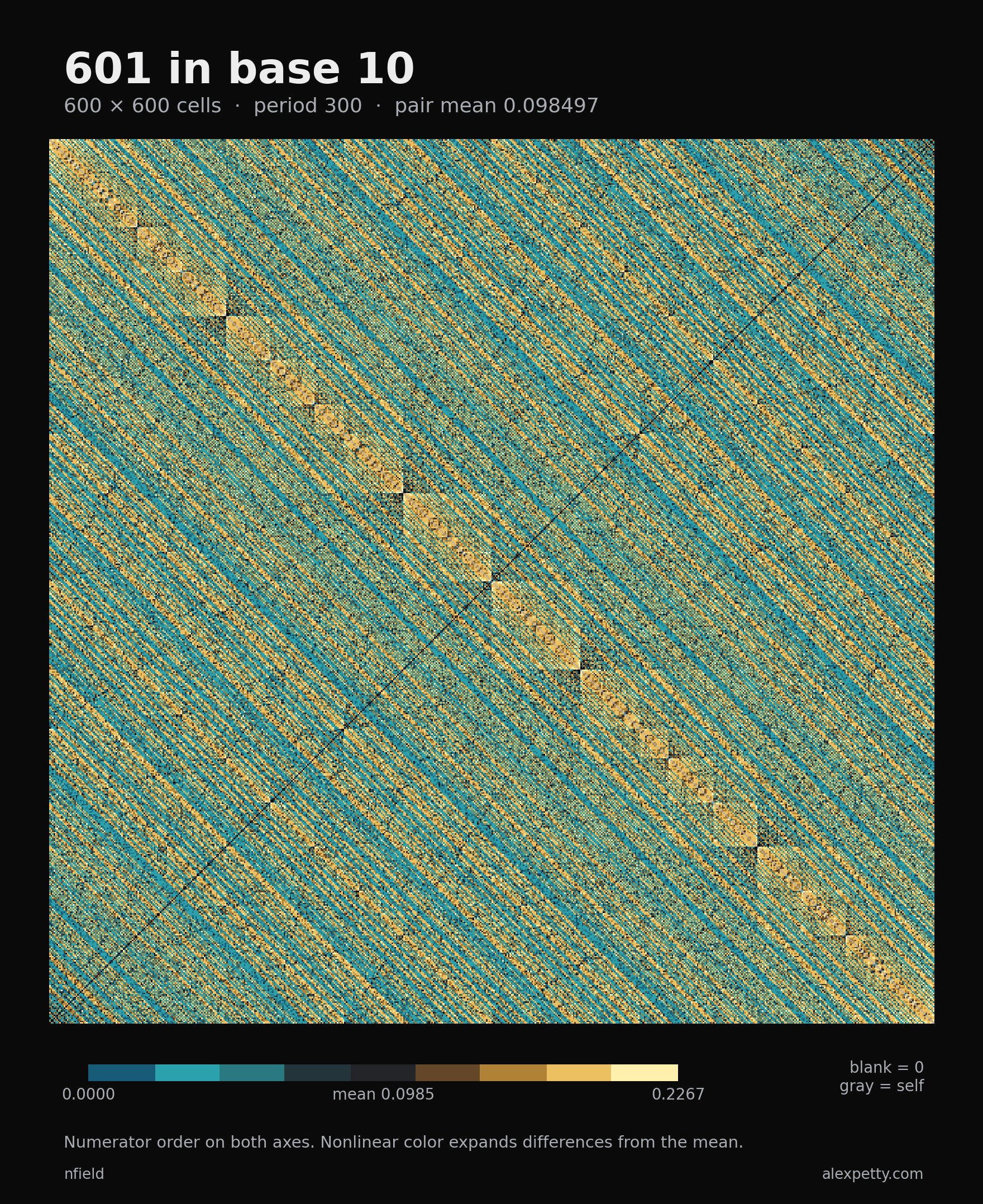
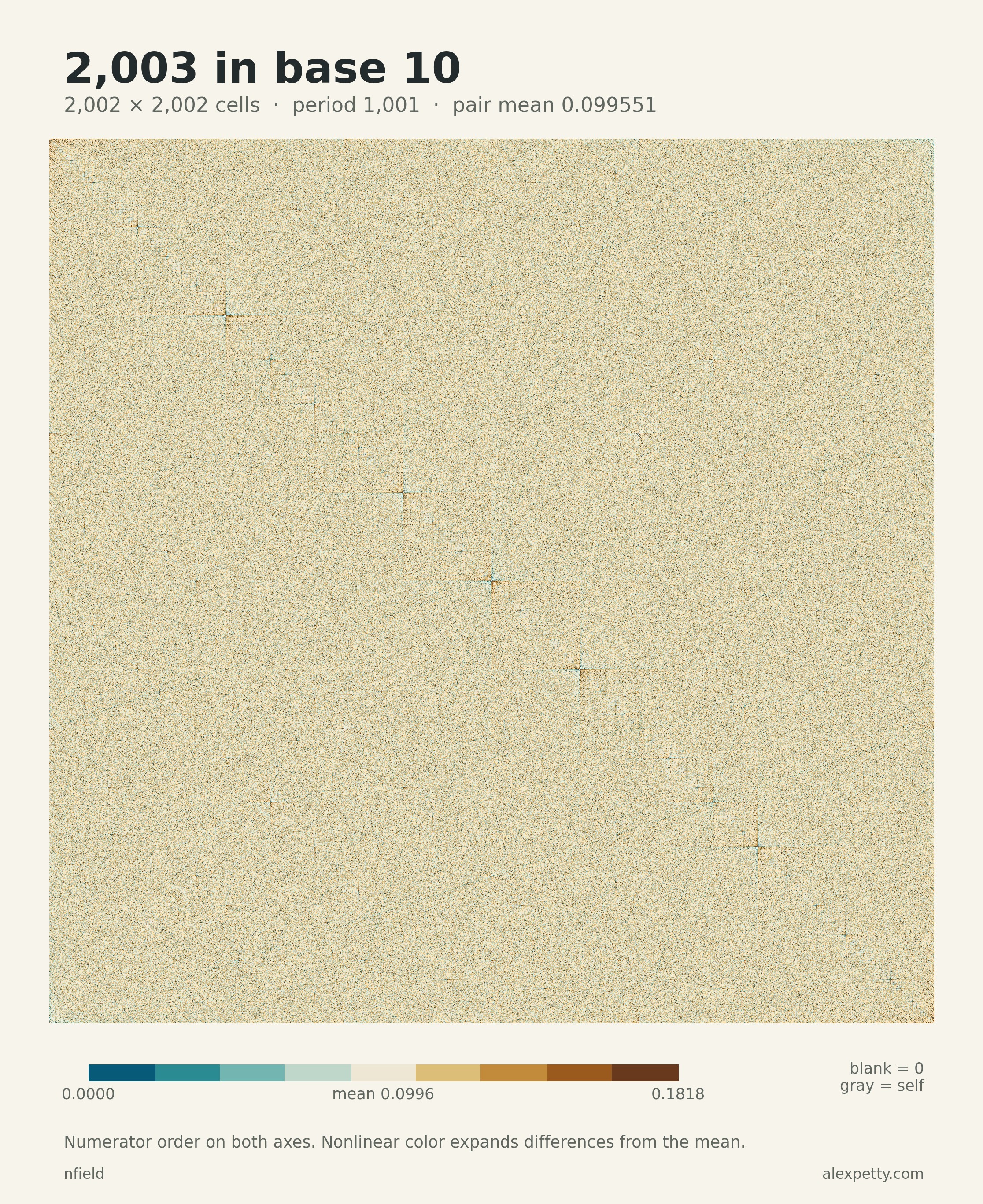
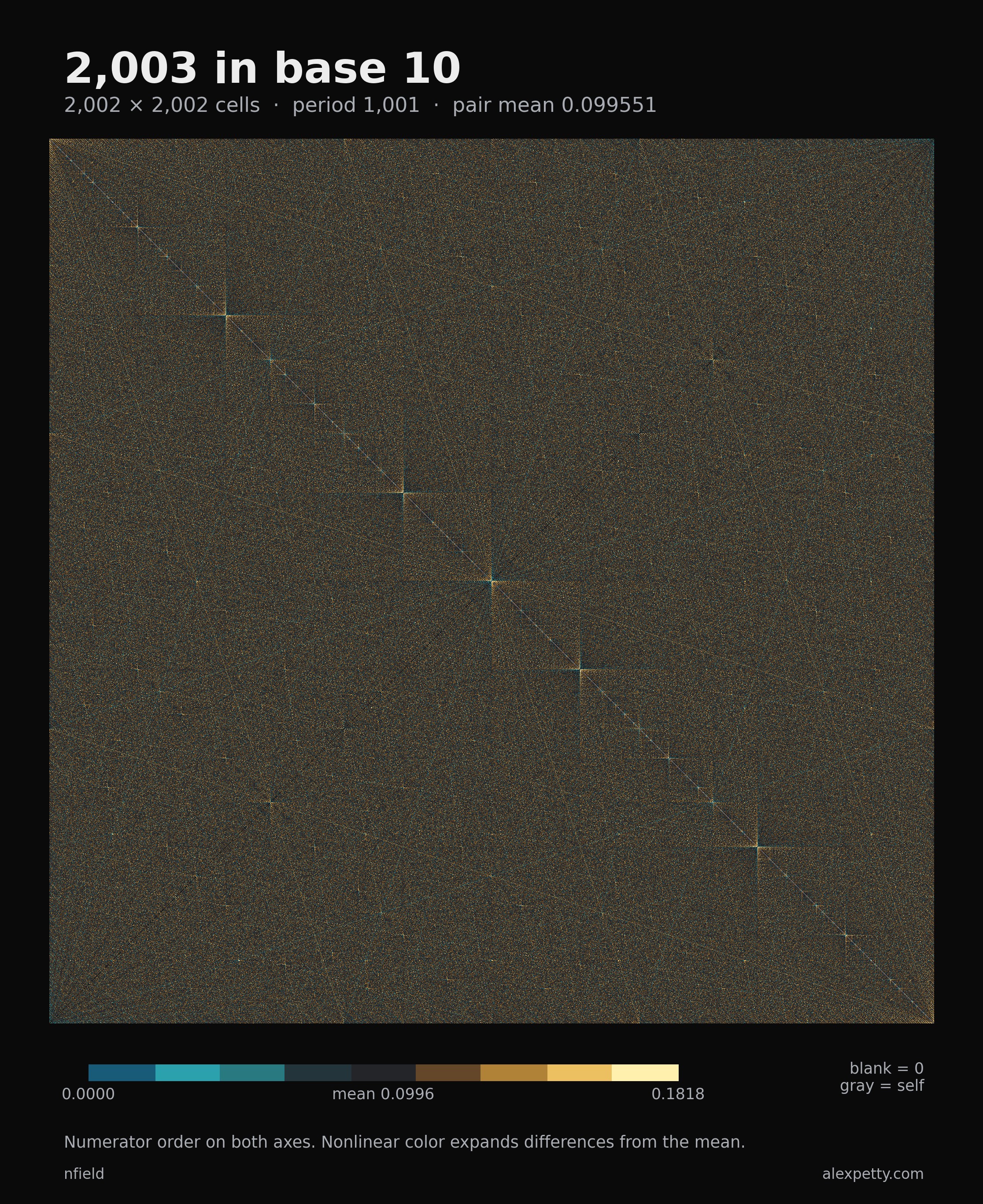
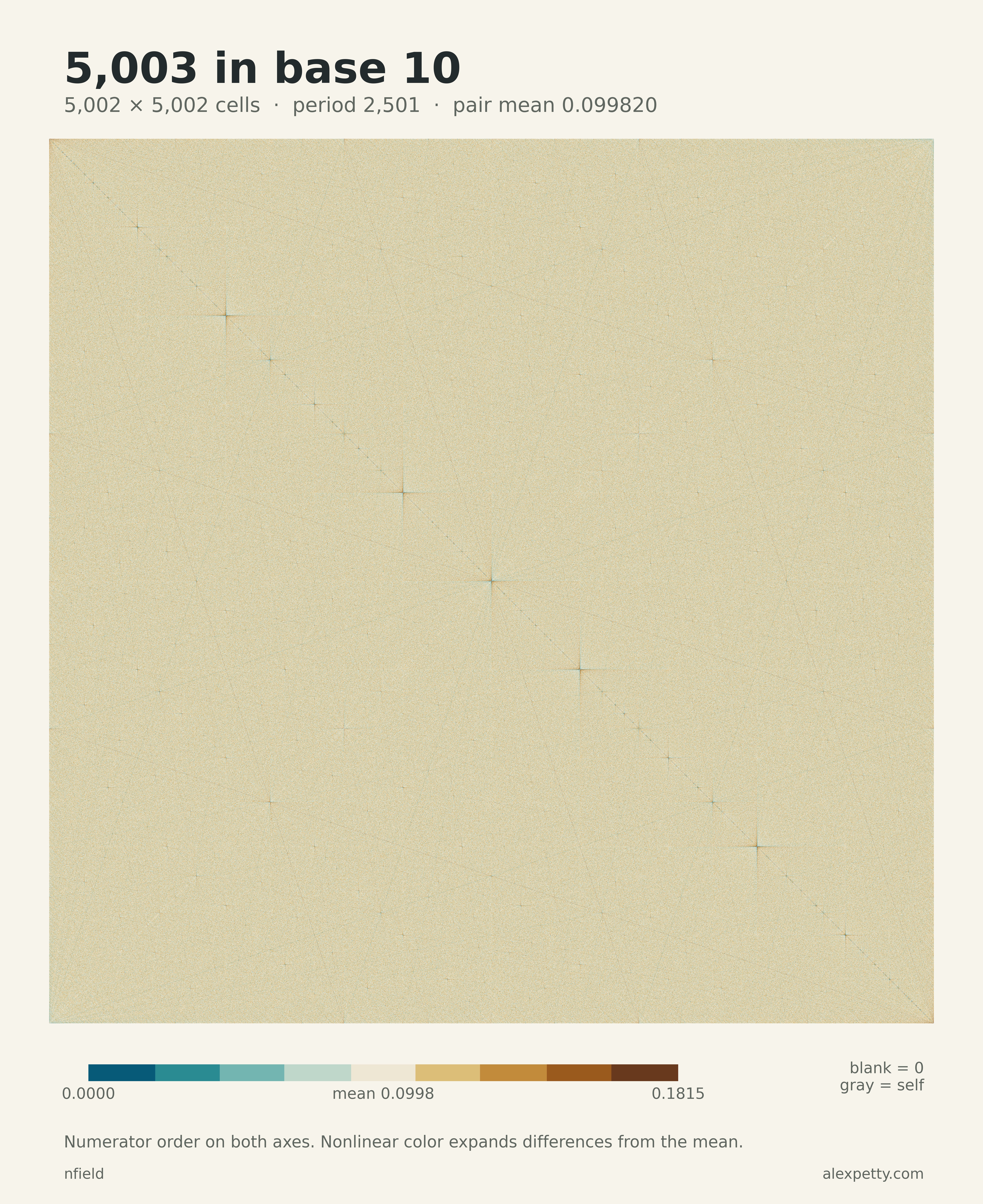
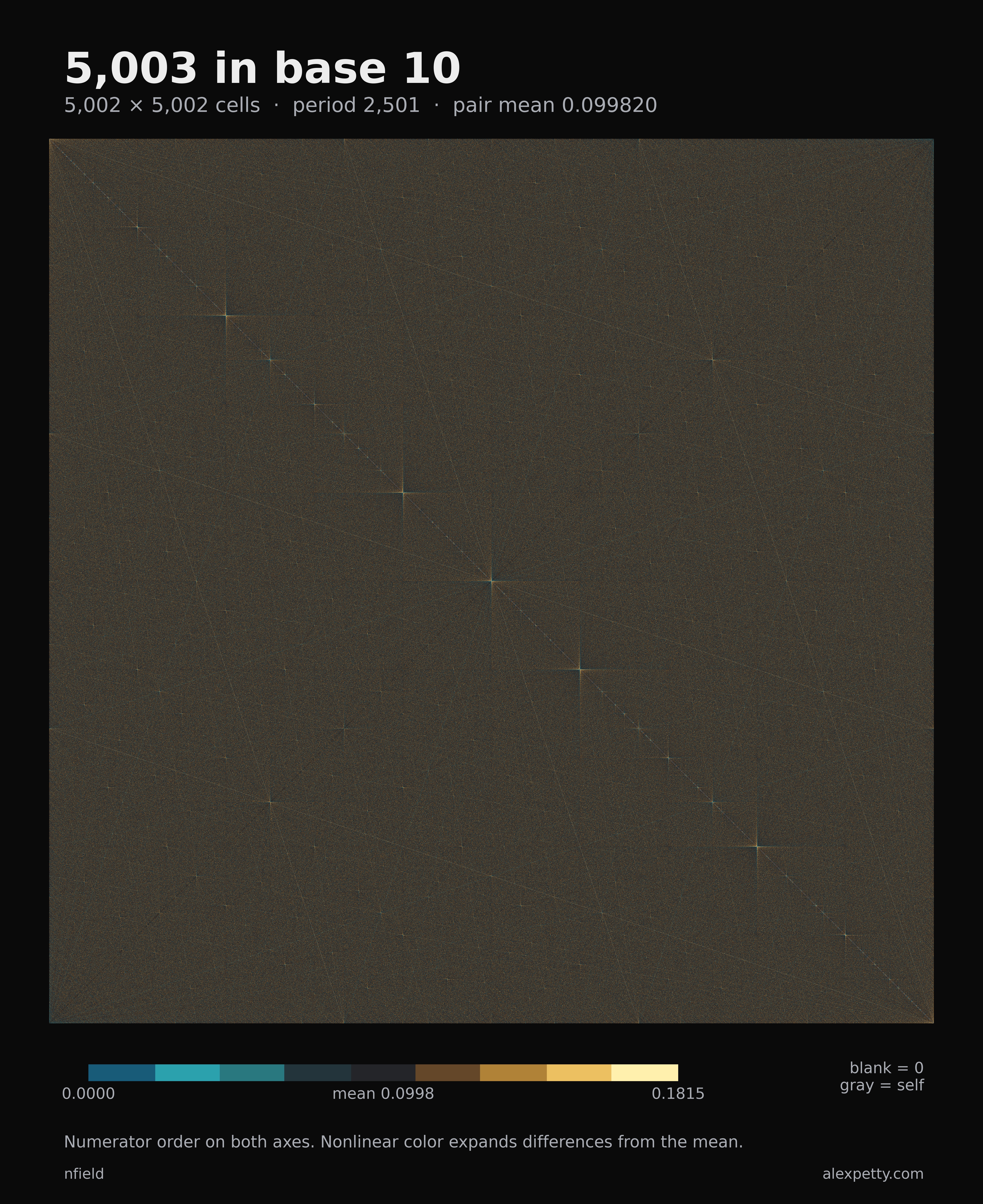
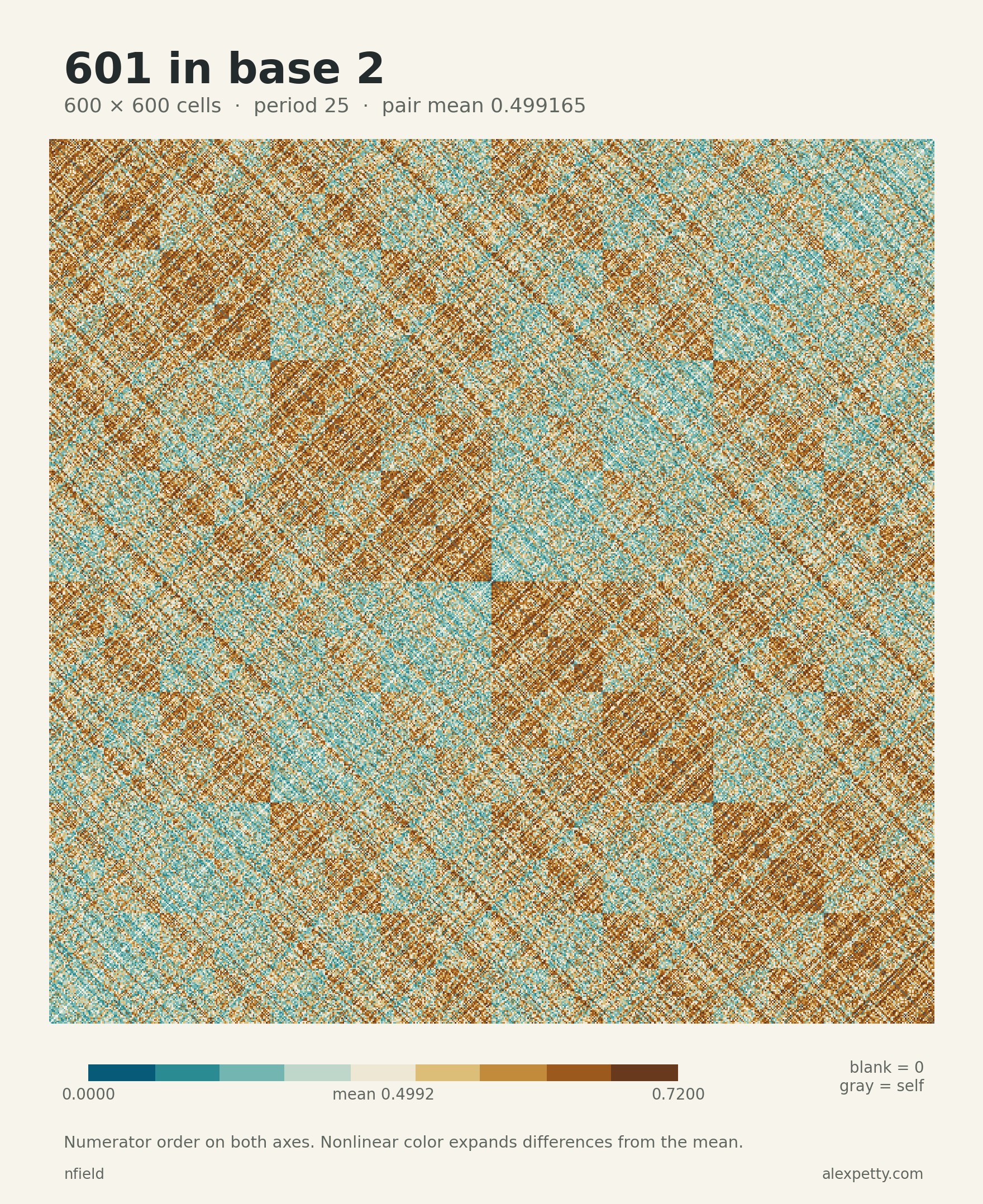
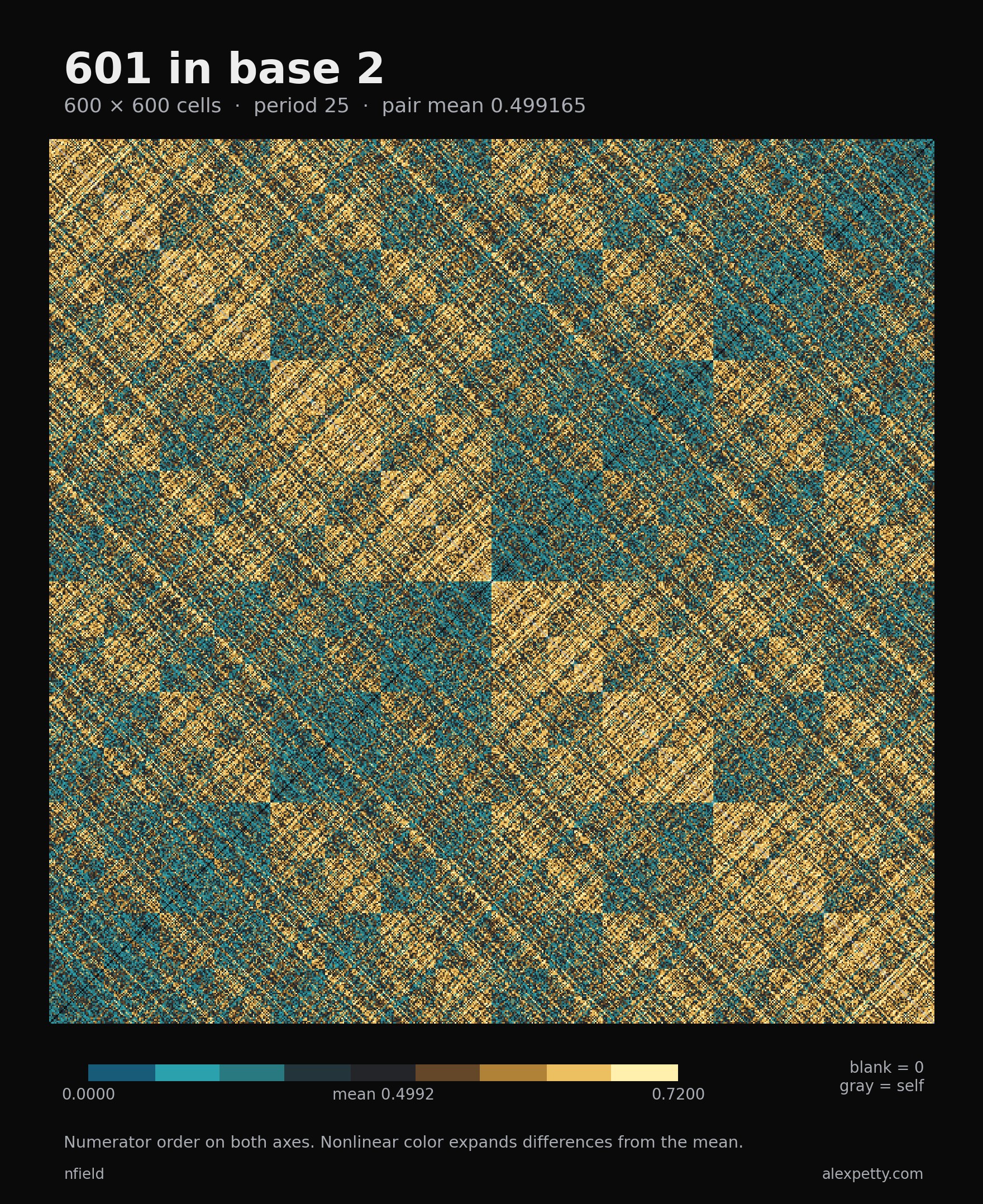
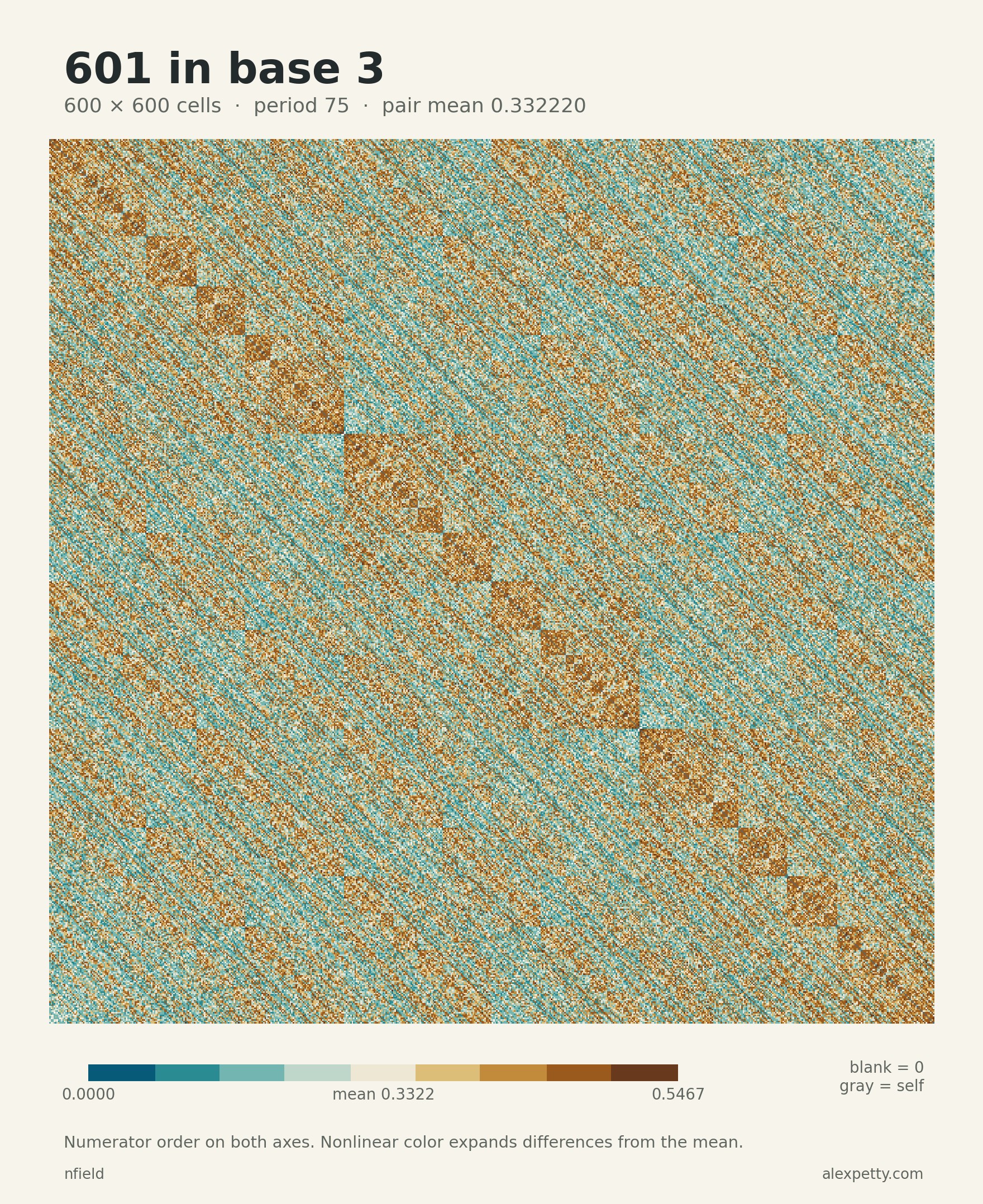
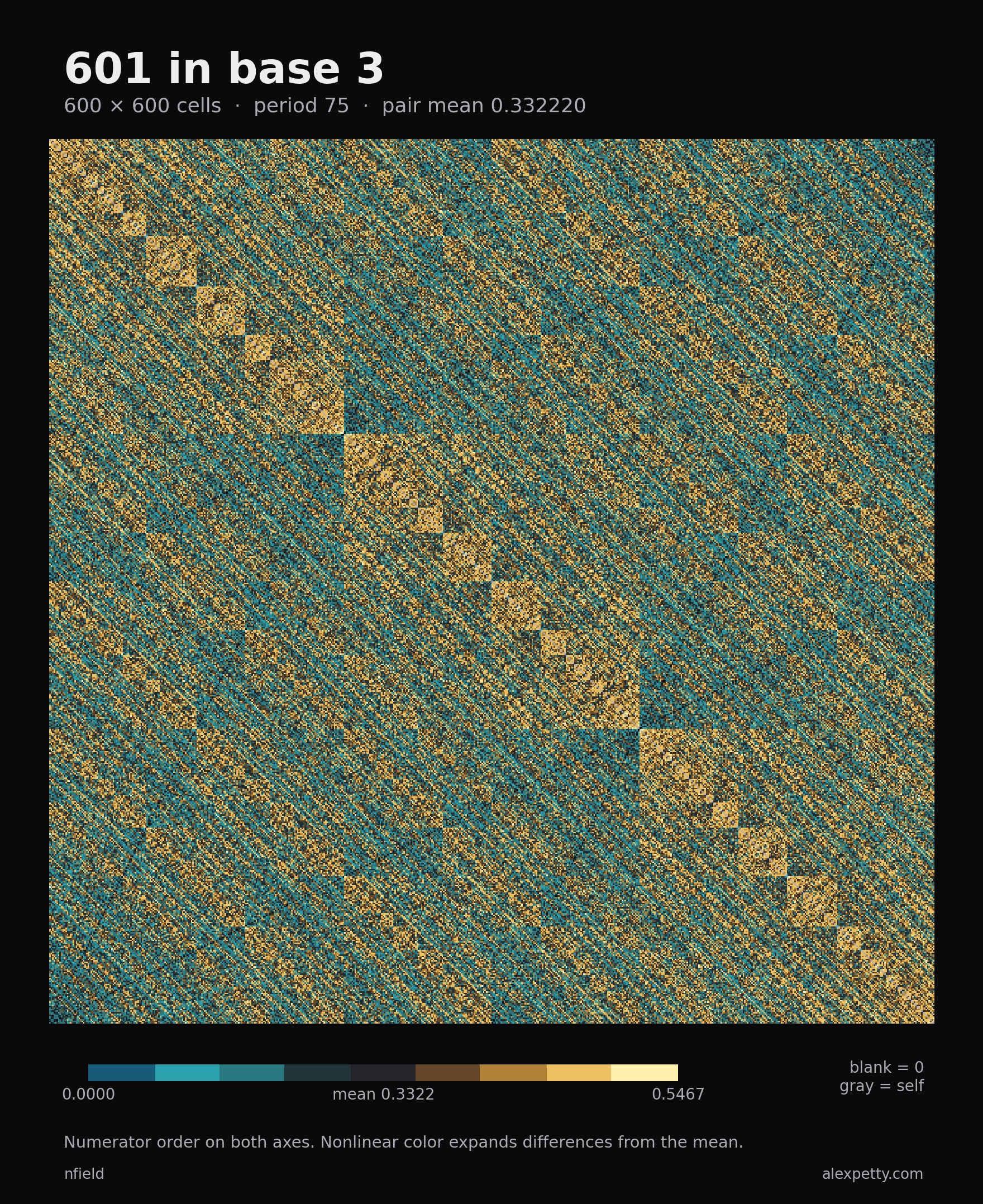
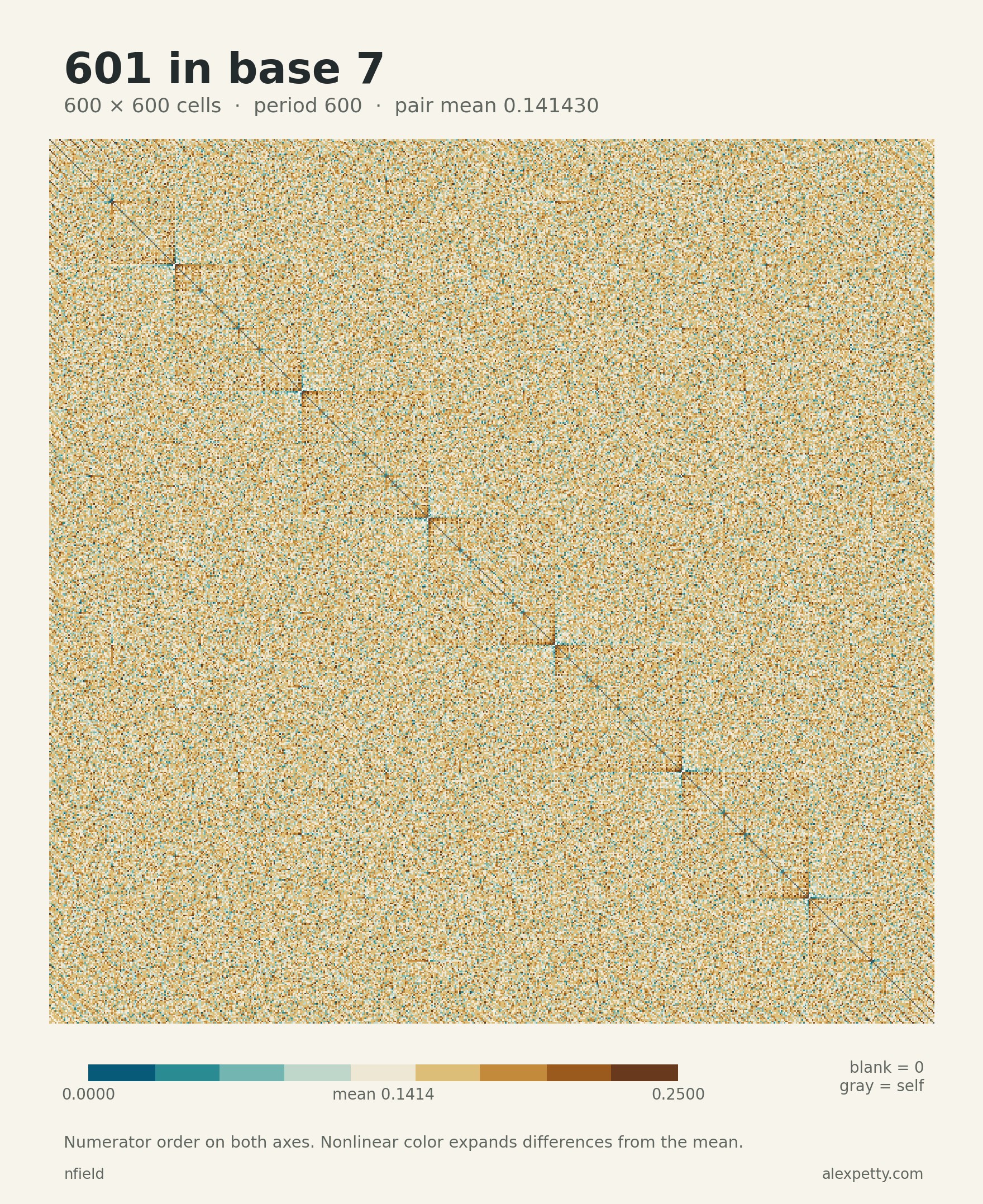
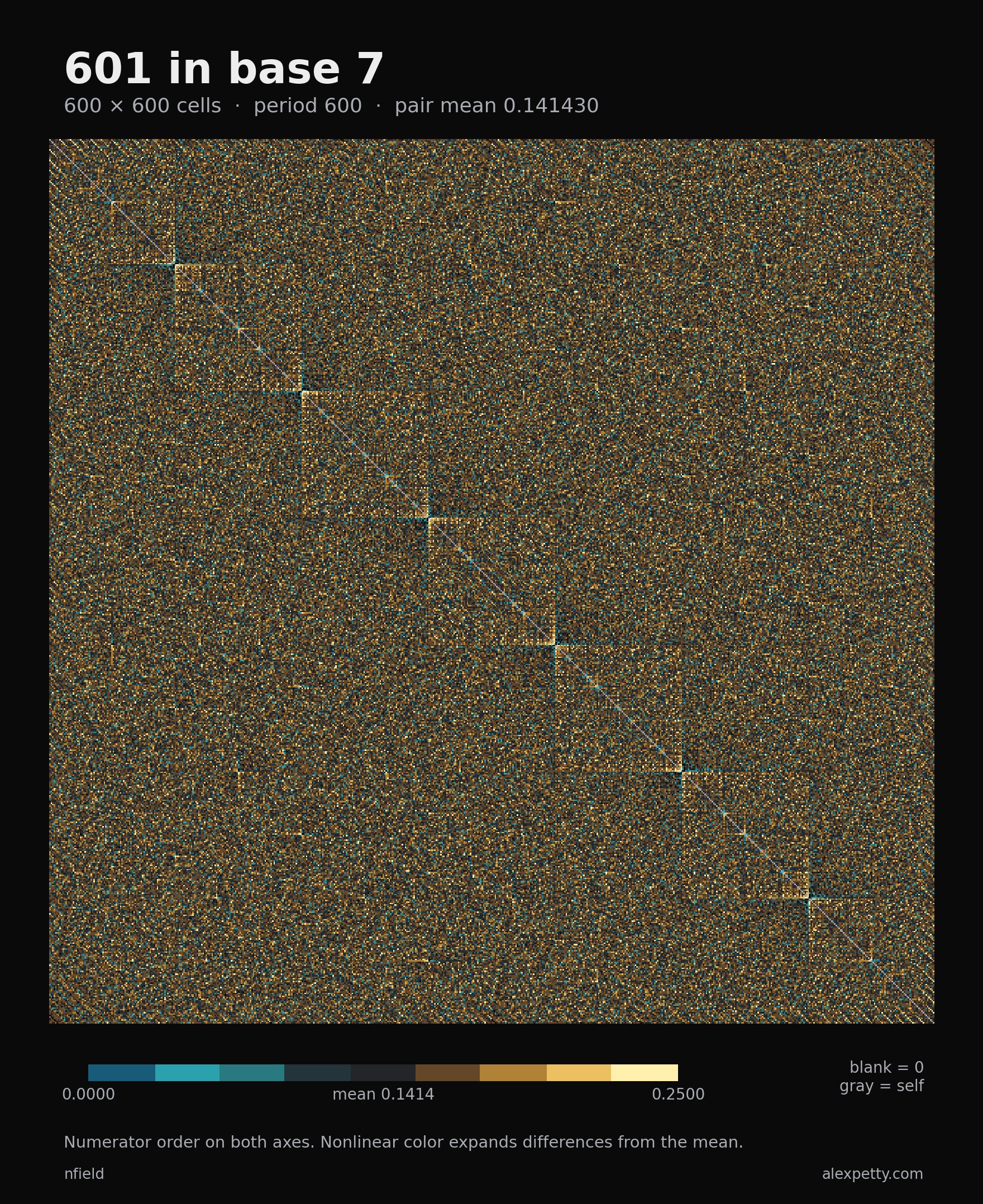
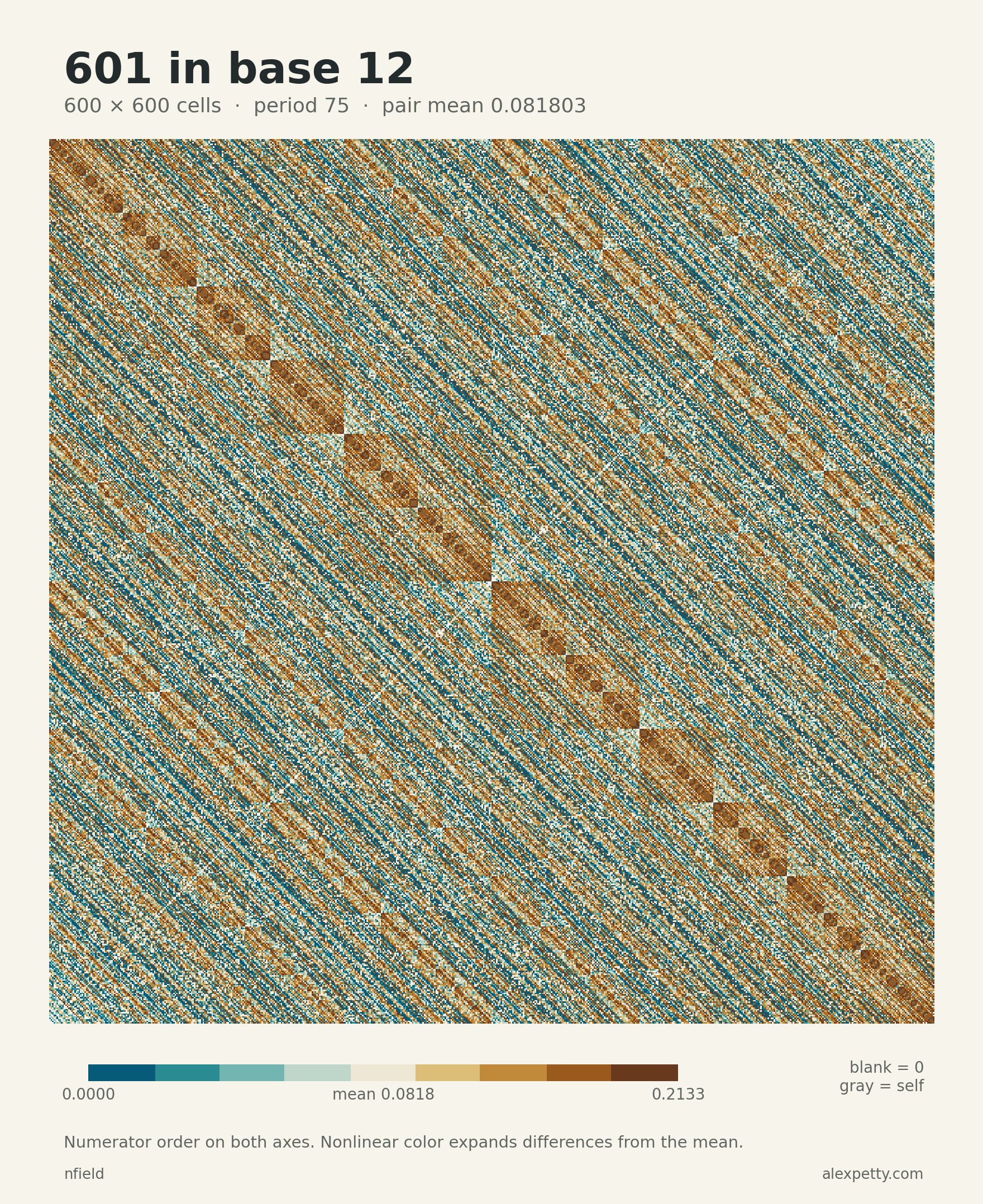
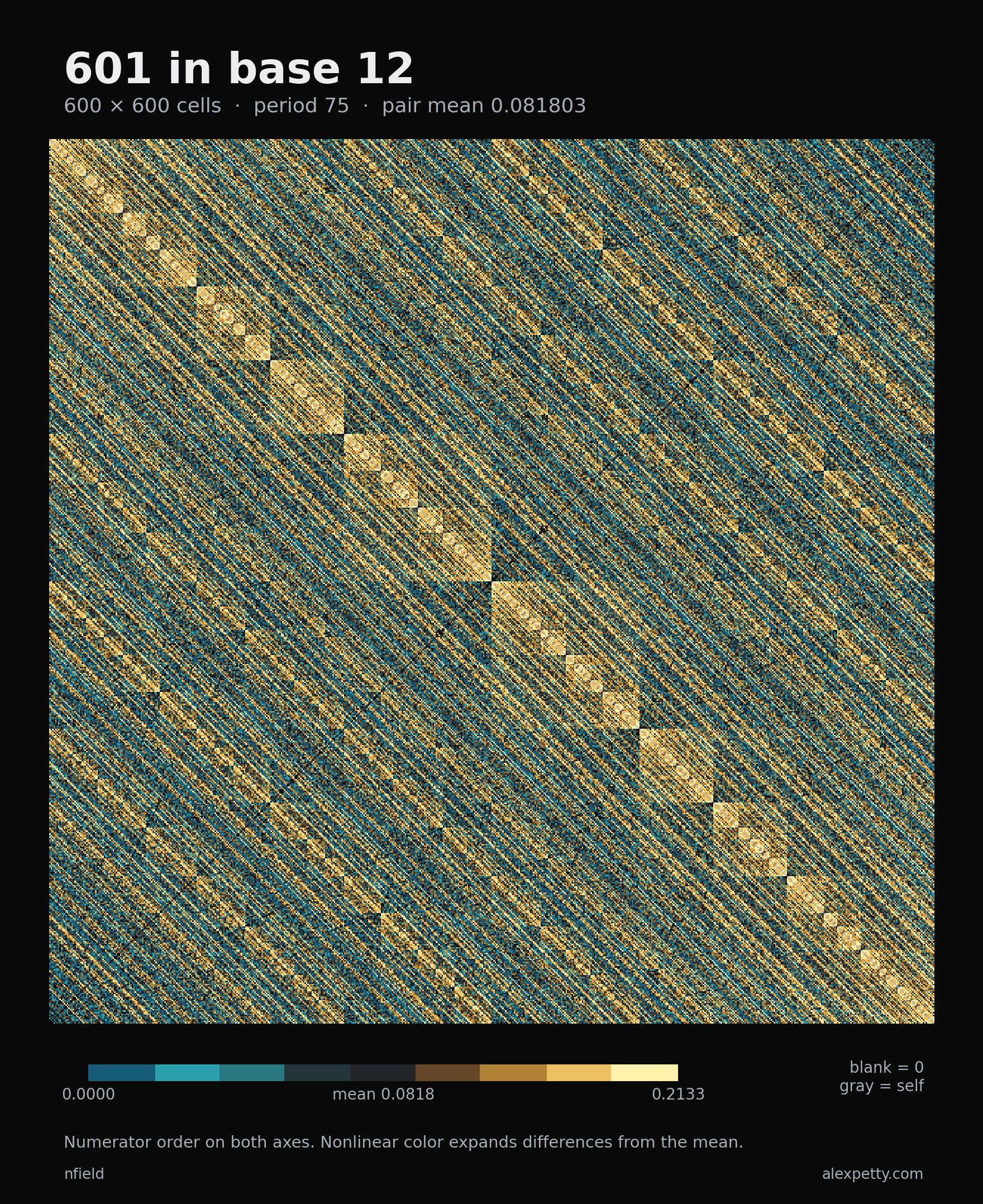
The gallery runs from ten rows to , with twelve decimal denominators along the way. The largest grid contains just over twenty-five million cells. Four further views keep the denominator at and change the base, so we can compare changes in the digit system without changing the number of rows.
The colors in these larger grids do a different job from the yes-or-no highlights above. Nine bands run from lower scores in teal to higher scores in gold, with a neutral band around each panel’s pair average, and a nonlinear scale spreads out the small differences near that average. Zero agreement is blank and the self-match diagonal is gray. Each plate has its own key, so the same color can mean different scores in different plates.
Both axes stay in numerator order. The views on the page are reduced, so open a plate and zoom to see individual cells. Read the pair averages in the captions as you go and they drift toward one over the base, a tenth in decimal and about a half in binary, which is how often two digits picked at random agree. That is an observation from these exact finite tables, not a theorem.
Small grids, from eleven to fifty-three
More rows, from seventy-seven to 401
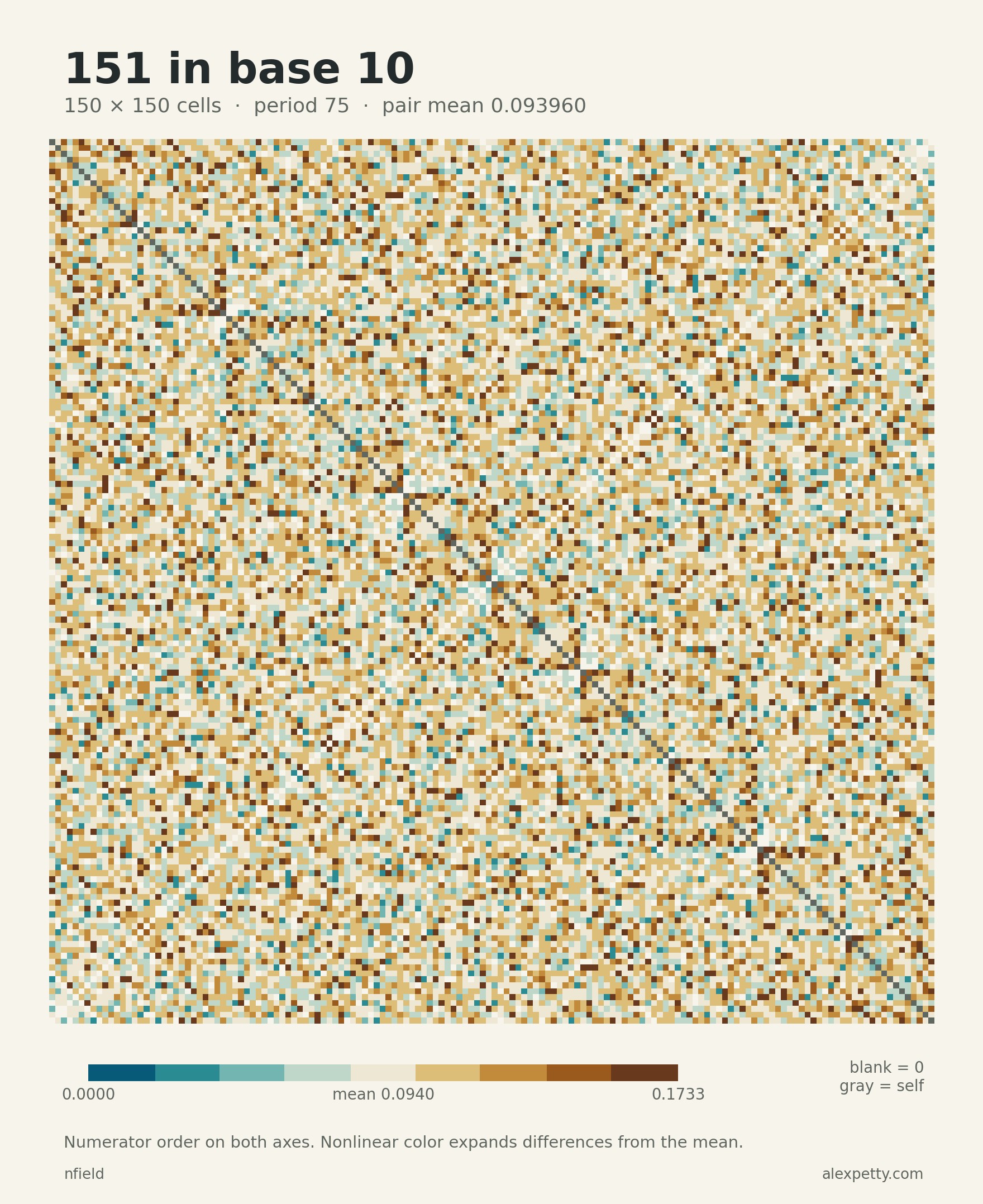
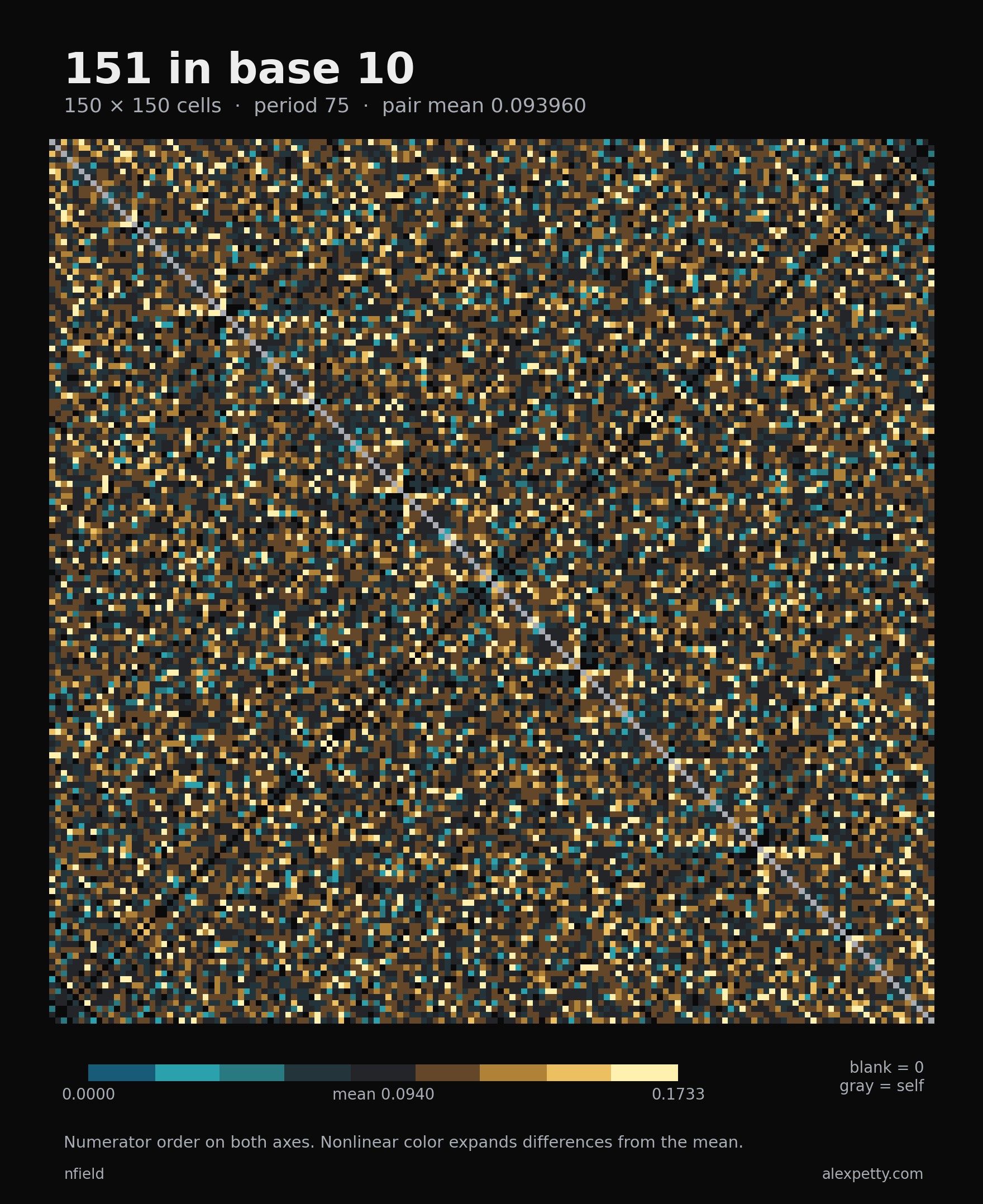
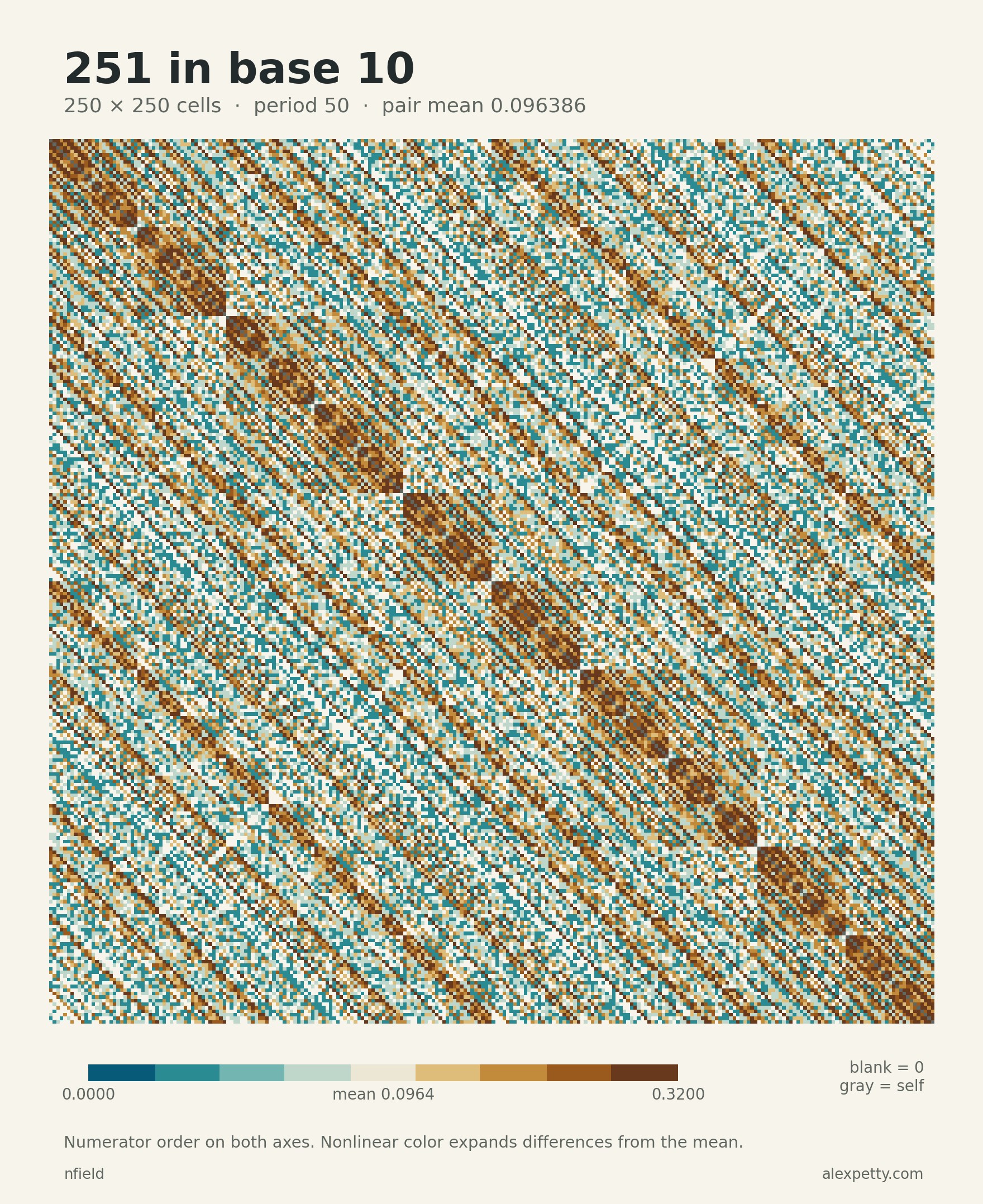
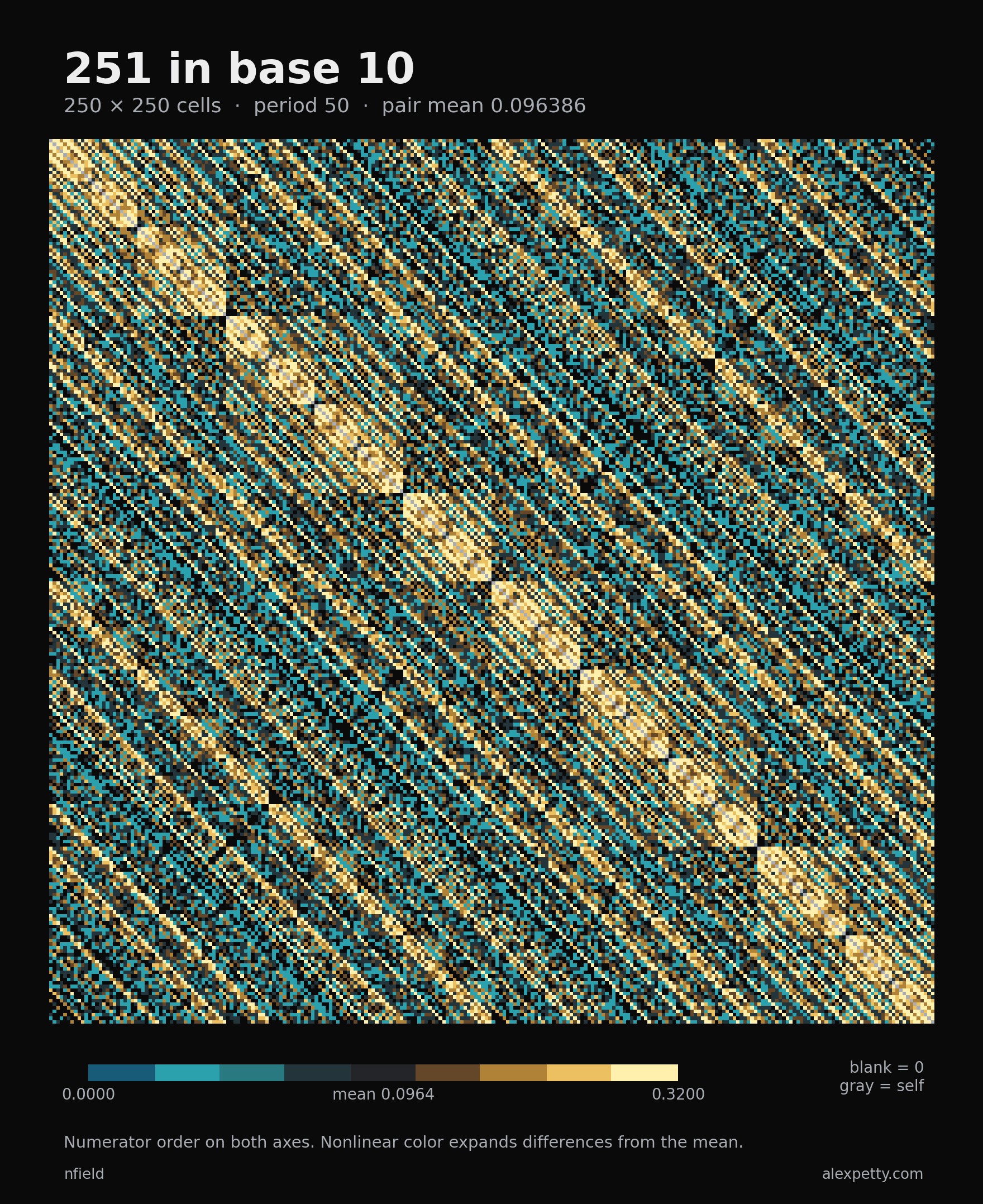
Dense grids, from 601 to 5003
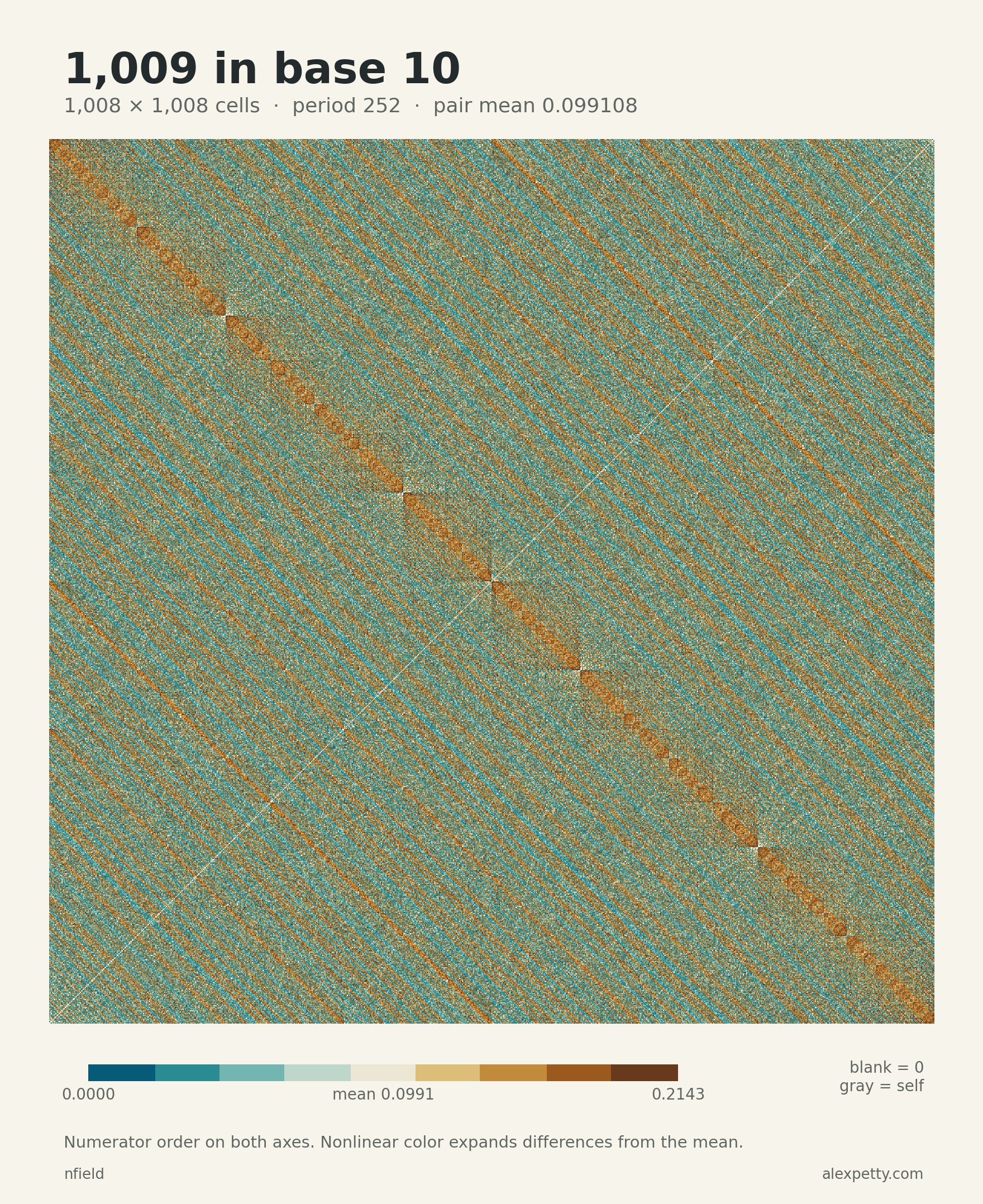
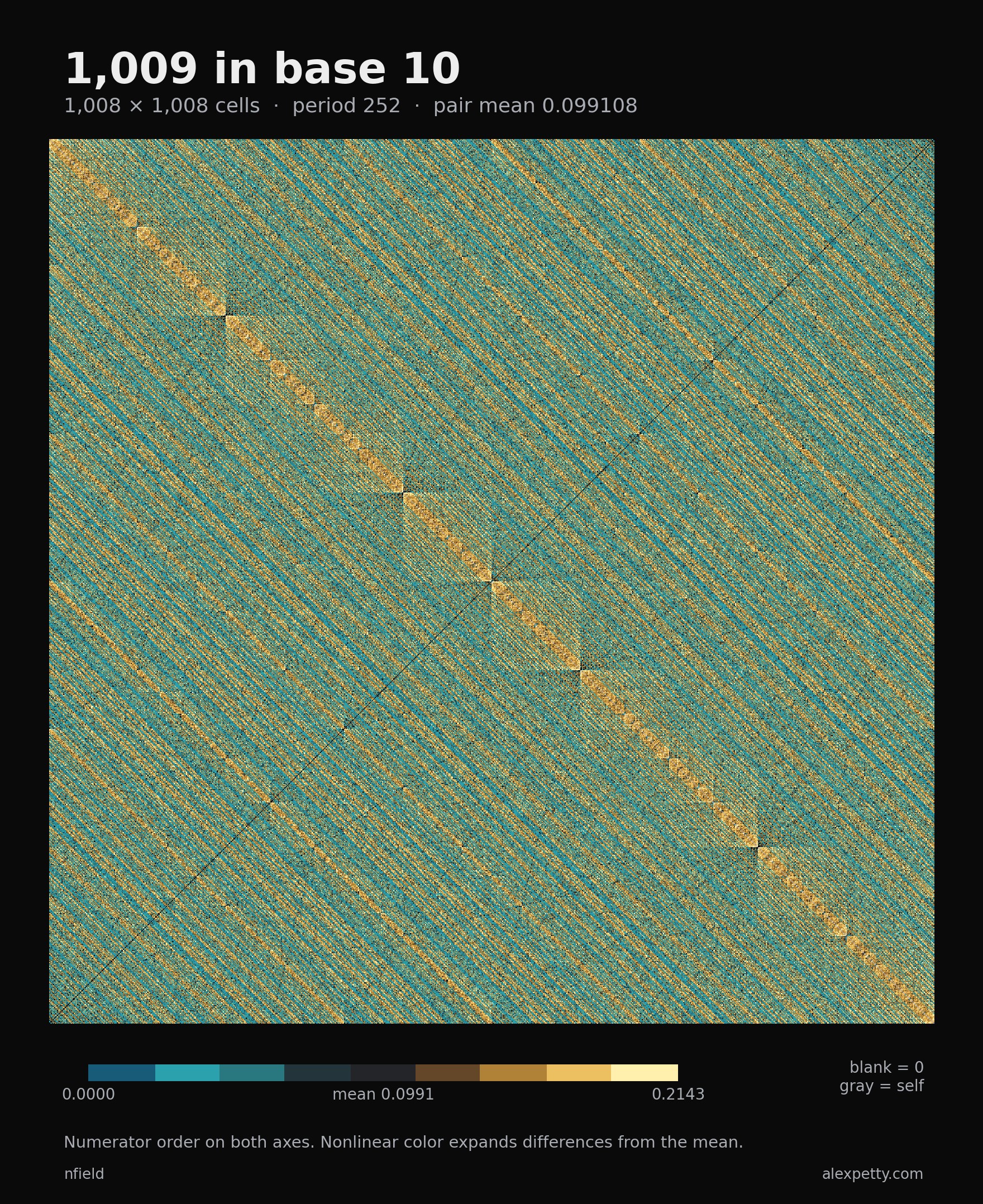
One denominator in four other bases
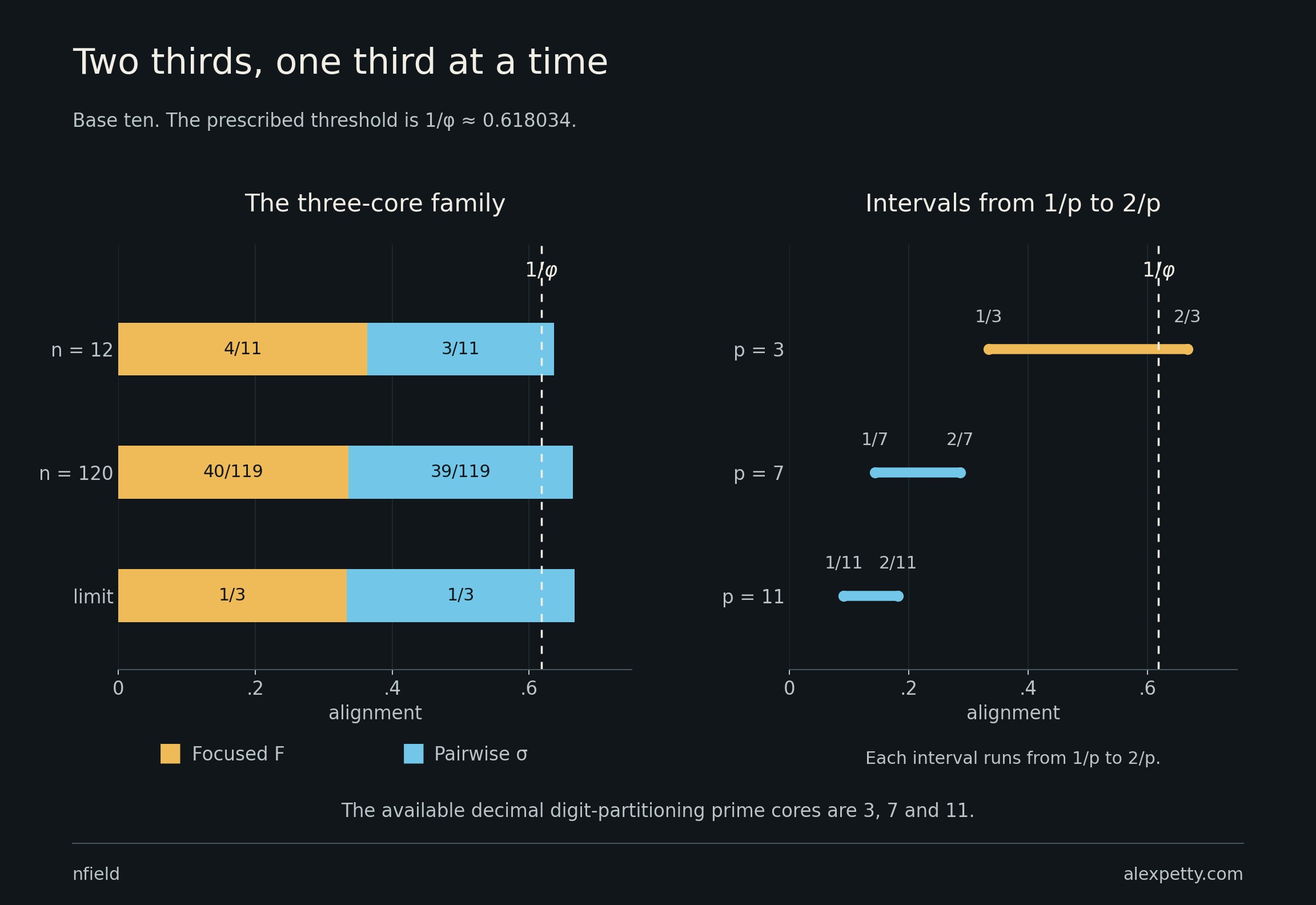
Two thirds, one third at a time
Let the supported factor grow while the digit-partitioning prime stays fixed. The focused part and the pairwise part each approach , and together they approach .
For the three-core family, each approaches one third. The golden threshold, , lies above either component but below their sum of two thirds. Here .
The crossing is already there at twelve. Neither nor reaches the threshold, but their sum, , does. At 120 the pieces are and , nearly equal thirds, and the total is closer to two thirds.
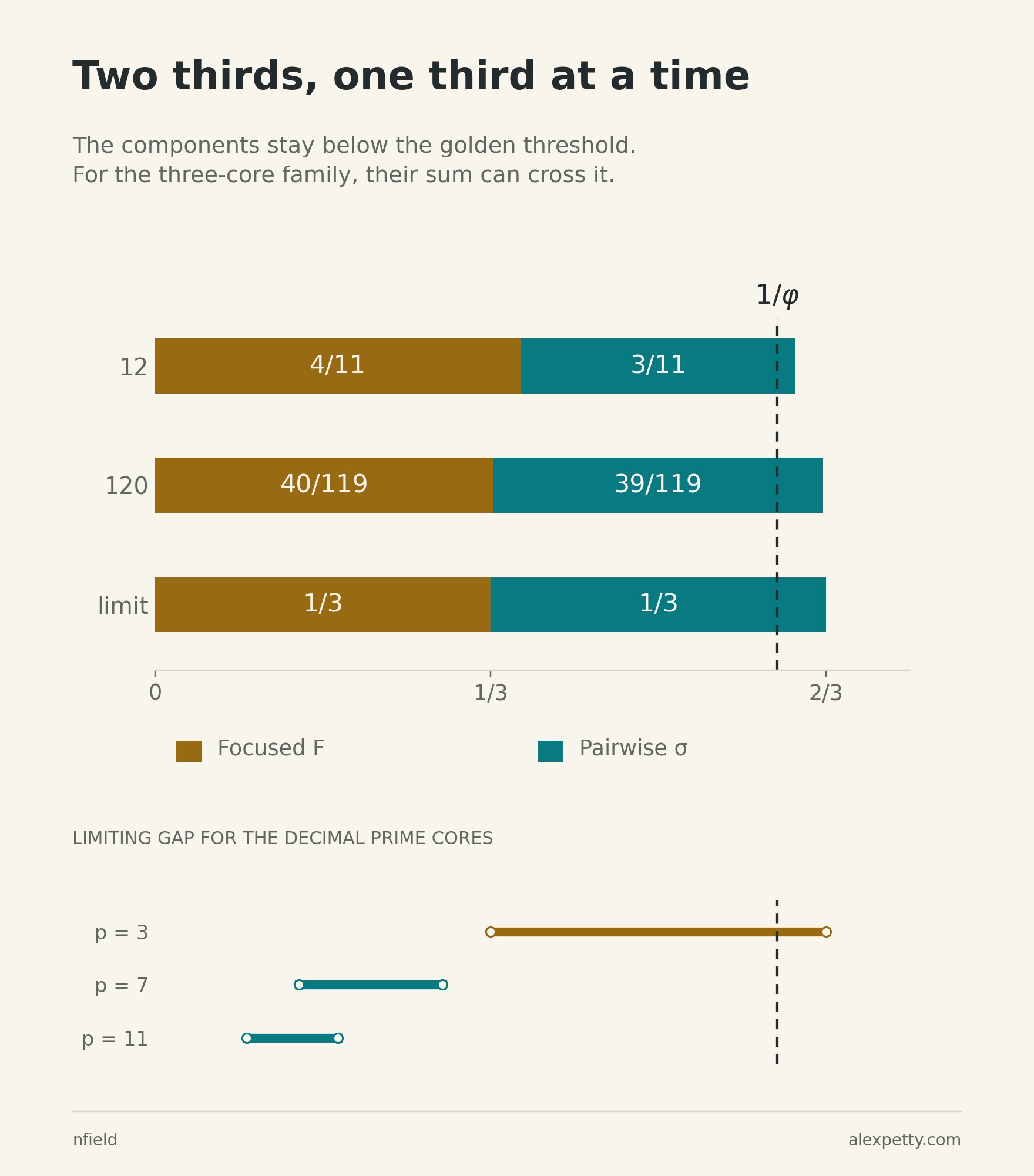
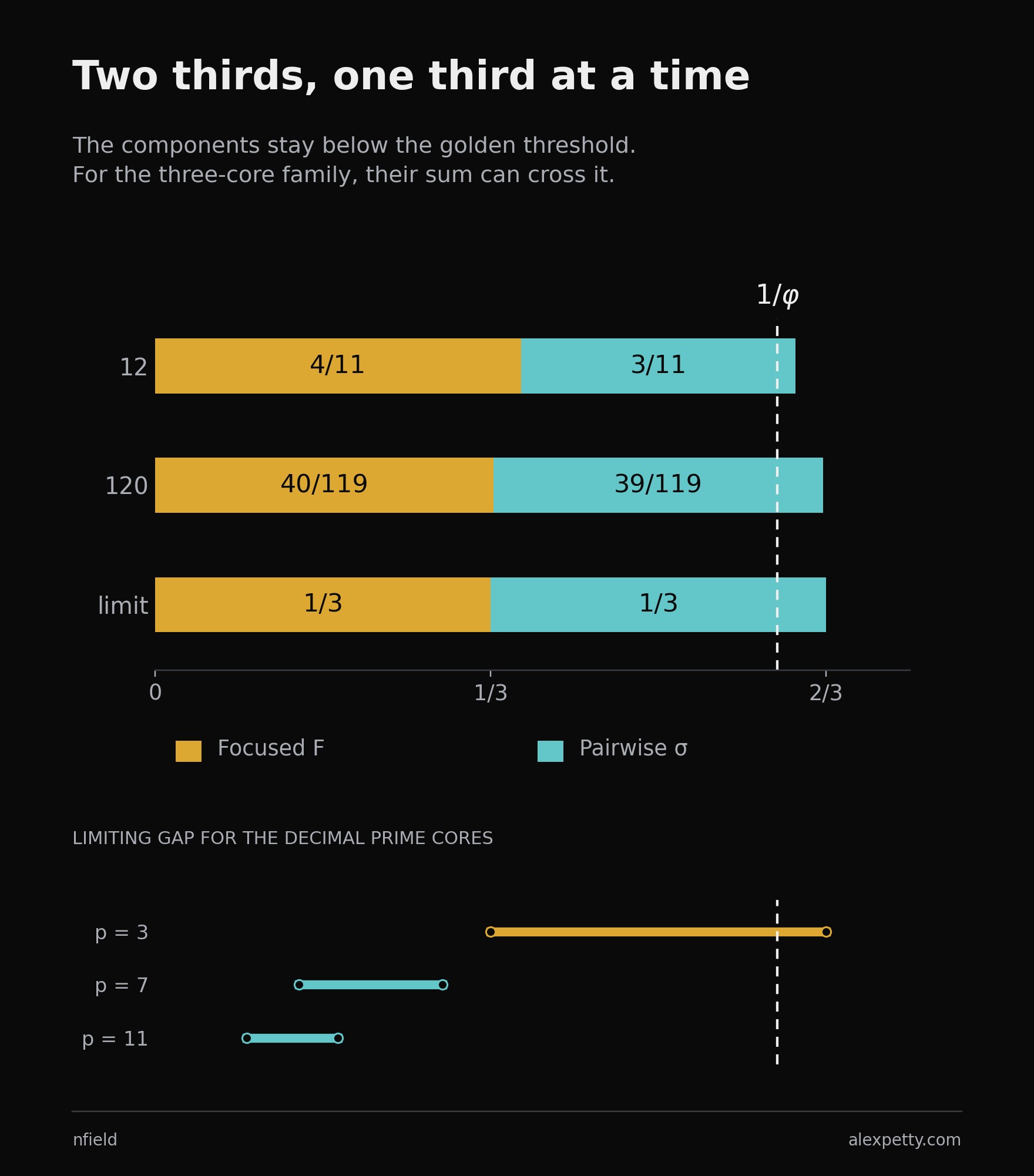
The limiting gap contains the prescribed threshold when
or equivalently . Since , only the primes two and three fit. Two is available in odd bases and gives reference alignment identically one. Among odd primes, three is the only case.
The components stay below the threshold at finite scales too. For an odd prime, , and . At , even their sum is below . No larger odd digit-partitioning prime can make the crossing.
The golden ratio doesn’t own this interval. A threshold of would separate one third from two thirds just as well and shut out every larger odd prime too. What the decomposition supplies is an exact account of the two quantities on either side of whatever line we draw.
Back to seventy-seven
Seventy-seven has neither the equal-digit classes of twelve nor the
empty off-diagonal of seven. Its rows include different periods. The
fraction repeats
09, while
repeats 142857. Comparing six positions accommodates both
periods without changing either row’s starting point.
The prime-core formulas do not apply here. Both seven and eleven remain in the denominator after removing the factors of the base, and distinct remainder classes can share digits. We count those partial matches on the common clock. In this table, of the distinct pairs score and the rest score zero, so
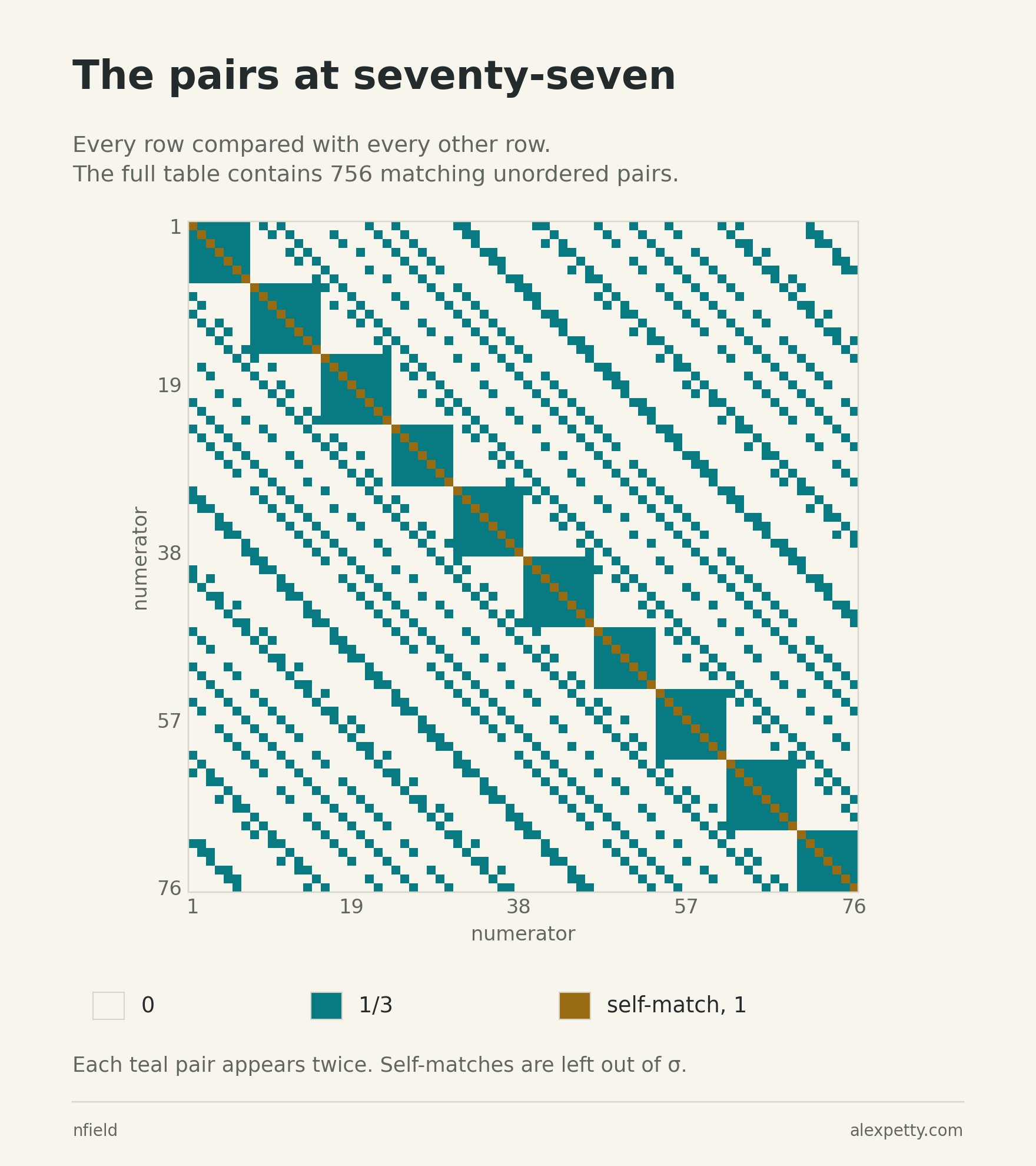
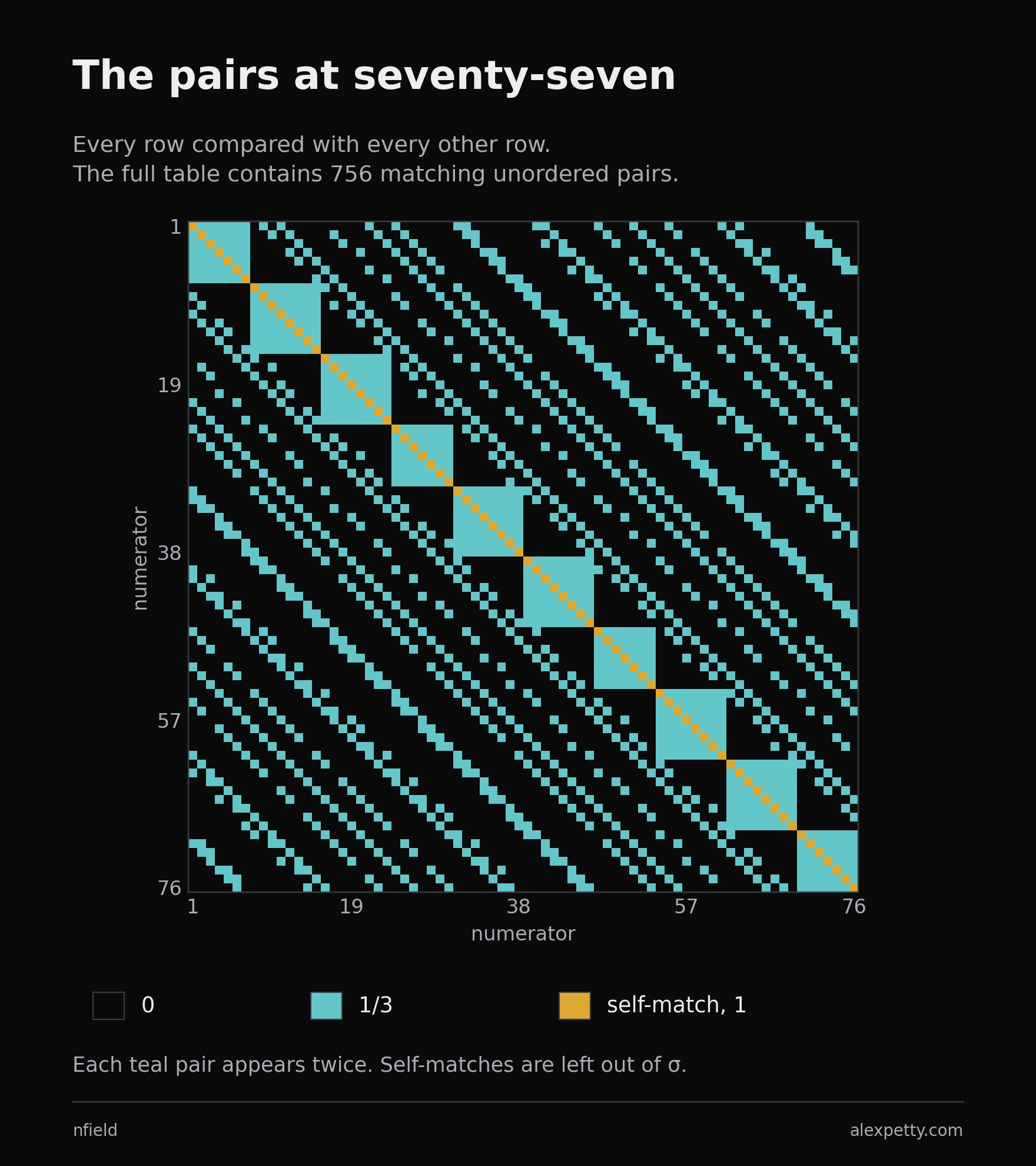
The pair counts in three diagrams
The first diagram follows the three groups at twelve. The second extends the pairwise grids to denominators 31, 53, and 151, where one average conceals increasingly detailed arrangements of matches. The third places the finite three-core scores beside the limiting intervals for the decimal digit-partitioning primes.
Hamming agreement and related work
Counting equal symbols has an established history. Lempel and Greenberger study Hamming correlation in finite sequence families. Kak and Chatterjee study distances and correlations in reciprocal digit sequences, including shifts of maximum-length sequences. Armstrong and Armstrong describe repetend multiplication and its group structure.
My construction compares the average over every distinct pair in a denominator’s table with the score of one marked reference. For digit-partitioning prime cores, the pair count gives the exact decomposition above without a single-cycle assumption. For a prime denominator, a zero pair average characterizes digit partitioning itself. Those are the results proved in The Coherence Decomposition.
By their reference scores, seven and seventy-seven sit in the same low tier. Erase the self-matches at seven and nothing is left. Do the same at seventy-seven and there are still pairs to account for.
Discussion
Sign in to join the discussion.