refinement
Unity, Refinement, and Signed Capture
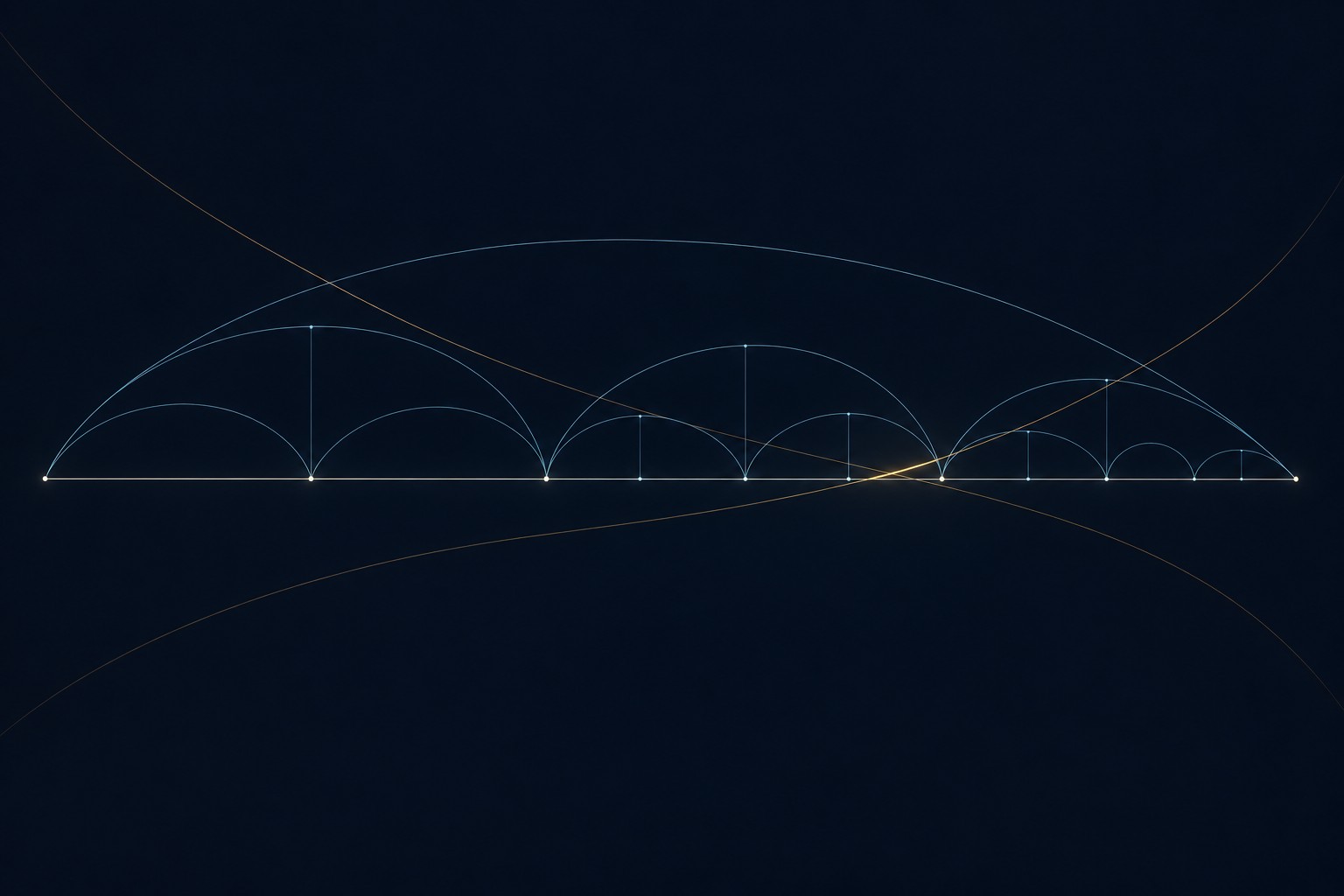
A sawtooth never holds still. The period-two clock reads one half at every odd number and zero at every even one, back and forth forever. The period-three clock climbs a third, two thirds, then drops to zero and starts over. Neither looks anything like a flat line. Double the first one, though, and it reads exactly one at every odd number. A single clock already matches the flat line on half the integers. Each new period adds another sawtooth to work with, and the best combination creeps closer to the flat line.
How close it can get depends on how the integers are weighed, and the collision program supplies the weighing. The primitive kernel in The Weight of a Carry puts mass on each coprime pair, and keeping only the pairs whose first entry is one gives the integer the weight . With those weights the question is an old one. In 1950 Bertil Nyman, a student of Arne Beurling, recast the Riemann Hypothesis as a question about sums of sawtooth functions. In the form Bhaskar Bagchi wrote down in 2006, building on Luis Báez-Duarte’s discrete version, the clocks are these clocks and the weights are these weights. The best possible error tends to zero exactly when the Riemann Hypothesis is true. I got here by a different road. The collision program reaches these weights by its own logic, from the kernel in The Weight of a Carry, and its clocks are the remainder clocks it had been reading all along. Finding Nyman’s problem underfoot was encouraging, a sign the road was sound. Others had stood here long before me, and the question they left is still open. The collision program comes to it with readings of its own, an exact account of what each one gains, and a proof of where one classical line of estimates runs out of room.
This article asks a more particular question. More clocks can only help, since the old best fit is still available, but a new reading of the leftover can see something real and still buy almost nothing. It may see what another reading already sees, or what the fit already made has paid for. At cutoff 25 one reading comes to before the old fit is counted and after. I call a reading’s actual contribution, sign and overlaps included, its signed capture. The paper builds readings whose combined cost stays at most two across any number of refinement levels, and it computes the exact improvement they make. It also proves that enough of that improvement, piled up step after step, would drive the error to zero. Whether it piles up is the open part.
Half the integers in one clock
Give the integer the share
Address one gets a half, address two a sixth, address three a twelfth. On the unit interval, address owns the stretch between and , so the shares tile the interval exactly. Everything from address onward owns together.
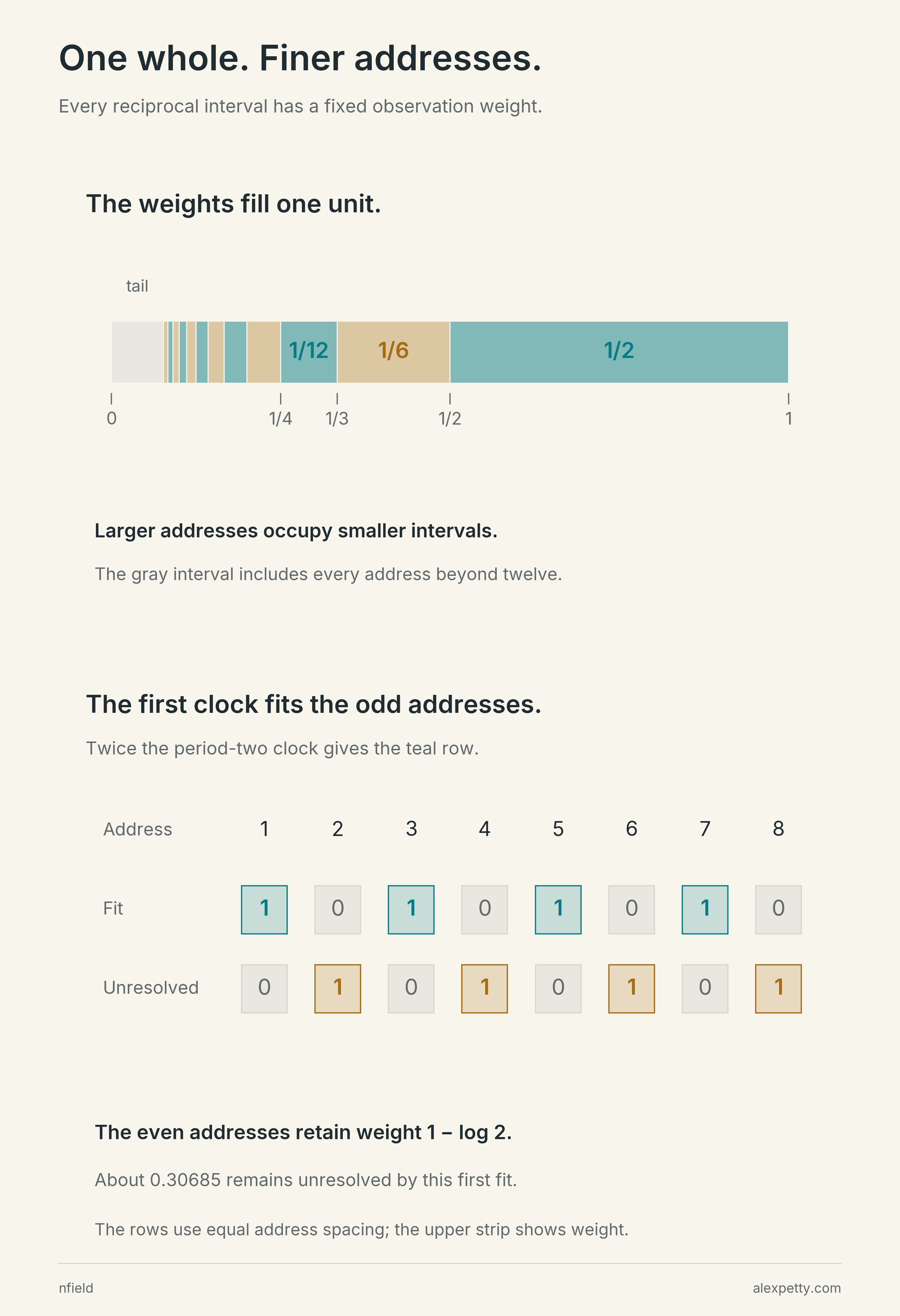
In the upper bar of the figure, address one takes the whole right half. The later addresses crowd toward zero until everything past twelve fits in the gray sliver at the left. Underneath, twice the period-two clock fits the odd addresses perfectly and misses the even ones completely. The odd addresses own , which is . The even ones own the rest, , about . That is the error after one clock, , and no multiple of the period-two clock does better.
Unity plays two parts here at once. It is the total of the weights, and it is the target, written as one at every address. Admitting more clocks changes neither. The weights stay put, the early clocks stay available, and the fit is all that moves.
The parent stays in the child
A clock of period reads , the fractional part of . Admit the periods two through and let be the weighted combination that comes closest to one. What it misses is the residual , and its squared size is the error . Best means best, so no adjustment built from the admitted clocks can improve it. A useful correction has to bring in a direction those clocks don’t contain.
Refinement has a natural way to carry the past forward. Send the value at address to both and , and put zero at address one. The weights cooperate,
so a copied pattern keeps its values and carries half its old squared size.
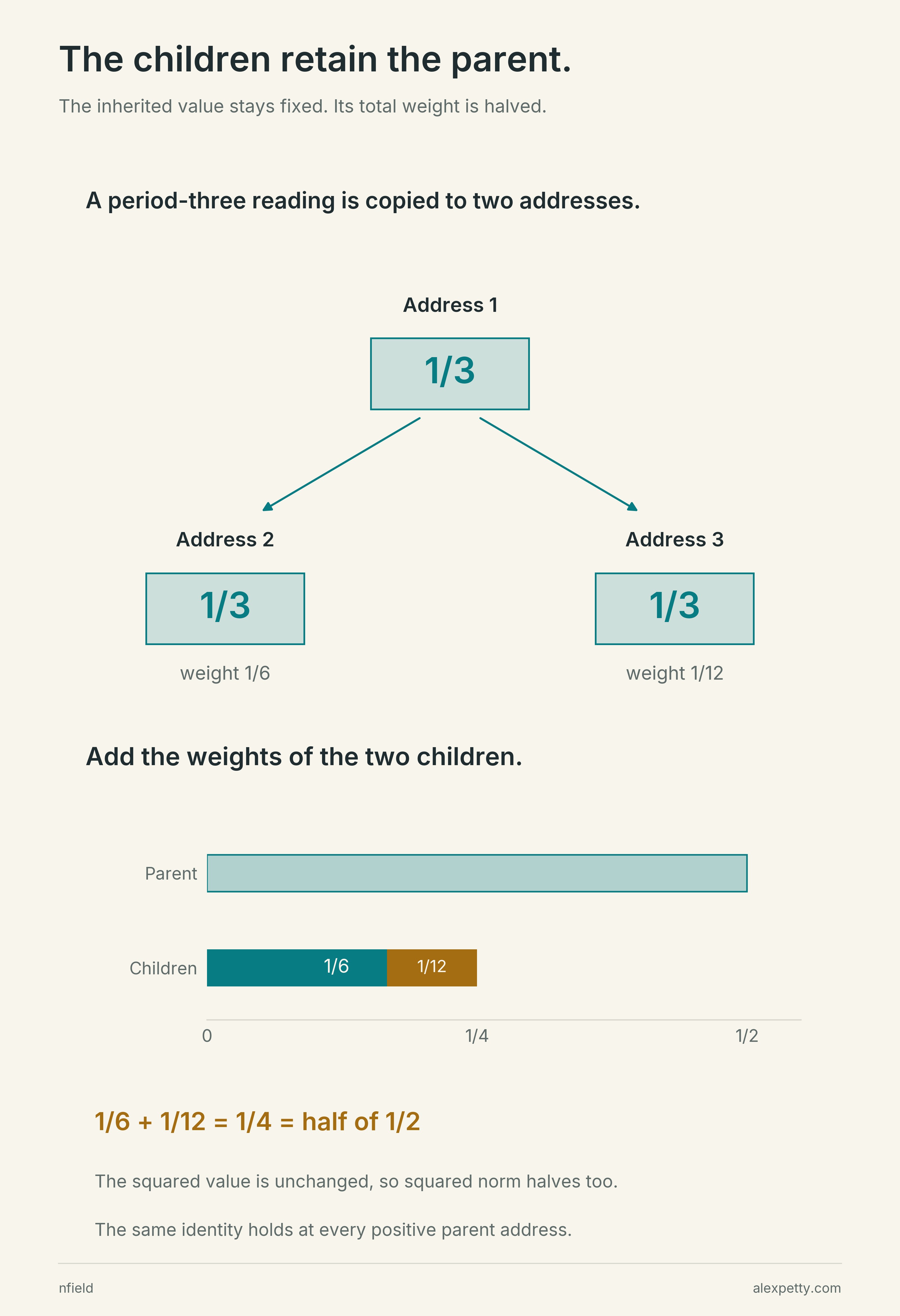
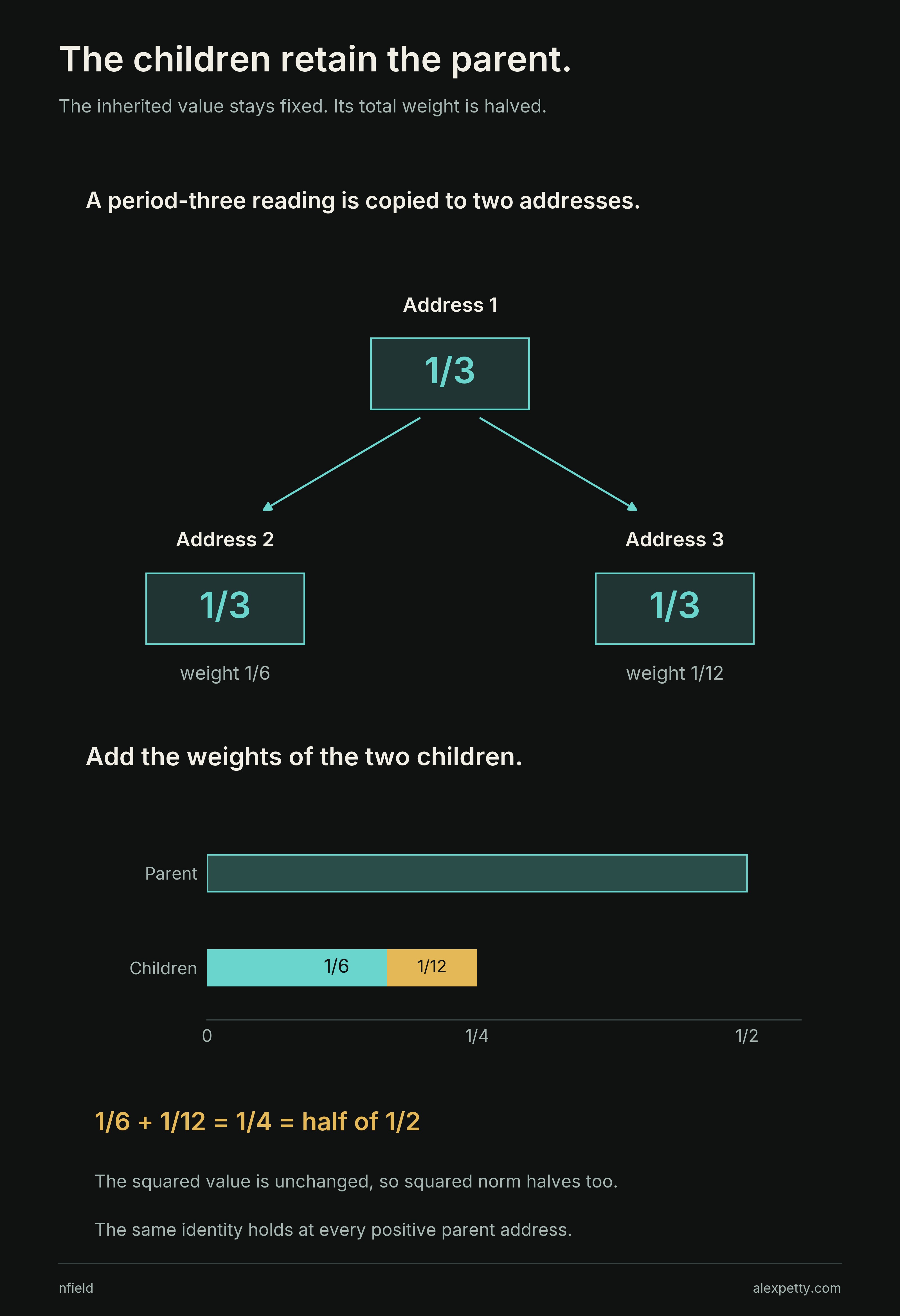
The figure follows the period-three clock’s value at address one down to addresses two and three. Their weights, a sixth and a twelfth, add to a quarter, exactly half the parent’s half. The copy is also something the clocks can say for themselves,
At address two the period-six clock reads and the period-two clock reads . At address three they read and , and taking a third of the second from the first leaves again. Every coarse description survives inside the finer one, held there by an identity between clocks.
Copying is only half of a refinement step. A new fit also brings a source beyond the copy , and the source meets the copy,
The first term is settled by copying. The other two carry the new arithmetic, and the cross term can have either sign.
The leftover has to surface early
Copying gives the integers a family tree, and the tree gives the residual somewhere to be looked for. Group the addresses in doubling blocks, one, then two and three, then four through seven, and so on. The flat line at one is built from these blocks, each with its own weight, and the paper calls them the spine. The residual pairs with one to give exactly , so it can’t hide entirely deep in the tree. At least of its energy shows up on the spine within the first levels.
Seeing that energy and using it are different matters. Build a reading of the shallow detail from clocks that are already admitted, and once is large the detail part has joint size at least . Every complete reading of that kind is exactly zero. The coarse part that comes along when the reading is made from permitted clocks cancels the detail it was built to see, because the fit has already used everything those clocks can say.
A cost that never passes two
So the readings that count have to come from new clocks. At each eligible depth the paper takes the part of the root address that the periods between and can express. It copies that part down levels and removes everything the old clocks already represent. The result, , lives among the clocks through and is perpendicular to every old clock.
Several readings used at once have a cost, the squared size of their combined correction, and overlapping readings can make it larger than the parts suggest. For this family the total never exceeds two.
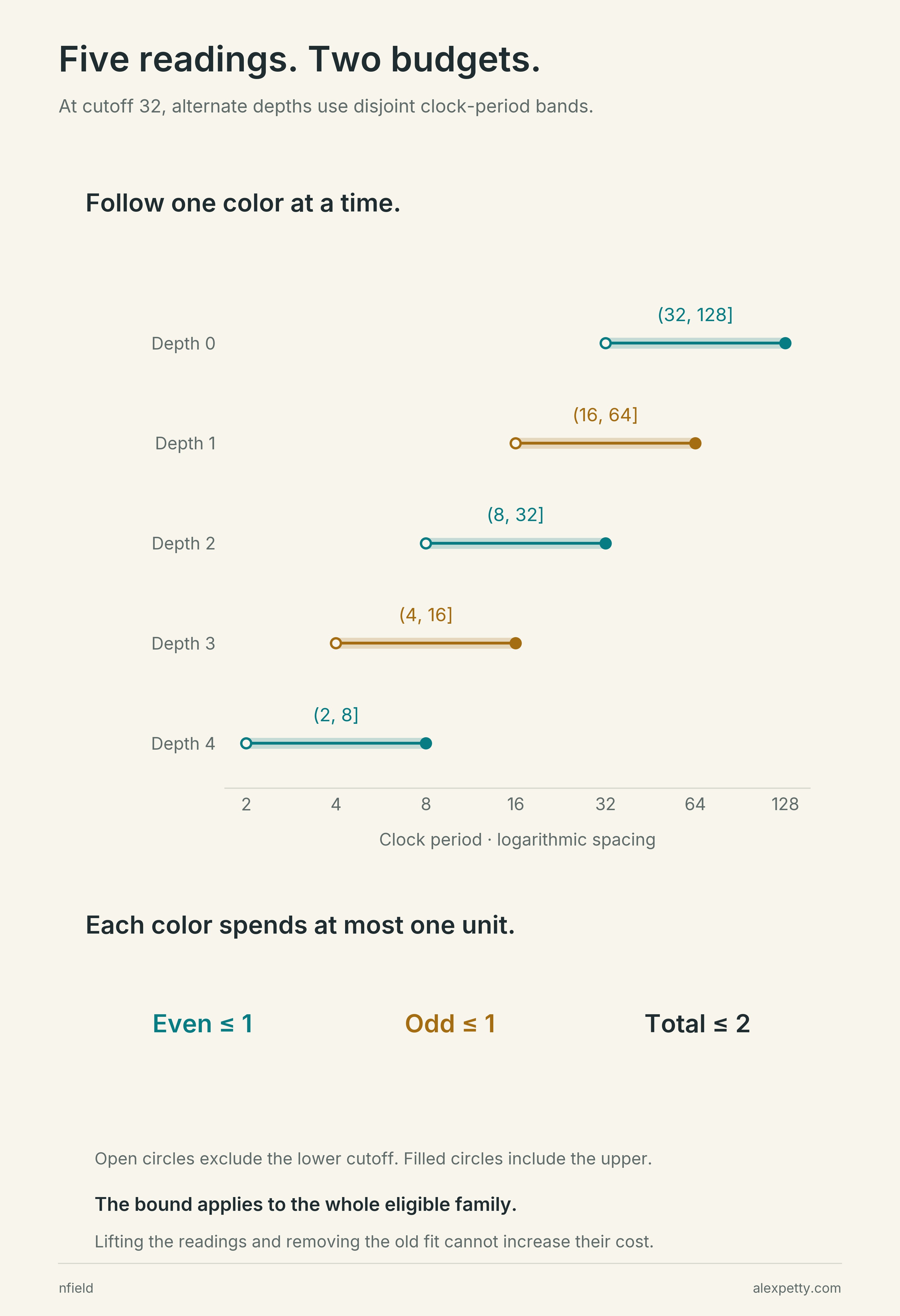
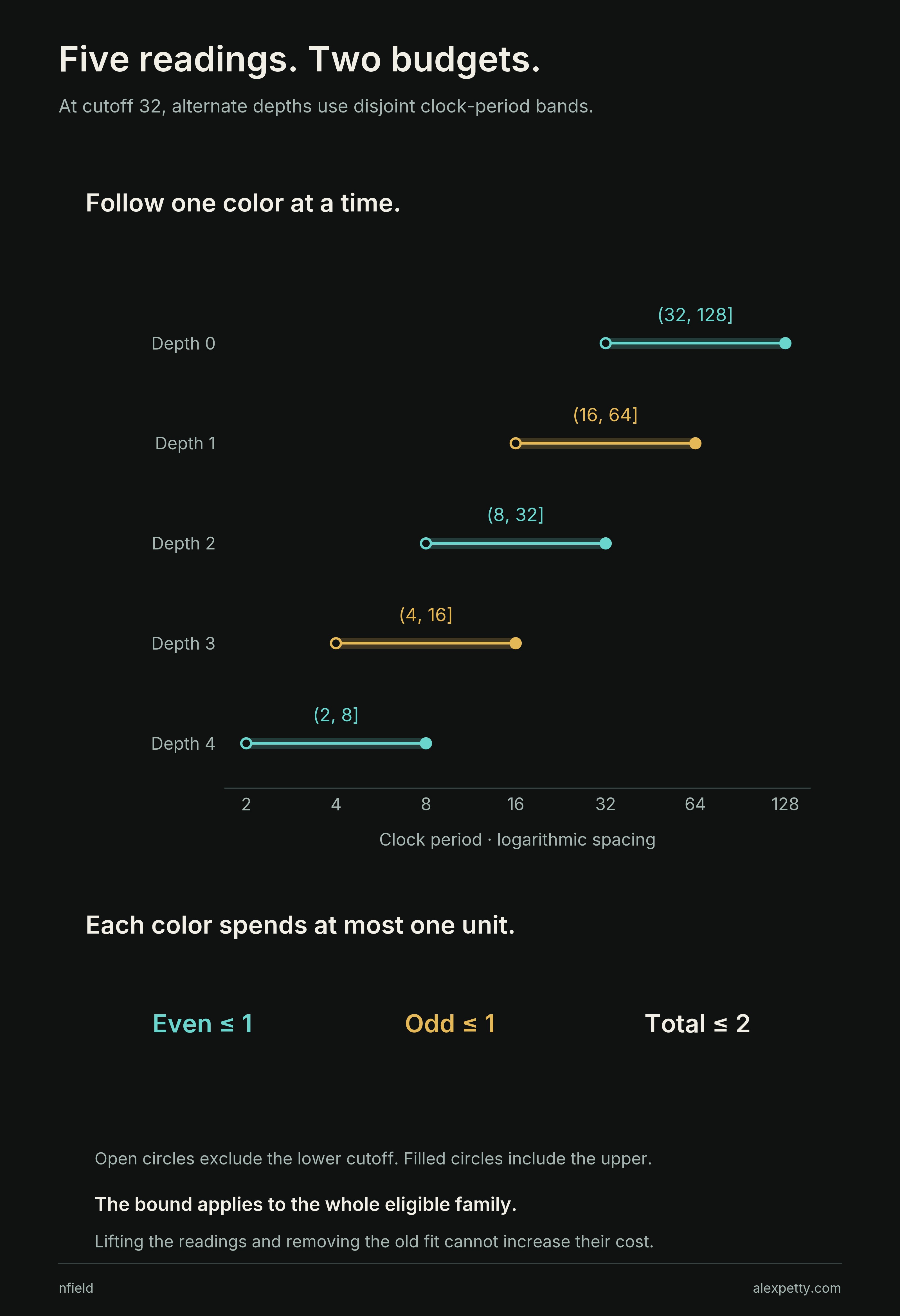
The figure shows the reason at cutoff 32. The five depths draw on the period bands , , , and . Follow one color and the bands never overlap, since each starts where the band two rows below it ends. Disjoint bands take separate pieces of the root address, whose total size is one, so each color spends at most one unit and the two colors together at most two. Copying keeps sizes, and removing the old fit can only shrink them. The bound doesn’t grow with the number of depths, and for large the total cost even tends to zero. In this setting cost means the size of a correction in the weighted space, and it says nothing about how long a computer takes to find one.
Now read the residual against each probe, , and record every overlap between probes in the matrix . Choosing all the coefficients together gives the best improvement the family can make,
where the dagger is the generalized inverse that handles redundant probes. Every sign and every overlap goes into the solve, and any nonzero reading makes positive.
The bound of two also allows a lazier update, half of each reading as its coefficient, with a guaranteed gain of at least . On the paper’s panel of 381 cutoffs that lazy guarantee comes to only to percent of . The joint gain itself recovers between and percent of the actual drop in error from to . The depth-zero probe alone accounts for to percent of that drop, and reading the depths together adds another to points.
A reading that changes its sign
The signs matter most when a reading is assembled from pieces. At cutoff and depth one, with parent cutoff 12, the paper splits one reading into three terms and evaluates each with 192-bit interval arithmetic in nfield, using the full infinite norm.
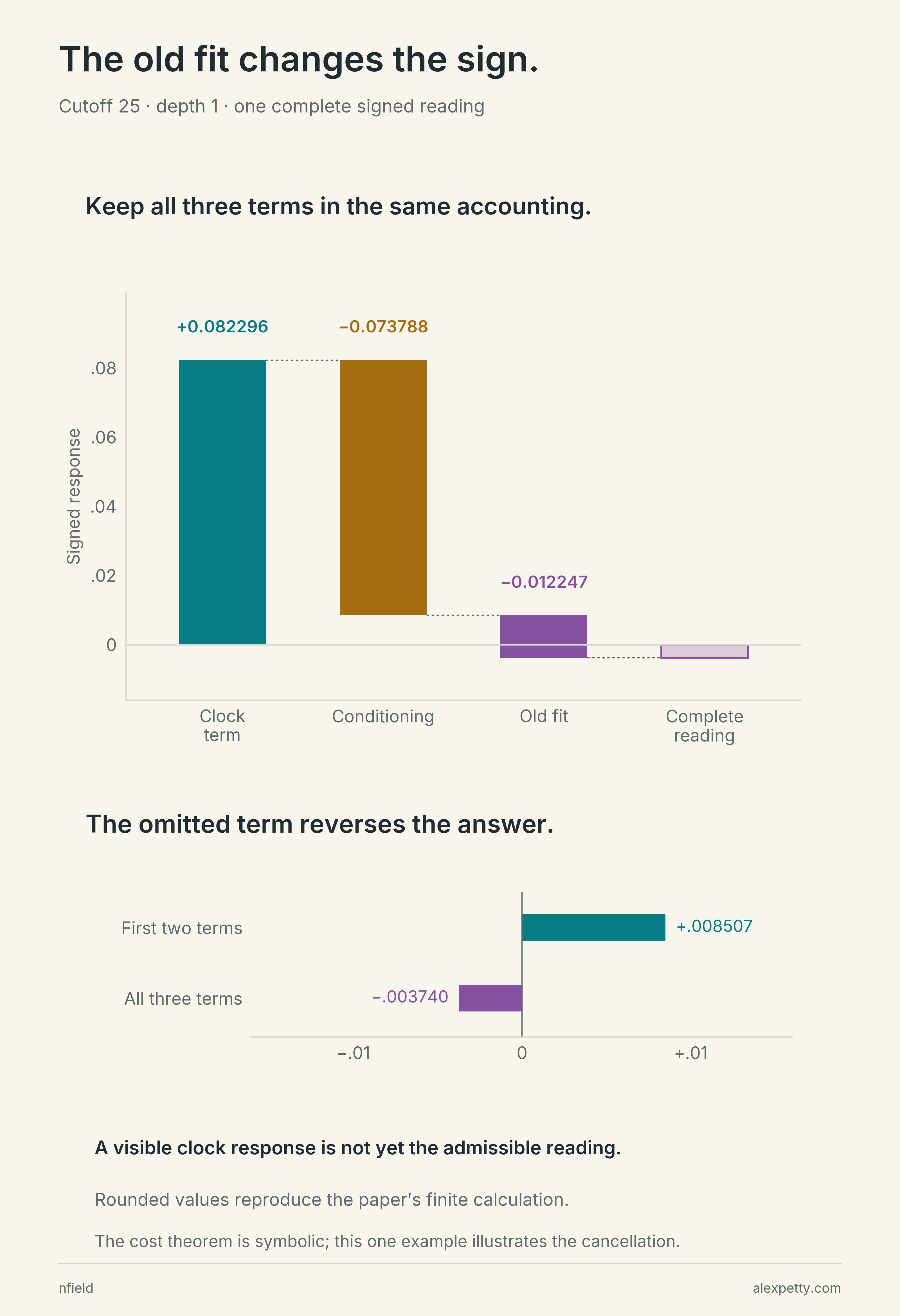
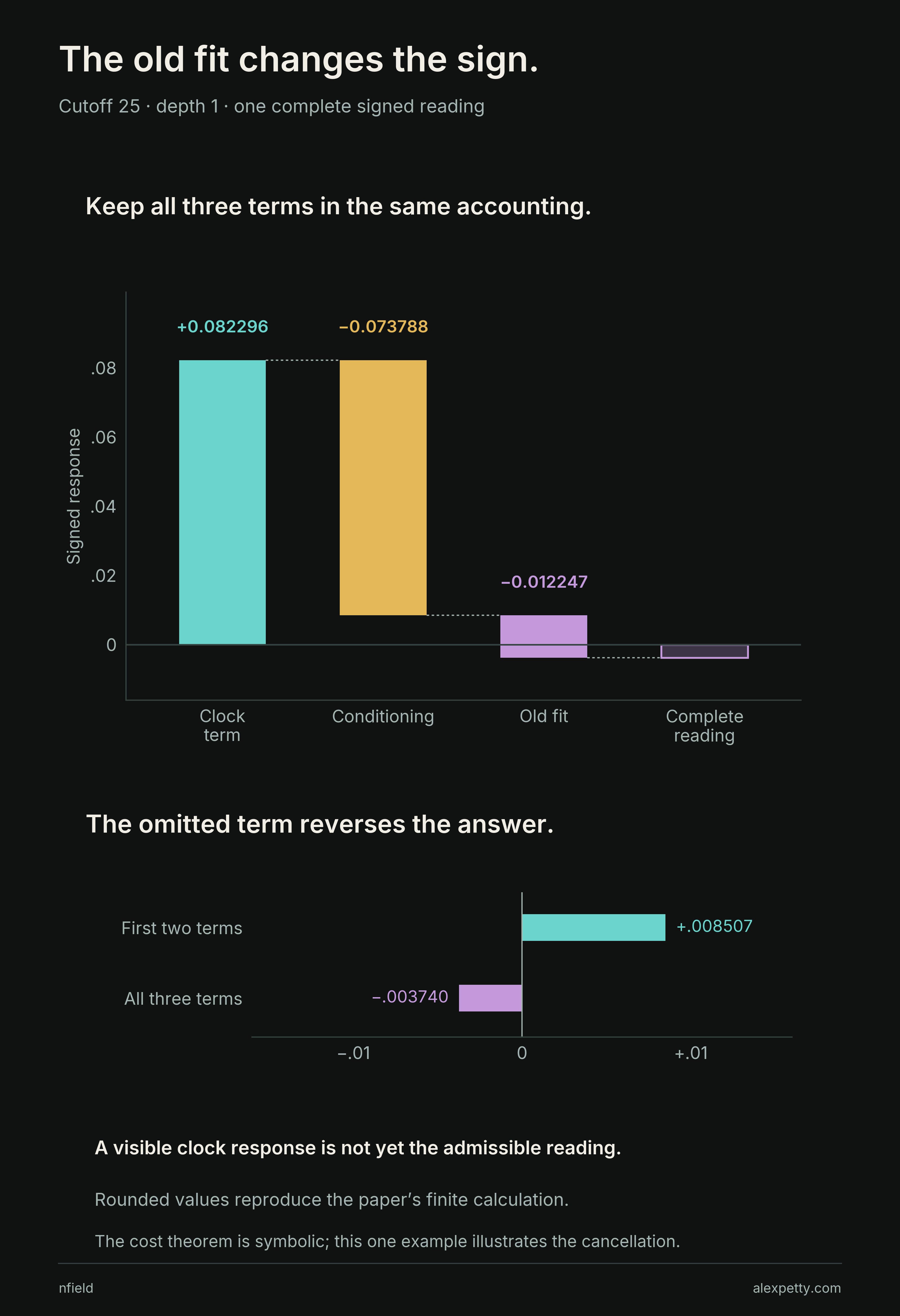
The teal bar is the clock term, about . Conditioning on the old clocks takes away about , and the first two bars together leave . Then comes the purple bar, the fit already made at cutoff 25, carried down a level. It removes , and the complete reading lands at . Leave out the old fit and the correction points the wrong way. It would ask a descendant clock to explain the target while forgetting what its ancestors already explain.
That is one finite calculation. The response identity behind it holds at every cutoff and depth, and the cost theorem uses the complete reading whatever its sign. Nobody has yet shown that strong readings must keep surviving all three terms.
Spokes, seams and a palindrome
The digits offer a second family of readings, and an old one for me. In Arithmetic Foundations, back in 2010, I colored the integers by digit sum on a nine-spoke wheel. I started using the words radial palindrome and torsion long before I could say exactly what they meant. The paper gives them definitions.
In decimal, the two-digit endings with digit sum nine form the block
Reversing the digits reverses the block, and that is its palindromic reflection. Addresses fall on nine spokes by their remainder mod nine, and nine steps return to the same spoke farther out. Each address gets a polarity, plus or minus, from its digit sum and its whole prefix. Below 100 it is plus for digit sums up to eight and minus from nine through seventeen. Half the change in polarity between neighboring addresses is a torsional reading. The nine readings in a turn add up to half the radial change between two addresses on the same spoke.
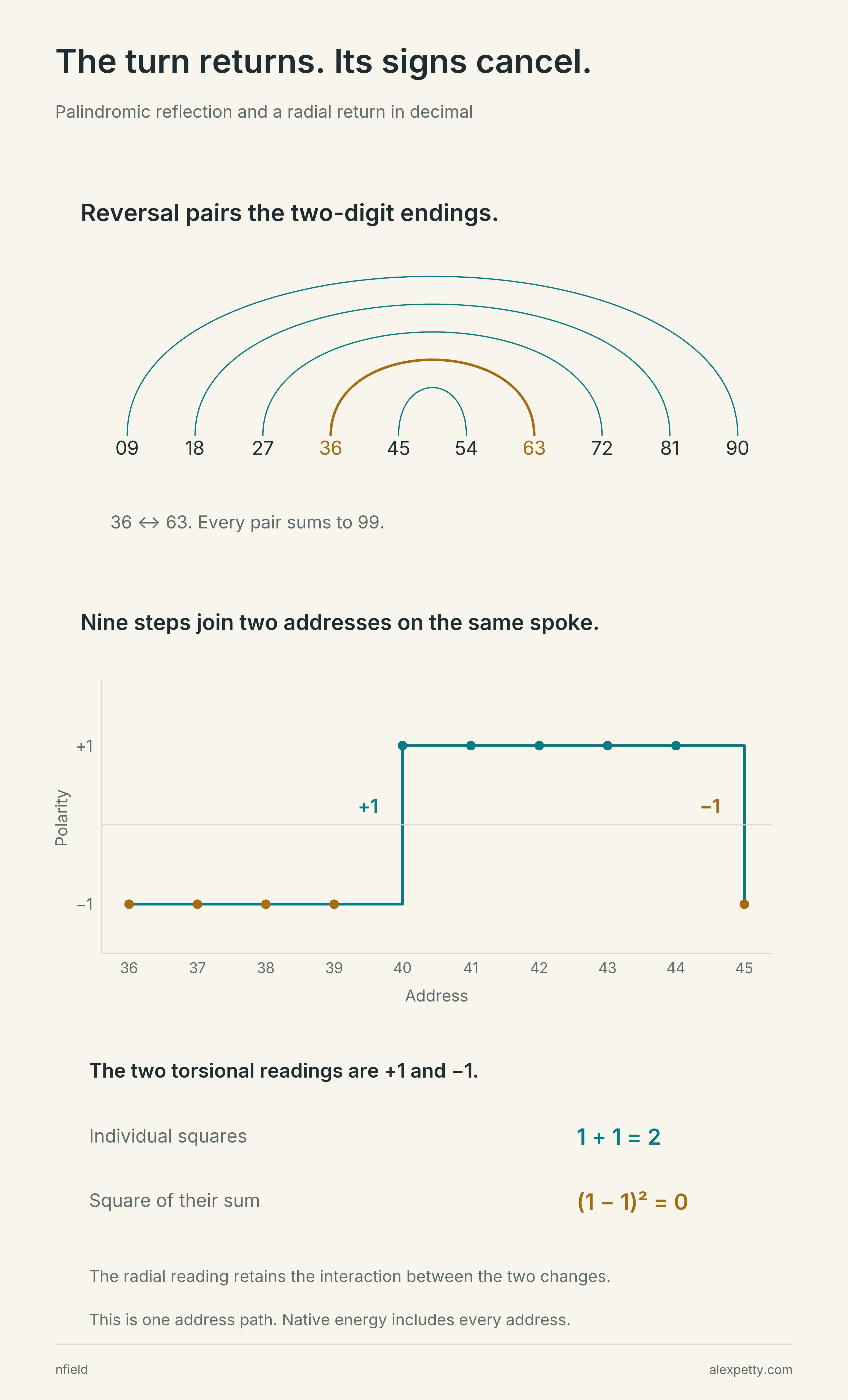
The arcs in the upper half pair 36 with 63, and each pair sums to 99. Below, follow the turn from 36 to 45. The polarity starts at minus, jumps to plus at 40, where the digit sum drops from twelve to four, and falls back at 45. The two torsional readings are and . Their squares add to two, while the square of their sum is zero, so 36 and 45 share a polarity and the radial change is nothing. The radial energy keeps that cancellation, so it can’t be counted as a third supply beside the torsional readings. Reflection doesn’t make the weights equal either, and 63 carries less observation weight than 36.
Copied patterns like these have a cost bound of their own. With copies spaced by a factor , the best universal constant is
which is three at fourfold spacing, however many copies are used. Three fourfold copies of the flat line already show it coming, since their equal mix costs , and the cost climbs toward three as more copies join. The bound is classical, the norm of a Kac-Murdock-Szegő matrix, applied to these native copies. It controls cost and promises no capture. In the paper’s tests the plain address probes did better. Between clocks 20 and 48 they recovered 91 percent of the available gain against 78 percent for the polarity masks, and between 100 and 200 it was 99 against 64.
A packet and its envelope
There is another way to use the same clocks. Báez-Duarte built explicit approximations to the flat line from the Möbius function in 2000. The paper averages a block of them and combines three of their errors, copied to different scales, into a packet that is exactly zero through address . The clocks themselves leave a fixed boundary there, at addresses one, two and three, and the argument turns on that boundary. A zeta zero with real part above one half would pair with it and force the packet’s energy to grow like a positive power of . Energy growing more slowly than every power along one doubling chain would therefore drive the error to zero.
The paper bounds that energy over every address out to infinity, with nothing cut off,
and an even stronger stretched-exponential saving stands behind it. That comes close to what the criterion needs without reaching it, since it still allows growth like . The paper also locates the shortfall exactly. The bound runs through an envelope with , and the envelope itself provably climbs to about the cube root of , infinitely often, along every doubling chain. Better Möbius bounds fed into that envelope can never close the gap, so the next estimate has to keep more of the packet’s own cancellation. Computed directly in the full norm at nine scales up to , the packet’s energy stays between and , far below what the envelope allows at those sizes.
A sum that has to keep growing
Back to the joint gain. Along the chain the paper proves
The proof is a few lines of telescoping, since each step raises by at least . The premise is the hard part. Weak steps are allowed as long as strong ones keep coming often enough, and the paper names one sufficient rate as an open problem. Proving it would prove the Riemann Hypothesis through the classical criterion, which is a good reason to expect it to be hard. Unity, Refinement, and Signed Capture has the proofs, the rate and the finite calculations.
Jean-François Burnol’s lower bound carries over to these clocks and gives for all large . It limits how fast the error can fall without saying that it falls at all. The period-two clock left of the whole unaccounted for. With every clock through 100 the best fit leaves , and through 200 it leaves . On the chain that starts at 25, the first term of the capture sum, , is certified above nineteen. The sum has to grow without bound from there.
Discussion
Sign in to join the discussion.