Collisions
The Collision Transform

The collision score of a prime is read from a table of forty numbers, one for each pair of last digits a prime past can end in. The table already favors some endings over others before any prime arrives. Add the scores over the primes, and it isn’t clear whether the running total says something about the primes or only about the table. This paper removes the table’s preferences exactly and then asks what the primes make of the cleaned table. At weight the total settles. Weight the large primes more heavily and the question passes to classical theory. The table selects a few Dirichlet -functions and fixes how much each one counts, and whether the sum still settles depends on their zeros in the usual way. A zero belonging to only one of them can’t be cancelled by the others.
It is the second of the three preprints going up on arXiv this month, arXiv 2604.00047, next to The Collision Invariant. The first paper fixes the finite table. This one distills what the notes worked out in The Centered Collision Sum and The Collision Transform and the Critical Strip into one argument, with complete proofs.
Four columns, four corrections
The table’s entries come from long division. At , eighteen of the fractions through begin with two identical digits. The smaller digit bin holds ten, so the score is . At only ten fractions match against a bin of nineteen, a score of . Every denominator past ending in scores , and every one ending in scores , as The Collision Invariant proves.
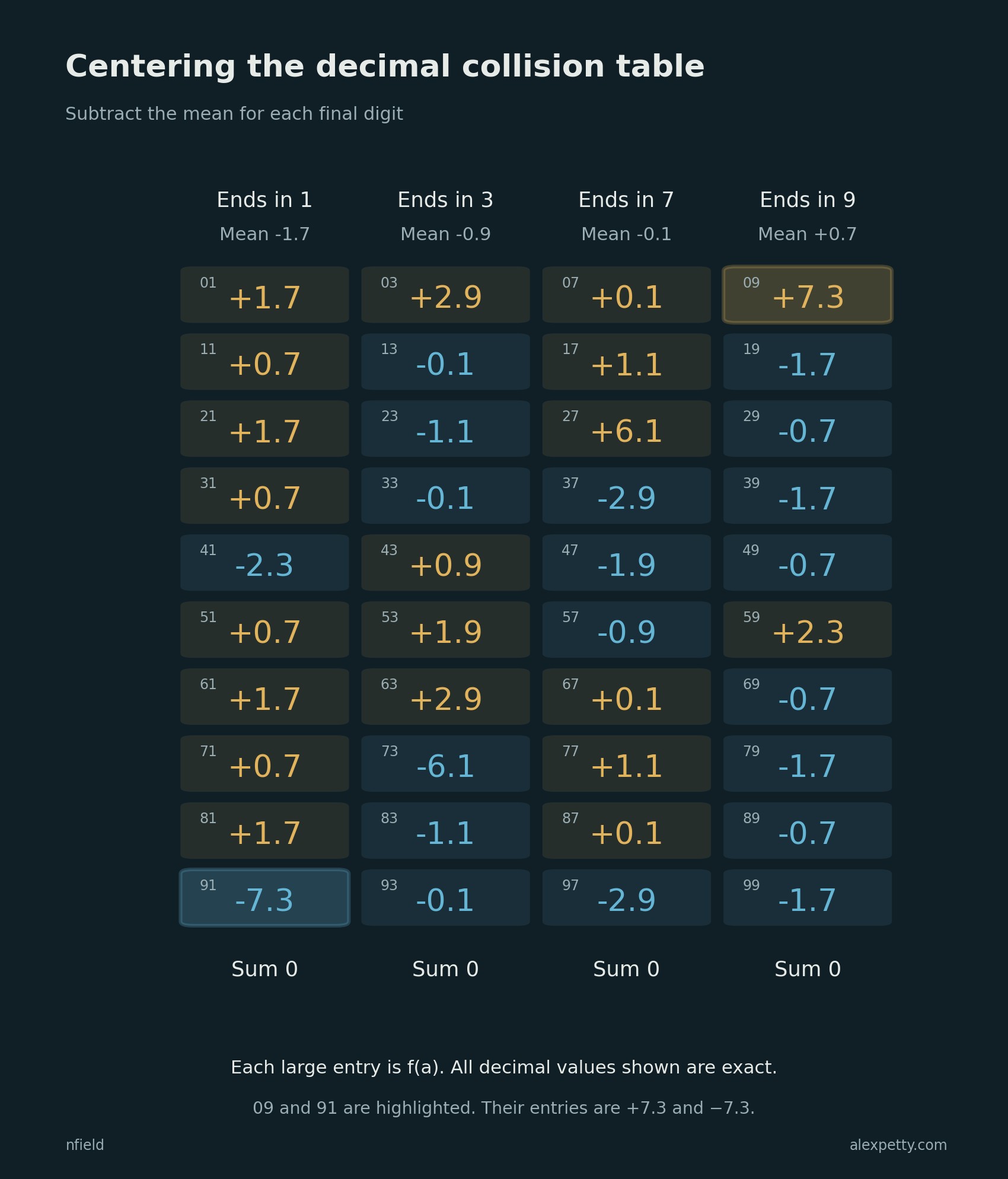
Arrange the forty endings in four columns, one for each final digit , , and . The column averages are , , and , so the table favors the s over the s before a single prime turns up. Subtract each column’s own average from every entry in it.
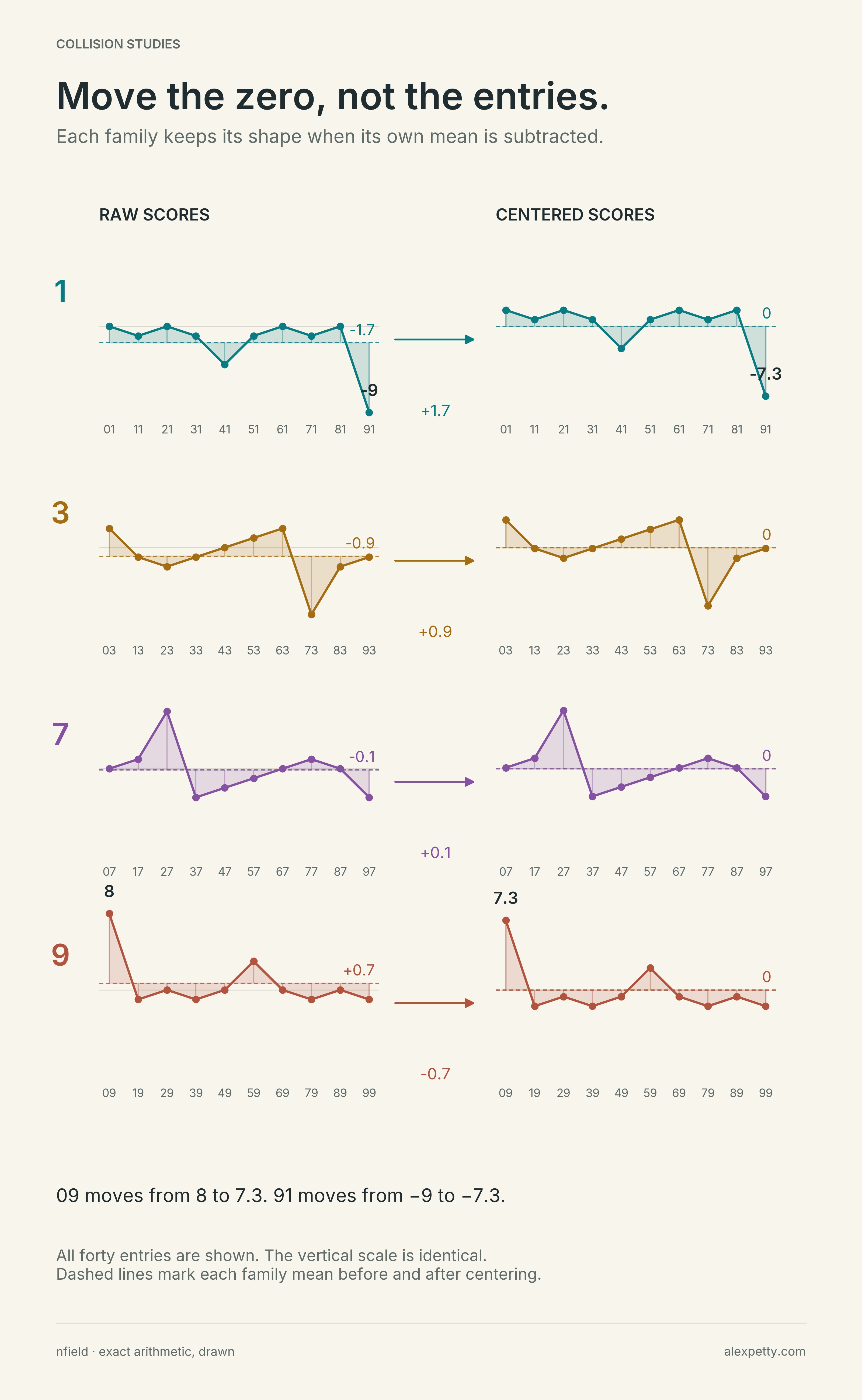
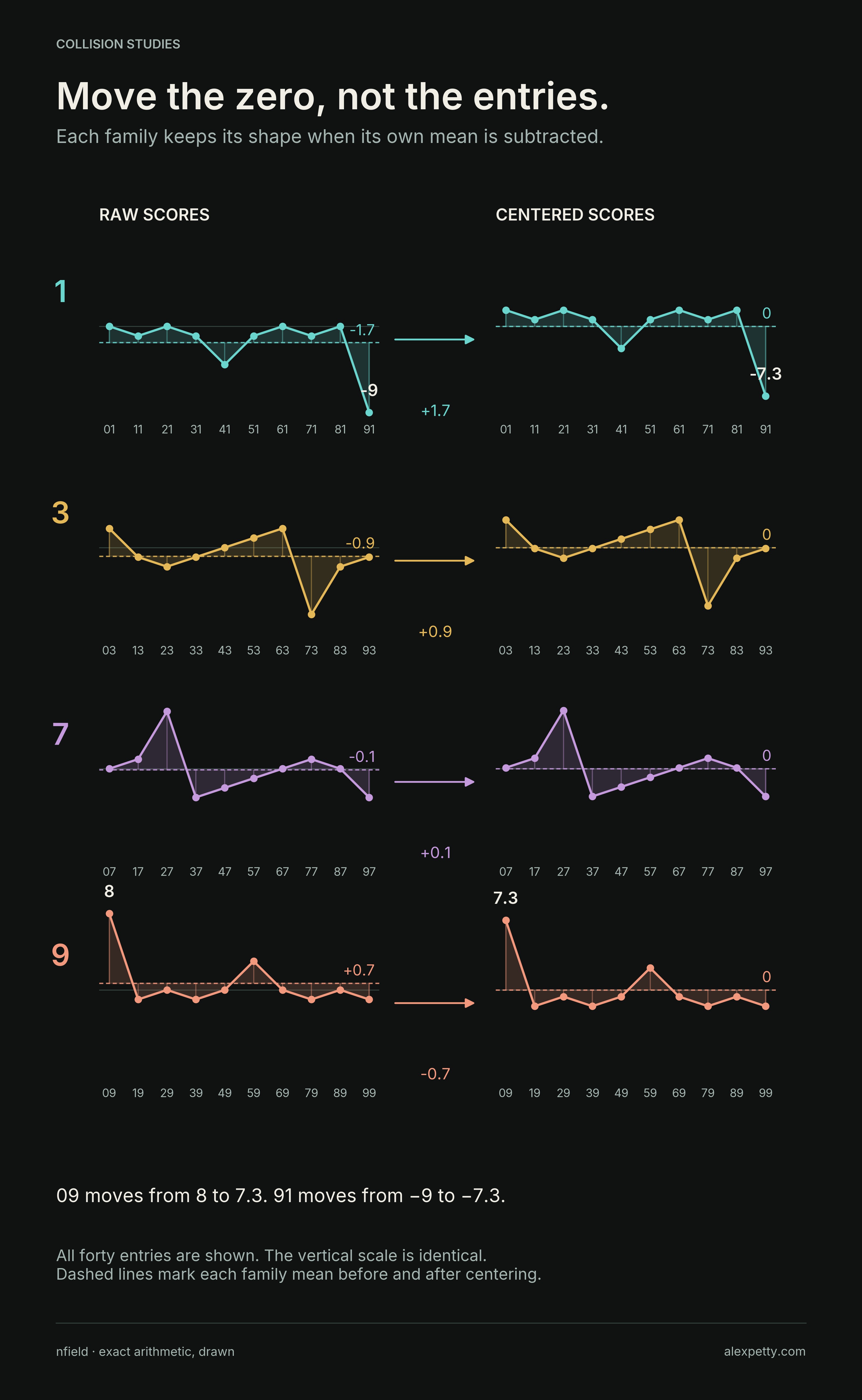
Each row of the figure is one family, raw scores on the left and corrected scores on the right, all on the same vertical scale. The shapes don’t change. The family ending in still drops deeply at and the family ending in still spikes at . Only the dashed zero line has moved, to each family’s own average. The at becomes and the at becomes .
Every column now sums to zero, and there is a second balance as well. Reflect an ending across , from to for instance, and its corrected score changes sign. Both properties are exact. One correction for the whole table couldn’t do this. The table averages , and adding everywhere would level the table as a whole while leaving its four columns at different heights.
The forty corrected entries
The row gives the tens digit and the column the units digit. These decimals are exact. Subtracting the column mean is called family centering. The paper calls each family a reduction fiber.
| Tens digit | Final 1 | Final 3 | Final 7 | Final 9 |
|---|---|---|---|---|
| 0 | +1.7 | +2.9 | +0.1 | +7.3 |
| 1 | +0.7 | -0.1 | +1.1 | -1.7 |
| 2 | +1.7 | -1.1 | +6.1 | -0.7 |
| 3 | +0.7 | -0.1 | -2.9 | -1.7 |
| 4 | -2.3 | +0.9 | -1.9 | -0.7 |
| 5 | +0.7 | +1.9 | -0.9 | +2.3 |
| 6 | +1.7 | +2.9 | +0.1 | -0.7 |
| 7 | +0.7 | -6.1 | +1.1 | -1.7 |
| 8 | +1.7 | -1.1 | +0.1 | -0.7 |
| 9 | -7.3 | -0.1 | -2.9 | -1.7 |
For base and lag , the table reads the final digits. Its modulus is . With raw entry and family mean , the corrected entry is
The bin-size baseline used before centering is .
The primes do not take turns
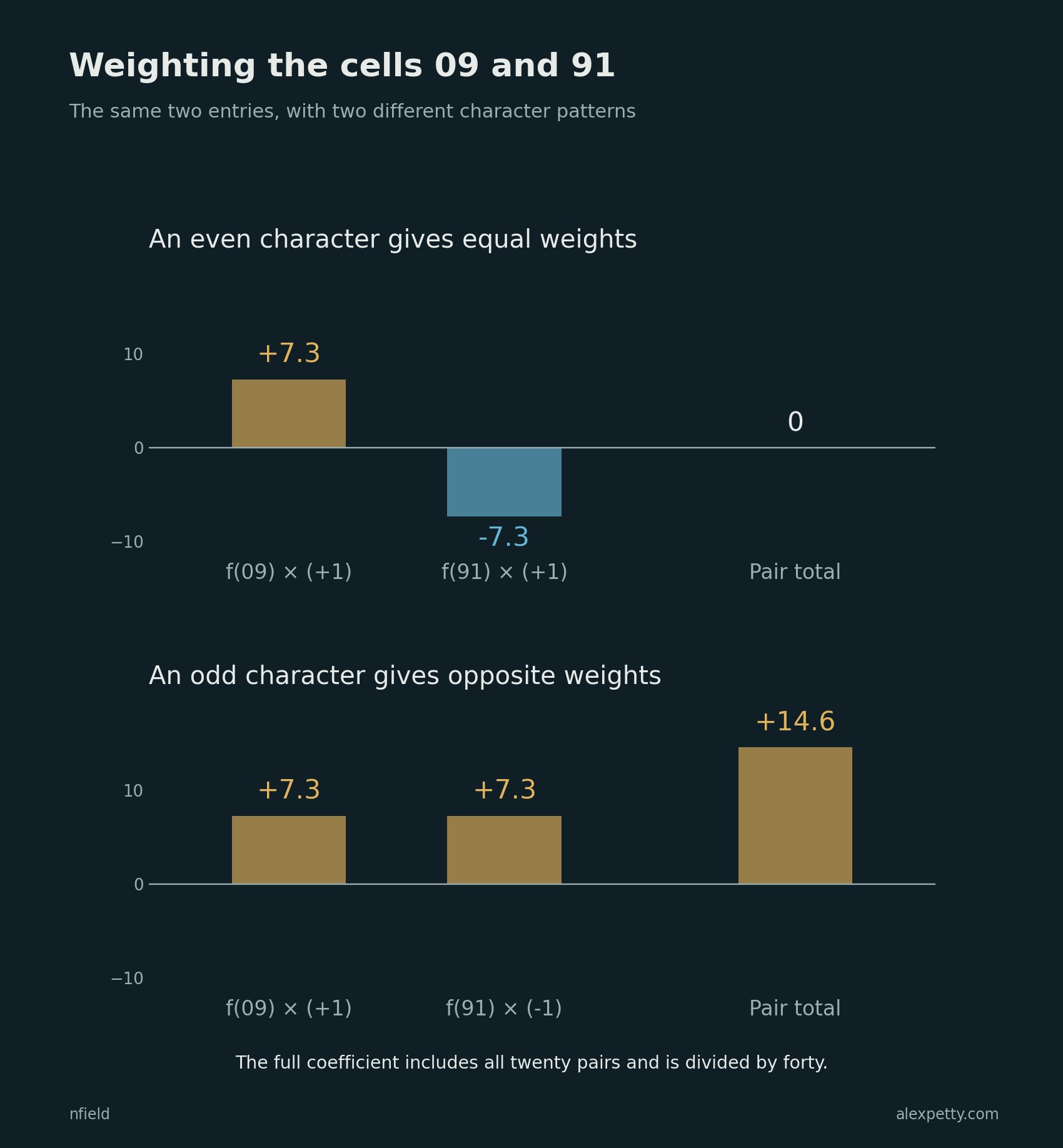
The two corrected scores at and are equal and opposite, but their contributions to the running sum are not,
The positive score has the smaller divisor and wins this round. Nor does every prime ending in arrive with a prime ending in conveniently nearby.
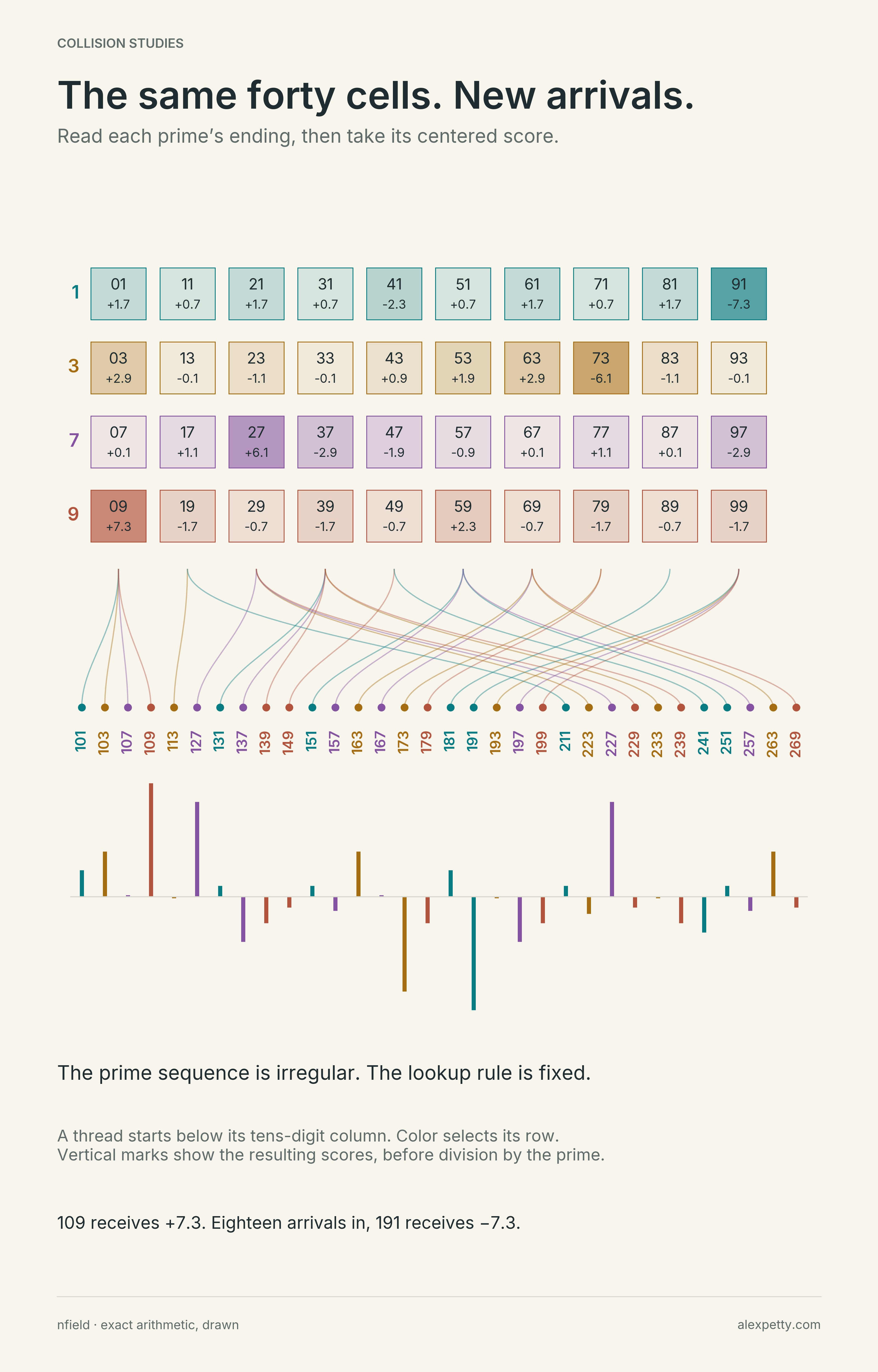
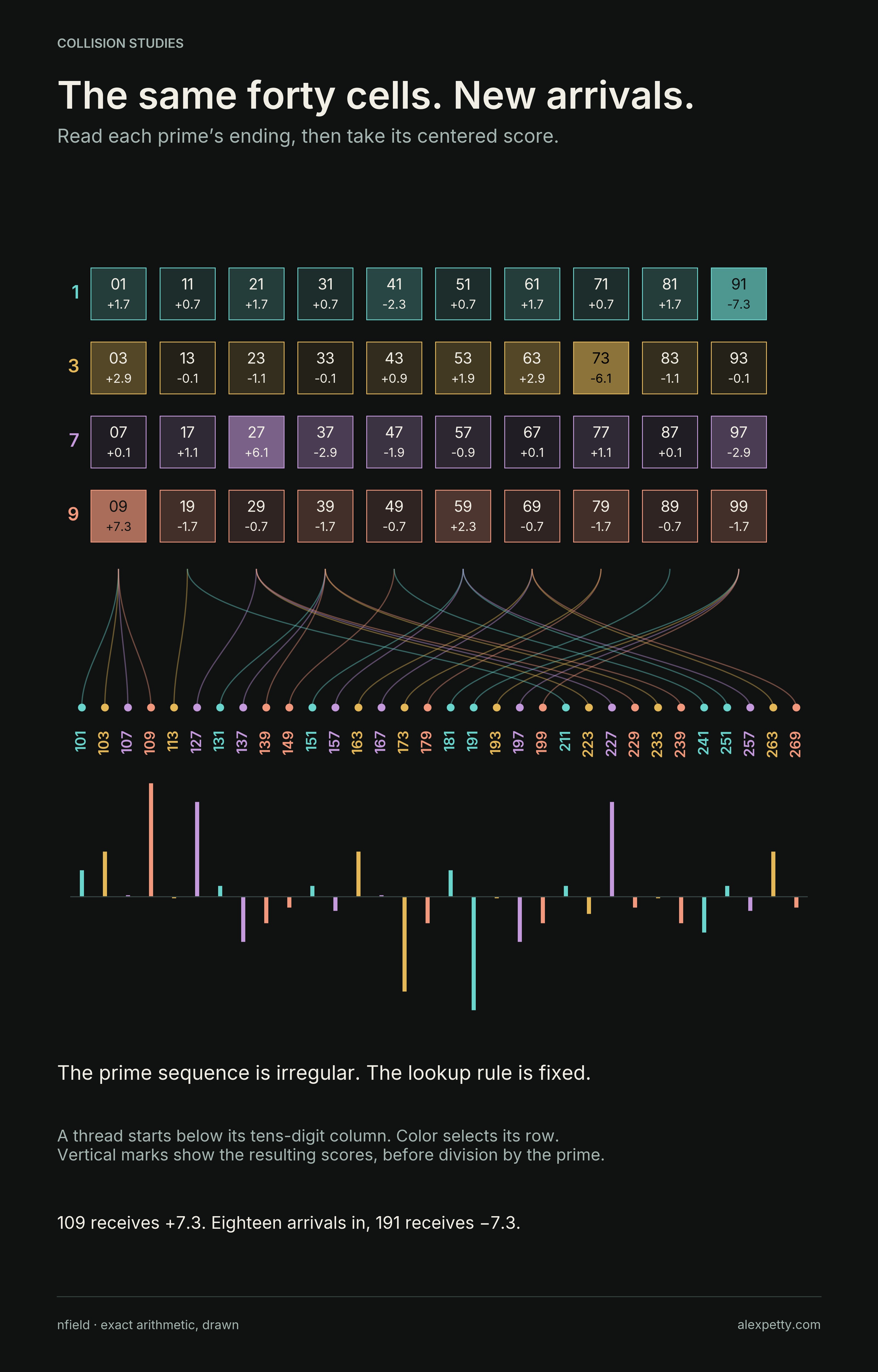
The threads in the figure run from each prime below to the cell holding its ending above, and the bars underneath are the scores the primes collect, before any division. The first thirty-two primes past draw from the table in no pattern at all. The tall bar at is , the deep one eighteen primes into the list is at , and , and pull from the other big cells at and . Centering balances the table, and it does nothing to schedule the primes.
The sum converges anyway when each score is divided by its prime. Mertens’ theorem for primes in arithmetic progressions assigns each of the forty endings the same slowly growing part, plus a constant of its own and an error that tends to zero. Weight those forty sums by the forty scores, and the common growth is multiplied by zero. The constants needn’t cancel, so the limit is finite and need not be zero.
Asking more of the cancellation means a smaller divisor. Divide instead by , and a prime near a million counts about a thousand times more than before, with its sign and its score unchanged.
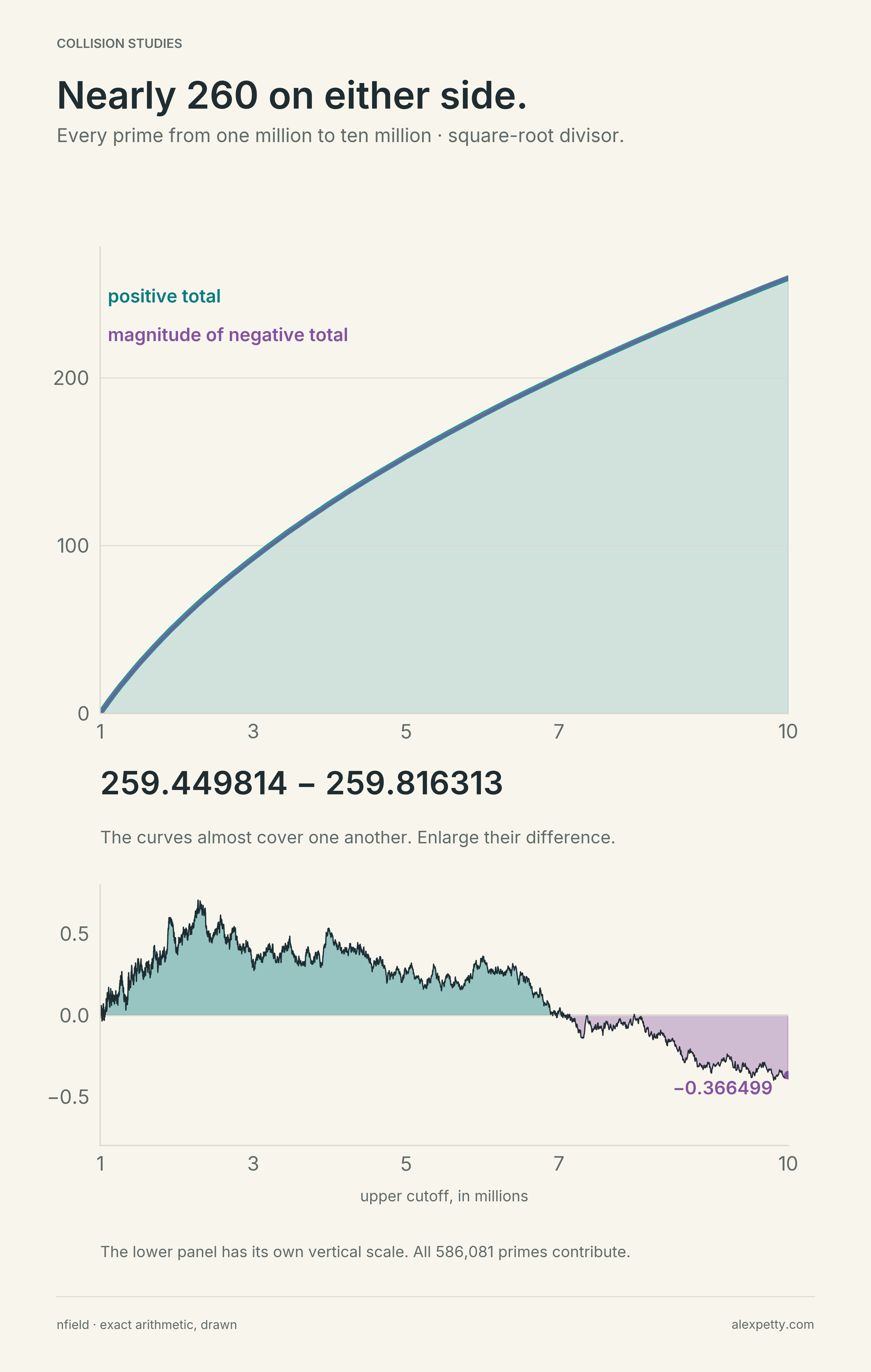
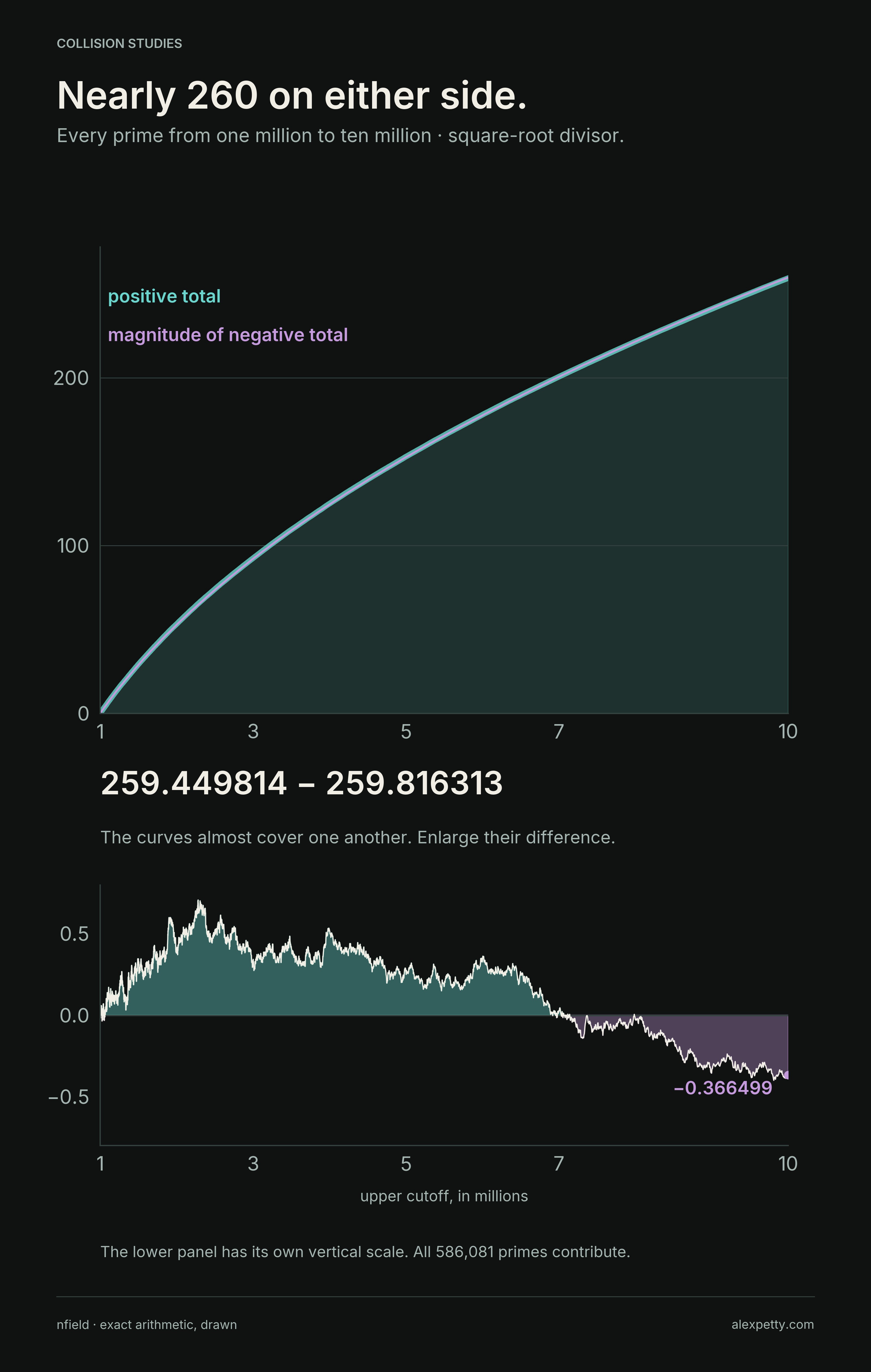
Take all primes between one million and ten million. The upper panel draws the positive contributions and the size of the negative ones, and the two curves climb almost exactly together to about and . The lower panel magnifies their difference. It rises to about by two million, drifts back down, crosses zero near seven million and ends at . That small number is the gap between two large ones, and a picture of the gap alone would hide how large they are.
With the original divisor the same window contributes about . At weight there is a theorem. At the square-root weight this window is a finite calculation and settles nothing about later cutoffs.
The sum and the complete window calculation
The collision prime series is
For real , decreasing makes the distant terms larger. Absolute convergence holds for . The family balances and Mertens’ theorem in arithmetic progressions prove ordinary convergence at for every fixed base and positive lag.
For each eligible ending ,
The common divergent term disappears because . This argument does not pair primes individually.
The complete decimal window gives the following totals. No primes are sampled or omitted inside the declared interval.
| Divisor | Positive total | Negative magnitude | Difference |
|---|---|---|---|
| p | 0.140265935 | 0.140200891 | 0.000065044 |
| √p | 259.449813675 | 259.816312851 | -0.366499176 |
Here and in the figure, the negative total is displayed by its magnitude when compared with the positive total. Subtracting the two leaves the signed result.
Two turns of a small wheel
A finite table can be rebuilt from repeating patterns. Picture a wheel that turns by a fixed angle each time its label is multiplied by two, so that once the angle is chosen every weight on the wheel is fixed. In base three only six labels are needed. Doubling visits , , , , and before returning to , and a sixth of a turn at each step closes after six steps, in either direction.
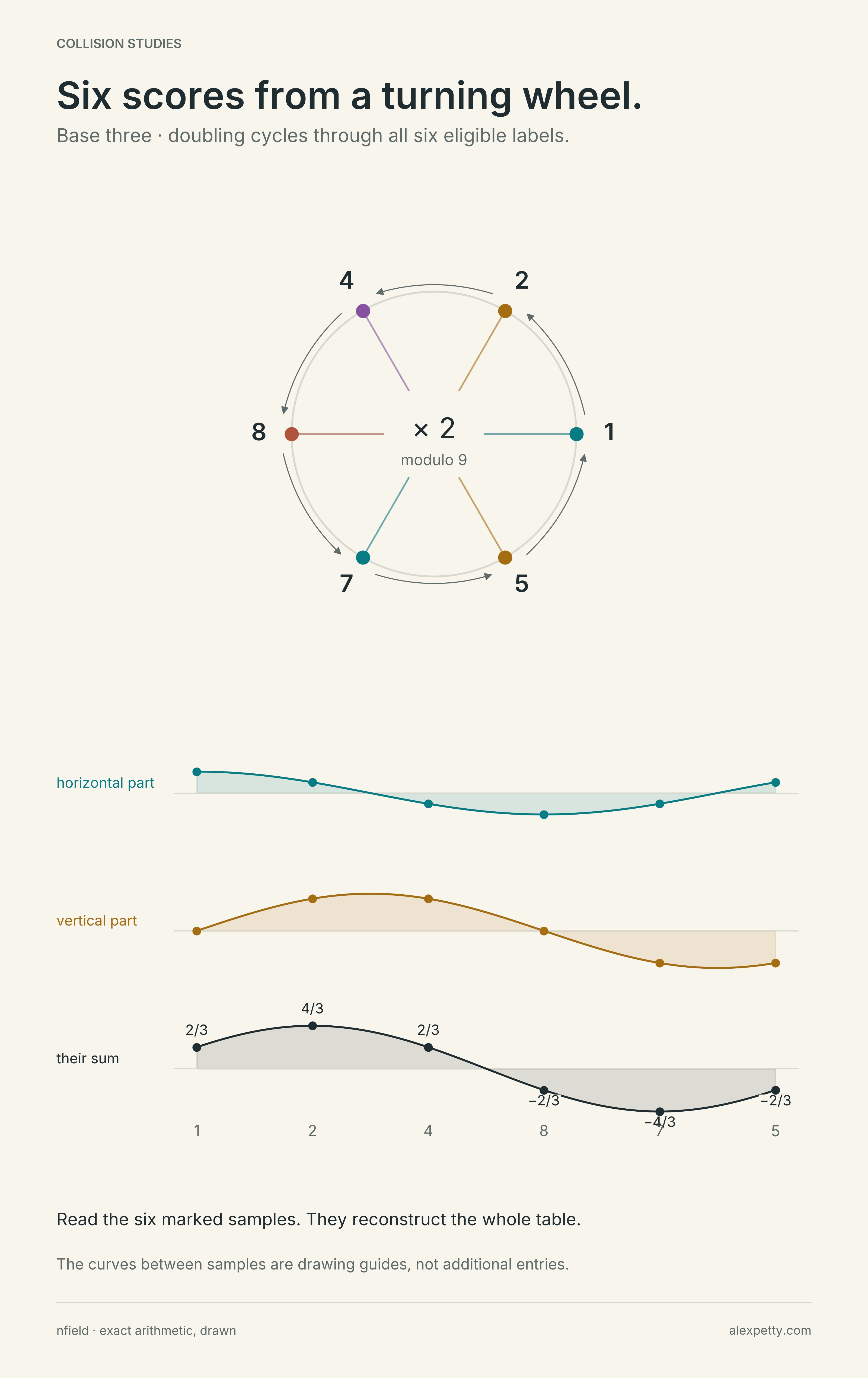
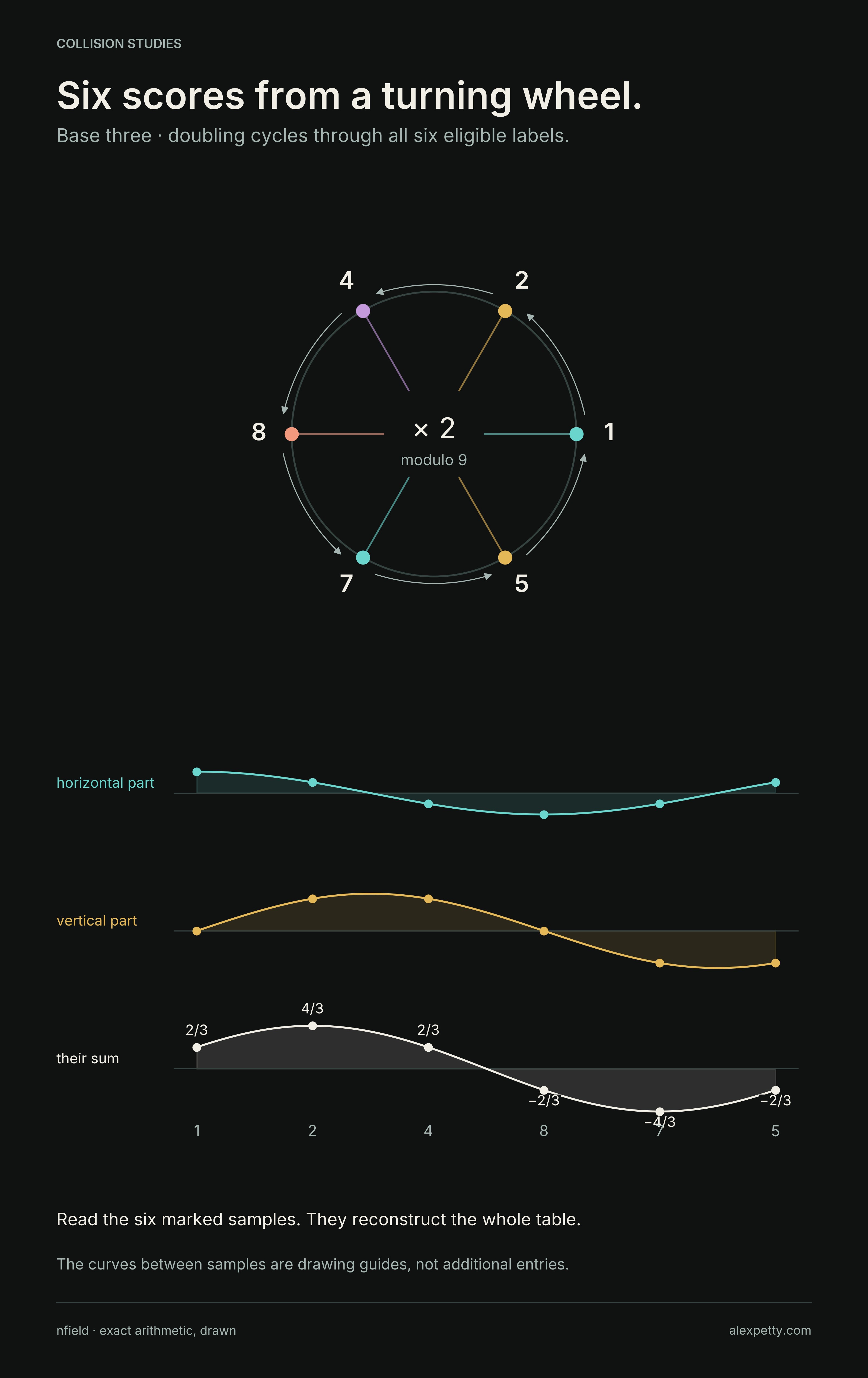
Those two opposite turns rebuild the whole centered table. The figure splits the wheel’s position into a horizontal part and a vertical part, each sampled at the six labels in doubling order. Their sum passes through exactly the six centered scores, , , , , and . The curves between the samples are only there to guide the eye.
Multiplication-respecting patterns like these are the Dirichlet characters, and they are natural coordinates here because long division moves remainders by multiplication. Changing to them discards nothing. The centering has already decided which patterns can contribute. A pattern that treats a whole column alike meets a column total of zero, and one that treats reflected labels alike meets equal and opposite scores. Both give nothing. Only patterns that tell positions within a family apart and change sign under reflection survive, two in base three and seventeen in decimal. However large the table, it travels with a finite list of coefficients.
Read the six-cell reconstruction algebraically
In powers-of-two order the centered scores are
Let . With , the exact reconstruction is
At the six positions , this becomes the real-valued expression drawn in the figure,
Only the six marked samples are table entries. Curves between them are visual guides. The six-character transform has four zero coefficients and these two nonzero ones. The decimal count is forty characters, minus twenty even characters, minus two further odd characters depending only on the final digit, minus the additional cancellation described in The General Neutrality Theorem.
A zero can stop the sum
Each surviving character comes with an -function, a product with one factor for every prime. Its logarithm turns the product into a sum over primes, plus extra terms from prime squares, cubes and higher powers. Removing the extras leaves exactly the character sums the collision table selected. That is the route from a page of digit scores to the functions classically used to study how primes are distributed.
Let the exponent in the divisor be complex and draw it in a plane. Its horizontal coordinate controls how hard the divisor holds back the distant primes, and moving left gives them more weight. Suppose one of the selected -functions has a zero in the region where we want the collision sum to converge. Its logarithm is singular there, and the correction for prime powers can’t remove the singularity.
Another selected -function could vanish at exactly the same point. Then their contributions might cancel, but only if the collision coefficients cancel the multiplicities exactly. A zero belonging to just one of the selected functions has nothing to cancel against. It blocks convergence anywhere to its left.
The paper proves both directions beyond one half. A common bound on how far right the selected functions’ zeros can lie gives a half-plane where the prime series converges. In the other direction, convergence of the prime series forces every zero to its right to cancel with exactly the collision weights. Locating the zeros is a different problem. The Collision Transform gives the proofs.
The identity and the obstruction
Write for the nonzero collision coefficient attached to each selected primitive character. Initially, for ,
The correction contains higher prime powers and finitely many omitted small primes. It is analytic for . Its leading infinite terms involve , which explains the appearance of one half.
If the ordinary series converges at a real , then at every zero to its right,
The proof differentiates the identity. Each logarithmic derivative has a pole whose residue is the zero’s multiplicity. The convergent series and the correction are analytic there, so the weighted residues must add to zero. Zeros at different points do not cancel each other.
For the base-three pair, the two coefficients have real part . Multiplicities at one point give a weighted residue with real part . It cannot vanish if either multiplicity is positive. This conclusion includes a zero shared by both functions.
Conversely, if all nontrivial zeros of the selected functions have real part at most , where , standard prime-sum estimates and partial summation give ordinary convergence for . Assuming their generalized Riemann hypotheses gives convergence for . That conditional conclusion does not prove the hypotheses or settle the boundary line.
The table, a reflected pair and the five-base windows
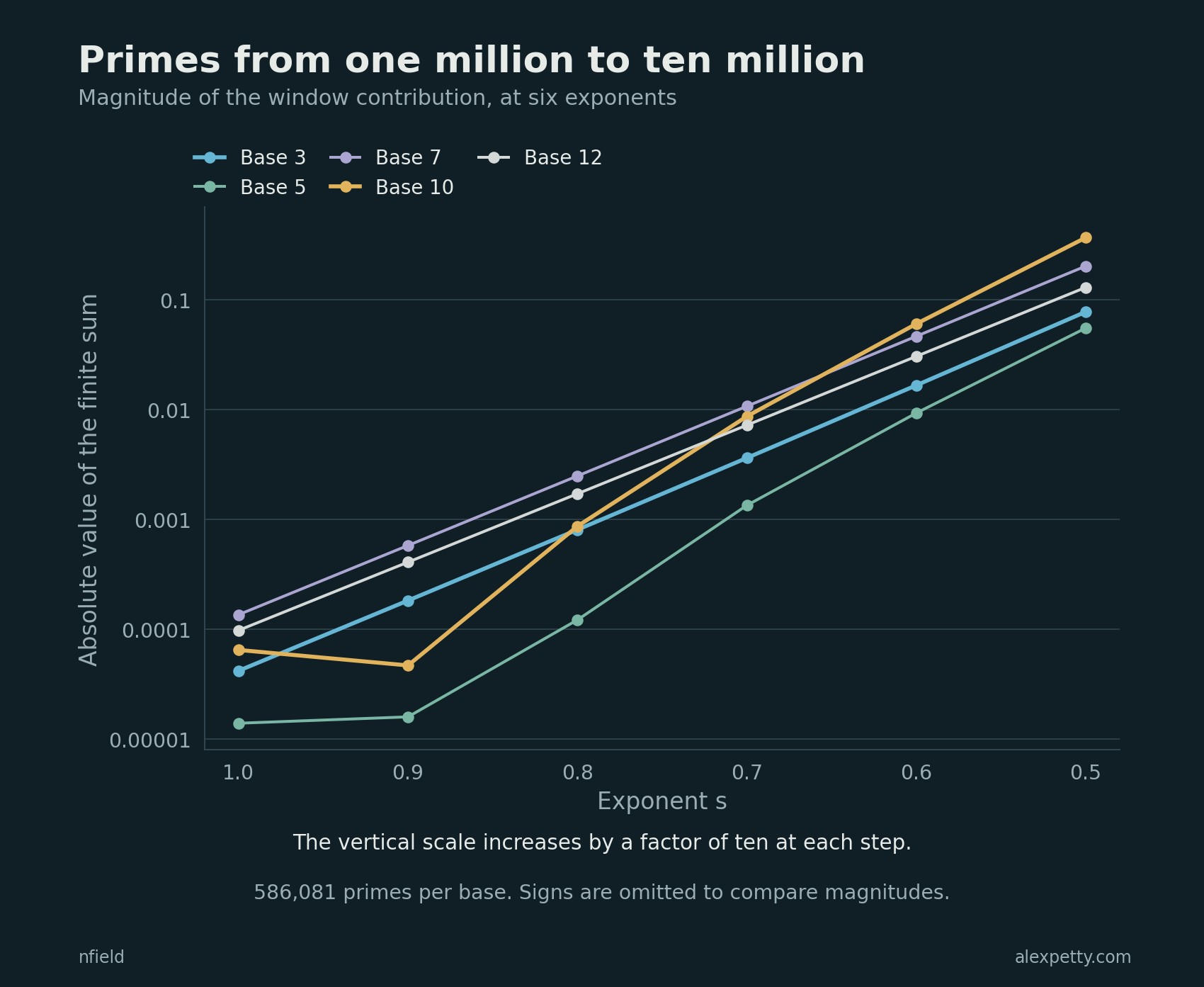
The proposed edge of convergence is one half, and the finite table can’t establish it alone. Even the conditional result leaves the line itself open. In the window between one and ten million, with the square-root divisor, the positive contributions total and the negative ones . Together they are all the window adds to the series, .
Discussion
Sign in to join the discussion.