Collisions
The Collision Spectrum

Each coefficient of the centered base-five collision table is a value of a Dirichlet -function times a short sum read off the diagonal of equal digit pairs. The new fact here concerns those diagonal sums. In every odd prime base, the squares of those diagonal sums add up to exactly . Scaled by that total they become weights that sum to one. Then the table’s squared entries, which total at base five, become an exact weighted average of , equal to at base five. The -values and the identity linking them to Bernoulli numbers are classical, and the digits supply the weights.
This is the third of the three preprints going up on arXiv this month, arXiv 2604.00054, beside The Collision Invariant and The Collision Transform. It distills the base-five results of The Collision Spectrum and the L-Function Landscape, the factorization of each coefficient, the collision energy of and the fourth moment , and proves the diagonal total in every base.
Eight sums drawn as walks
Each of those -values is an infinite sum, and a sum of complex numbers can be drawn. Put each term down as an arrow, tail at the tip of the one before, and the sum is wherever the arrows end up.
For the th arrow has length , and the character sets its direction. Take the character that turns eighteen degrees at each factor of two. Every that five doesn’t divide is a power of two modulo , say , and arrow points degrees around from straight right. Arrow points straight right with length . Arrow turns degrees with length . Since modulo , arrow turns degrees with length , arrow turns degrees with length , and arrow is skipped. Past the directions repeat, and over every block of twenty-five they point all around the circle and cancel. The shrinking arrows therefore settle toward one point, about . That point is . The other seven characters turn by other multiples of eighteen degrees and draw seven more walks.
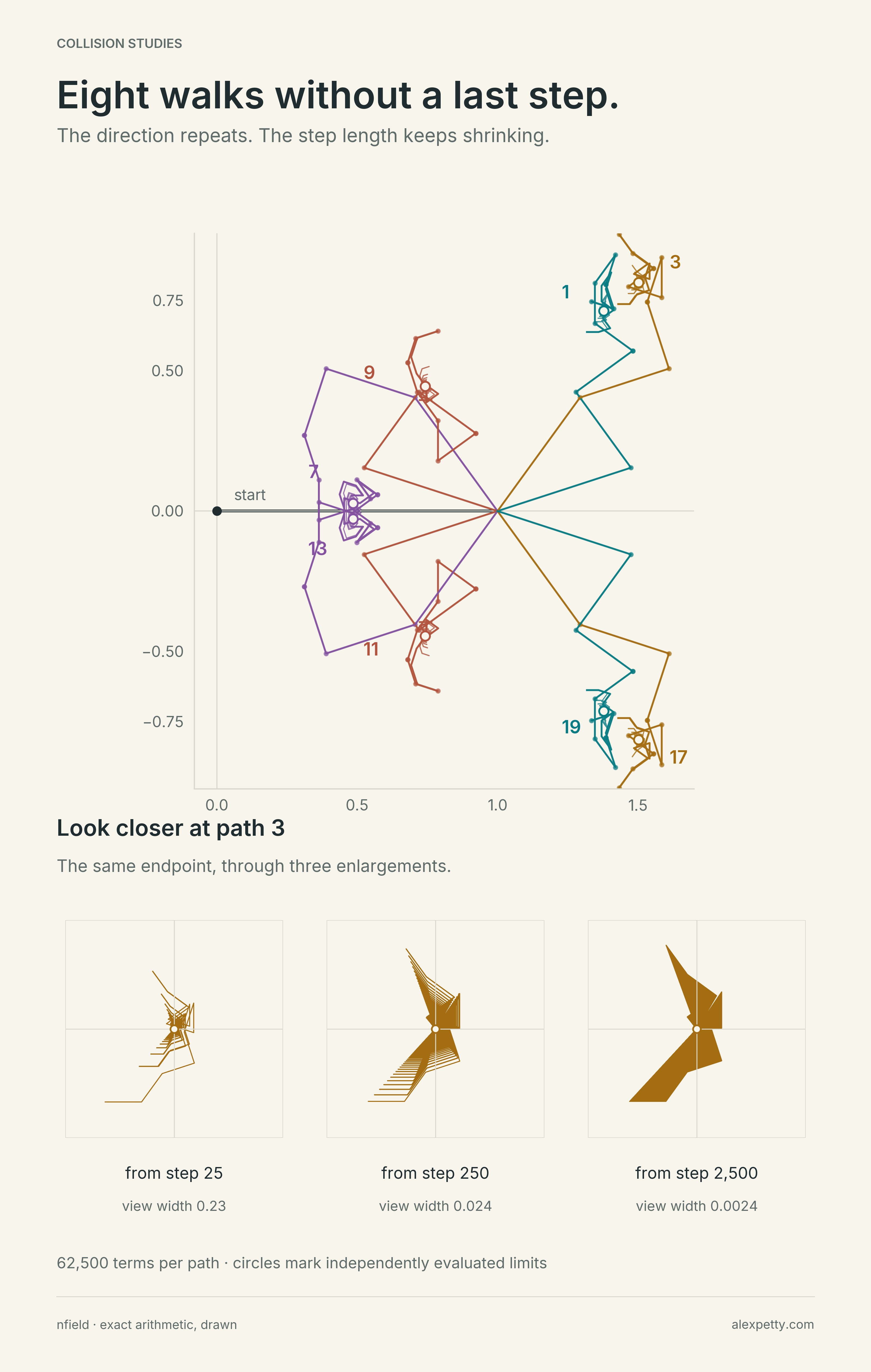
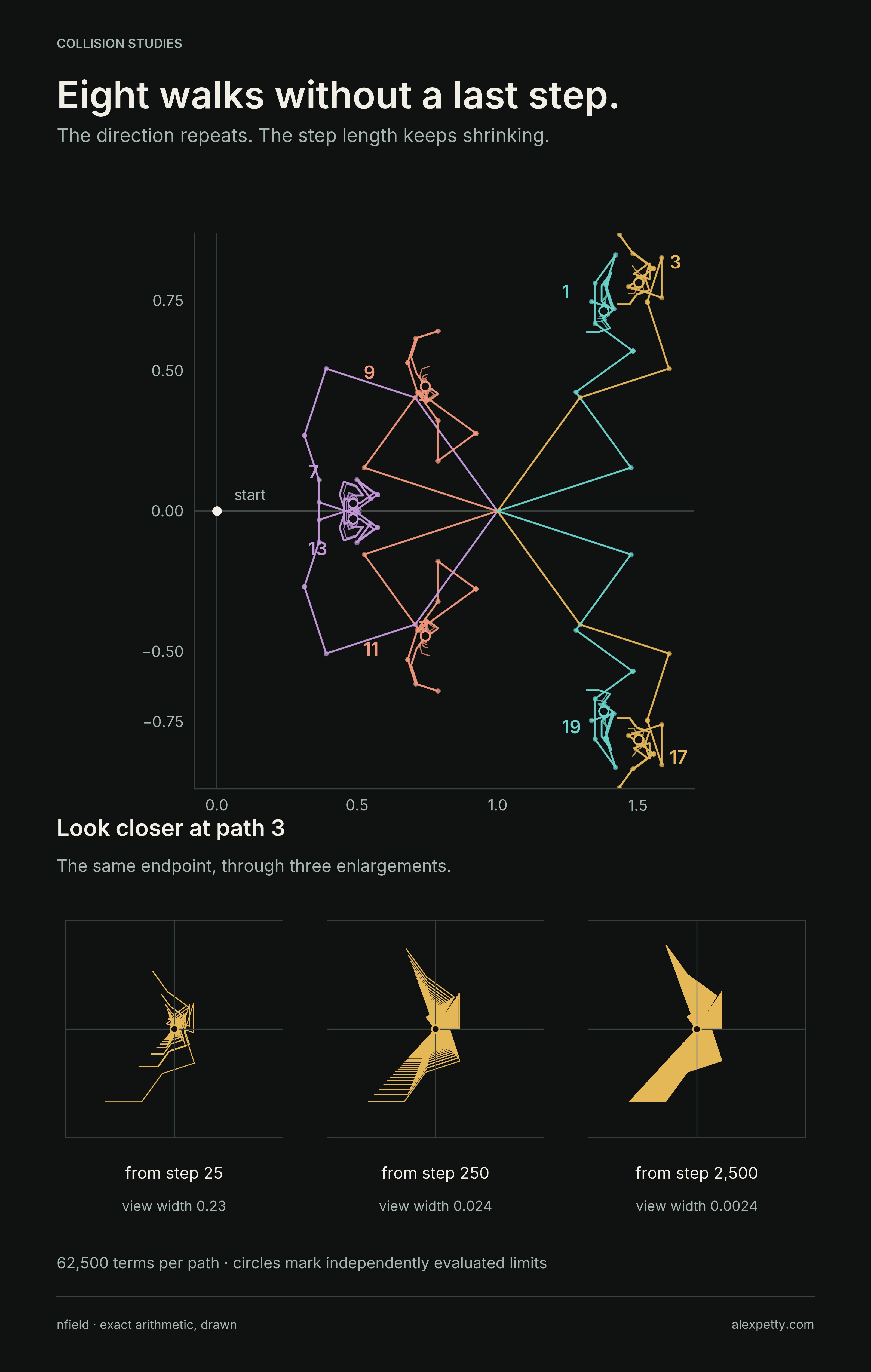
All eight walks take the same first step, one unit to the right, because every character points the number straight ahead. That is why their lines all leave from the point at on the axis. From the second arrow on they split up. The endpoints come in mirror pairs, four above the axis and four below, because two characters that turn by the same amount in opposite directions draw mirror-image walks. The open circles mark the limits computed independently, and after arrows every walk is still circling its own. The lower panels follow walk from arrow , from arrow and from arrow , each view ten times narrower than the last, and the path is still turning. An infinite sum has no last arrow, so the drawing only ever gets closer.
Eight matches at twenty-nine
The finite side starts with long division in base five, whose digits are through . Divide each number from through by and stack the repeating blocks, which are fourteen digits long, one under another.
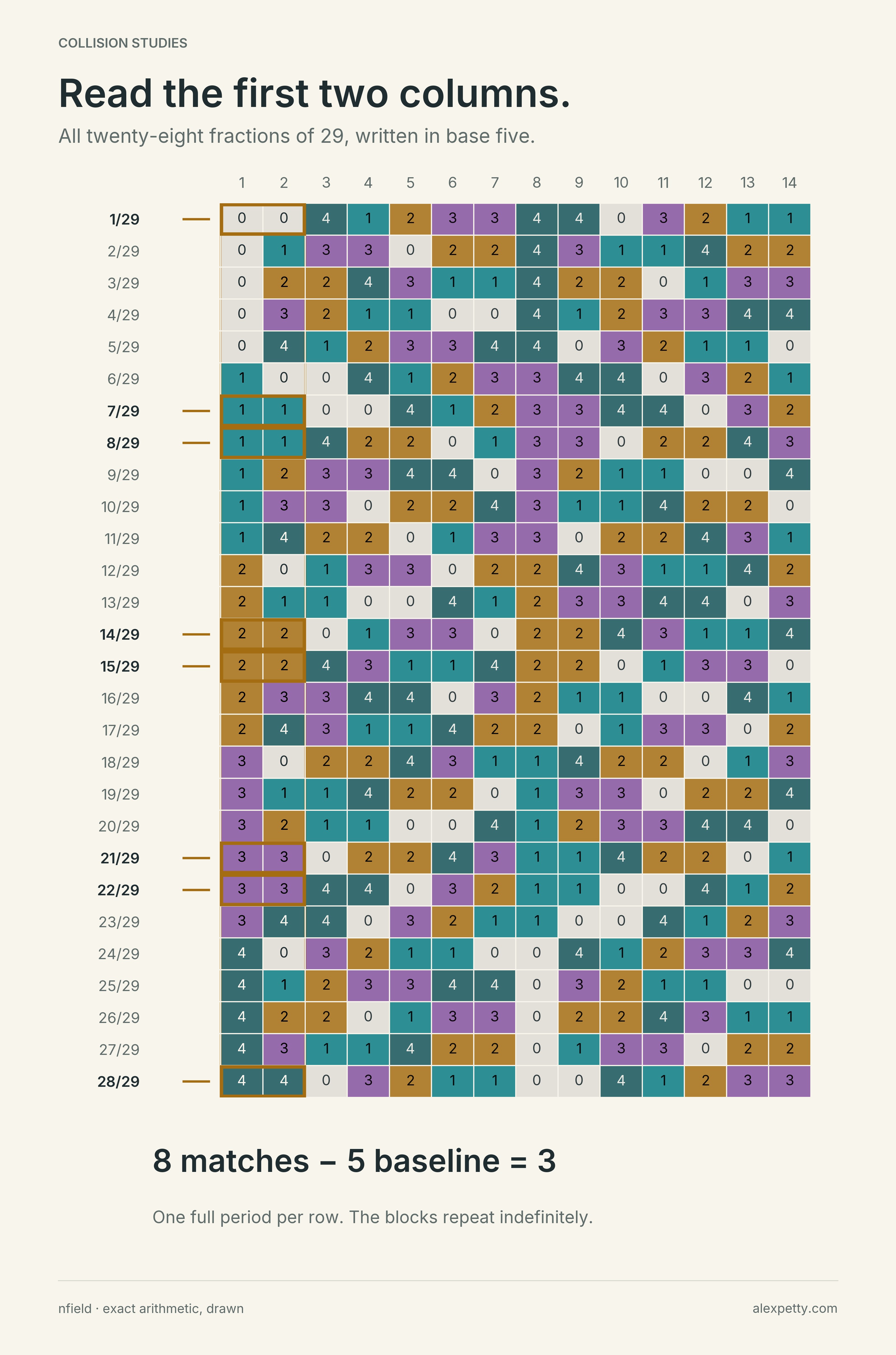
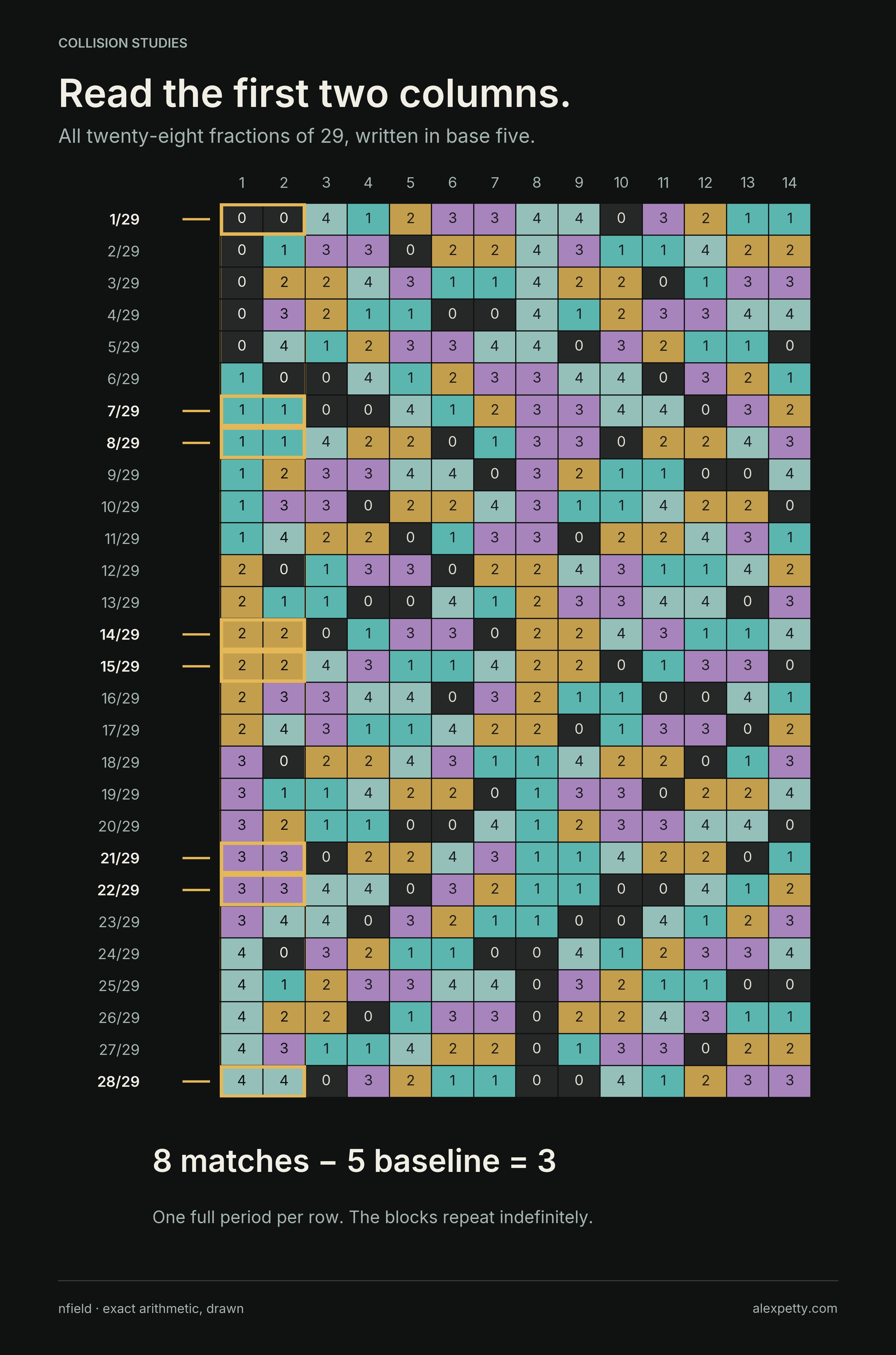
Read down the first two columns and box the rows whose two digits agree. There are eight, at , , , , , , and , beginning , , , , , , and . Read from the top and bottom at once and they pair up. The lone faces the lone , the two s face the two s, and the two s meet in the middle.
The first digits split the fractions into five bins of five or six, and eight matches against a smaller bin of five make a collision score of . That score depends only on the last two base-five digits of the denominator. Twenty-nine is in base five, so it reads cell , whose column averages , and the centered entry is
Doing the same for the other nineteen cells gives the centered table of The Collision Transform. Every column adds to zero, and every reflected pair of cells is opposite in sign.
The complete count and the two tables
The eight numerators whose first two base-five digits agree are 1, 7, 8, 14, 15, 21, 22 and 28. Their two-digit words are 00, 11, 11, 22, 22, 33, 33 and 44. The figure shows every fraction.
The raw lag-one collision table has twenty cells. The row supplies the first base-five digit of the address; the column supplies the last.
| First digit | Final 1 | Final 2 | Final 3 | Final 4 |
|---|---|---|---|---|
| 0 | 0 | 1 | 0 | 3 |
| 1 | 0 | -1 | 2 | -1 |
| 2 | 0 | 1 | -2 | -1 |
| 3 | 0 | -3 | 0 | -1 |
| 4 | -4 | -1 | -2 | -1 |
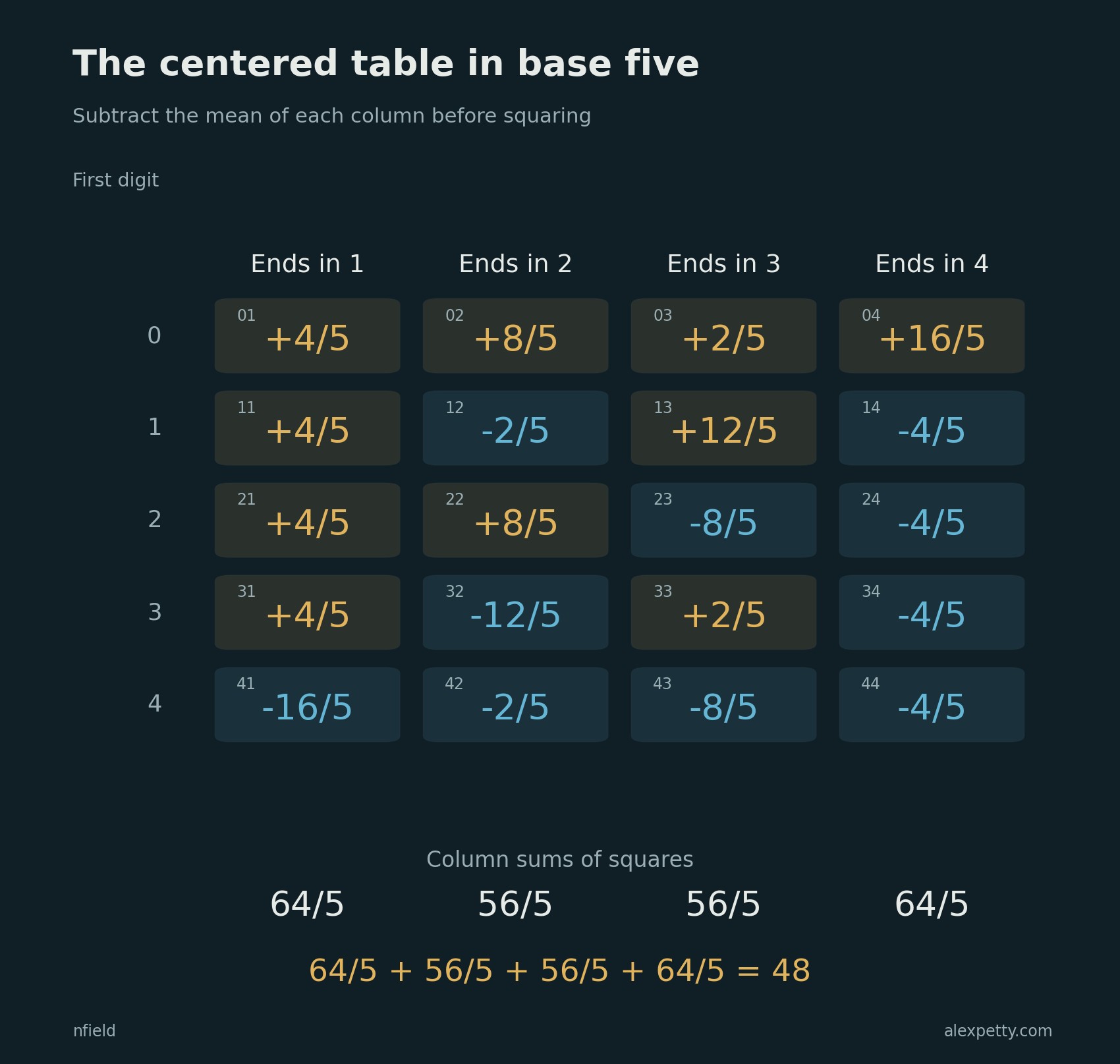
The column means are . Subtract them to get
| First digit | Final 1 | Final 2 | Final 3 | Final 4 |
|---|---|---|---|---|
| 0 | 4/5 | 8/5 | 2/5 | 16/5 |
| 1 | 4/5 | -2/5 | 12/5 | -4/5 |
| 2 | 4/5 | 8/5 | -8/5 | -4/5 |
| 3 | 4/5 | -12/5 | 2/5 | -4/5 |
| 4 | -16/5 | -2/5 | -8/5 | -4/5 |
The entries belong to the residue classes modulo 25 coprime to five. The formula applies to every denominator above 25 in those classes, prime or not.
The same amount, differently arranged
Square each centered entry and add. Squaring stops the negative entries from cancelling the positive ones, so the total measures how much variation the table holds. The twenty squares add to exactly , and that survives a change of coordinates. The table can be read address by address, or as a mixture of repeating patterns, the Dirichlet characters modulo . Only eight patterns are needed, and the eight coefficients rebuild the whole table.
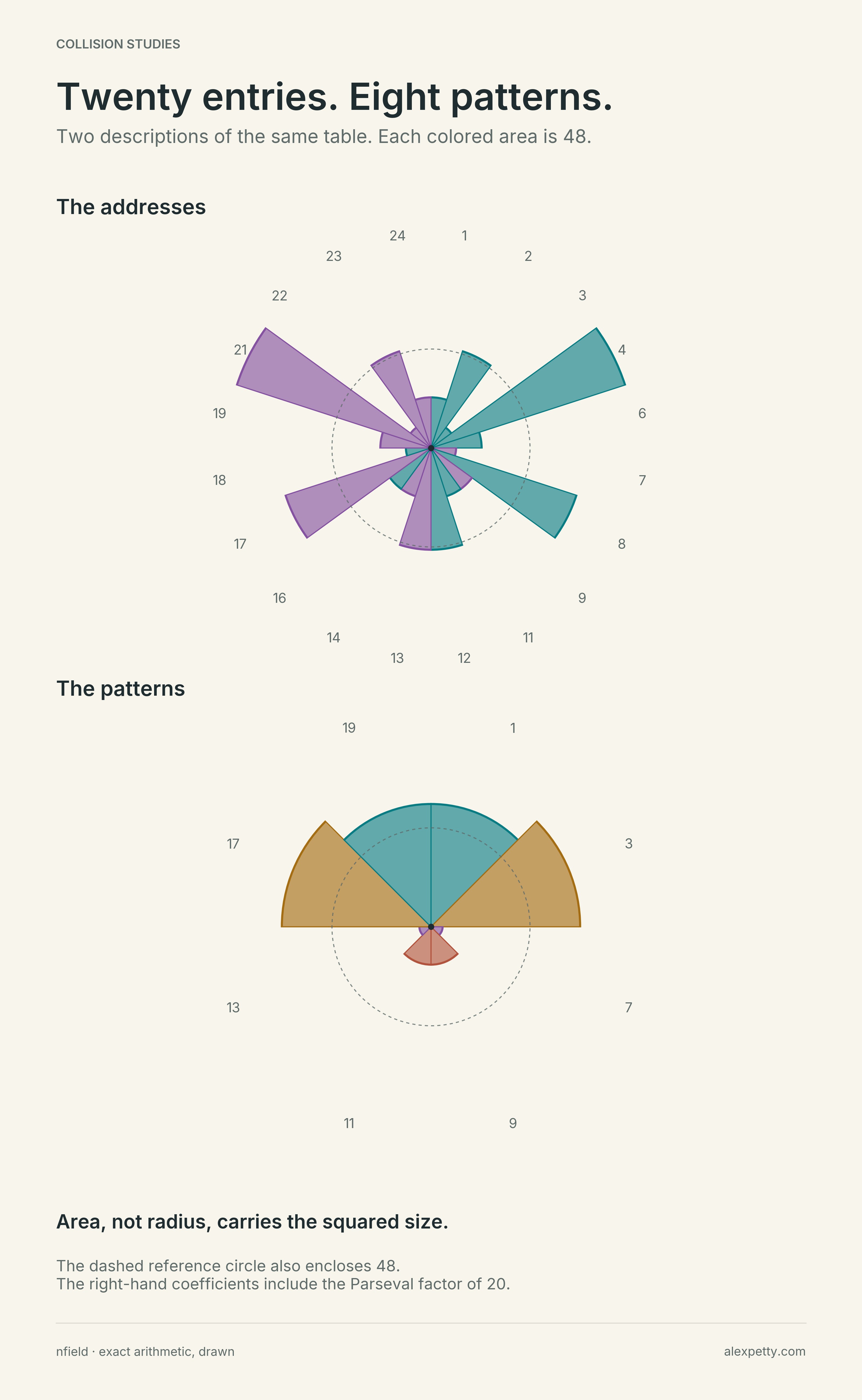
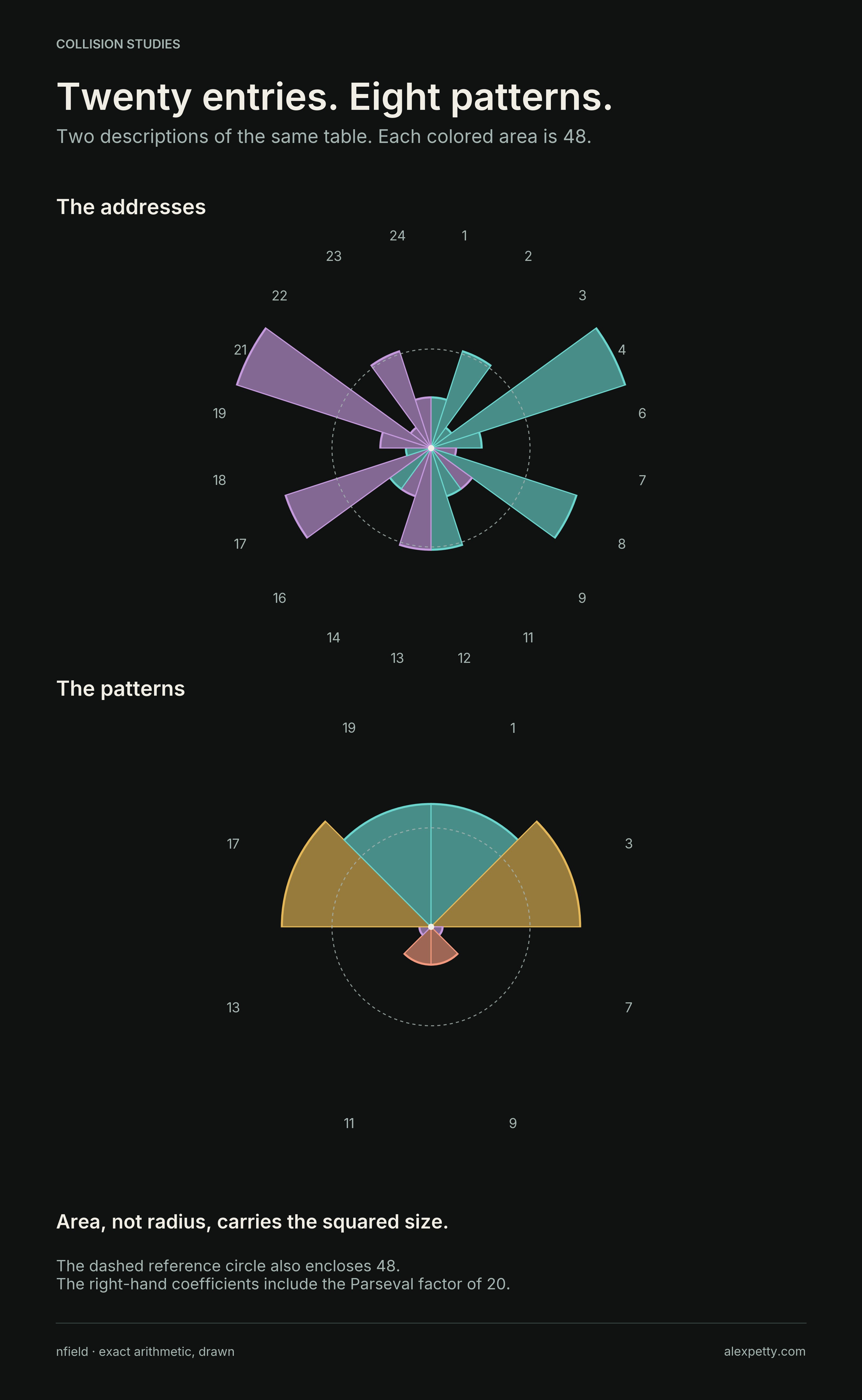
The two shapes in the figure look nothing alike and enclose the same area, the dashed circle’s . In the upper one each of the twenty addresses gets a sector whose area is its squared entry, so the long spokes at and are the two entries of size . In the lower one the area belongs to the eight patterns. The pairs and and and take nearly all of it, and , , and get the small wedge at the bottom. That conservation of squared size is Parseval’s identity, and it lets the total be computed in whichever coordinates are easiest. Twenty small fractions are very easy coordinates.
Eight patterns and the factor twenty
The patterns are Dirichlet characters modulo 25. Write . A character respects multiplication, so this choice fixes its value at every eligible address. It is zero at multiples of five.
Each nonprincipal character has total weight zero over a period. Its partial sums are therefore bounded, and Dirichlet’s test proves convergence after division by . The finite paths in the opening illustrate that theorem. They do not establish it by getting close to an endpoint.
Reflection removes the even characters. Family centering removes those inherited from modulo five. The eight primitive odd characters have indices
With the average normalization
Parseval reads
The spectral shape therefore assigns each sector area . The original shape assigns area . Sector areas, rather than radii, represent the quantities. All sectors are shown on the same area scale.
The endpoints enter the count
The eight patterns are also the direction rules of the eight walks. At step the character gives the direction and the length, so summing forever gives . The connection runs deeper than a shared label. Each coefficient factors into the -value, a factor fixed by the boundaries of the matching-digit intervals, and a phase that turns the product without changing its length.
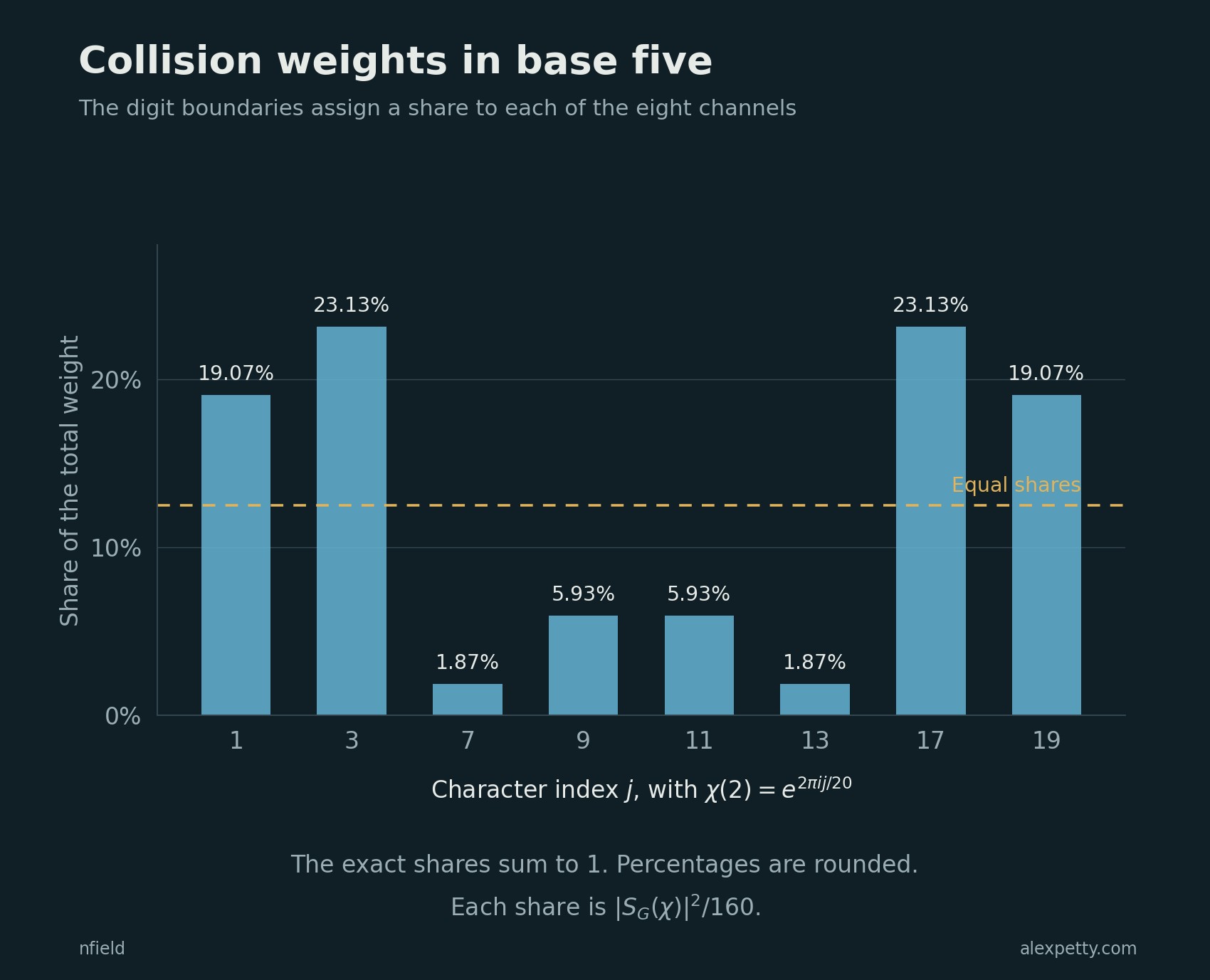
In base five the boundary factor comes from four small integers, the right-hand ends , , and of the matching intervals among the twenty-five equal pieces of the unit interval. No large prime enters that calculation. The boundary factors give the eight squared distances unequal weights, some counting far more than others, and the total weight has an exact formula. Normalized to one, it turns the conserved into the weighted average of the squared distances,
No walk had to be followed to its end. One exact statistic of all eight came straight from the finite table.
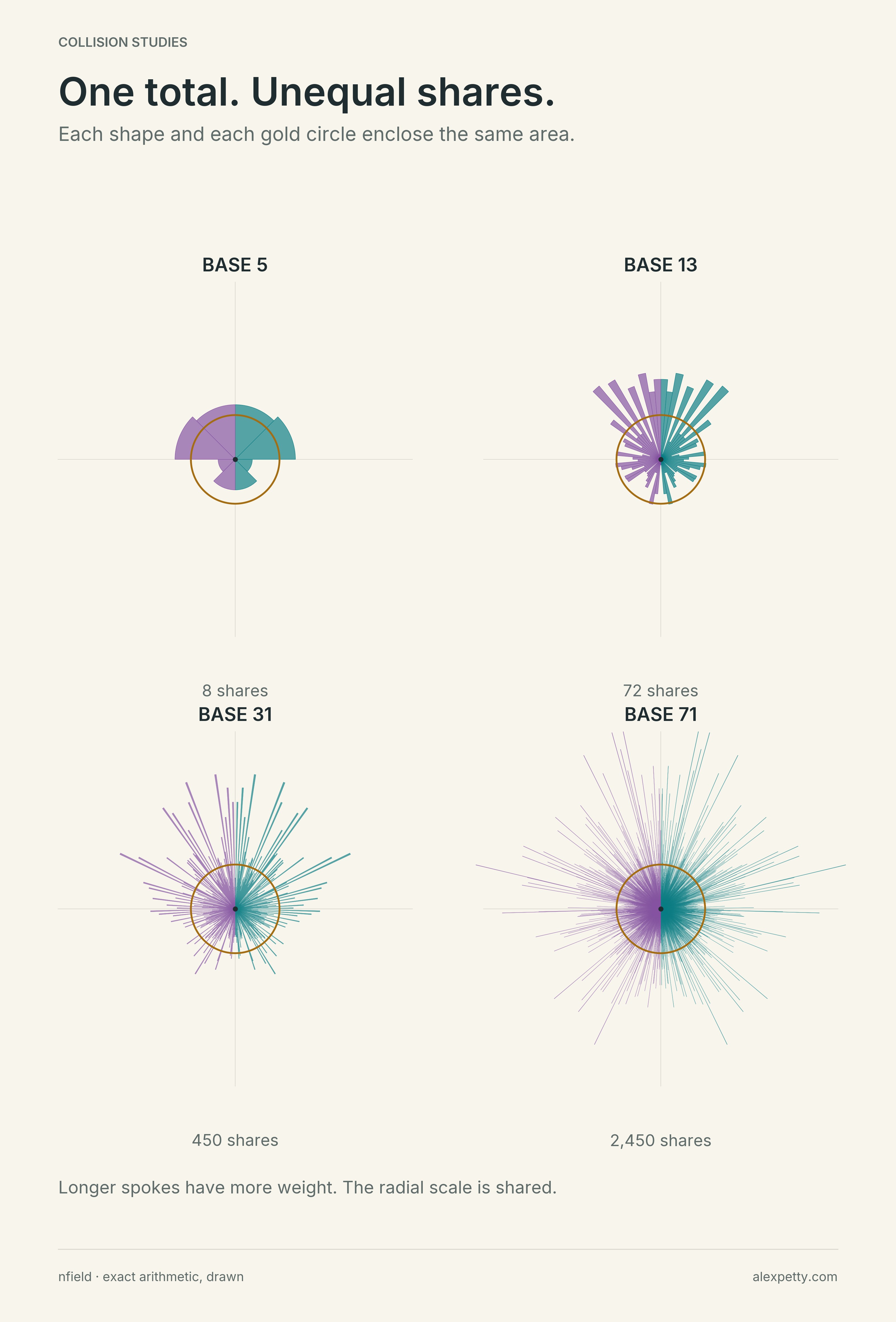
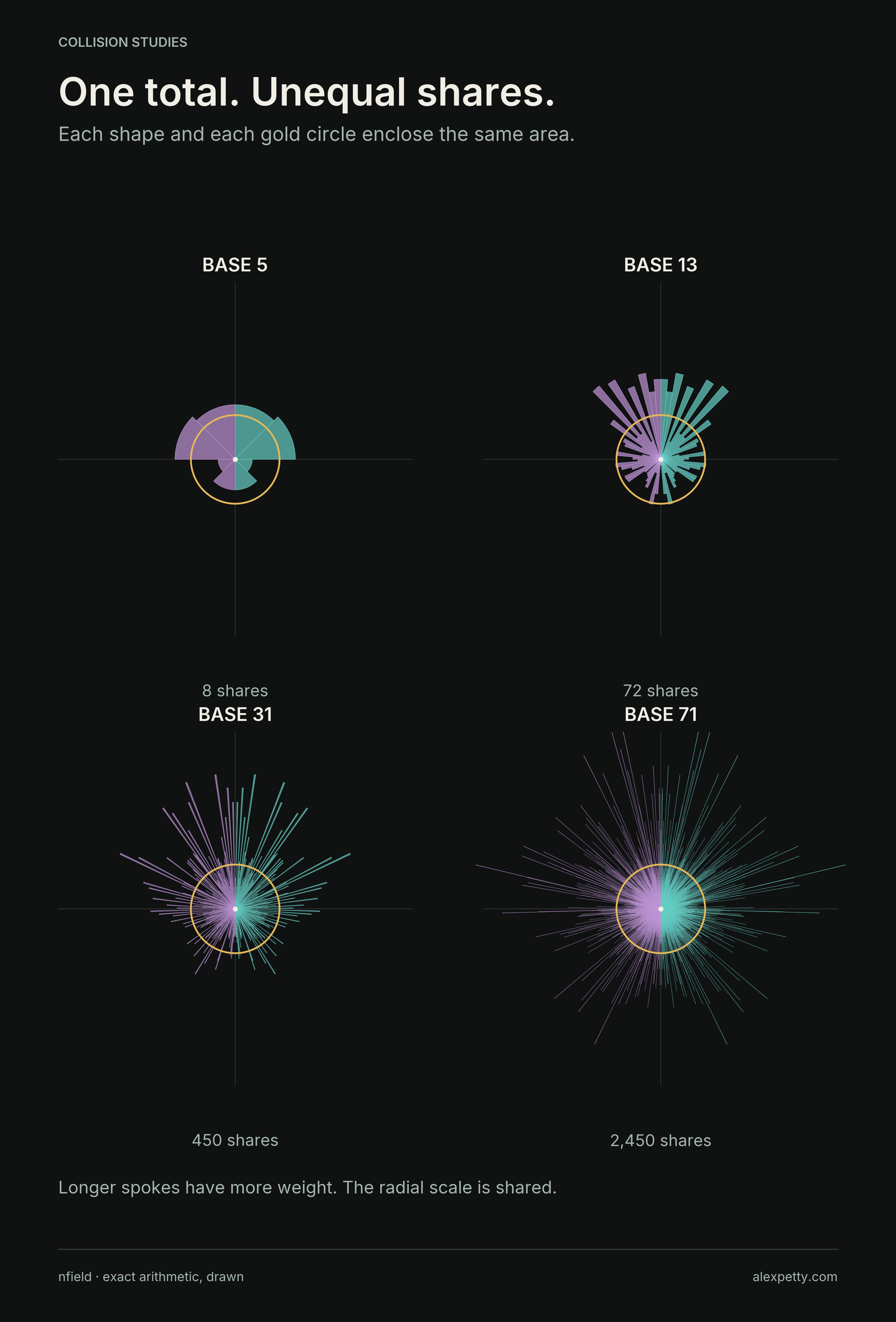
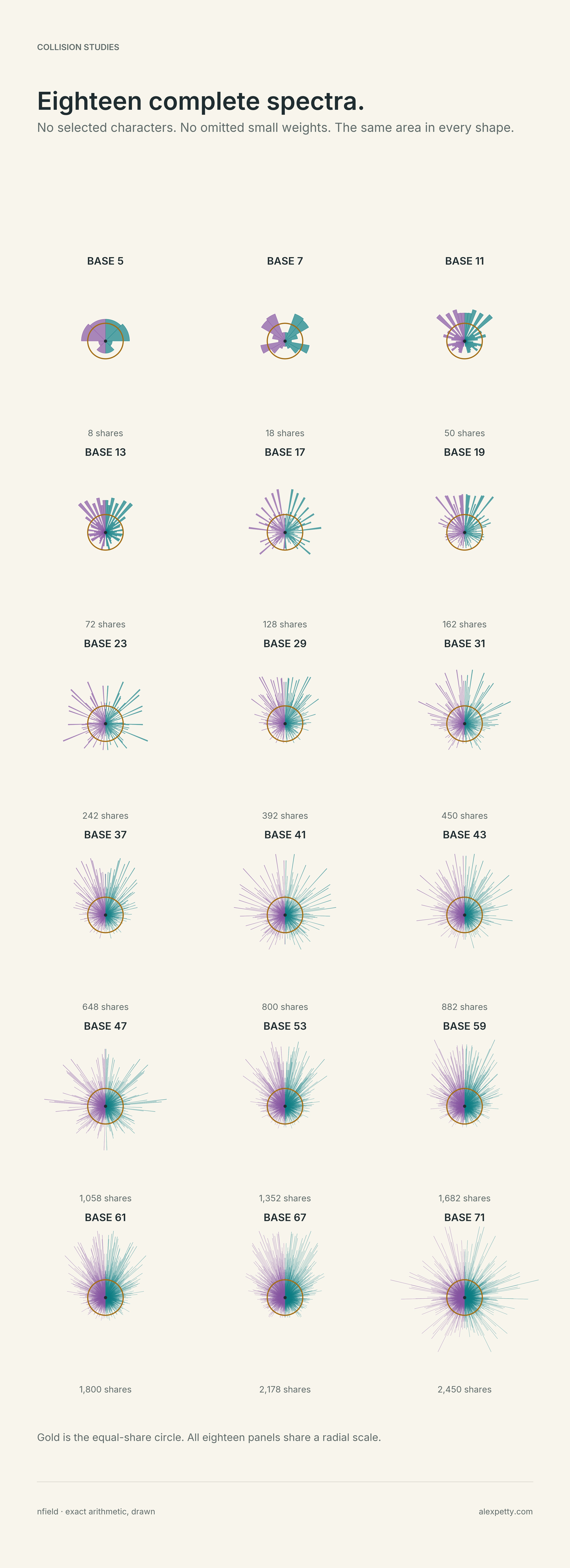
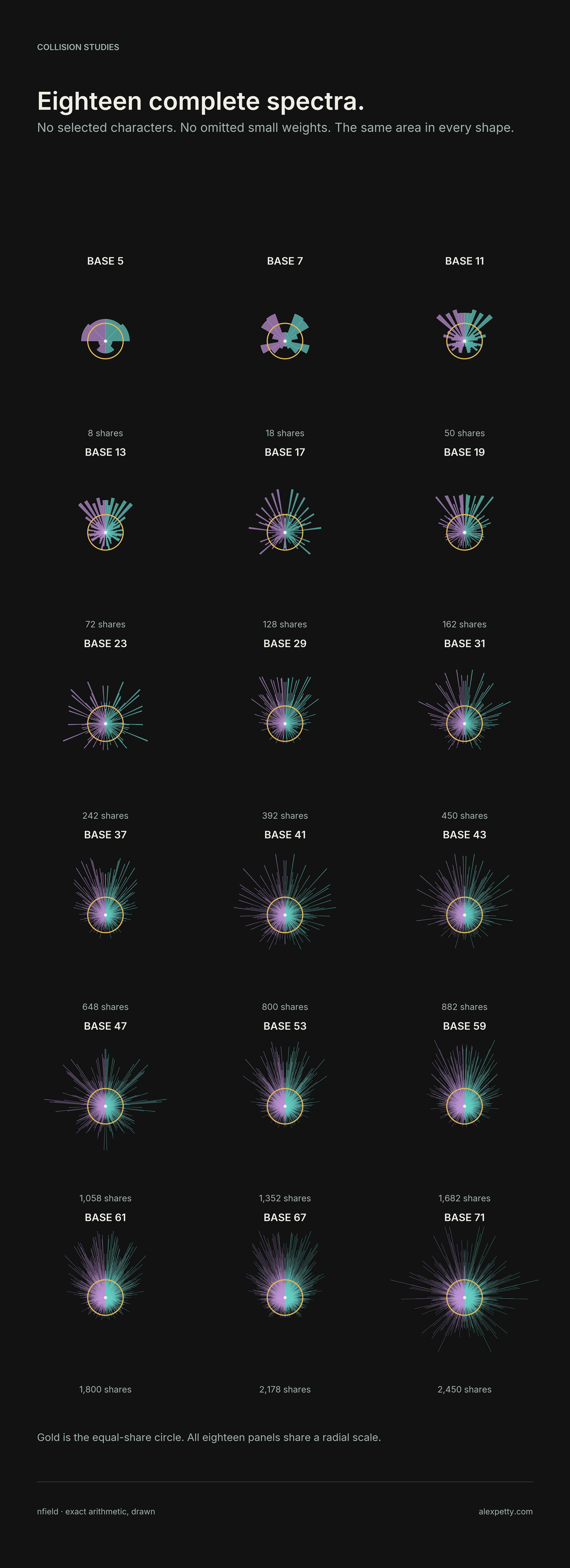
Every shape in the figure, and every gold circle, encloses the same area, one full unit of weight. At base five the eight shares make a fan with two broad wedges and two thin ones. At thirteen there are shares and the spokes start to vary, and at thirty-one there are . At seventy-one the shares burst into a ragged star, its longest spokes reaching far past the circle while most of the rest sit inside it. The total never changes. Only its allocation does, and the shapes at larger bases are finite records with no limiting shape claimed.
The exact weights and weighted mean
For an odd prime base , the diagonal boundary factor is
Summing over all primitive odd characters gives the exact total
Thus sums to one. The coefficient factorization and Parseval give
At five, the total boundary mass is 160 and the table energy is 48. Substitution gives .
| Character index | Share | Squared distance |
|---|---|---|
| 1 | 19.07164% | 2.409338 |
| 3 | 23.13314% | 2.922431 |
| 7 | 1.86686% | 0.235843 |
| 9 | 5.92836% | 0.748935 |
| 11 | 5.92836% | 0.748935 |
| 13 | 1.86686% | 0.235843 |
| 17 | 23.13314% | 2.922431 |
| 19 | 19.07164% | 2.409338 |
The total-mass proof expands a squared boundary sum into ordered pairs. Character orthogonality retains equal endpoints modulo , rejects opposite endpoints at that modulus, and subtracts the inherited modulo- contribution. The two lower-modulus counts cancel in total. At five, the endpoint sum has squared total . Doubling each endpoint sum gives the boundary-factor total 160. The Collision Spectrum has the full proof.
A second copy of the distance
Base five has one more exact relation. Its normalized weight is proportional to the squared distance itself,
so a walk that ends twice as far from the start gets four times the weight. The weighted average then holds two copies of the same squared distance and becomes a fourth power,
about , though the fraction is the exact value. A finite polynomial identity proves that extra relation at base five. Nothing here assumes the two factors ought to resemble each other in other bases, and I don’t extend it on the strength of a picture.
Check the fourth-power identity
At base five the exact relation is
Insert it into the weighted mean to get
For the finite certificate, set
Write and . At primitive twentieth roots, . The finite certificate is
where
and
The factor vanishes at those roots. The Collision Spectrum identifies the two polynomials with the Bernoulli and boundary factors. Their magnitude relation gives the displayed weight formula, character by character.
Keep following the patterns
The digit fields below show every numerator and one complete period at six denominators. They share the same five-color digit key. At larger denominators the individual cells become too small at reading width. Open the full-resolution plate to inspect them.
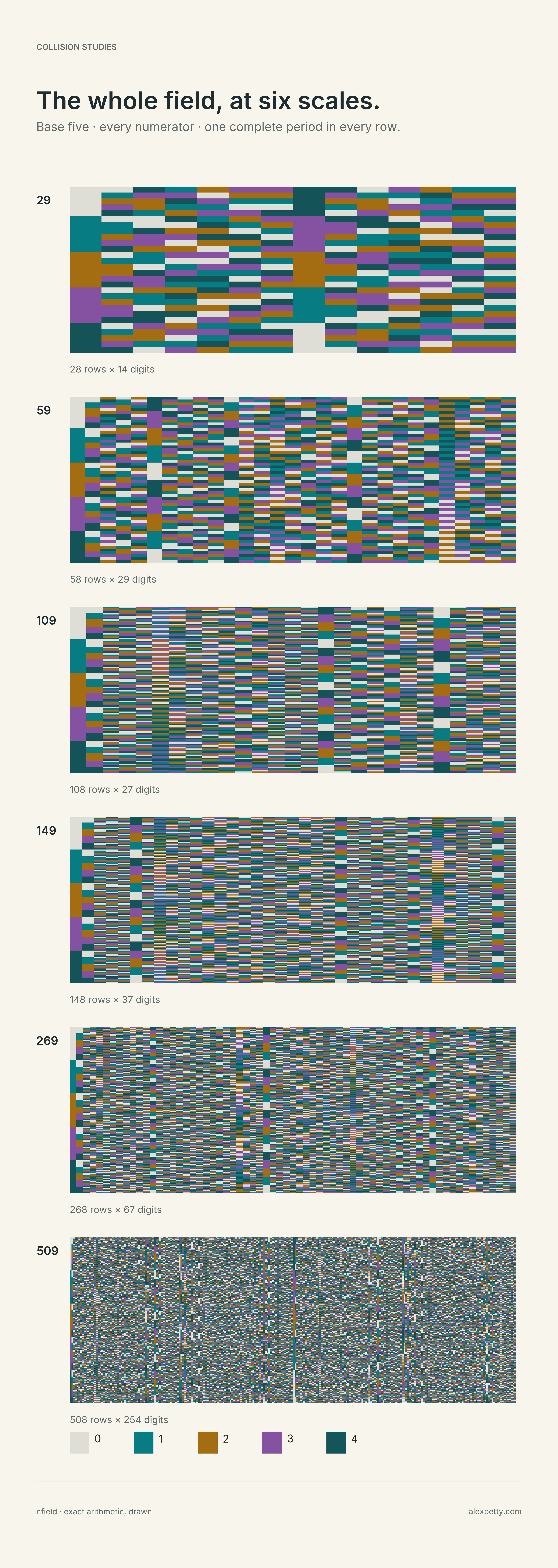
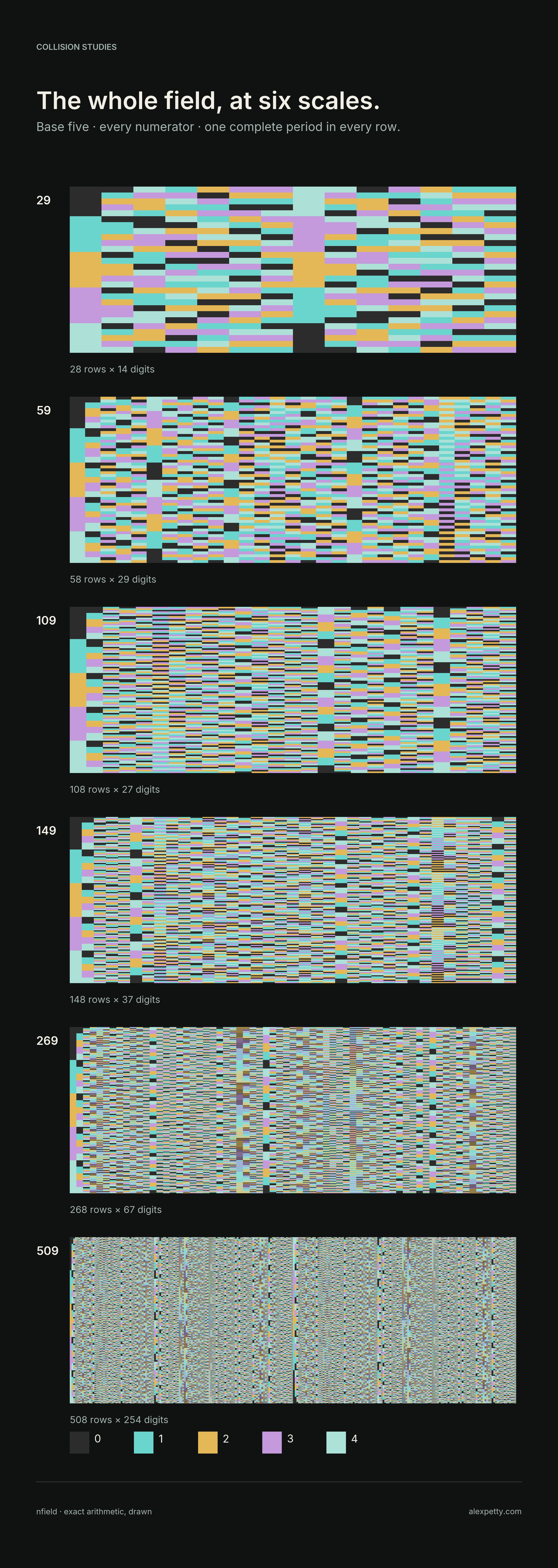
The second atlas keeps every primitive odd character at eighteen prime bases. Sector area represents normalized weight, with the same total area and radial scale throughout. The unit circle marks equal weights.
Three additional plots retain the individual numerical comparisons.
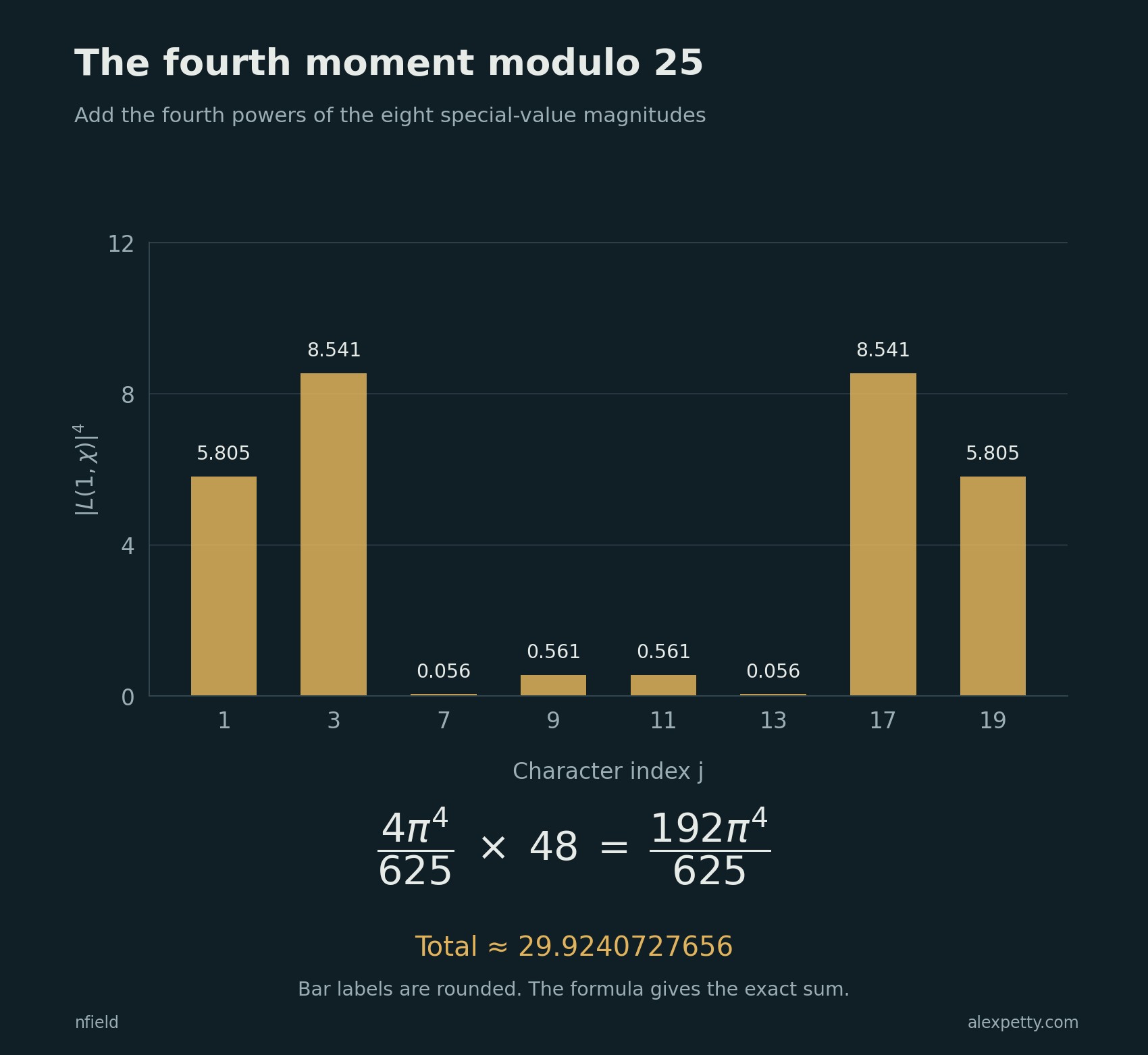
The exact total of the weights holds at every base, and their allocation is the part still to understand. At seventy-one the boundary factors and the -values share channels unevenly, and how they divide the weight as the base grows is open. At five the two factors are exactly proportional, which they are at no other base through seventy-one, and that proportionality is what makes the sum of the eight fourth powers exactly .
Discussion
Sign in to join the discussion.