Collisions
The Collision Invariant

Line up the repeating decimal of with a copy of itself shifted one place, and count the digits that match. The count looks as if it should depend on everything about the prime. Instead it obeys a few exact laws that hold for every prime at once, and for most denominators that aren’t prime as well. In decimal, exactly nine multipliers move every remainder to a different digit, whatever the prime. The number of matches is fixed, up to the size of a digit bin, by the last two digits of the denominator. Those laws are the ground the rest of this work builds on, the character sums and the -functions included.
Until now this series has been research notes, each one following the question the last one left open. This paper is the first place the notes are distilled. It states the laws once, with complete proofs that stand without the notes. It is the first of three preprints going up on arXiv this month, arXiv 2604.00045, with The Collision Transform and The Collision Spectrum beside it.
The paper proves four such laws, in any base . Exactly multipliers send every remainder to a different digit bin. The collision deviation at lag is fixed by the last digits of the denominator, and no fewer digits will do. Reflection pairs each ending with its complement so that the two values add to , which puts the average at exactly . Underneath that, every interior interval splits the unit classes exactly in half. All four come out of one change of coordinates, in which multiplying by the base turns the digit bins into ordinary congruence classes. For most of them neither a prime nor a primitive root is needed.
Watch the narrated slides
I walk through the argument in sixteen slides, from a pair of matching digits to the finite table and its reflection law.
Another video presentation I’m trying out
I tried Gemini Notebook’s new video capability on this paper, and it did a pretty good job. Many of the animated illustrations are generic, though. They look fine, but they don’t explain the mathematics being discussed. With more control over what the pictures actually show, this could become a useful tool for presenting research before long.
One table, three papers
The path through the notes runs from Three and the Golden Ratio and The Cross-Alignment Matrix, through digit bins and The Collision Periodic Table, to character sums and -functions. The three preprints put it into one argument. The first fixes the finite object and the rules it obeys, the second resolves it into characters and samples it at primes, and the third factors the characters and finds the -values inside.
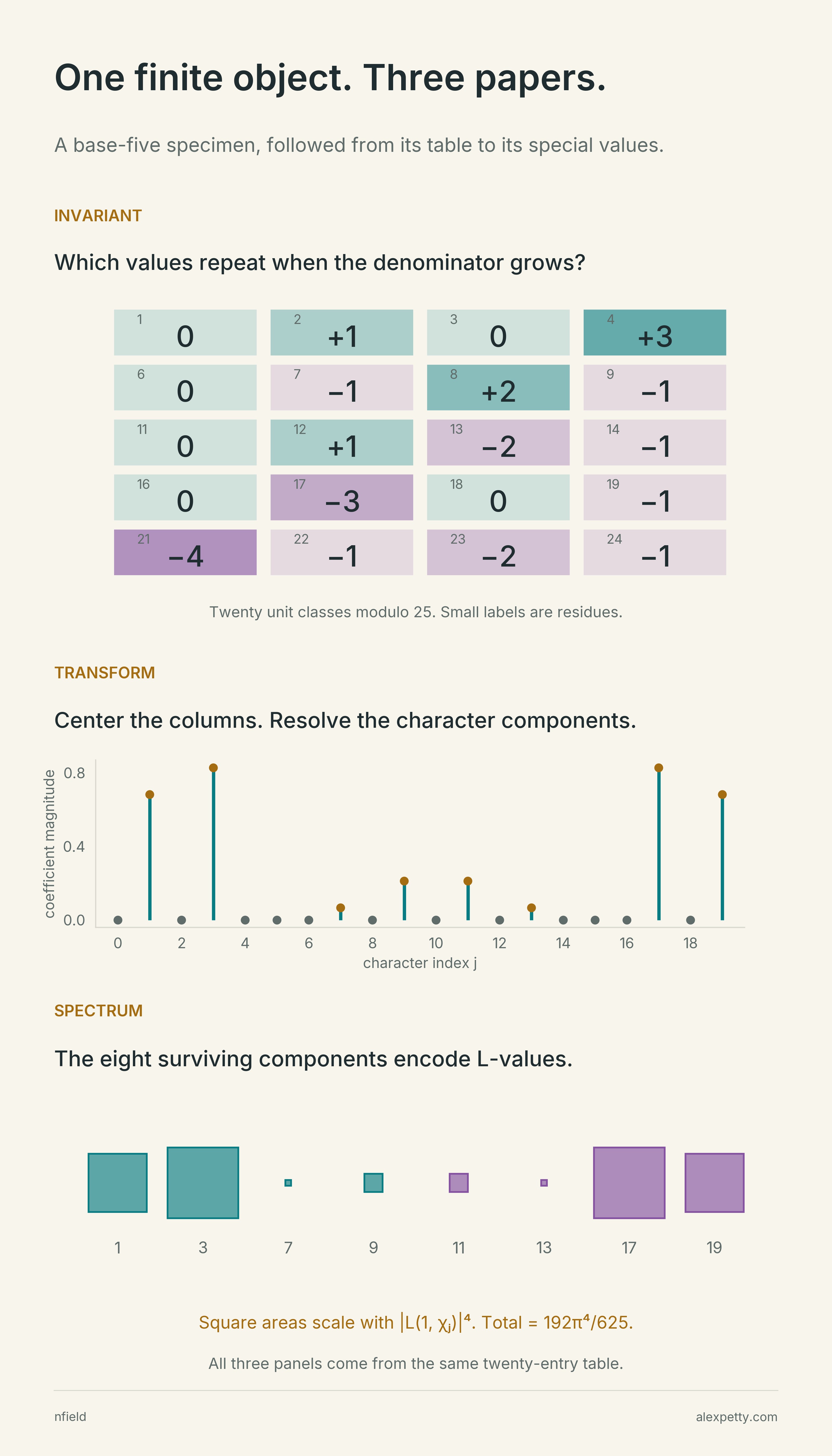
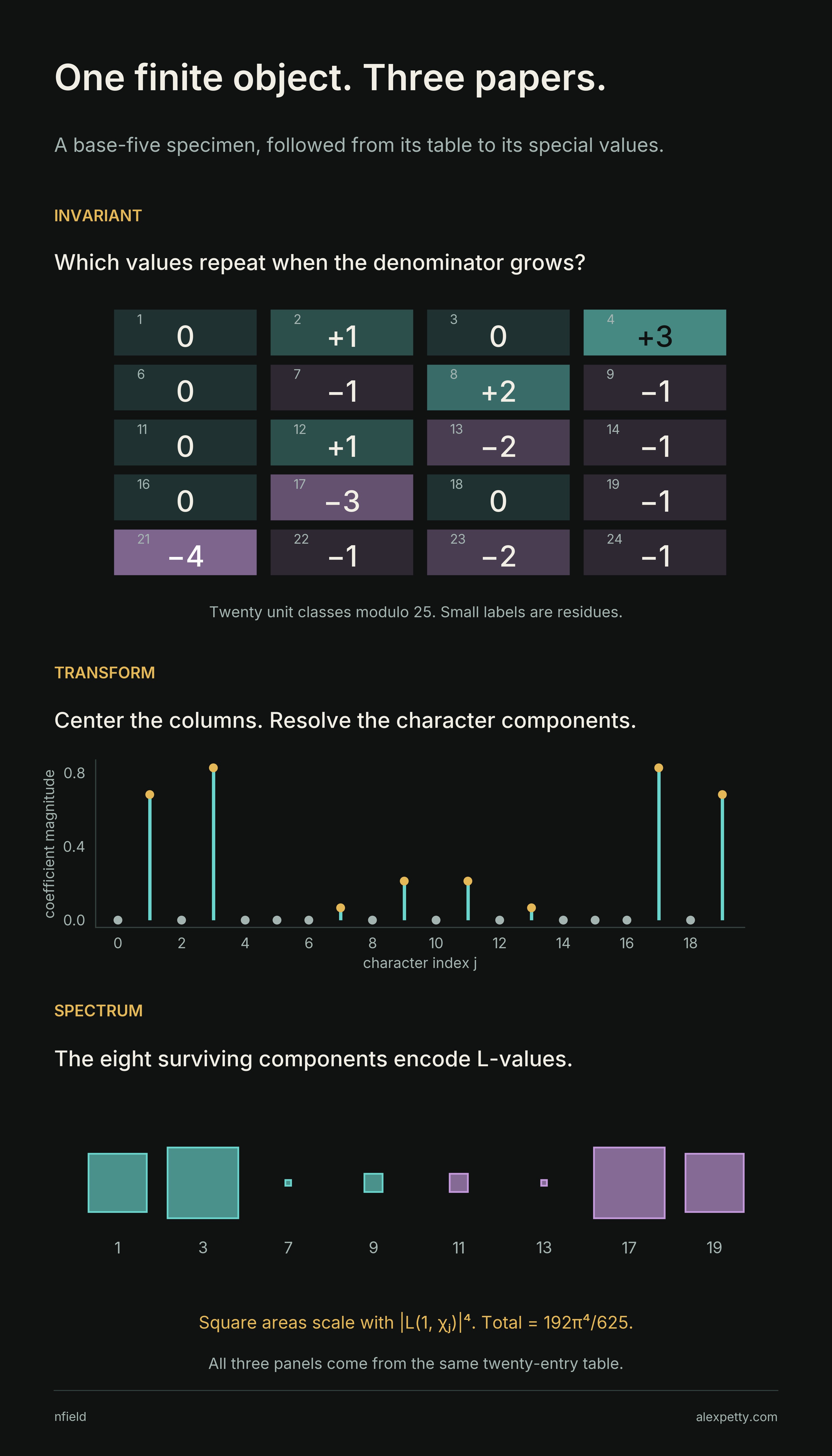
The figure follows one base-five table through all three. At the top are its twenty entries modulo , the values that repeat however large the denominator grows. In the middle, once each column is centered, only eight of the twenty character coefficients are left standing, with the tallest pairs at and , then and . At the bottom each surviving character becomes a square whose area scales with , and the squares add to . Everything below the top row belongs to the other two papers. This one stays with the table.
A collision at thirteen
The basic event is easy to watch. Divide by and by ,
and both decimals begin with , so the remainders and sit in the same digit bin. Multiply the remainder by and reduce modulo ,
and it lands on , still in bin . That is a collision, a multiplier carrying a remainder to another remainder with the same leading digit.
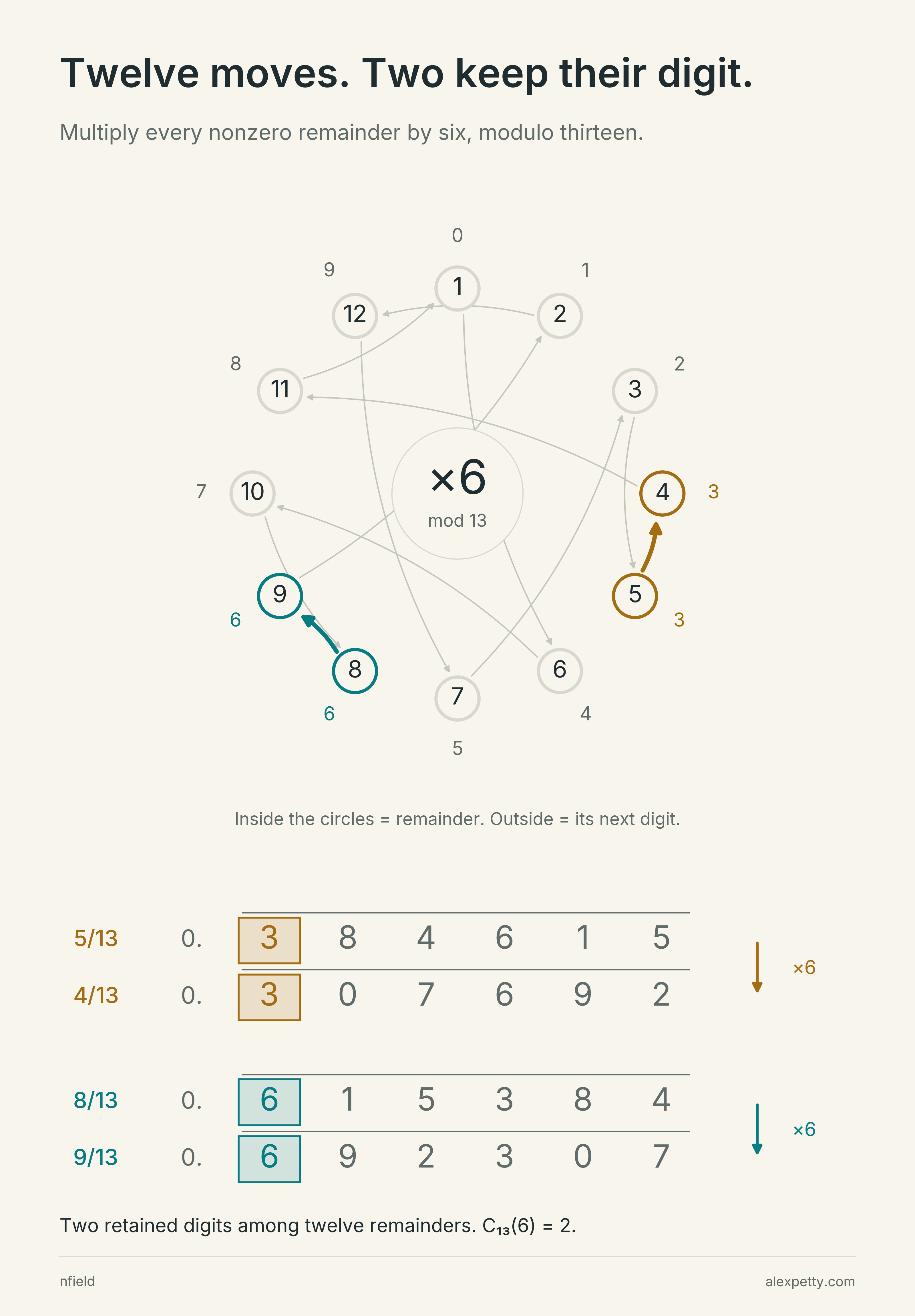
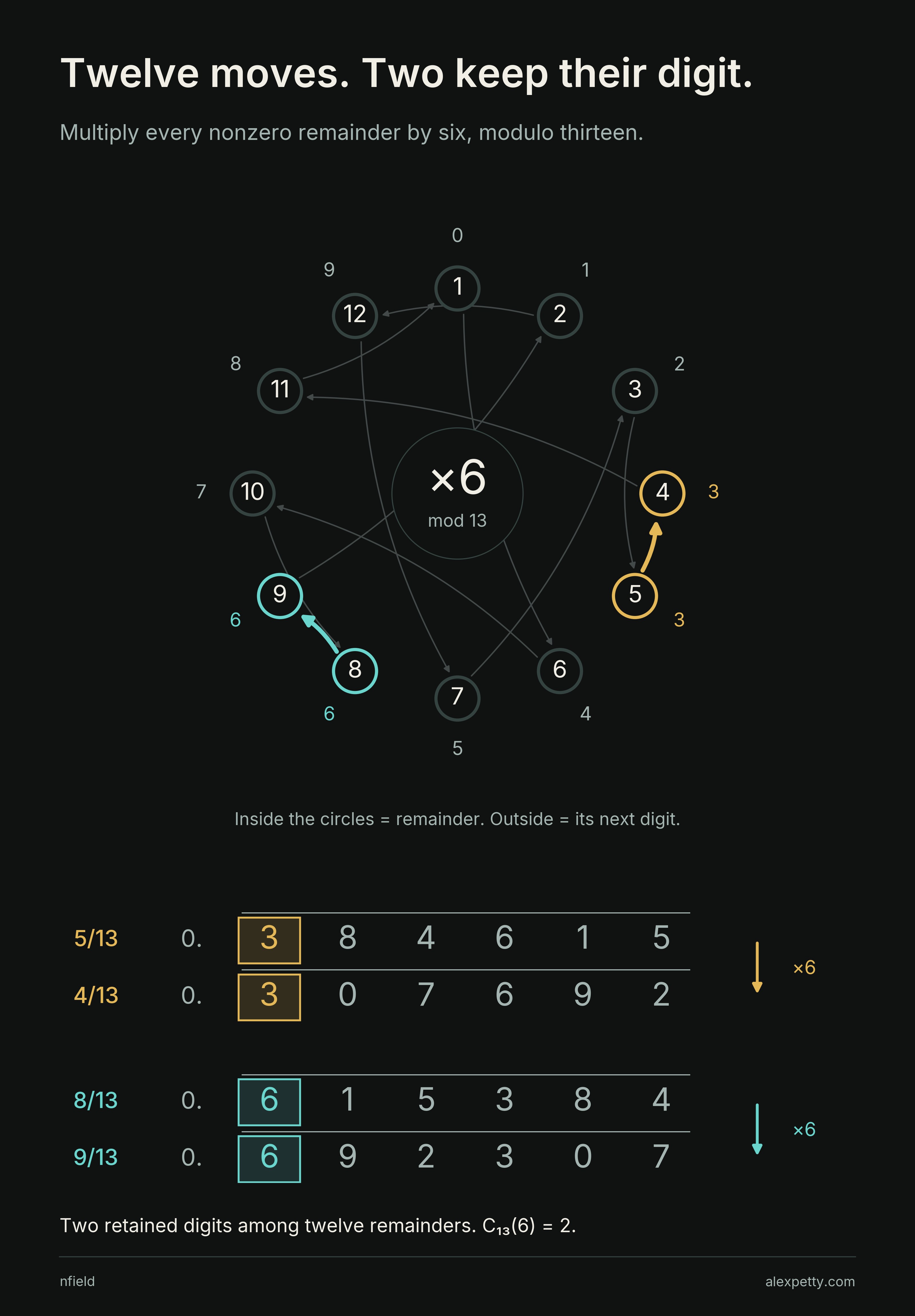
On the circle, multiplying by six sends each of the twelve remainders somewhere else, and the gray arrows nearly all change the outer digit. Only two arrows keep it, the gold one from to inside bin and the teal one from to inside bin . The decimals underneath show the same pairs, and both starting with , and both starting with . So .
Bins into classes
The digit a remainder writes next in base is
which rounds down, so and both give . Multiply each remainder by the base and reduce, and the bins turn into something more familiar.
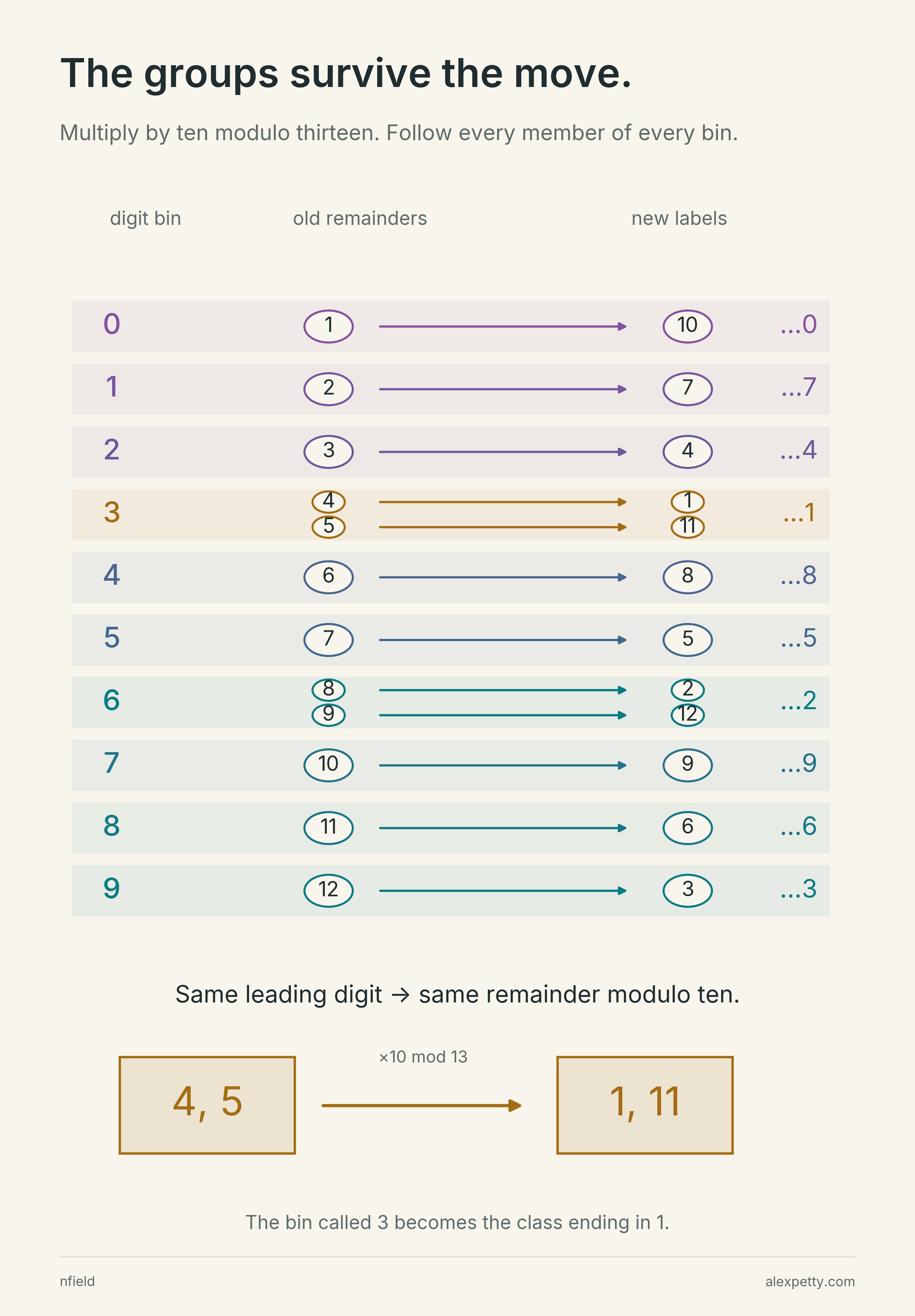
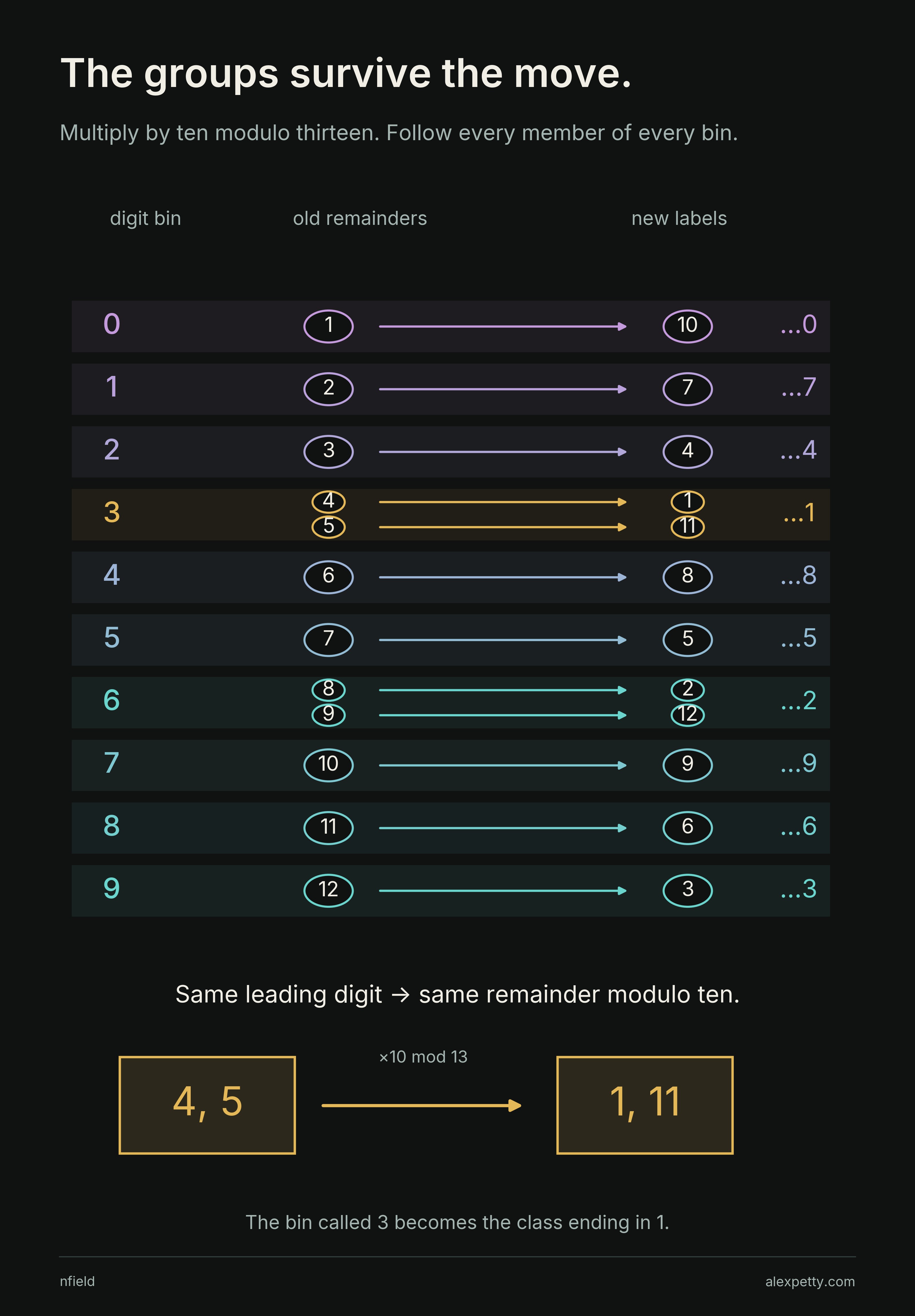
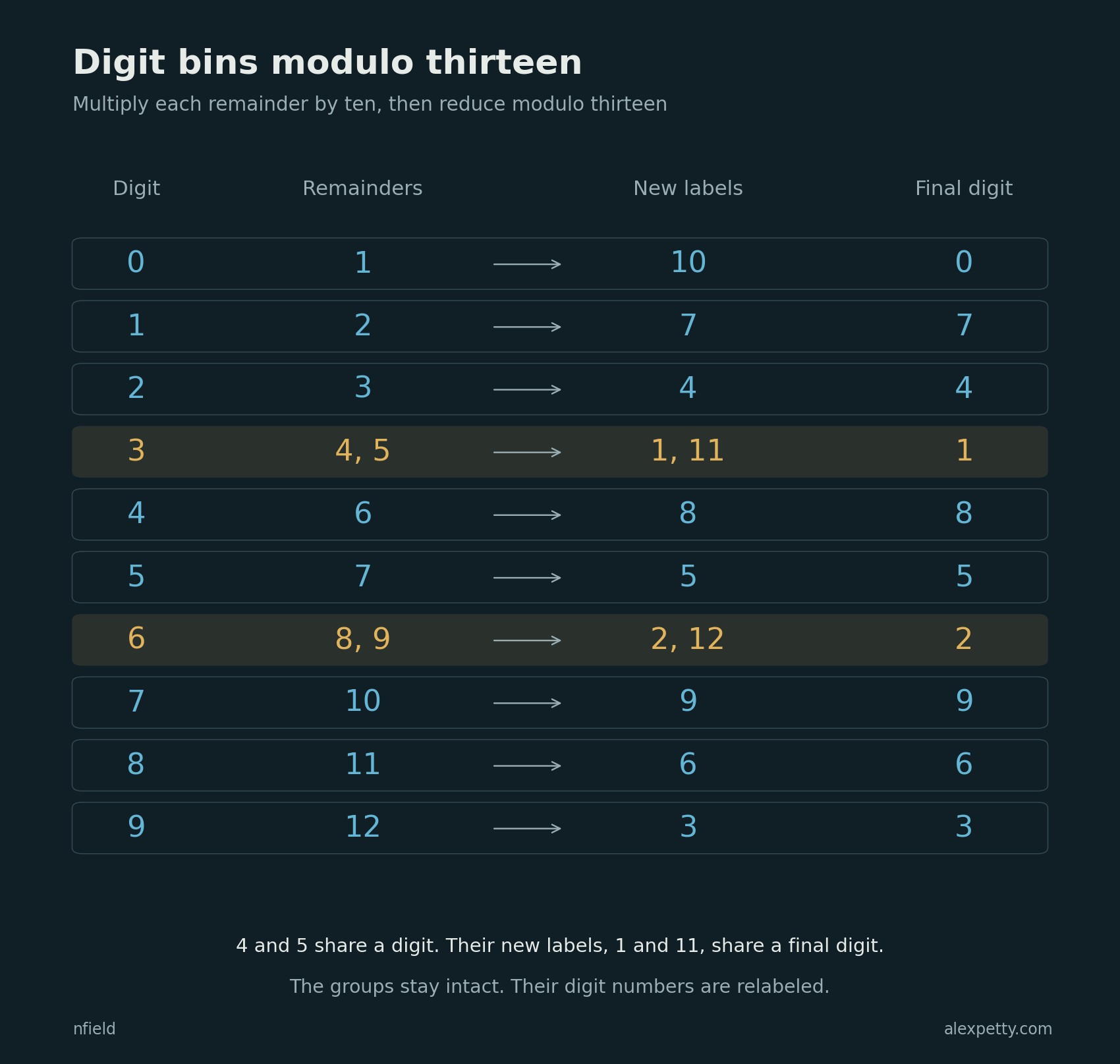
Each row of the figure is one digit bin at thirteen, with its old remainders on the left and their images under multiplication by ten on the right. Bin holds and , and they go to and , which both end in . Bin holds and and goes to and , both ending in . Every bin keeps its members together and picks up a new name, the last digit they now share. Interval boundaries have become a test of congruence, which is far easier to count with.
Long division explains it. Write , where is the new remainder. Modulo this says , and is invertible modulo , so the digit and the last digit of determine each other. The same linearization works for any denominator coprime to , prime or not, using every remainder from to , even those no single repeating block visits.
Nine empty multipliers
At thirteen, multiplication by gives two collisions and so does multiplication by . Every other multiplier except the identity gives none.
| Multiplier | 2 | 3 | 4 | 5 | 6 | 7 | 8 | 9 | 10 | 11 | 12 |
|---|---|---|---|---|---|---|---|---|---|---|---|
| Collisions | 0 | 0 | 0 | 0 | 2 | 0 | 0 | 0 | 0 | 2 | 0 |
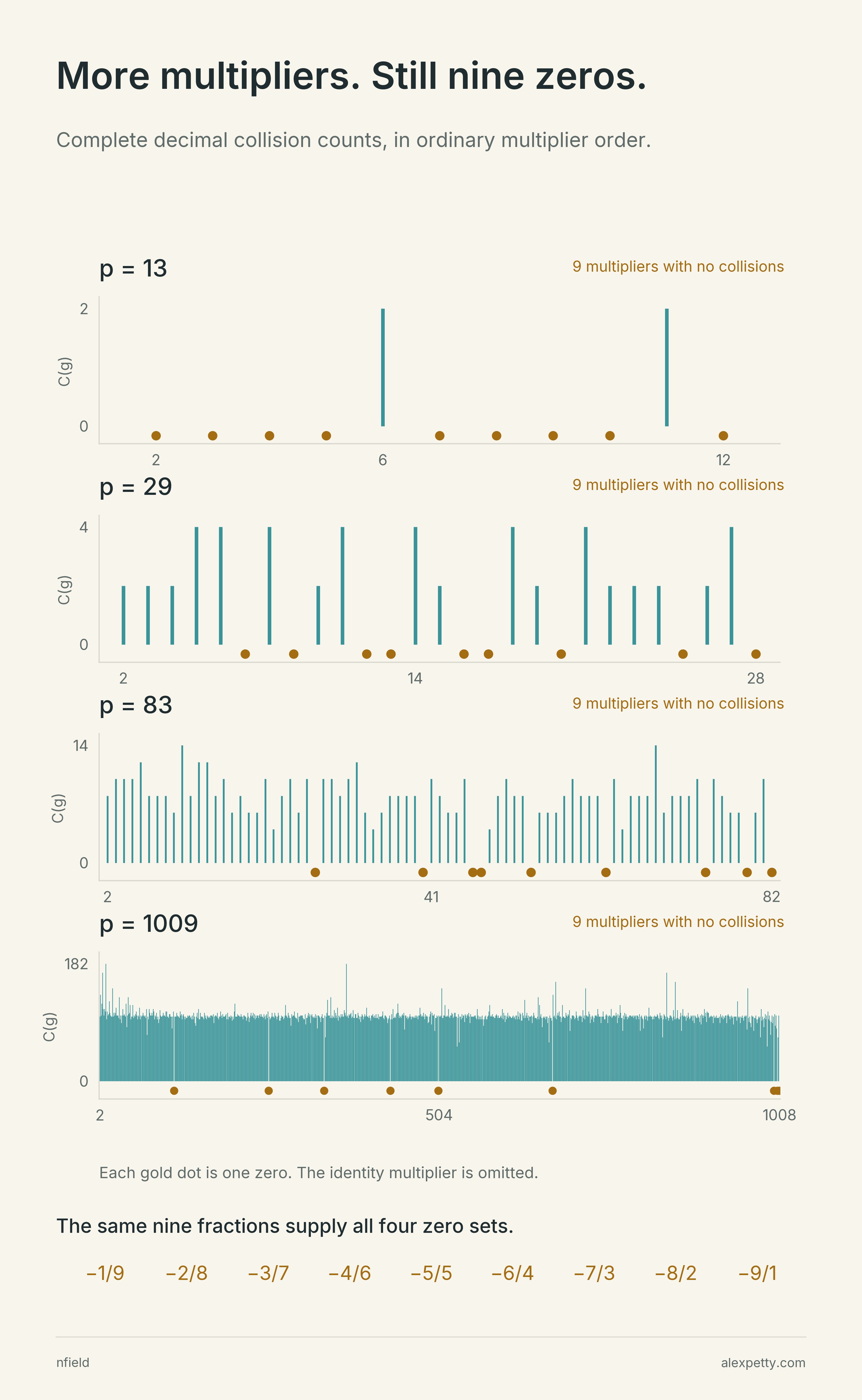
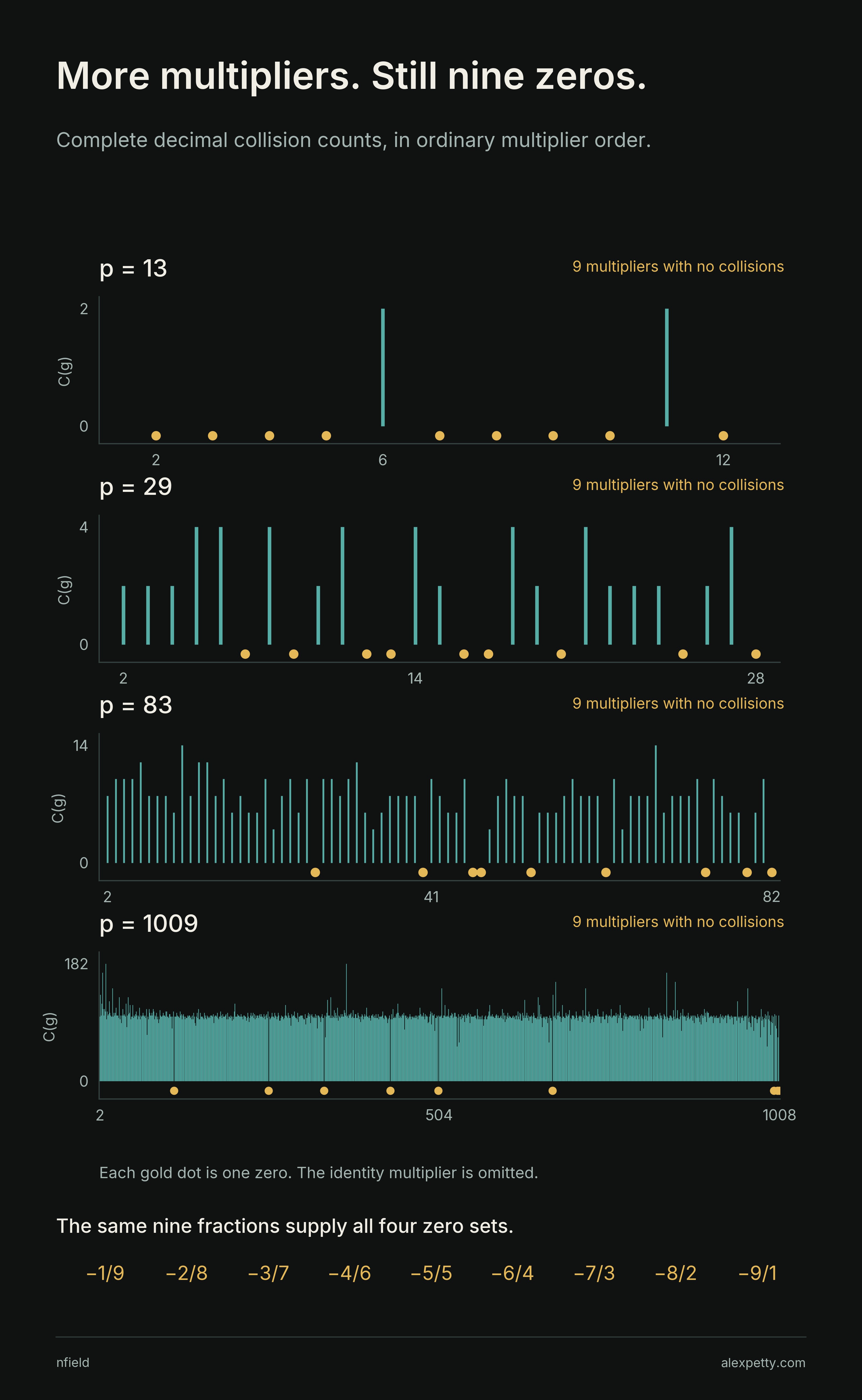
The gold dots along the bottom of each panel are the zeros. There are nine at , nine at , nine at , and at , with more than a thousand multipliers and counts reaching , still nine. Bin Derangements and the Gate Width Theorem gave the whole list, and the nine fractions printed under the panels are that list. For any prime , the collision-free multipliers are
which are distinct residues fixed before the prime is chosen. In decimal, gives , which is modulo , and the middle choice gives . In an even base that multiplier sends digit to , and since no digit is its own complement, every remainder leaves its bin. The same count shows that every collision count is even, because each collision comes with a partner displaced the opposite way.
The list is complete
For a nonidentity multiplier , let be the integer from 1 to satisfying
The value would require , so it is excluded. Put . In the new coordinates, a collision has displacement or . Each successful positive displacement has a reflected partner. Counting both gives
where is the least nonnegative residue.
If , then and . Every test fails. If , the first test passes. Thus precisely give zero. Solving for and setting gives the displayed rational family. The same count proves that every nonidentity collision count is even, and the identity contributes the even number .
The last two digits
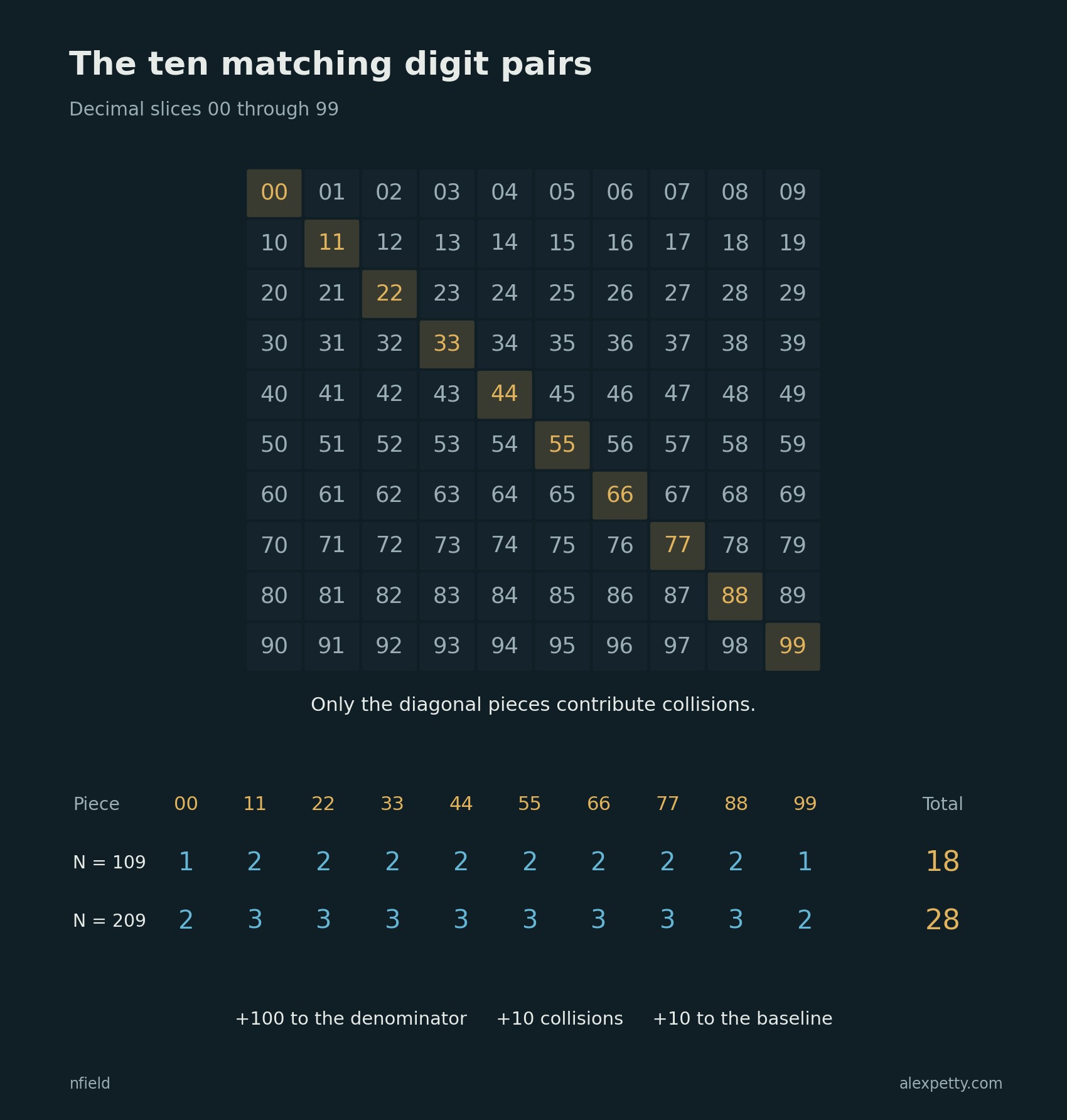
Fix the multiplier at ten. One multiplication now advances long division by one digit, and a collision means the first two digits of a fraction agree. At there are collisions against a smaller bin size of , a difference of . At there are , less , and again , even though is composite.
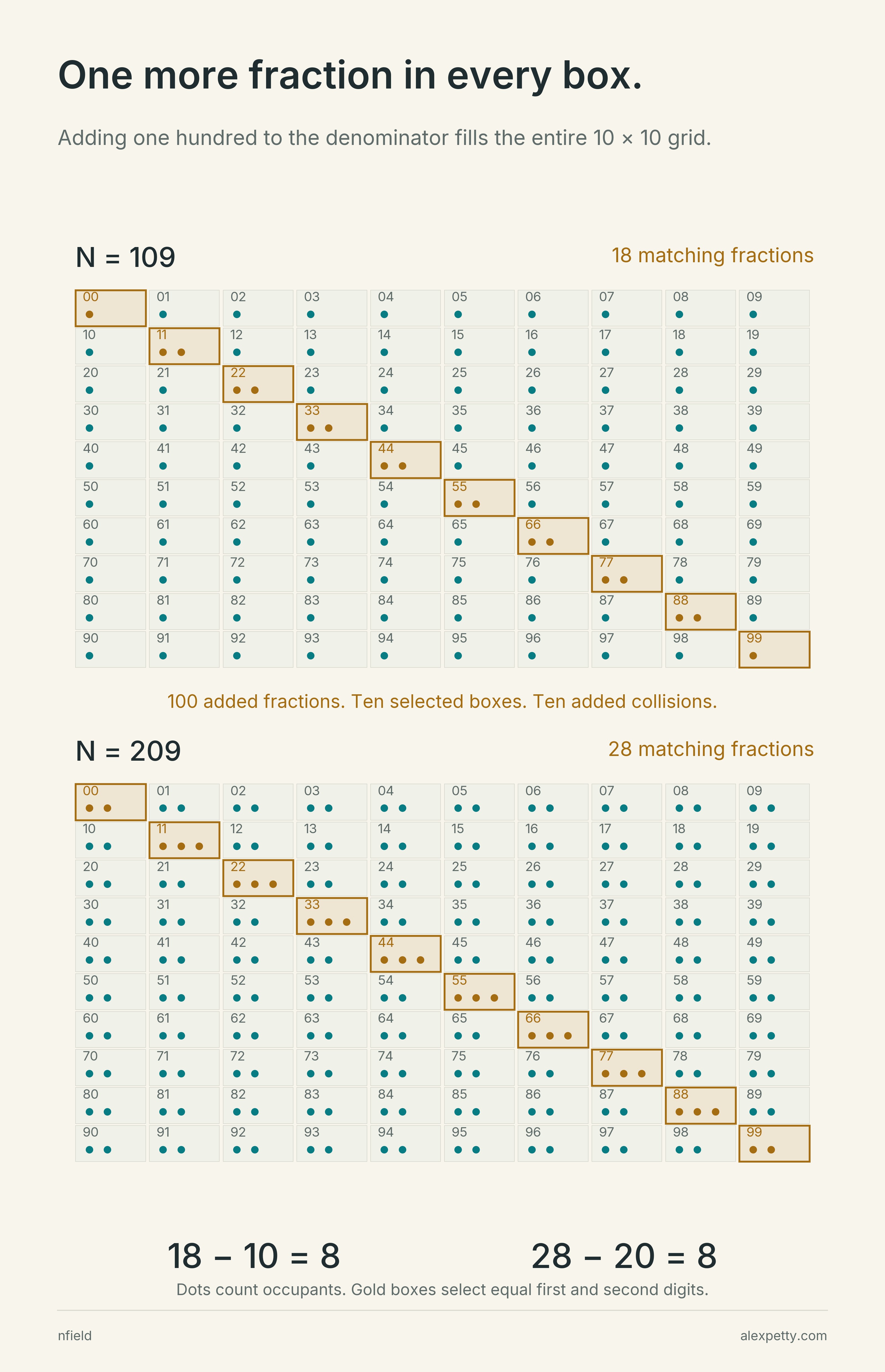
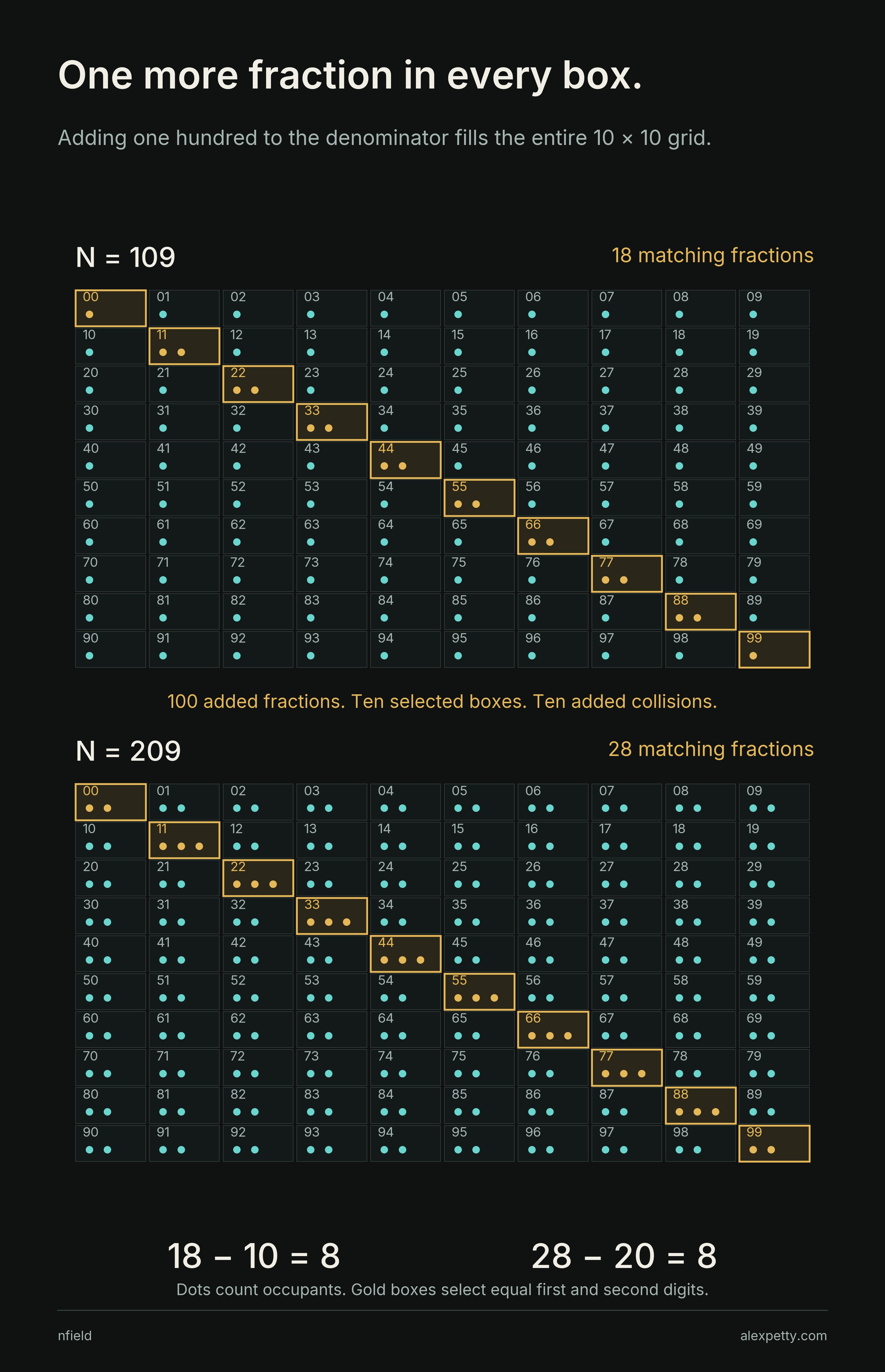
Each box in the figure is one hundredth of the unit interval, labeled by the first two digits of the fractions inside it. The gold boxes on the diagonal are the ones with equal digits. Going from to drops one more dot into every box, the ninety plain ones and the ten gold ones alike. The collision count rises by ten and the baseline by ten, so the difference stays at . That difference is the collision invariant,
and the subtracted baseline sets the scale of a digit bin.
| Denominator | Collisions | Baseline | Difference |
|---|---|---|---|
| 109 | 18 | 10 | 8 |
| 209 | 28 | 20 | 8 |
| 409 | 48 | 40 | 8 |
| 1009 | 108 | 100 | 8 |
For coprime to ten, the last two digits of determine , and all forty possible endings fit in The Collision Periodic Table. No primality test enters the lookup. At lag , the first and last digits of an -digit block must agree, the table lives modulo , and the last base- digits of suffice once . One digit fewer won’t do. In decimal at lag one, and both end in , yet their values are and .
The finite formula, including the endpoint
Put and . Let contain the integers from 0 to whose first and last base- digits agree. It has members. Write , where is a unit modulo .
Each selected interval contributes
The last interval includes the excluded endpoint , so subtract one. The copies of cancel those in the baseline, leaving
The exact obstruction to a smaller base power is also uniform. The classes and agree modulo , yet
The Collision Invariant derives both values from the same floor formula.
The other half of 09
The ending carries . Reflect it across to and the value is , so the two add to .
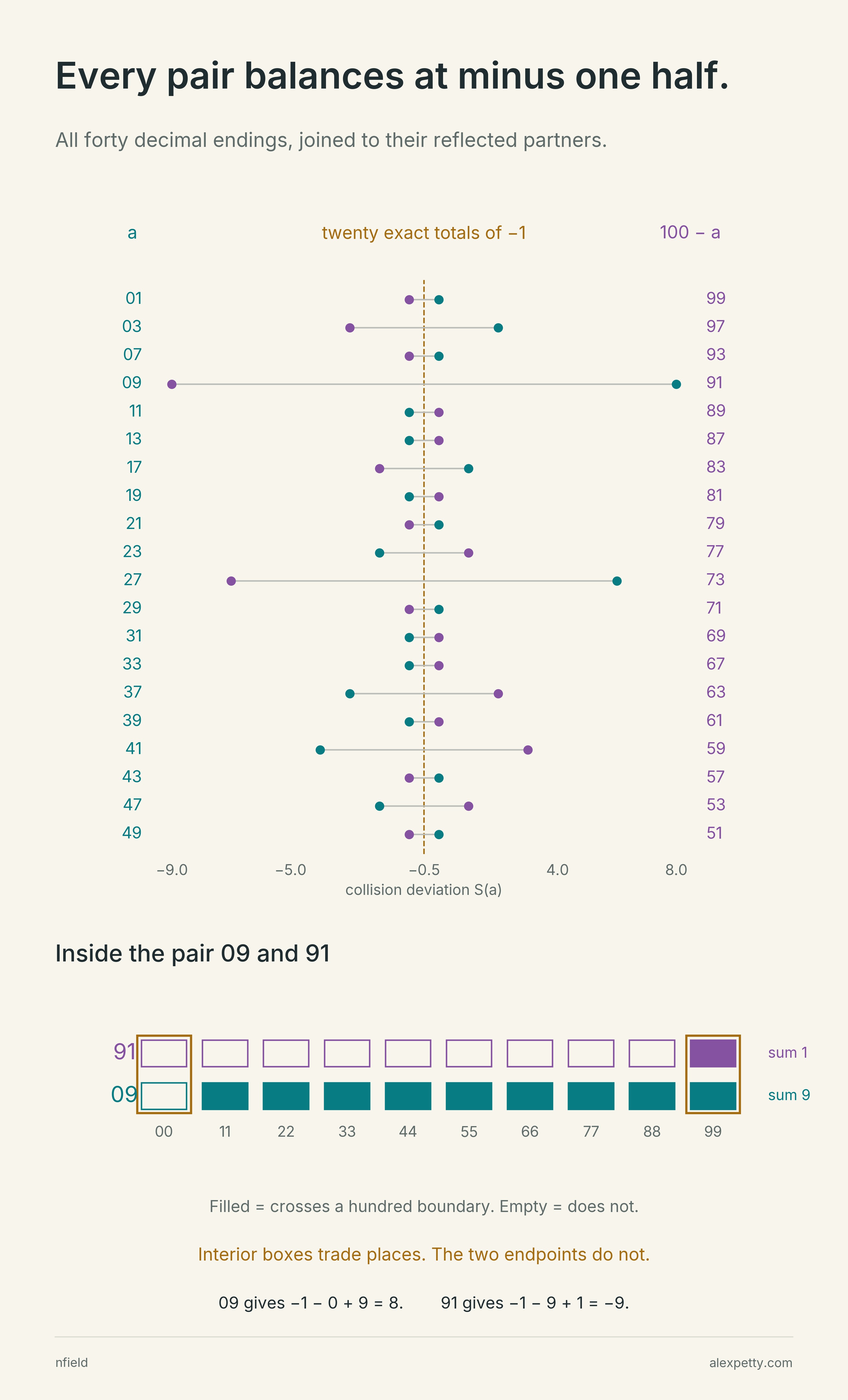
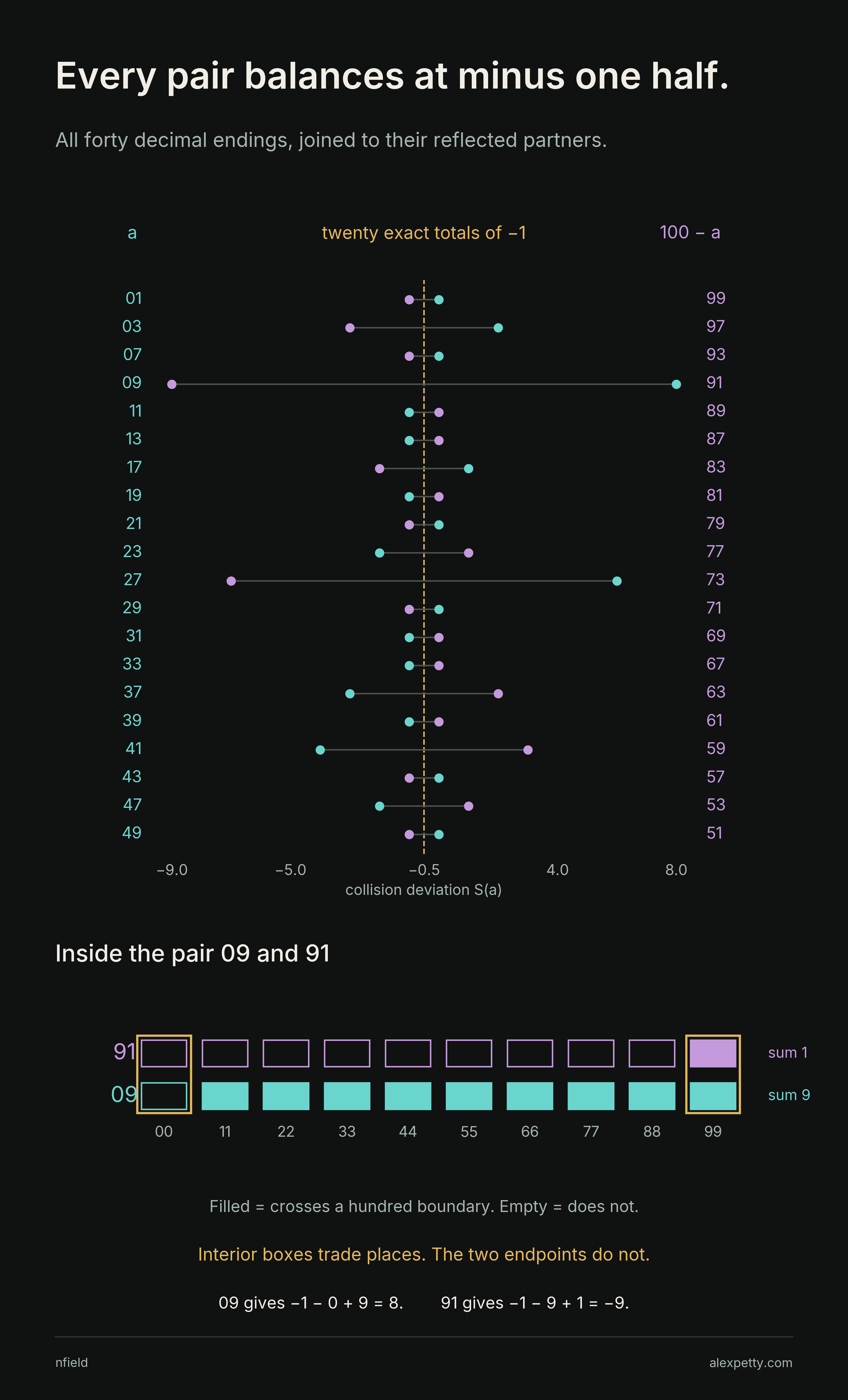
In the top panel each of the twenty lines joins an ending to its partner, teal on the left and violet on the right. Every line is centered on the dashed mark at . The long line from to balances there exactly as the short lines near the middle do. Twenty pairs each adding to give a total of and an average of . The row of boxes below shows the reason for and . Of the ten matching intervals, crosses a hundred boundary in nine, every interior box filled, and crosses only in the last. The interior boxes trade places between the two, while the endpoints stay put. The first box is empty for both and the last is filled for both, and that shared endpoint is where the comes from.
This is the reflection identity, true in any base at any positive lag. With ,
Read all forty values
The row gives the tens digit; the column gives the final digit. Read row 0, column 9 for ending 09.
| Tens digit | Final 1 | Final 3 | Final 7 | Final 9 |
|---|---|---|---|---|
| 0 | 0 | 2 | 0 | 8 |
| 1 | -1 | -1 | 1 | -1 |
| 2 | 0 | -2 | 6 | 0 |
| 3 | -1 | -1 | -3 | -1 |
| 4 | -4 | 0 | -2 | 0 |
| 5 | -1 | 1 | -1 | 3 |
| 6 | 0 | 2 | 0 | 0 |
| 7 | -1 | -7 | 1 | -1 |
| 8 | 0 | -2 | 0 | 0 |
| 9 | -9 | -1 | -3 | -1 |
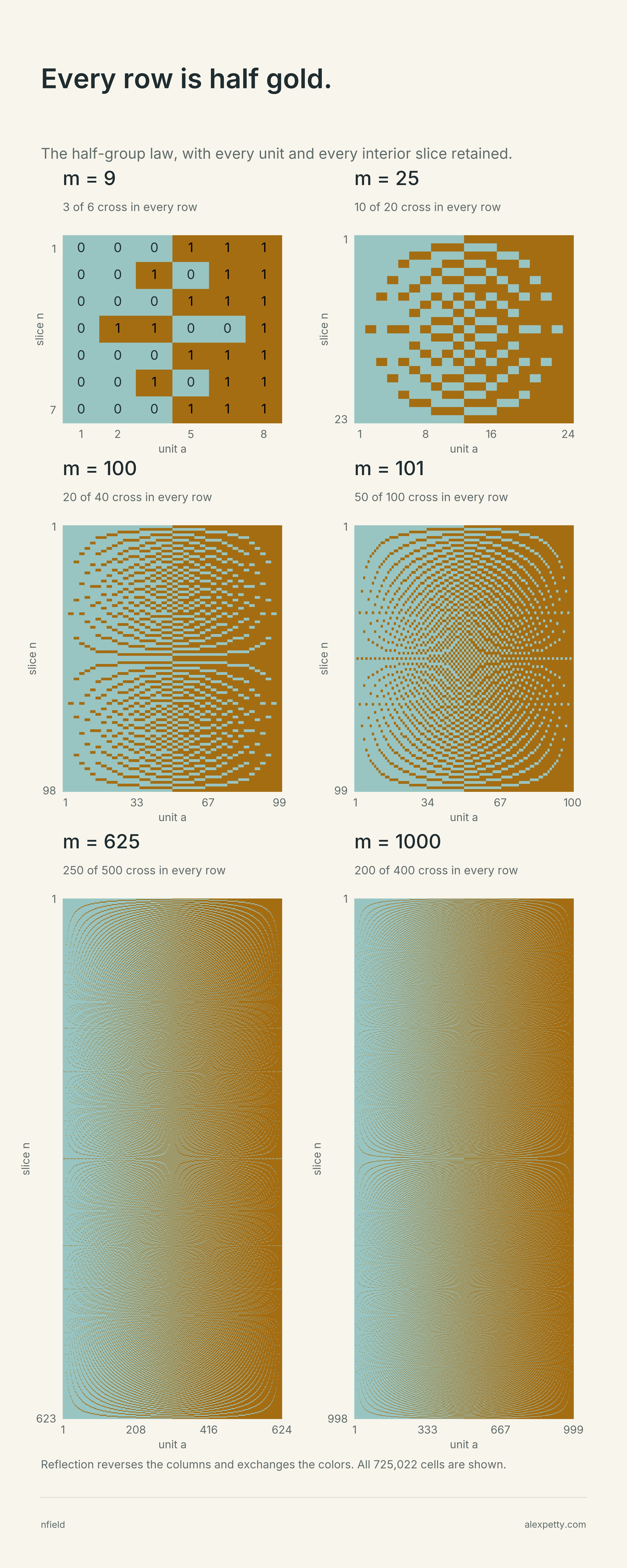
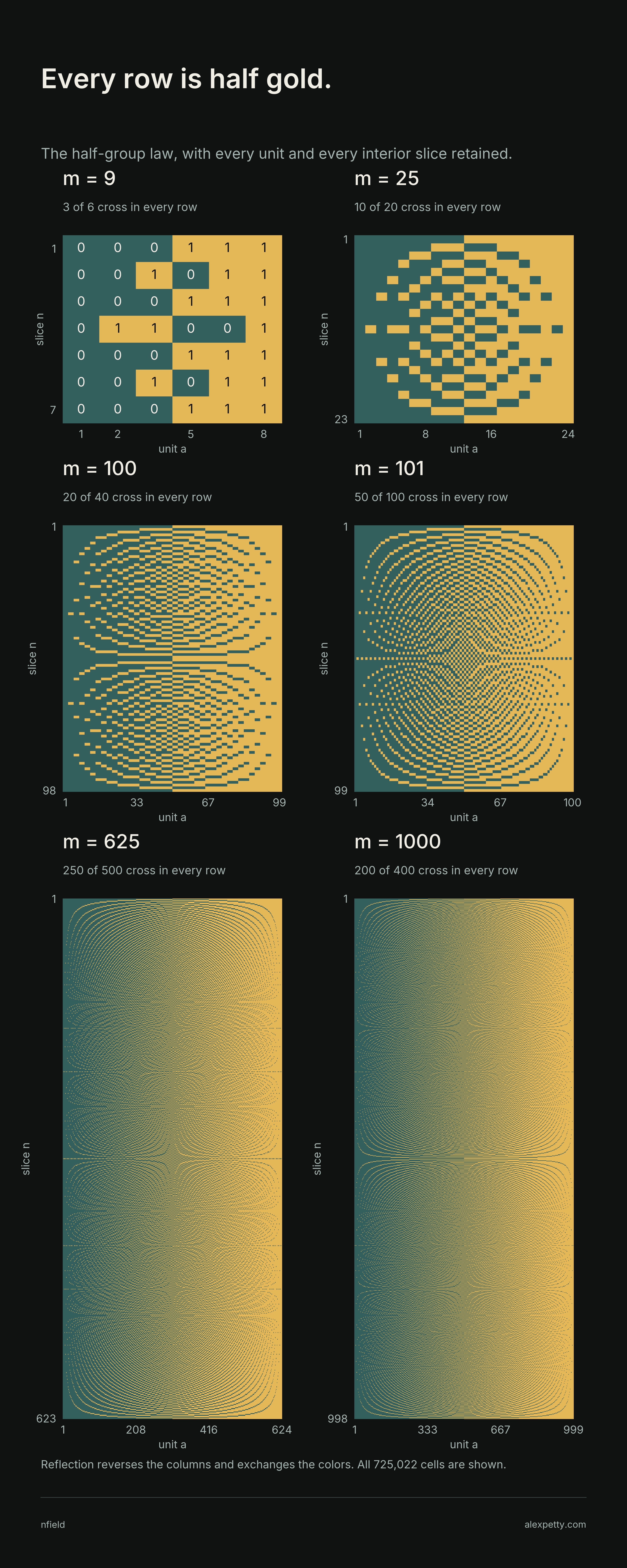
There is a smaller balance inside each entry. Take interval . At the step from to runs from to and crosses . At it runs from to and stops short of . Across the forty unit classes modulo , exactly twenty cross at interval , and the same twenty-twenty split holds at every interior interval from to , even as the crossing half changes membership. This half-group law holds for every modulus , whether or not it is a power of a base.
Every crossing, from nine positions to a thousand
The endpoint arithmetic behind the offset
For an interior index, complementary floors give . At the first and last indices the totals are 0 and 2. Both endpoints belong to the selected diagonal, whose other members each contribute 1. Also
Add the two finite formulas,
For the half-group law, the crossing test is . Neither equality nor a zero residue is possible when is a unit and . Replacing by reverses the strict inequality. It pairs every crossing with exactly one noncrossing.
The bins, the boxes and the crossing, up close
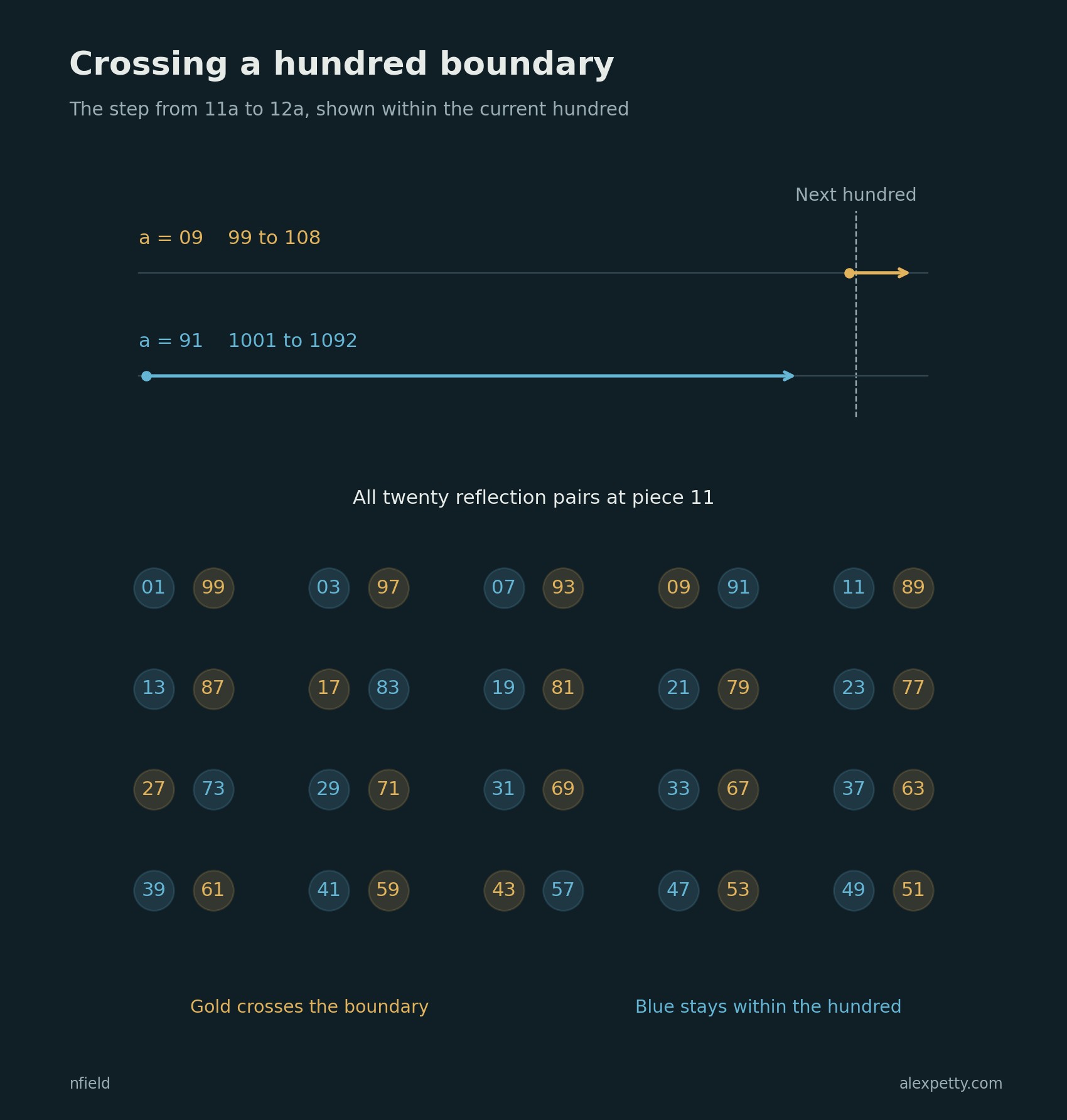
The paper ends with a table that no longer grows with the denominator. At lag it has one entry for each unit modulo , and every reflected pair adds to . Every interior interval crosses for exactly half the units, and primes and composites read the same values. In decimal at lag one that is forty numbers averaging , from at down to at .
Discussion
Sign in to join the discussion.