Collisions
The Collision Transform and the Critical Strip
At each prime, see how many of its fractions start with two equal base-three digits and turn that count into a small weight. Then add the weights over the primes, each one divided by a power of the prime. Divide by the prime itself and the sum settles down. Divide by something smaller and the distant primes get louder, and the question is how loud they can get before the sum stops settling. The digit table can’t answer that by itself, but it does decide which Dirichlet -functions the answer depends on, and how much each one counts. In base three it picks a single -function and its mirror image, and from there classical prime-number theory takes over. If the Generalized Riemann Hypothesis holds for that function, the sum converges at every exponent past one half, and if the sum converges that far, GRH holds for it. In that second direction the table contributes one small fact beyond its choice of function, a weight whose real part is positive.
The weights are the base-three entries of The Collision Periodic Table, with each family’s average removed by the centering of The Centered Collision Sum. That article already showed the sum settles when every weight is divided by . Base three is the friendliest case of what happens below that. Larger bases bring in more -functions, and a zero shared by several of them could in principle cancel out of the sum. One thing holds in every base with no hypothesis, the classical obstruction for sums of logarithms of -functions. A zero that belongs to just one of the selected functions can’t be cancelled by the others, so the sum can’t converge anywhere to its left.
Six weights
A fraction has a doubled beginning in base three when its first two base-three digits agree. Eleven makes a good first example. Its ten fractions begin
and four of those beginnings are doubled. Sorted by first digit, the fractions fill bins of three, four and three, and eleven comes out one above the smaller bin. That excess depends only on the prime’s remainder modulo nine, so six numbers cover every prime past nine.
| Remainder modulo 9 | 1 | 2 | 4 | 5 | 7 | 8 |
|---|---|---|---|---|---|---|
| Table entry | ||||||
| Centered weight |
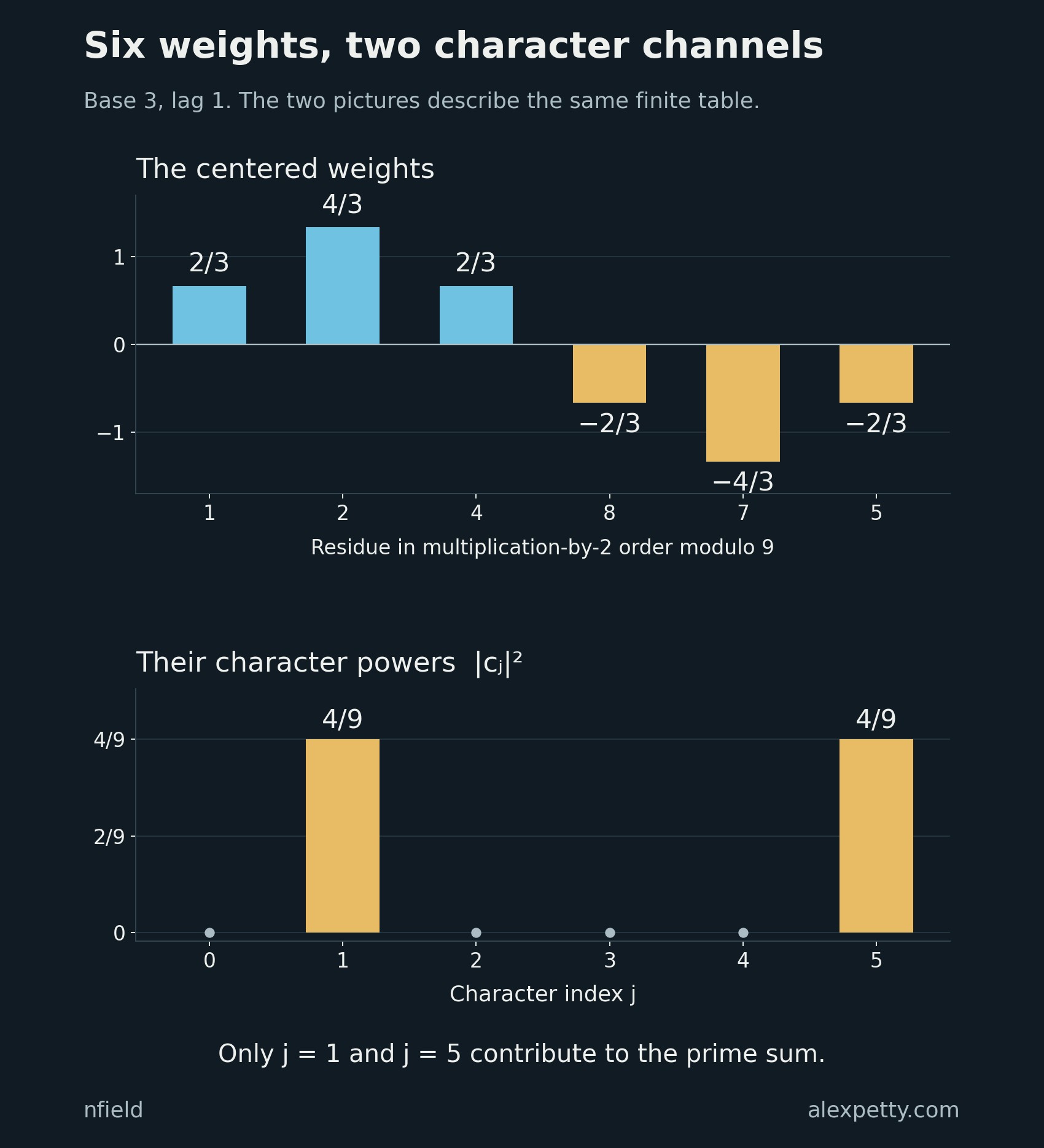
The remainders , and form one family modulo three, and their entries average . The family , , averages . Taking each family’s average out of its own entries gives the bottom row. Eleven leaves remainder two and takes , thirteen takes , seventeen takes , and every larger prime looks up the same six entries.
Write for the centered weight. The sum is
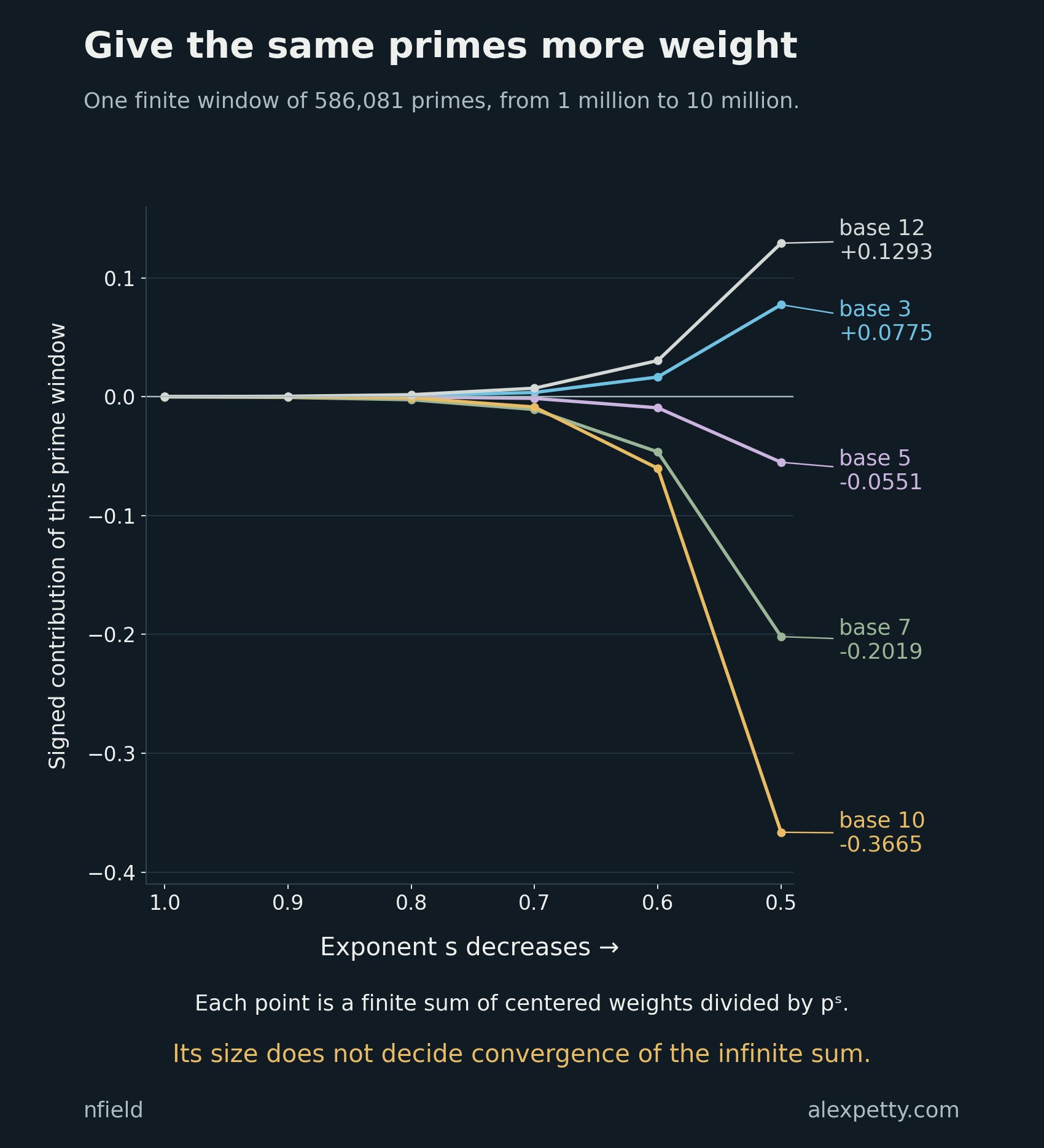
with the primes added in increasing order. At eleven contributes divided by , about . At it contributes divided by , about . Nothing about eleven has changed except the divisor, and the effect grows with the prime. A prime near a million carries a thousand times more weight at than at .
The six weights add to zero, which is a good start and not nearly enough. The primes visit the six remainders in their own order, and whether the sum converges depends on how evenly those visits balance as the primes thin out.
The next nine million
Before any theory, I like to watch the sum run. Take every prime between a million and ten million, all of them, and start a fresh total at zero. Add their contributions one at a time, once dividing by and once dividing by .
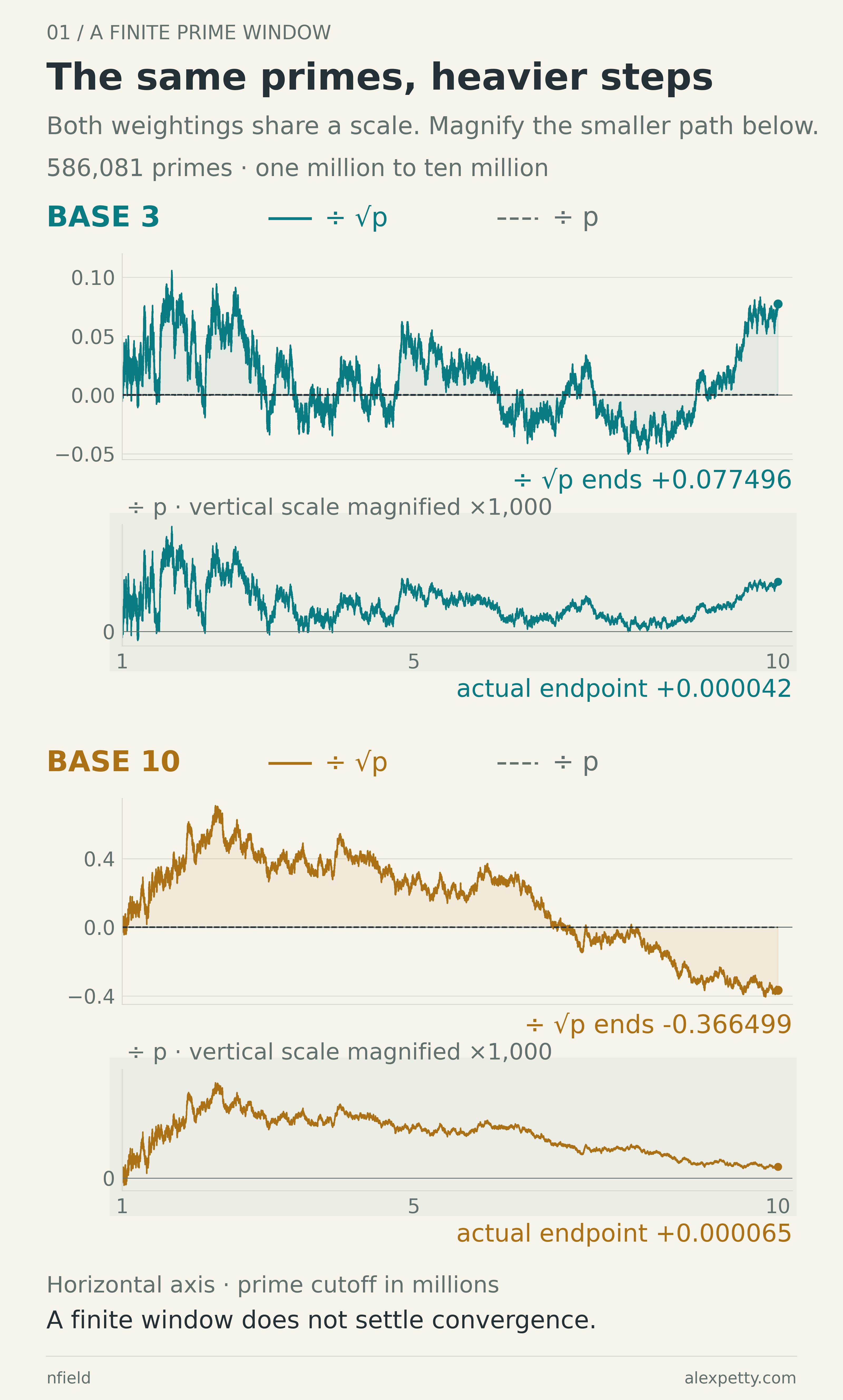
In each base the solid path divides by . The dashed one, divided by , hugs the zero line so closely that it needs its own panel, magnified a thousand times, to show any shape at all. Base three’s heavy path wanders between about and and finishes at , while its light path finishes at . Base ten’s heavy path climbs to about , slides back across zero near seven million and ends at , though its light path stays positive and ends at . In each base the same primes and the same table entries make both paths, and only the divisor differs.
It’s tempting to read a lot into where a path ends, and these pictures argue against it. A window can finish near zero after long excursions to either side, and heavier weights can flip its sign, as they do in base ten. A small total from one window can’t prove convergence and a large one can’t rule it out, because the next window has no obligation to look like this one.
Five bases, three exponents, every prime in the window
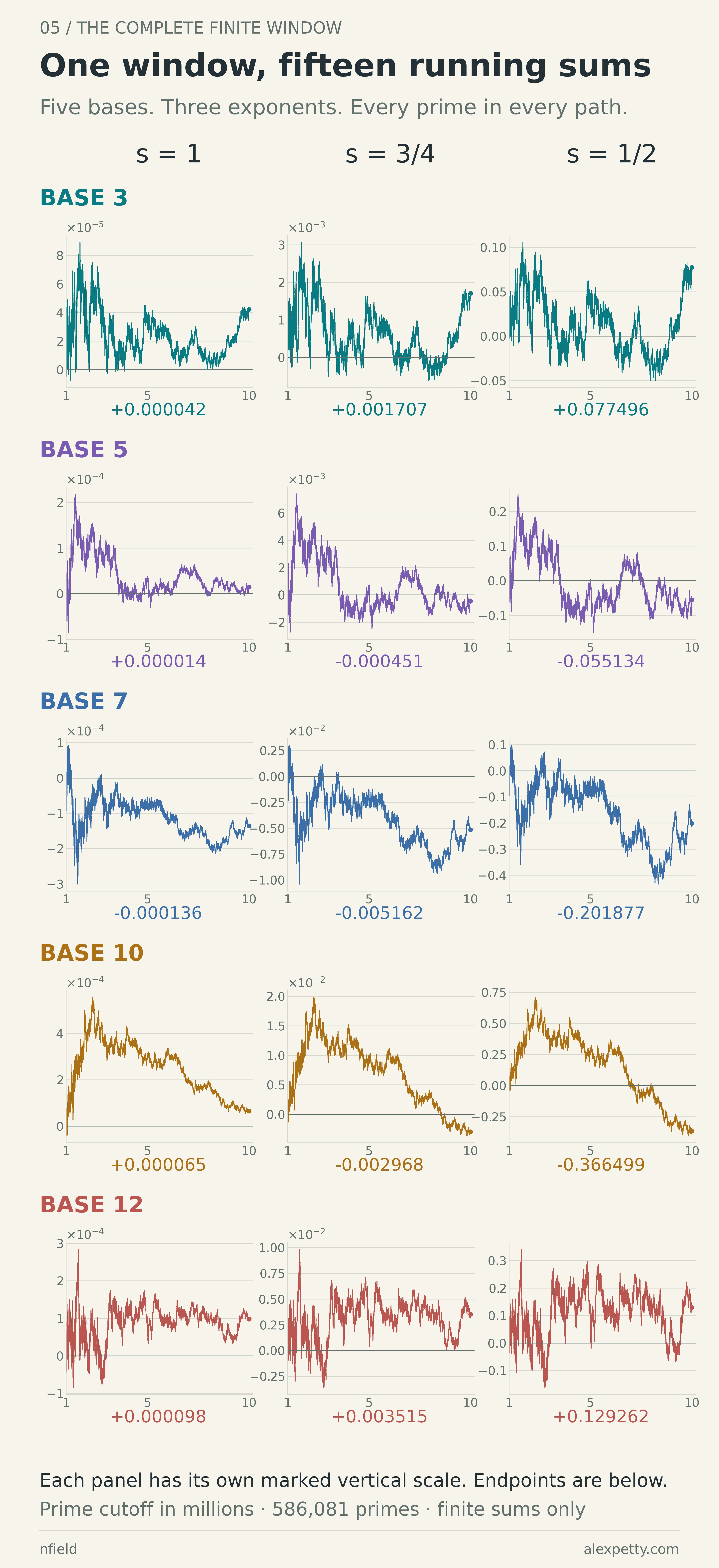
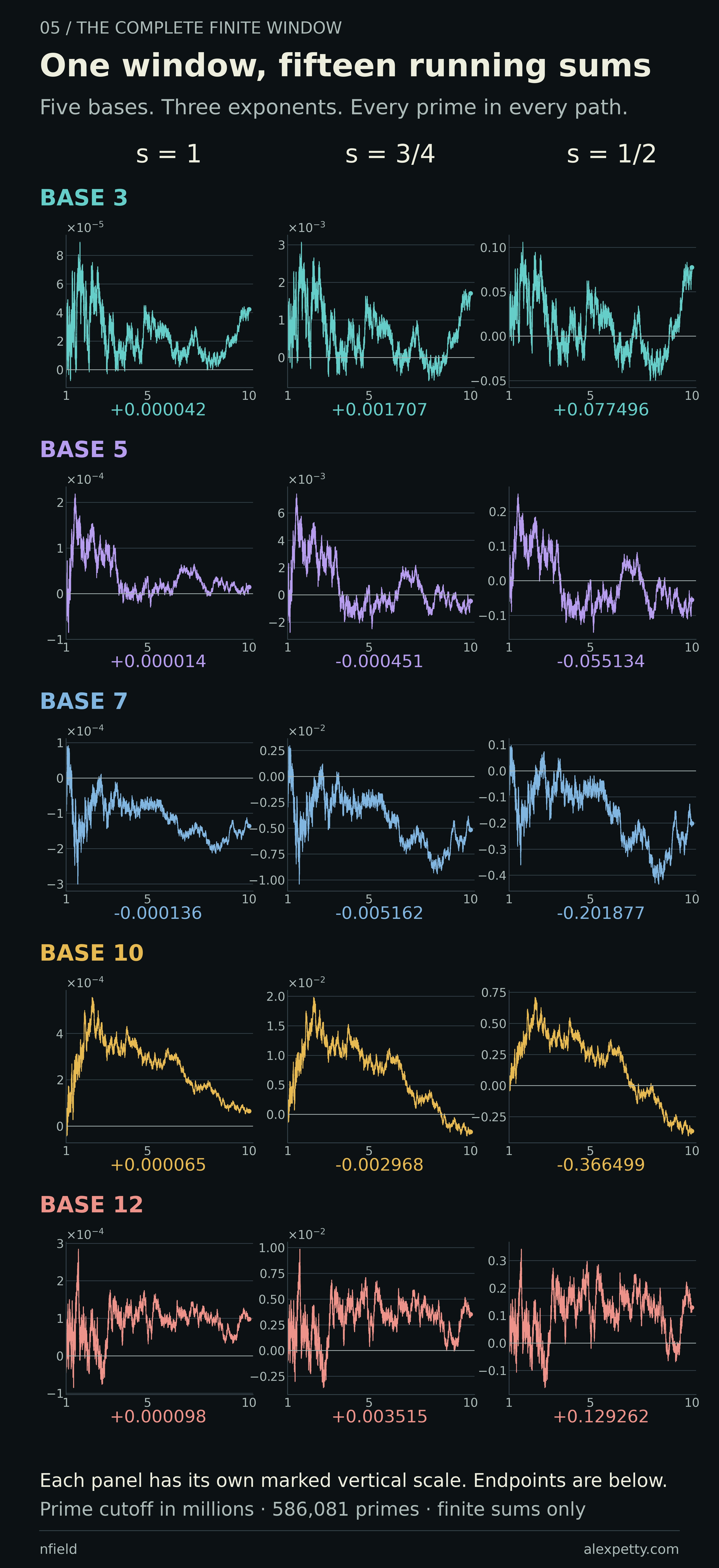
Every prime in the window contributes to all fifteen paths. Each panel has its own vertical scale, so a path that looks lively may still be very small.
The decimal window also splits by a prime’s remainder modulo three, which has nothing to do with base ten. At the primes leaving remainder one contribute about , and the leaving remainder two contribute about , for a total of . The two signs stay opposed at all six exponents tested. Whether that lasts beyond this window, and whether it belongs to the two families separately or to a single twist running through both, is a question this one window cannot settle.
Two turns around nine
Multiply by two over and over modulo nine and the remainders run through all six before coming home.
A Dirichlet character gives each remainder a complex number, and it does so in a way that respects multiplication. Choose . Each multiplication by two then turns the character’s arrow through sixty degrees, and six turns bring it back to the start. The conjugate character turns the same amount the other way.
Six characters live on this cycle, and the centered table uses only these two. Reflection removes the three even ones, which give and the same value, because the centered weights change sign under that swap. Family centering removes the last odd character, the one that only sees a prime’s remainder modulo three. That leaves
where
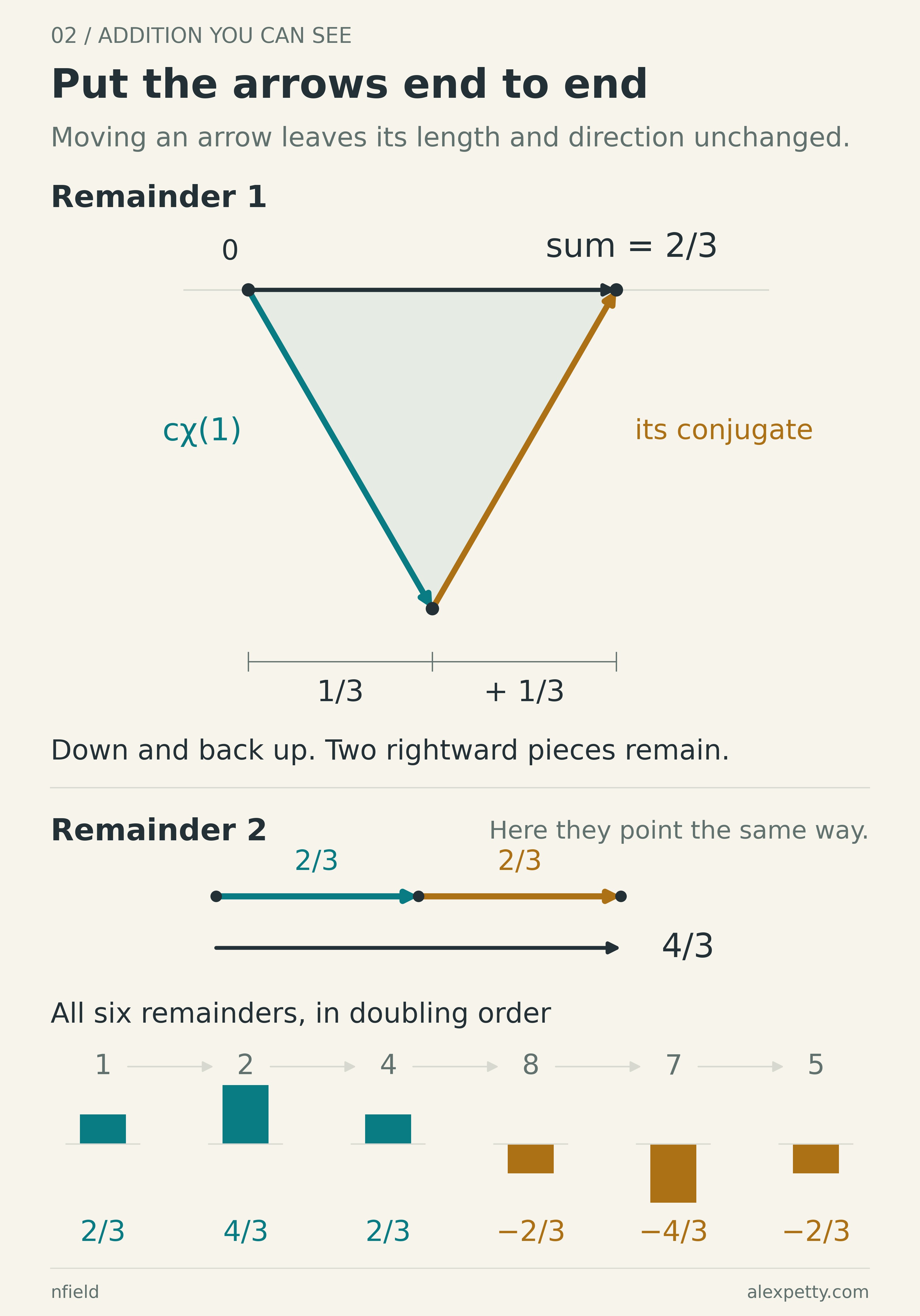
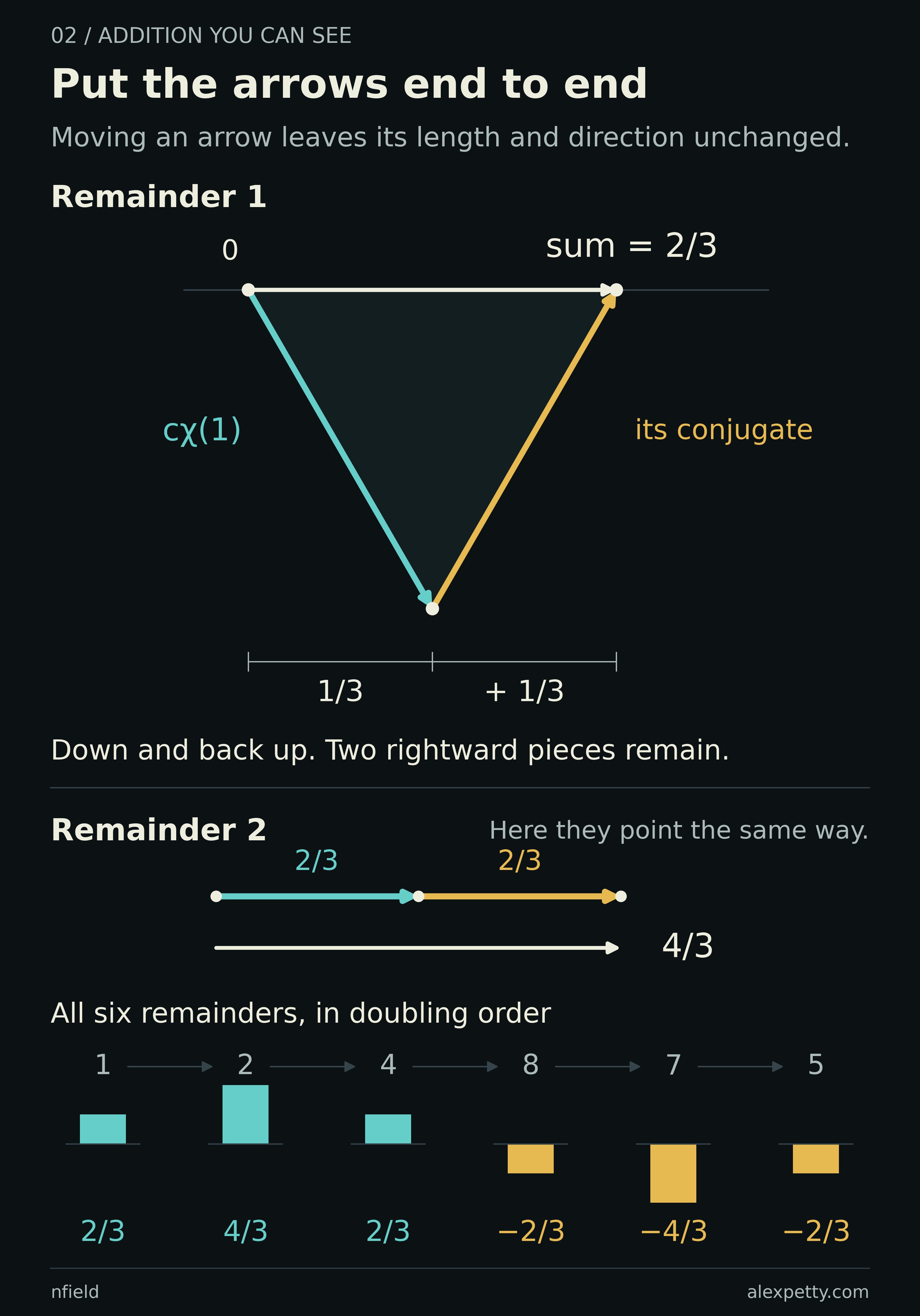
The figure does the addition with arrows laid end to end. At remainder one the teal arrow drops down and to the right by a third. Its gold mirror image climbs back up by another third, and together they make a flat arrow of length . At remainder two the two arrows already line up, and end to end they reach . Around the whole cycle the bars give all six weights, , and , then the same three with the sign flipped. So splits into two prime sums, one weighted by and the other by .
Other bases, and digits compared farther apart, bring other tables and other characters, sometimes a great many. A character whose coefficient isn’t zero is called active, and the same two rules hold everywhere. No even character is active, and neither is any character that depends only on the prime’s last digit in that base.
The prime sum inside the logarithm
Each character has its own Dirichlet -function, built as an Euler product with a factor for every prime. The logarithm of that product, with every factor expanded by , is
The first sum is exactly the kind of prime sum we want. The second carries along the squares, cubes and higher powers of each prime. As written, the identity holds where and everything converges absolutely.
Subtracting the higher powers, along with the few small primes the collision sum leaves out, gives
for any fixed base and lag. Here collects those corrections, and the coefficients come from the digit table.
The higher powers start at , which converges absolutely whenever . So is harmless throughout , and any trouble on the right side in that region has to come from the logarithms. The logarithm of only misbehaves where is zero.
It’s easy to be fooled at this point. The formula can be continued across any region free of zeros, and that looks like the end of the story. The sum, though, is the primes added one at a time in order, and continuing a formula doesn’t make them settle. For that the primes themselves have to cancel.
Moving the line left
Let be complex, with its real part as the horizontal coordinate. The critical strip is the band between real parts zero and one, and the critical line runs down its middle at . The Generalized Riemann Hypothesis puts every nontrivial zero of a primitive Dirichlet -function on that line.
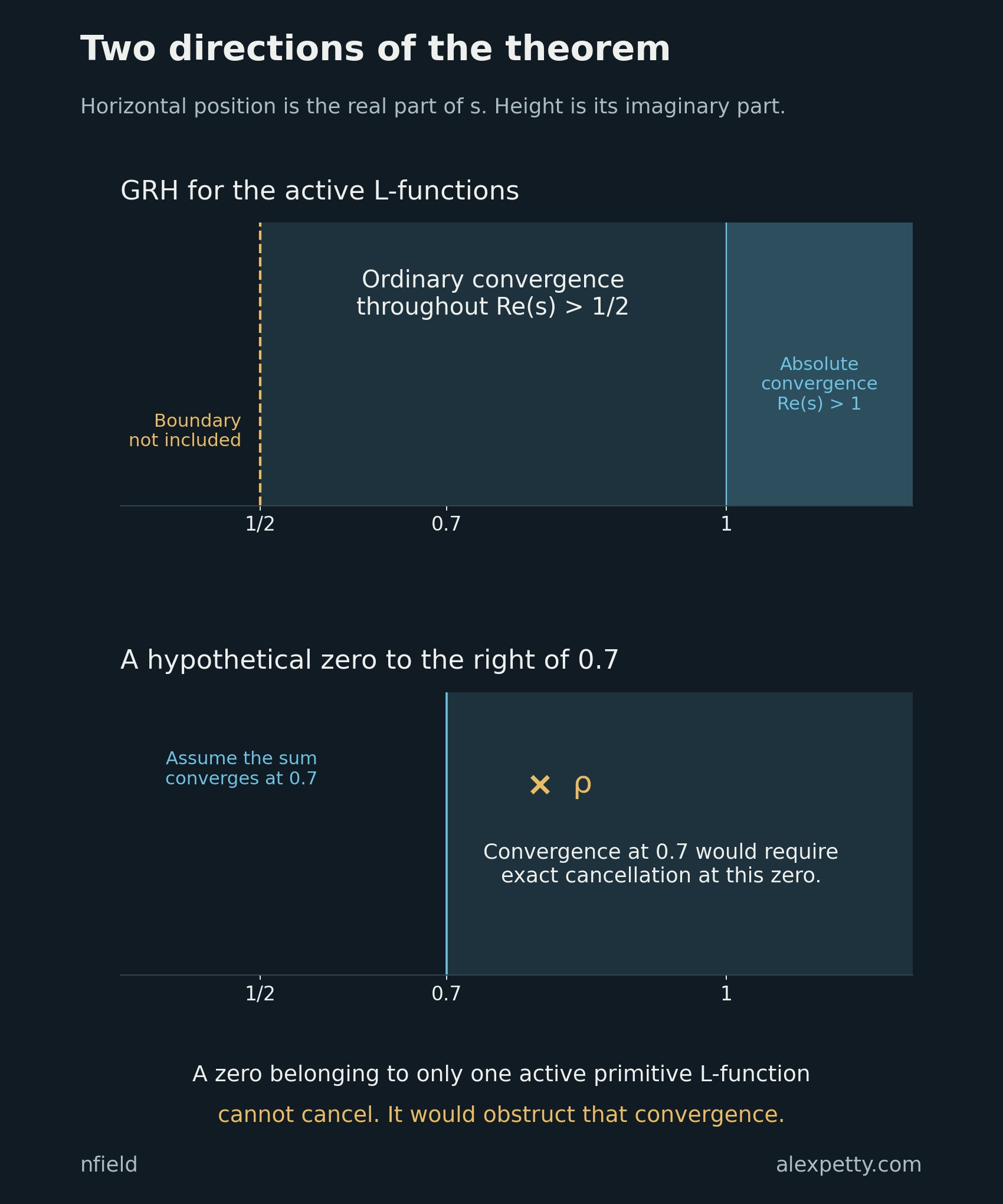
Assume it for the -functions our table selects. Then the collision sum itself, with the primes added in order, converges locally uniformly throughout
That is a statement about the primes themselves, which is more than continuing a formula, and it leaves the line itself alone.
The cancellation comes from the primes. Under the hypothesis, the running total of up to grows no faster than , apart from logarithms. Partial summation turns that into a bound on the tail of the collision sum, and at the tail is controlled by
for a fixed power . Any positive makes the integral finite and its tail shrink to zero. At the bound gives nothing. The Collision Transform and the Critical Strip carries out the explicit-formula estimate and the partial summation.
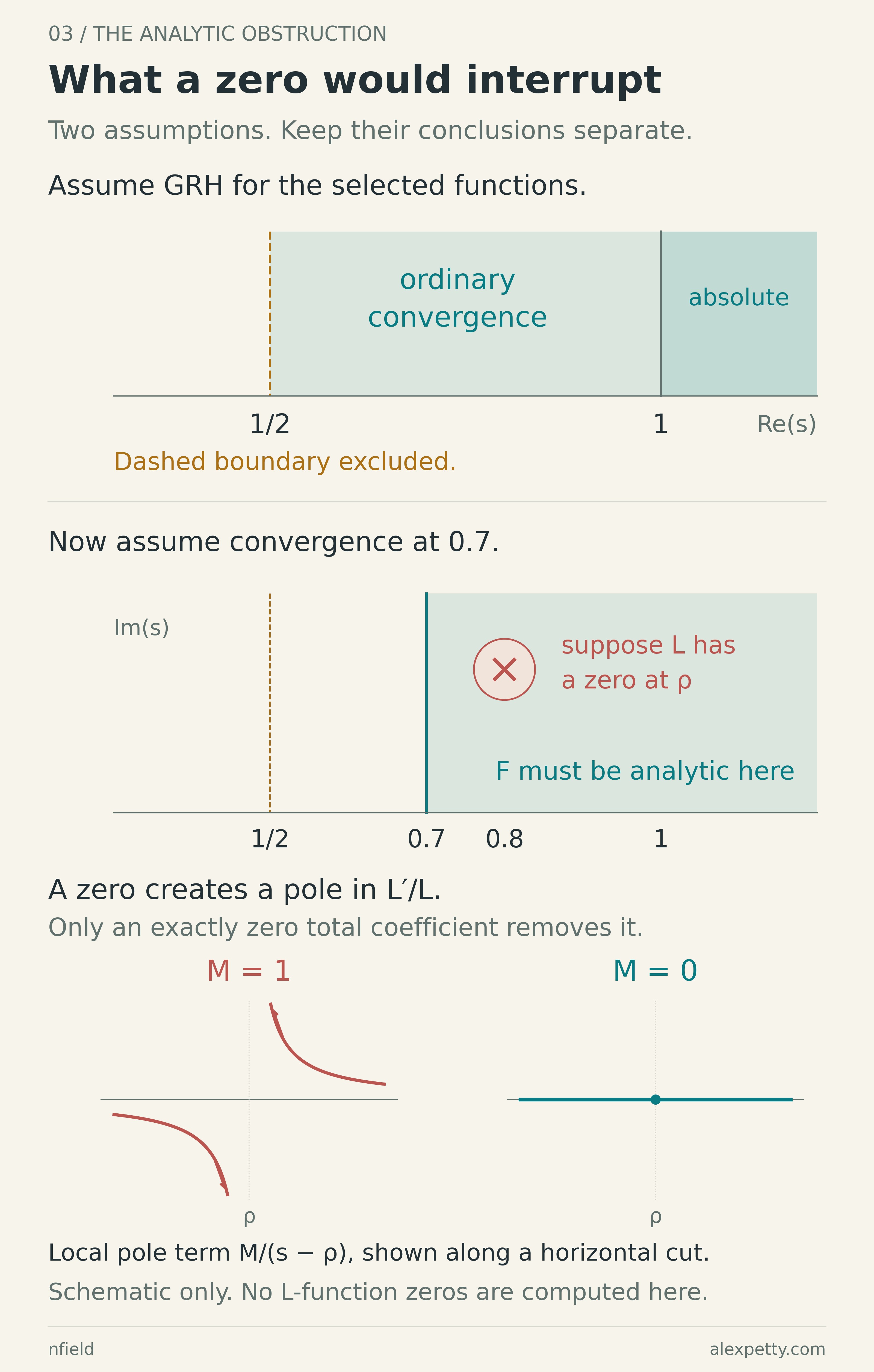
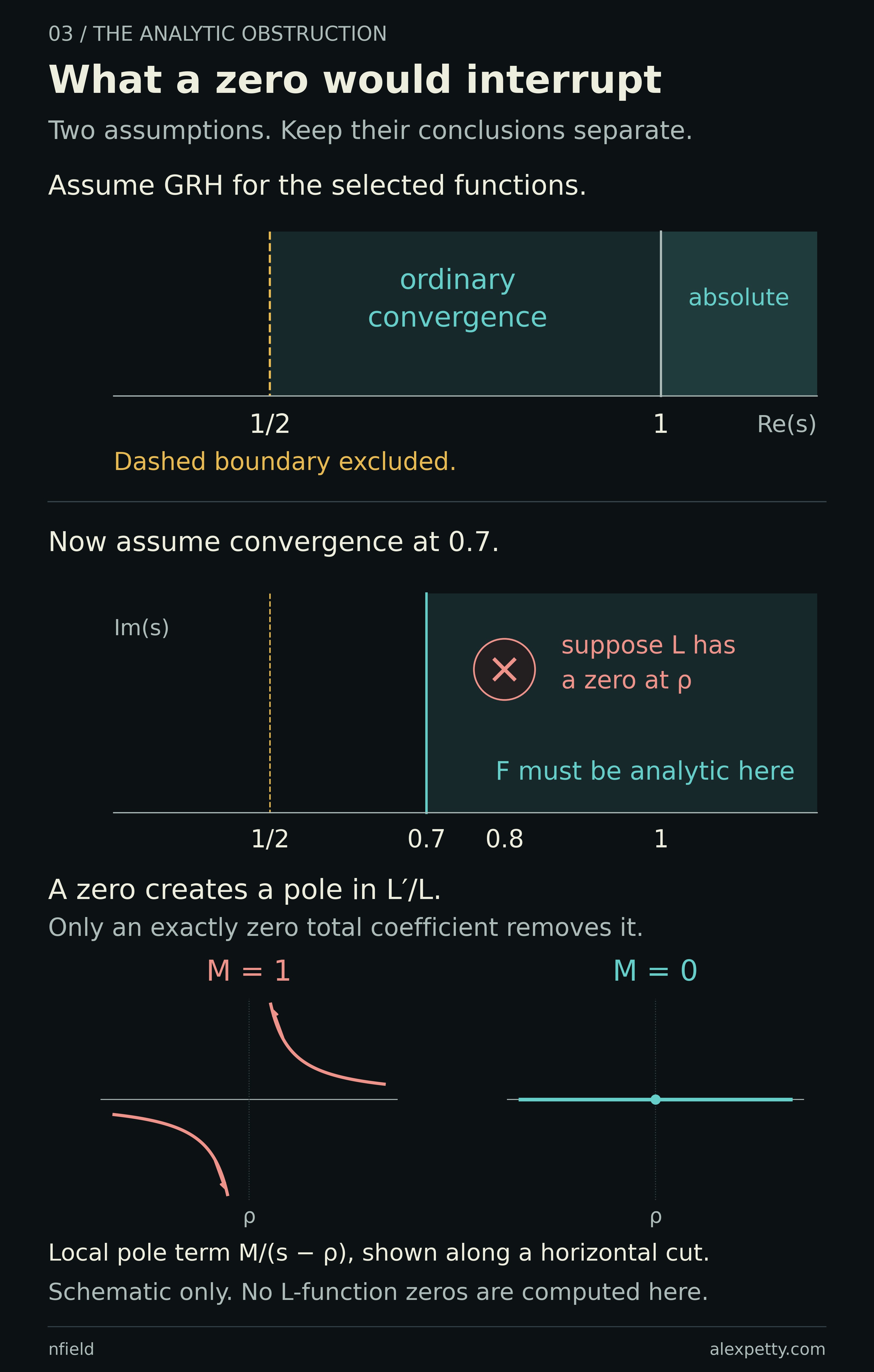
The top of the figure is that conditional picture, ordinary convergence everywhere to the right of the dashed line at one half and absolute convergence past one, with the dashed line itself left out. The middle panel turns the assumption around. Suppose we knew the sum converged at . Then would have to be analytic everywhere to the right, and a zero at , the cross at , would put a pole there. The bottom shows that pole along a horizontal cut, a term that shoots off to infinity when its coefficient is and lies perfectly flat when is . Only a coefficient of exactly zero makes the trouble go away.
Call the edge of ordinary convergence . For every centered table that isn’t identically zero, the conjecture is
That takes two inequalities. GRH for the selected functions gives . Showing the edge can’t sit farther left is a separate problem that neither the window sums nor the conditional theorem touches, and even equality would leave the line itself undecided.
A zero that cannot hide
The other direction needs no hypothesis at all. Suppose the sum could be shown to converge at . A general theorem about Dirichlet series would then make it analytic everywhere to the right of that line.
Now put a zero of one active -function at , inside that region. Its logarithm is singular there, and , being analytic, can’t repair it. Only other active -functions vanishing at the same point could cancel it. Let be the multiplicity of the zero for each active , with when isn’t zero. This weighted count of zeros is the collision zero ledger, and convergence requires it to balance,
The logarithmic derivative shows why. A zero of multiplicity contributes to , plus something regular, and a sum that is analytic at can’t keep that pole. Its total coefficient has to vanish, which is the flat line in the lowest panel of the figure above.
A zero that belongs to just one active primitive -function has nothing to cancel against. Shared zeros could cancel, but only with exactly the right weights. The ledger tells us where zeros can’t be if the sum converges. It doesn’t locate any of them, and it doesn’t prove GRH.
The window totals, the character powers and the two directions
In base three the ledger can be checked by hand, because only two functions are active. At a fixed point , let their multiplicities be and . The weighted sum is
Multiplicities are whole numbers and never negative, so if either function vanishes at , the real part is positive and the ledger can’t balance. Not even a zero shared by both functions can cancel.
Conjugating the character reflects a function’s zeros across the real axis, which doesn’t by itself put a zero of the partner at the same point. The calculation covers both possibilities and never needs to know which one happens.
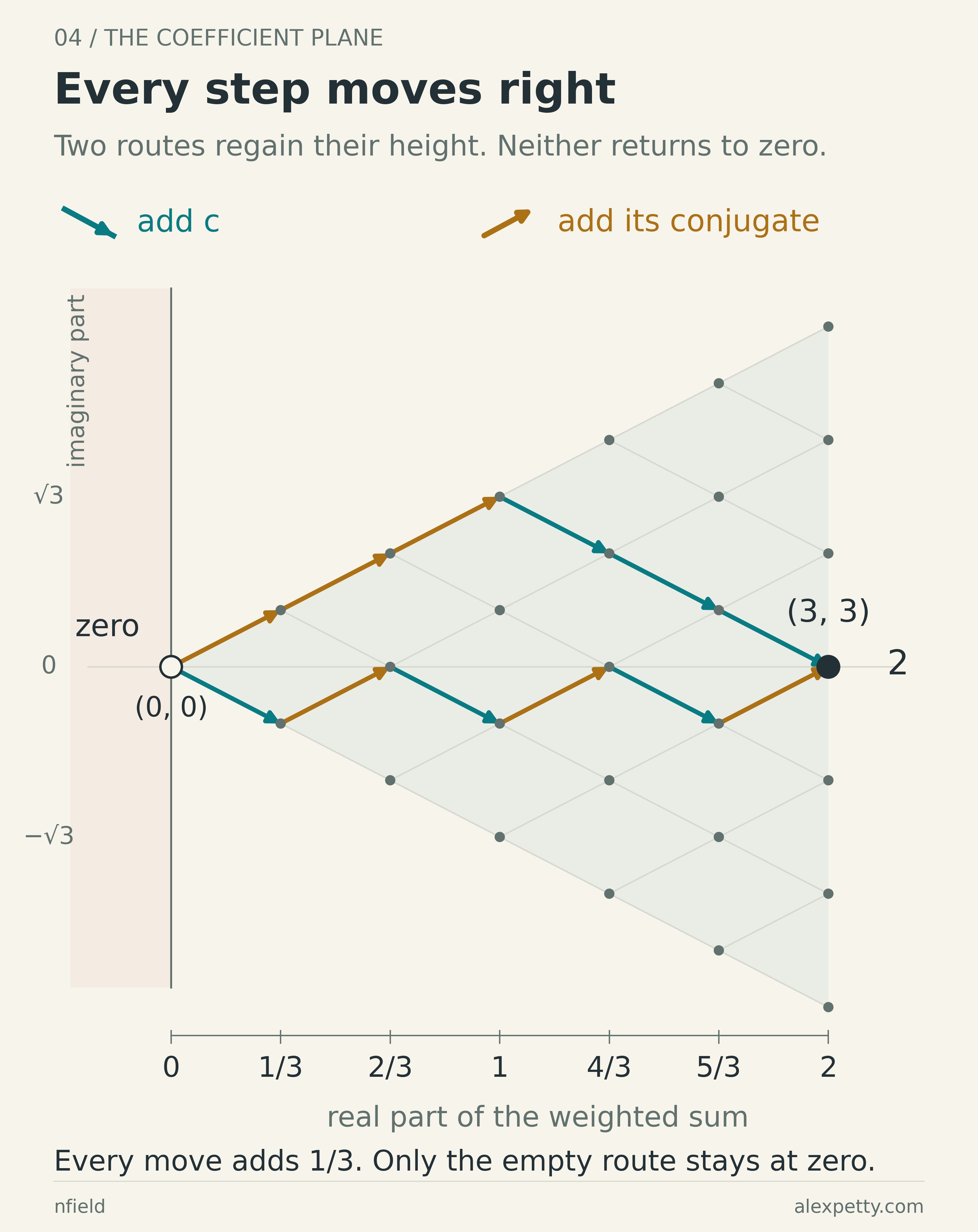
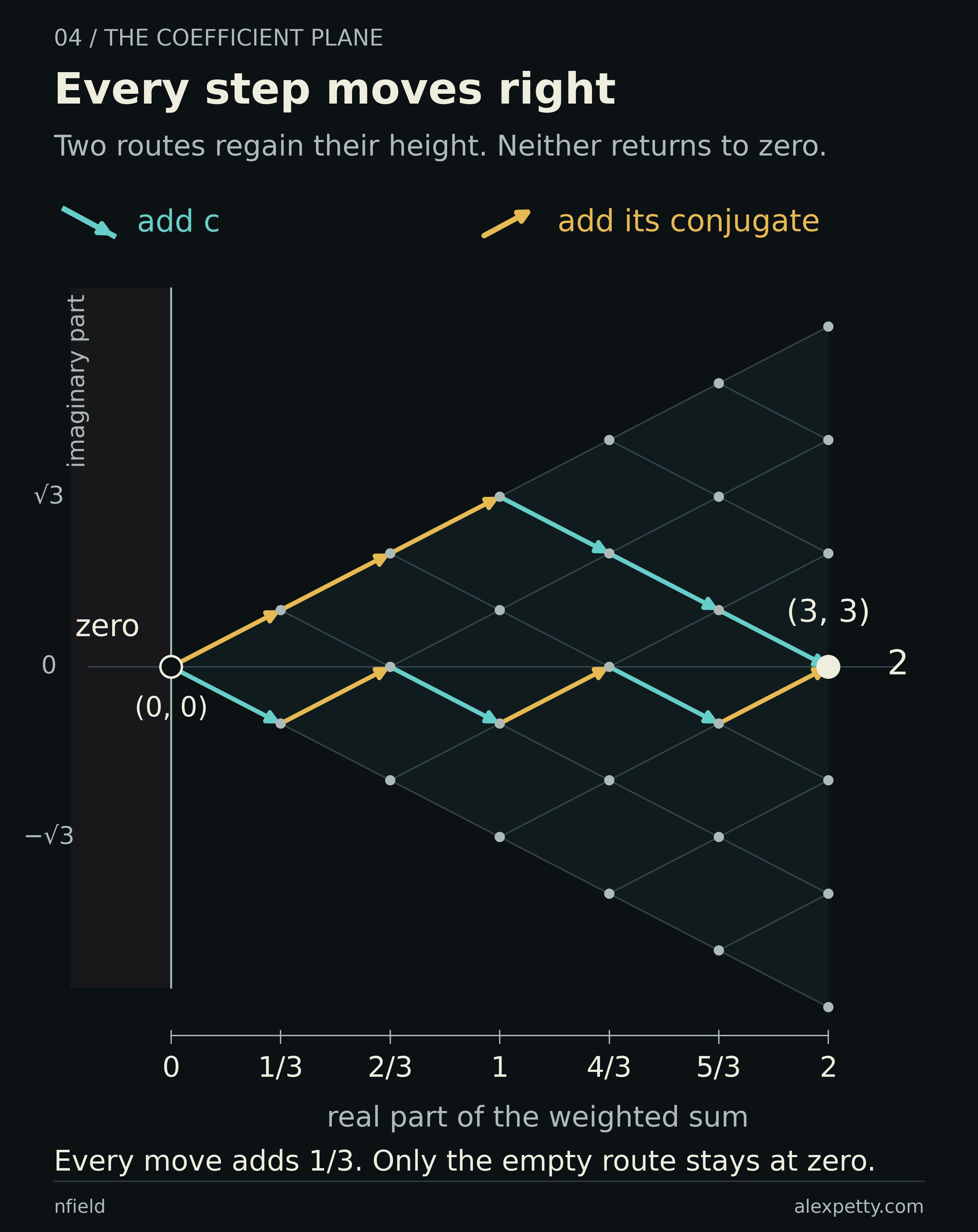
The figure lays out every possible ledger in base three. Each teal step adds and each gold step adds its conjugate, and both kinds move a third to the right. The two routes drawn there wander up and down and come back to height zero at , but by then they sit two whole units right of the origin. Every move adds a third, so the only route that stays at zero is the empty one, where neither function vanishes.
Put the two directions together for base three. GRH for gives GRH for its conjugate, whose zeros are the mirror images, and then the sum converges at every past one half. In the other direction, convergence at every past one half leaves neither function a zero to the right of the line. The functional equation matches a zero of at with a zero of at , so neither has a zero to the left of the line either. That second direction rests on a single real part. Every point of the ledger has horizontal coordinate , and with whole-number multiplicities it reaches zero only when both counts do.
Discussion
Sign in to join the discussion.