Collisions
The Character Structure of the Collision Fluctuation

In 1853 Chebyshev remarked in a letter that primes of the form seem to stay ahead of primes of the form , and the same kind of race runs in the last digit. Primes ending in 3 or 7 tend to stay slightly ahead of primes ending in 1 or 9. A single total hides a race like that, because it adds the leaders and the trailers together. The collision fluctuation is a total of exactly that kind. It adds up, over the primes, how far multiplication by ten sits from the average multiplier at keeping first decimal digits, and through ten thousand it has drifted down to about .
Split by last digit, that one sum is four sums, and Dirichlet’s characters, the tool behind his 1837 proof that every one of those endings carries infinitely many primes, are exactly the right coordinates for pulling them apart without losing anything. One of the four coordinates sets 1 and 9 against 3 and 7, the same split as the race, and at ten thousand it points up while the total points down.
Here is how the sum is built.
Ten against the other multipliers
Take the fractions through and read their first decimal digits. Group the numerators by the digit they produce. Multiply each numerator by ten, take the remainder after division by , and read the digit again. This is one step of long division.
Count the matches, and at thirteen there are none, while at seventeen there are two.
Now compare all the nonidentity multipliers. Some preserve no digits, so call those with positive counts constructive and take their mean. Bin Derangements and the Gate Width Theorem gives that mean from the bin sizes alone, without testing each multiplier.
Subtract it from the count for multiplication by ten, and the difference is the collision deviation, .
A negative deviation means multiplication by ten preserves fewer digits than the average constructive multiplier at that prime, and zero means it reaches the mean. At seventeen the deviation is zero even though two digits match.
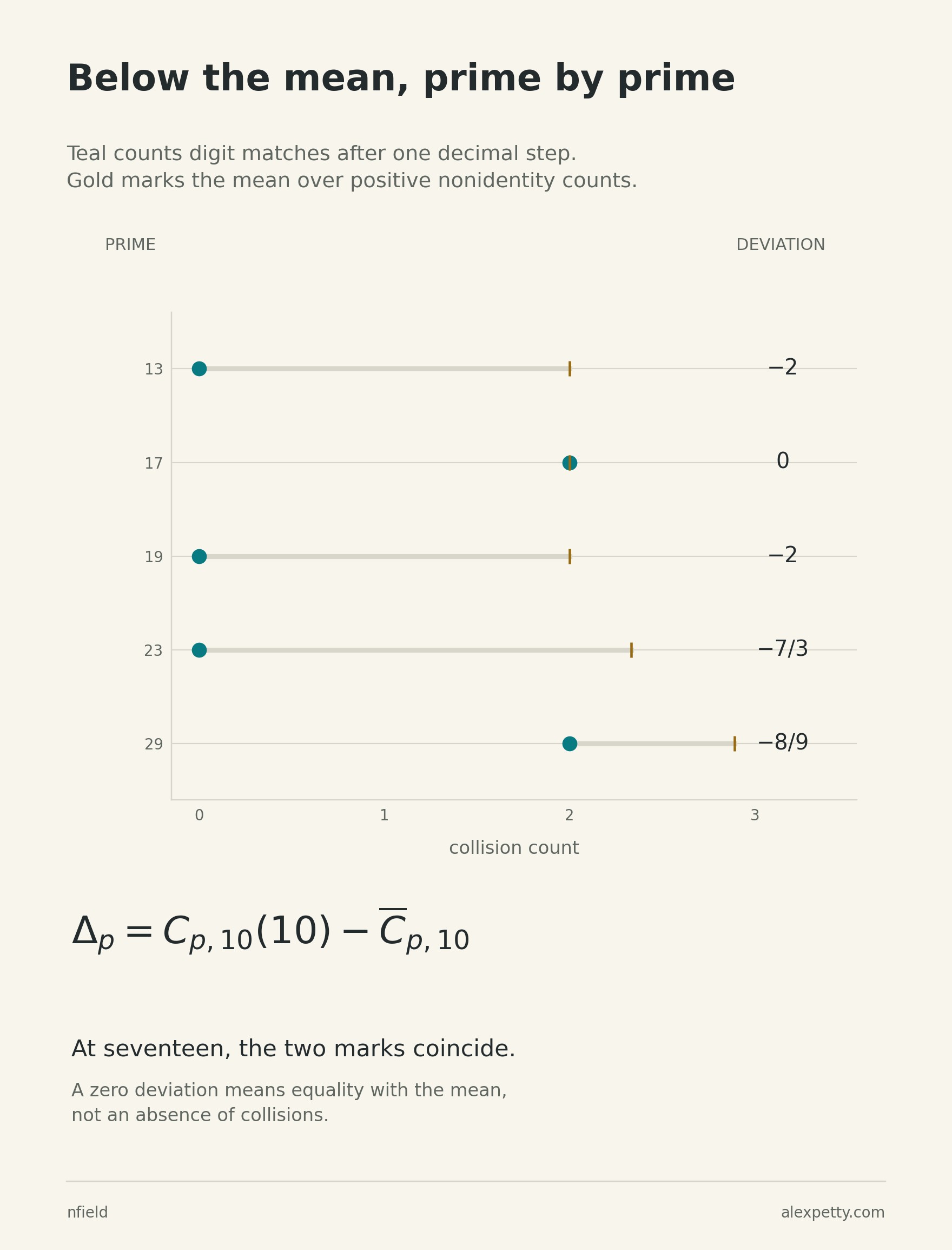
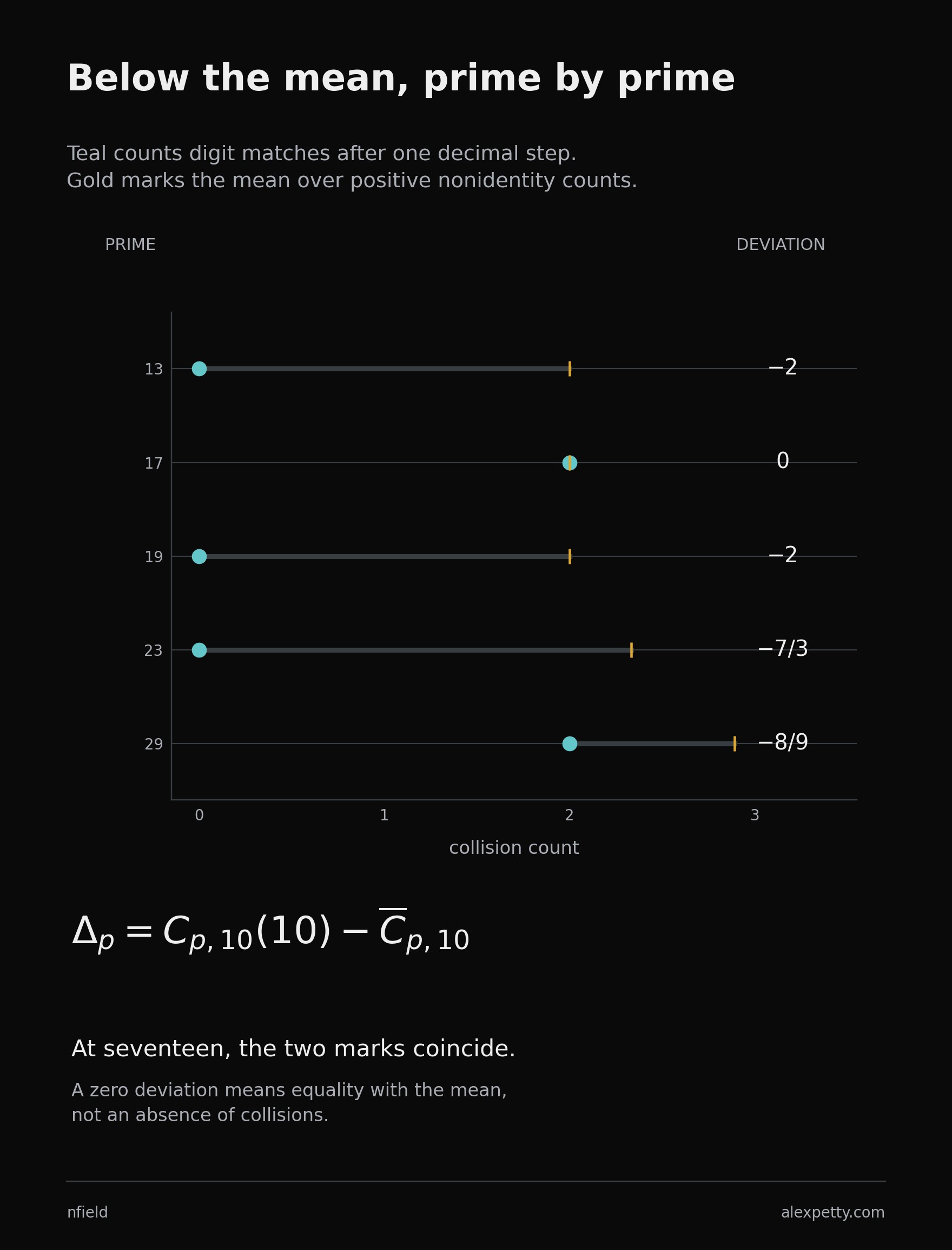
The five counts and their reference levels
| Prime | Count | Mean | |
|---|---|---|---|
| 13 | 0 | ||
| 17 | 2 | ||
| 19 | 0 | ||
| 23 | 0 | ||
| 29 | 2 |
In decimal there are constructive multipliers. A bin of size supplies ordered pairs with distinct members, and each pair belongs to one multiplier, so the mean is
At thirteen, eight bins have one member and two have two, so the crowded bins supply four pairs and the two multipliers that share them have mean two. At twenty-nine the pair count is fifty-two and there are eighteen constructive multipliers, for a mean of .
The prime must exceed eleven. At eleven the bins are singletons, every nonidentity count is zero, and the constructive mean is undefined.
Divide each deviation by its prime, so the first contributions are , , and , and include every prime greater than eleven up to the chosen cutoff.
The subtraction does not force this prime sum to vanish. The reference mean averages positive counts over the multipliers at one prime, while here we choose one multiplier, ten, and carry its deviation into a sum over different primes.
Four running totals
Let collect the weighted deviations at primes ending in one, and let , and collect the other endings, all four stopping at the same cutoff.
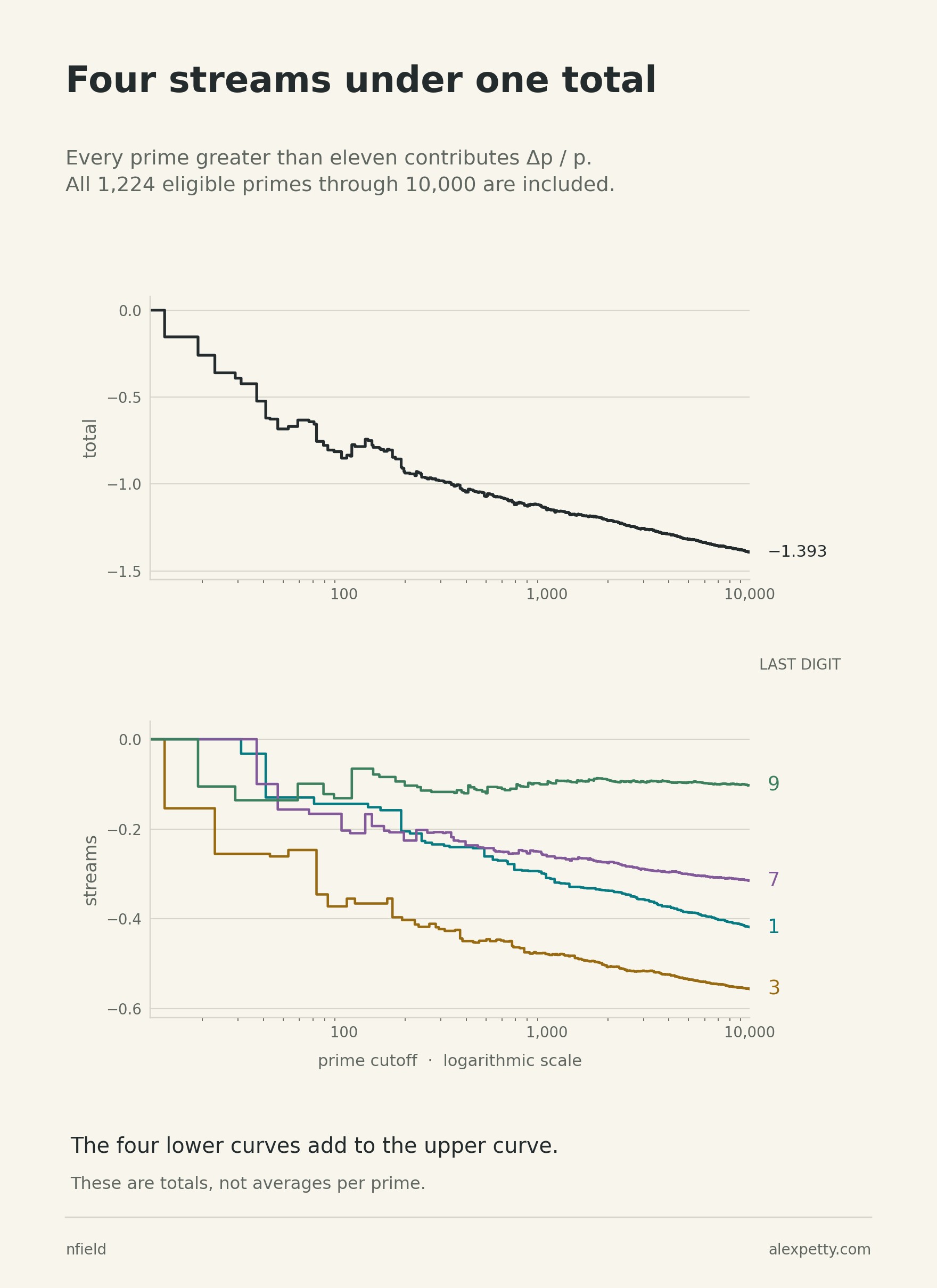
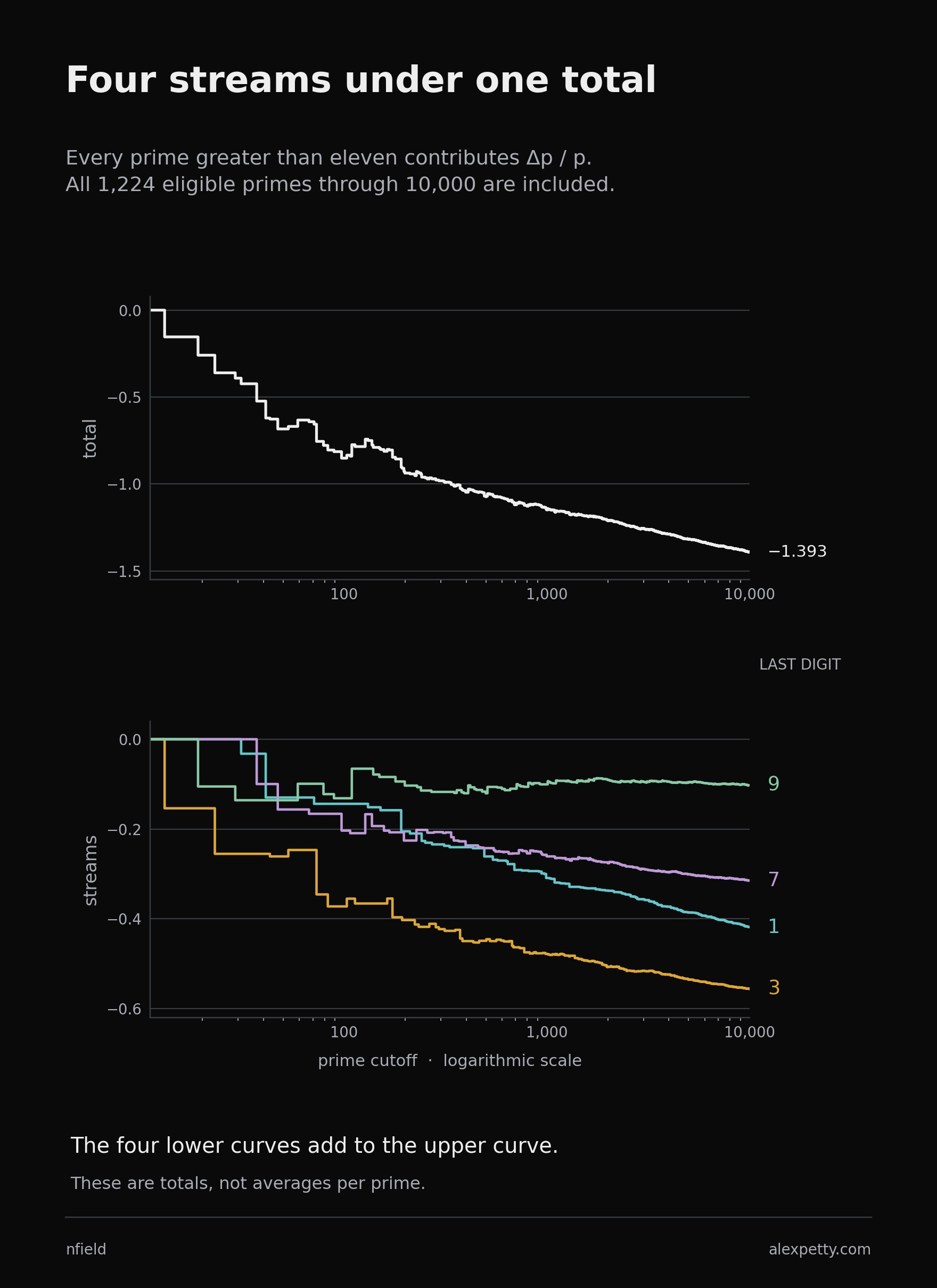
Through , their values are
| Last digit | Weighted sum |
|---|---|
| 1 | -0.418680 |
| 3 | -0.556673 |
| 7 | -0.314742 |
| 9 | -0.102500 |
All four totals are negative here, and the stream ending in three contributes more than five times the negative amount of the stream ending in nine.
These are weighted totals, not per-prime averages. Each combines the number of primes in its class with the size and sign of their deviations, and no random model enters the calculation. Keeping separate accounts exposes the difference, and there is also a way to recombine them that respects how their last digits multiply.
Weights that multiply correctly
Numbers ending in three and seven multiply to a number ending in one, and two numbers ending in three multiply to one ending in nine. A Dirichlet character assigns a nonzero weight to each of the four endings, with weight one for ending one, in such a way that multiplying the weights gives the weight of the product’s ending.
Giving every ending weight one works. Another recipe gives to endings one and nine and to three and seven. For three times seven the weights give , the weight of ending one, and for three times three they also give one, the weight of ending nine. This is the recipe that splits the endings the way the prime race does.
Two more recipes use , the square root of . Multiplication by is a quarter turn, and four turns return to the start. Repeated multiplication by three makes the endings visit and then one again, so giving those endings the weights makes both circuits obey the same multiplication.
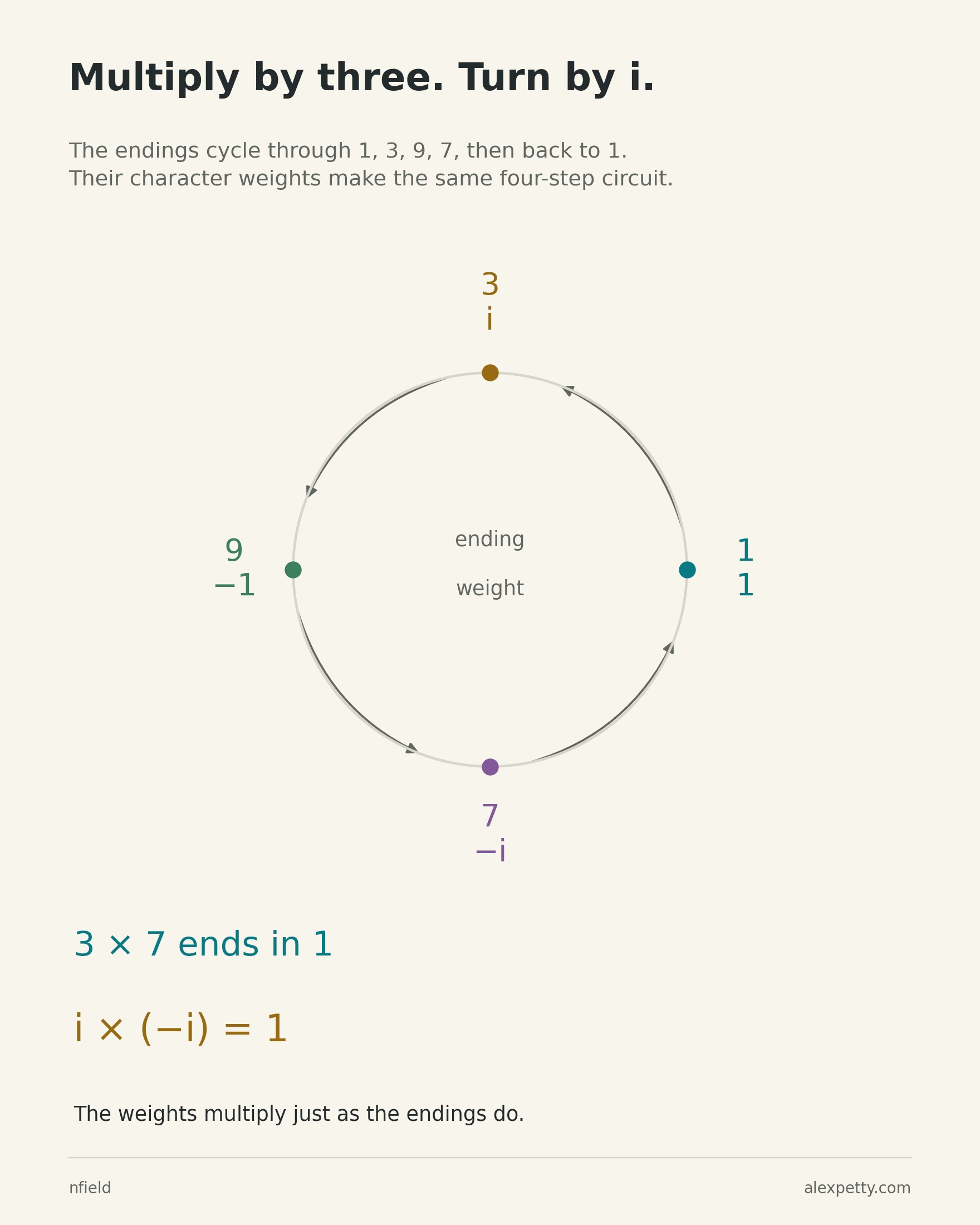
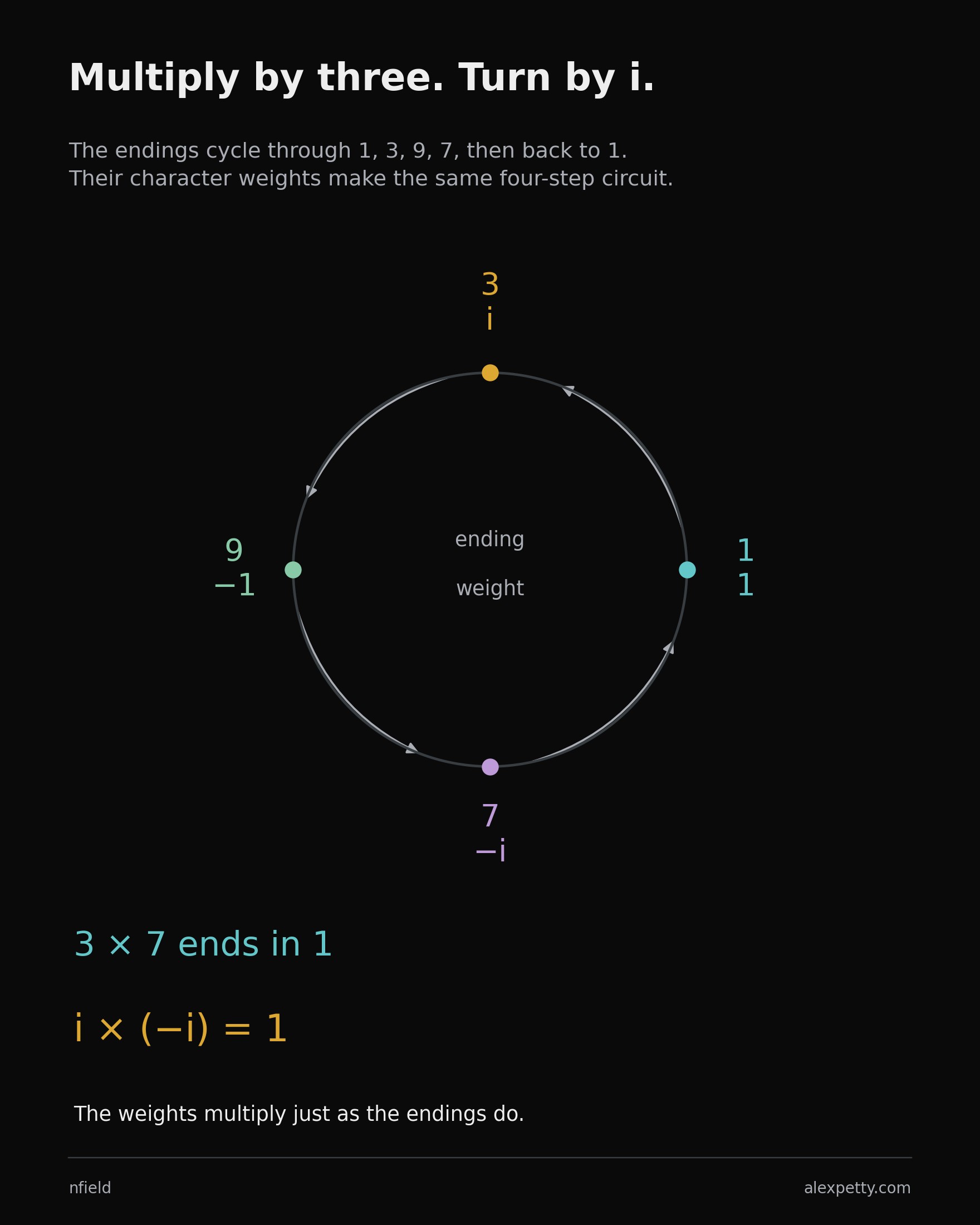
The weight of ending three can only be , , or , because its fourth power must be one, and that choice fixes the other three weights. So there are exactly four recipes, and we call the sums they produce .
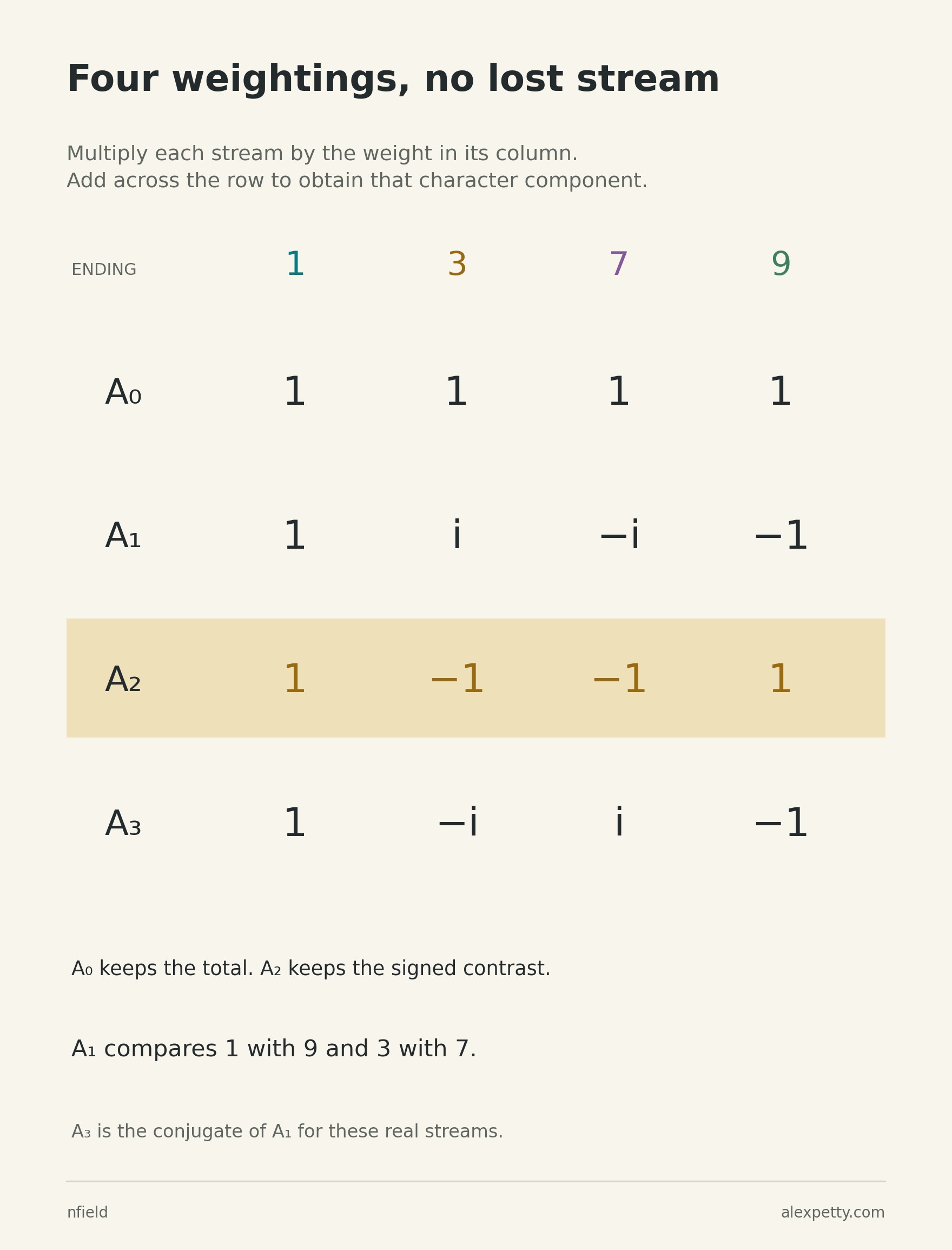
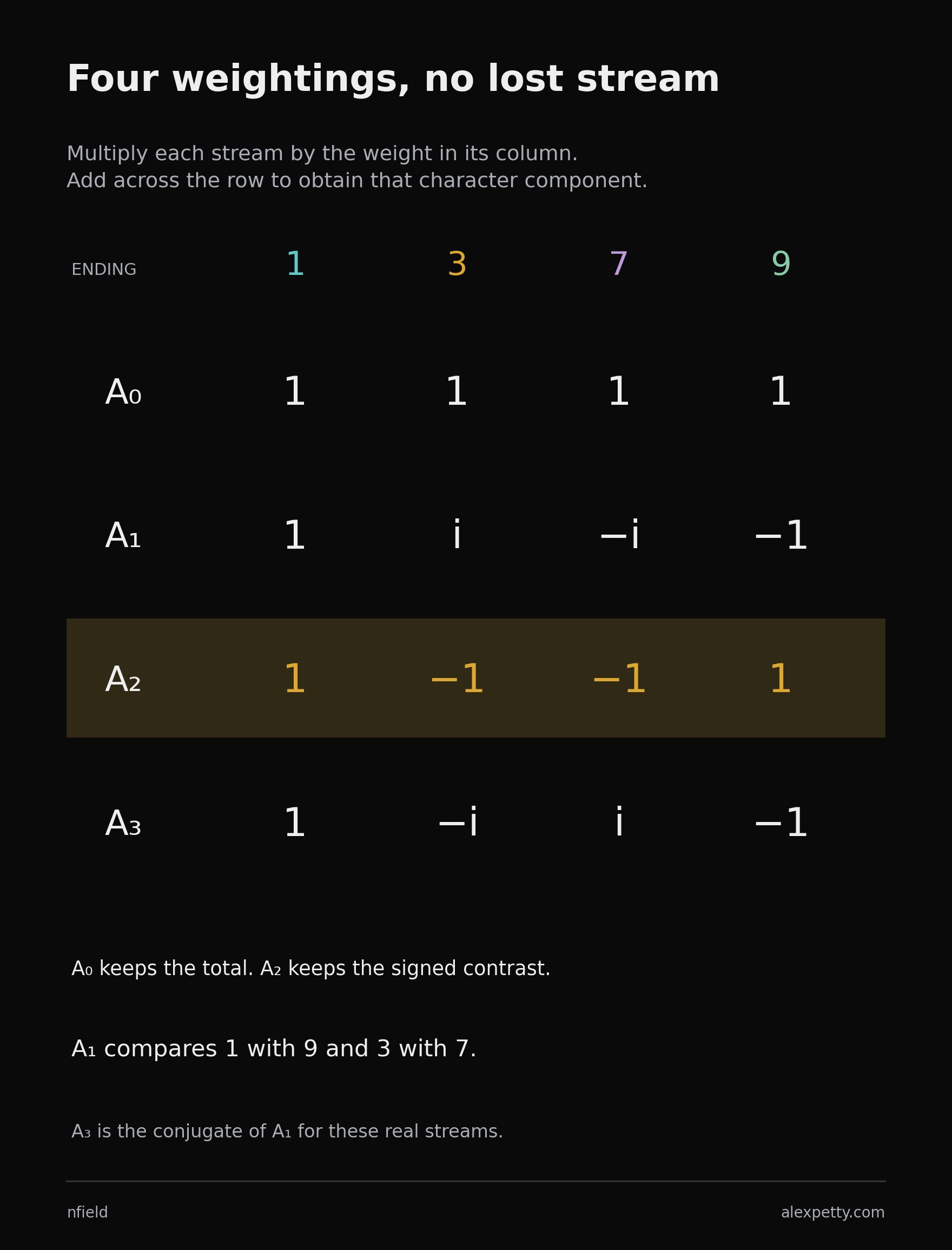
The all-ones recipe gives the principal component
With this normalization it is the total, not the average. The signed recipe gives
It compares the combined contributions of one and nine with those of three and seven. The complex recipe collects the two remaining differences
Its real part compares one with nine and its imaginary part compares three with seven. The fourth recipe reverses the imaginary part, so , and their equal magnitudes are built into the weights rather than being a coincidence in the data.
The difference hidden in the total
Apply the signed recipe at , keeping the contributions from one and nine and reversing those from three and seven.
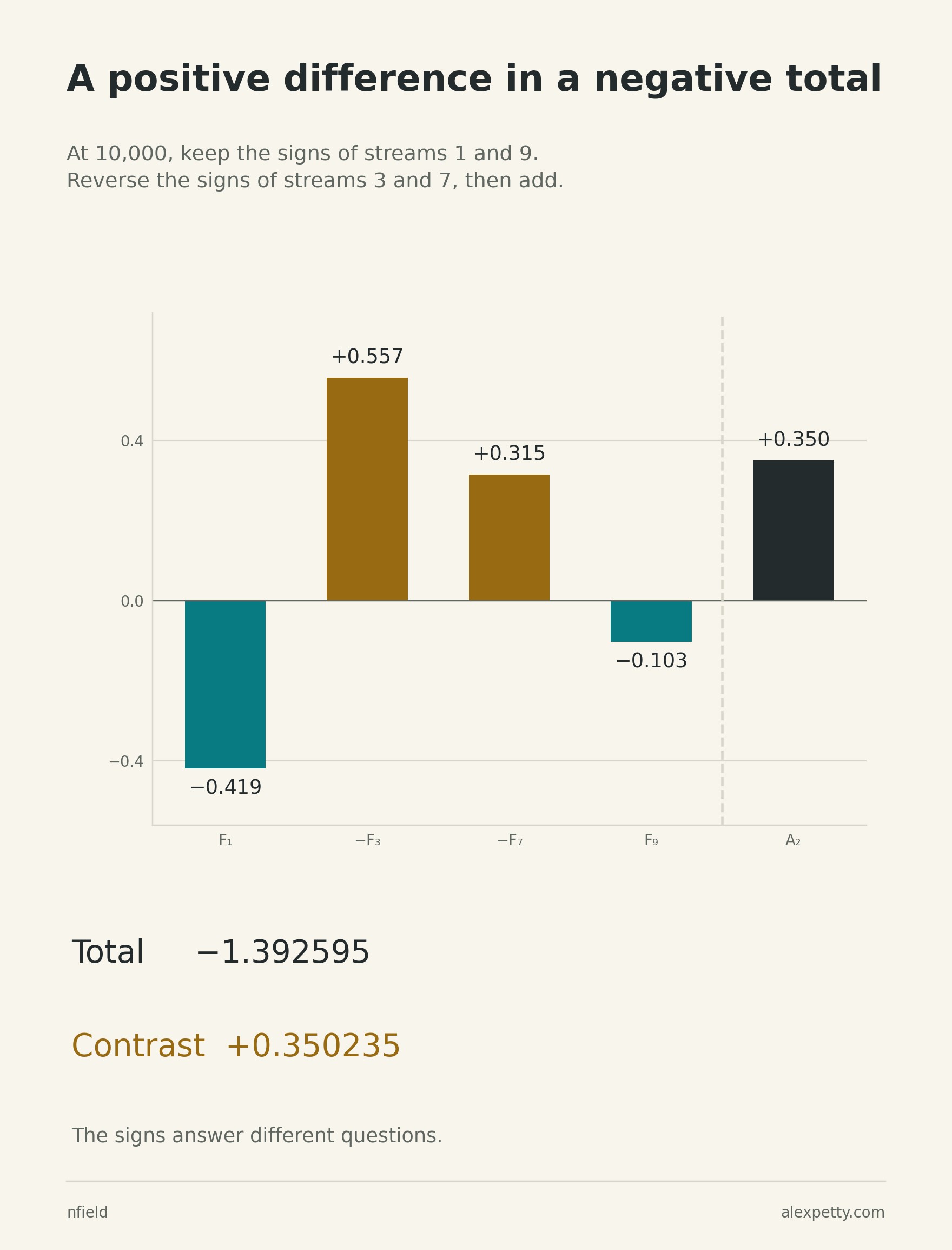
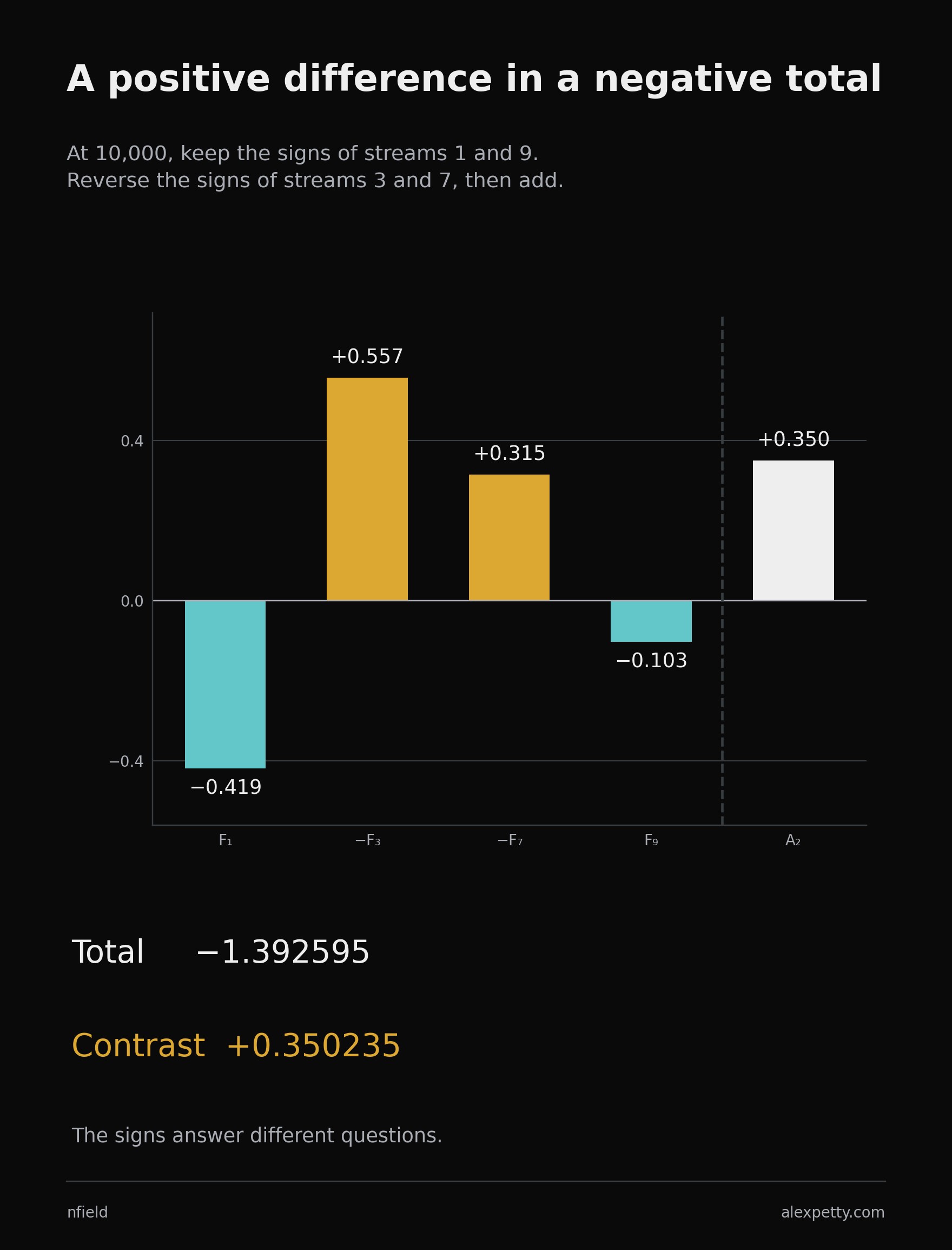
The total is about and the contrast is about . Endings three and seven supply the larger combined negative contribution, so subtracting them leaves a positive difference, and a downward total can carry that difference without showing it.
Every step, through three cutoffs
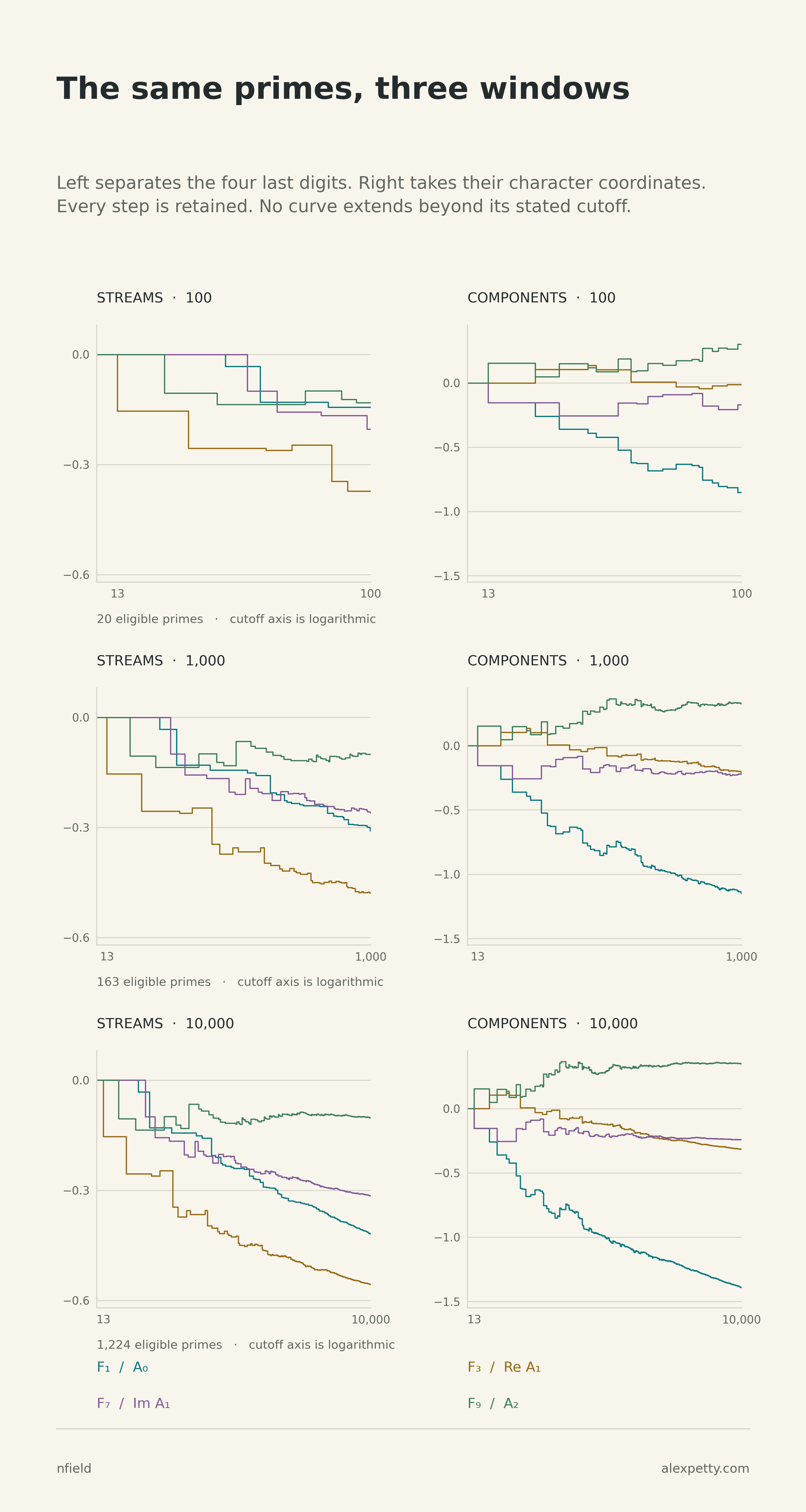
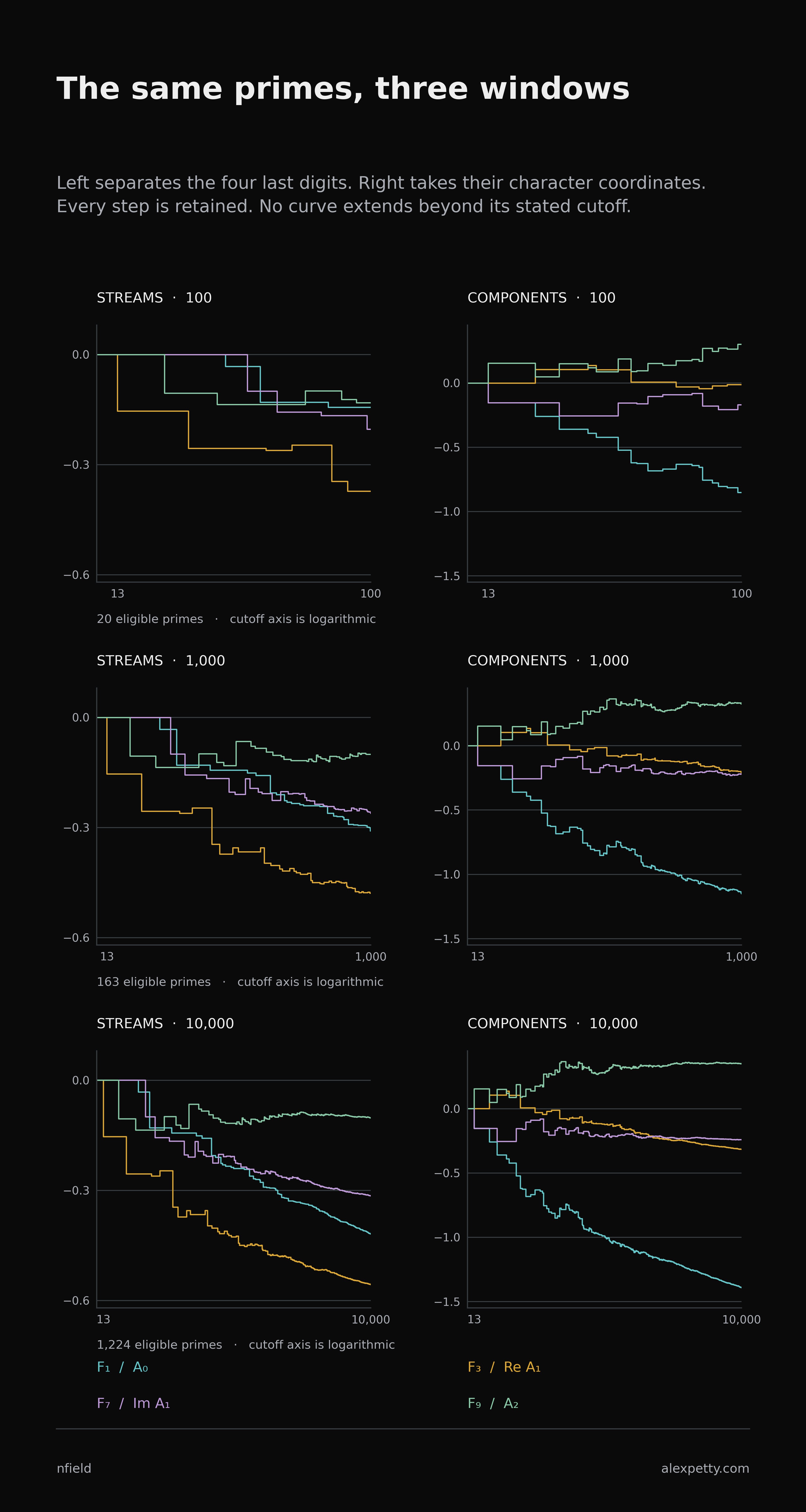
Each row stops at a different cutoff, and within a row the two panels use exactly the same primes. The left keeps the last-digit streams and the right keeps the total, the real and imaginary parts of and the signed contrast . The vertical scales stay fixed within each column, and neither panel extrapolates.
The four numerical checkpoints are
| Cutoff | ||
|---|---|---|
| 100 | -0.851414 | 0.300620 |
| 1,000 | -1.149104 | 0.329630 |
| 5,000 | -1.318994 | 0.354014 |
| 10,000 | -1.392595 | 0.350235 |
| Cutoff | ||
|---|---|---|
| 100 | -0.012410 | -0.168966 |
| 1,000 | -0.208657 | -0.217315 |
| 5,000 | -0.288890 | -0.234378 |
| 10,000 | -0.316180 | -0.241931 |
There are twenty eligible primes through one hundred, 163 through one thousand, 664 through five thousand and 1,224 through ten thousand, and the table includes all of them. The displayed decimals are rounded from rational sums.
The total becomes more negative at these cutoffs while the signed contrast rises and then falls a little, and following every intervening step does not turn that finite observation into a limit.
Every stream comes back
The four components retain all four running totals. To recover the stream ending in one, use
Add and and the streams ending in three and seven cancel. Add twice the real part of and the stream ending in nine cancels too, leaving four copies of .
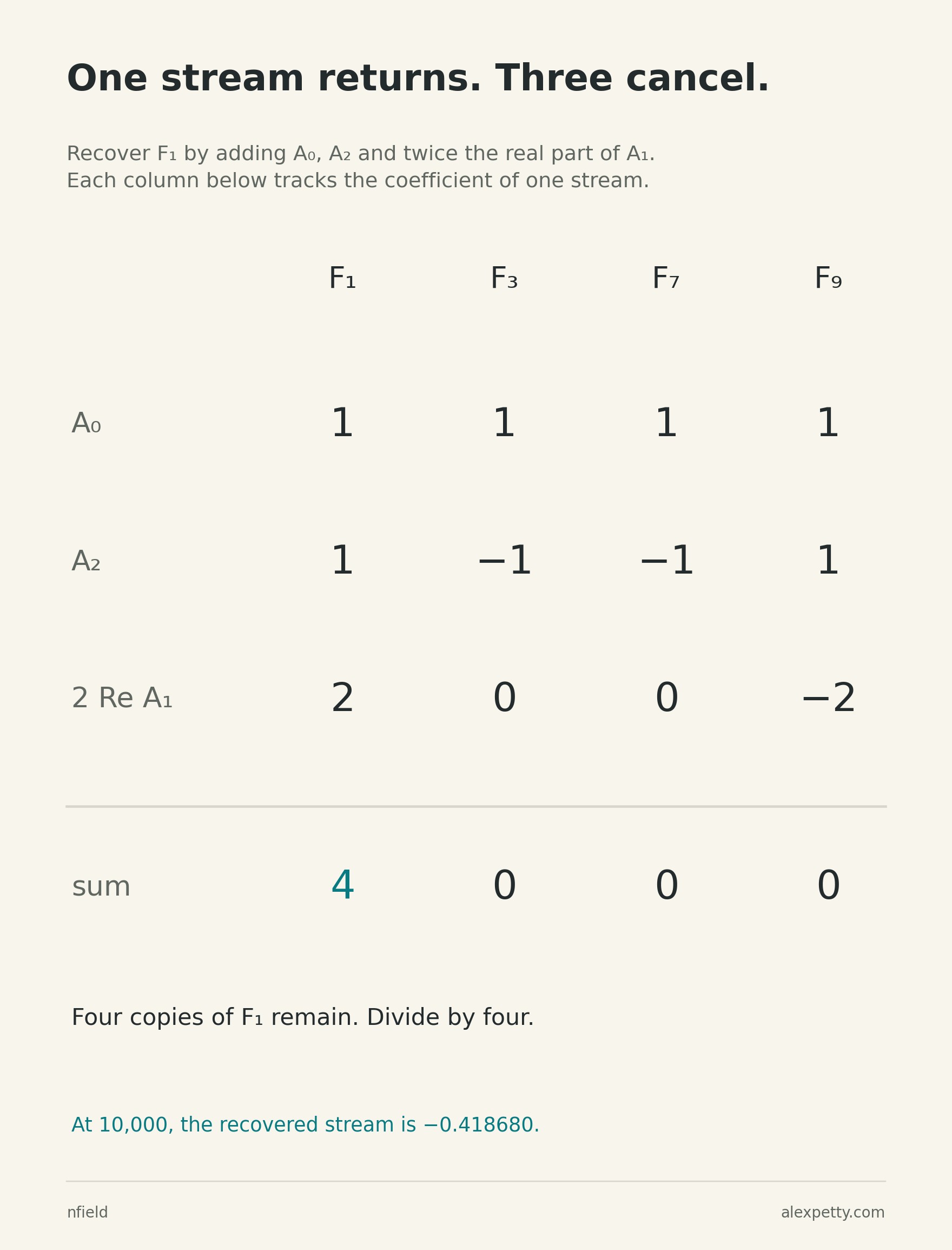
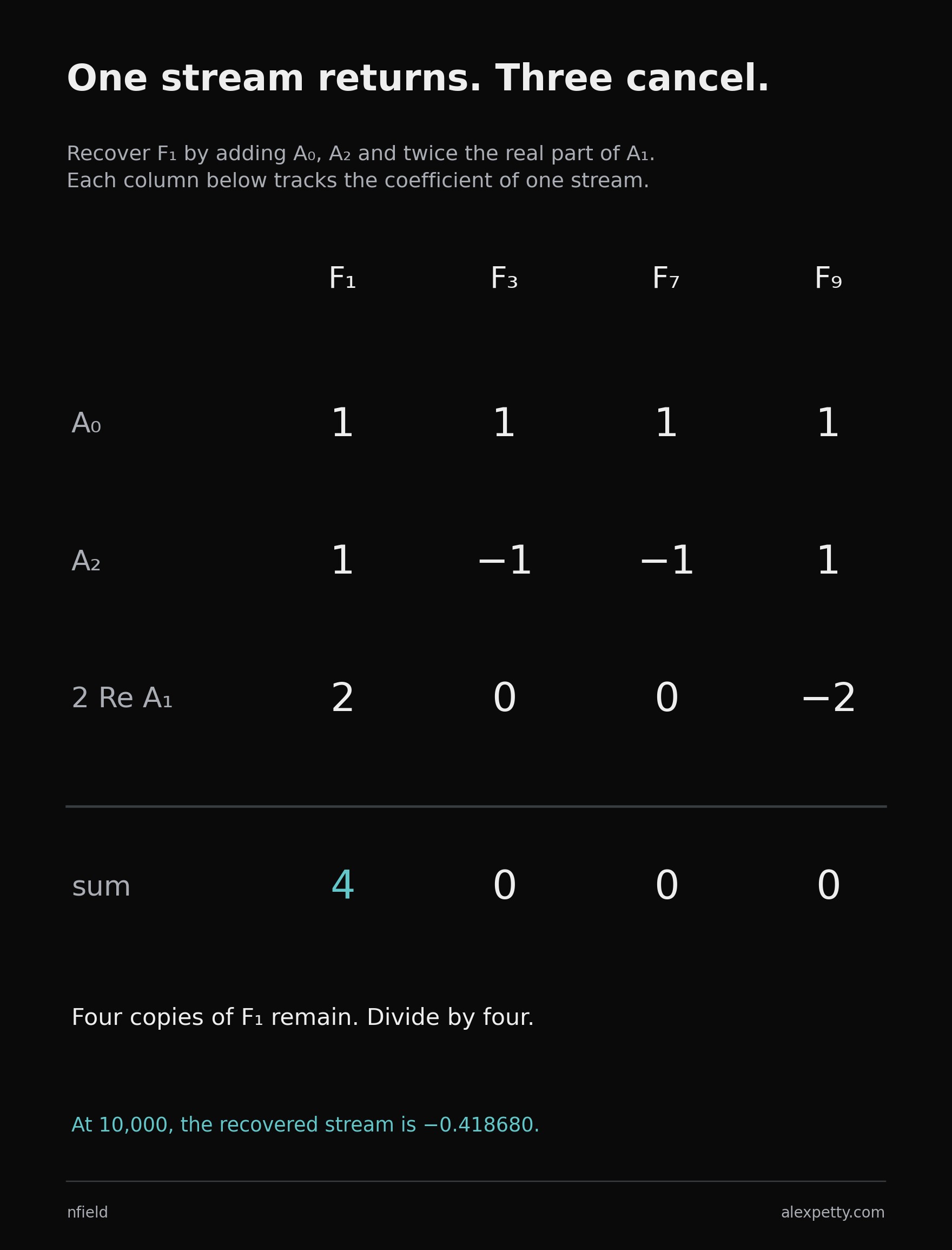
The other streams return by changing the signs. This is finite Fourier inversion on the four unit classes, using the classical orthogonality of Dirichlet characters. The transform is standard, and the digit table supplies the collision deviations we put into it.
Recover the other three streams
There are four real quantities to recover. The real components and supply two and the real and imaginary parts of supply the other two, so its conjugate does not add a fifth independent quantity.
Parseval’s identity accounts for the squared sizes as well
The factor four comes from using unnormalized character sums, and reconstruction and this identity hold at every finite cutoff, not just at the four checkpoints.
In another base, use the residue classes coprime to that base, of which there are , and as many characters. We can compare remainders several digit steps apart, or replace by , and the finite reconstruction still works. For complex , conjugating a component also conjugates ; the simple equal-magnitude pairing above uses real weights .
These characters also define Dirichlet -functions, where the coefficient of is . Here we sum over primes and insert the additional coefficient , and sharing the characters does not make the two series the same. The Character Structure of the Collision Fluctuation proves the finite reconstruction and leaves the cutoff question open.
The running sums, weight table and signed contrast
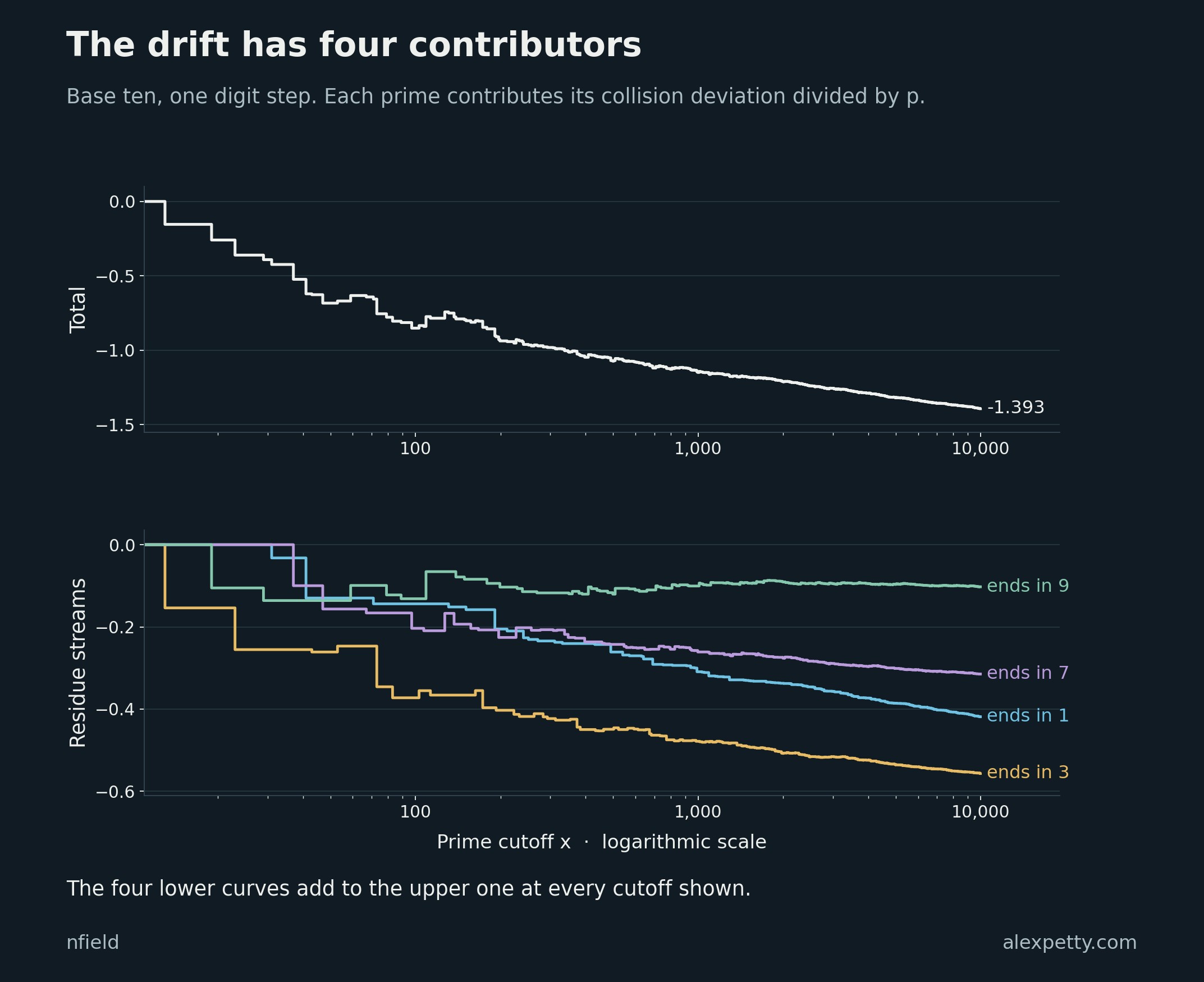
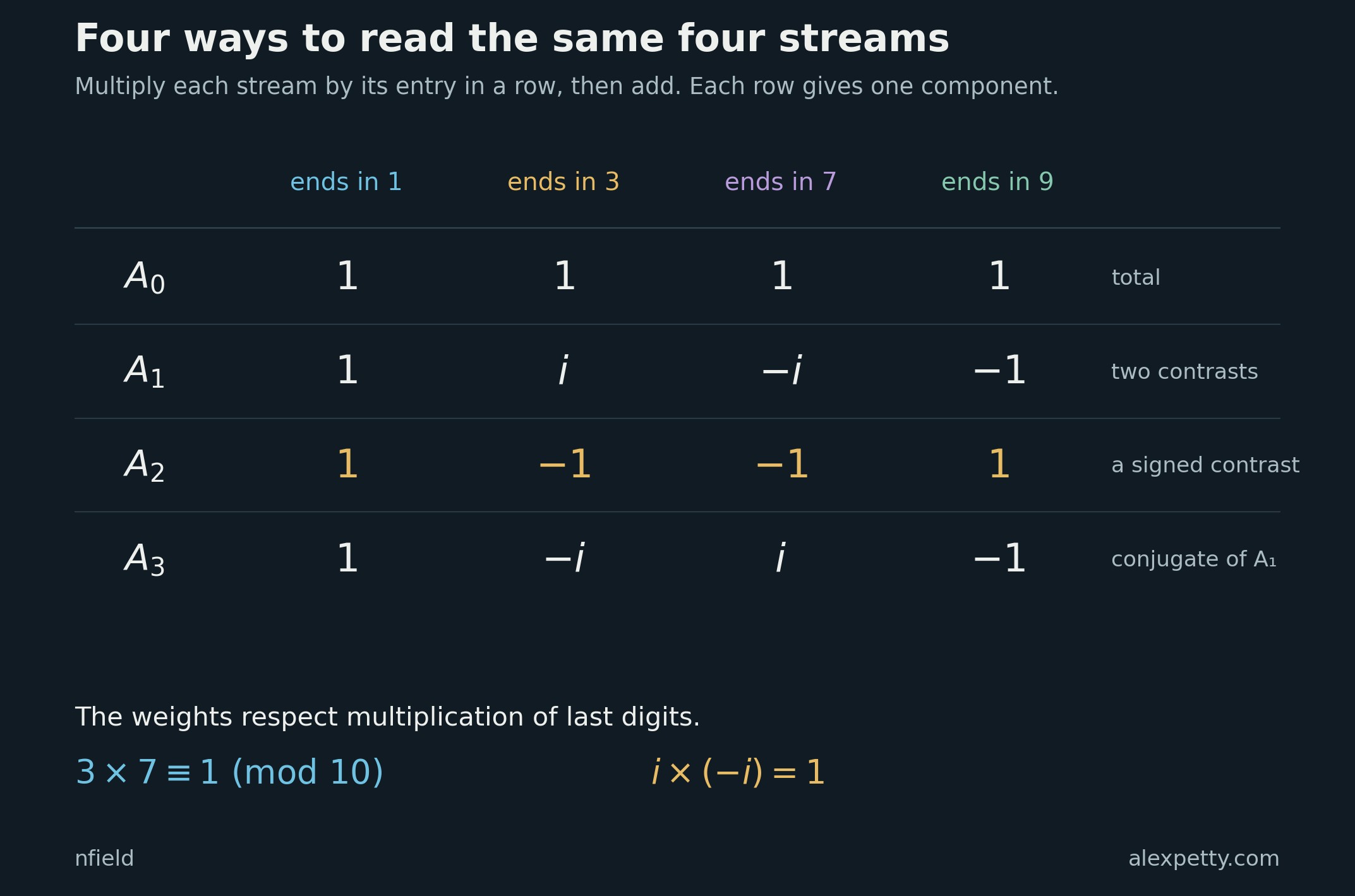
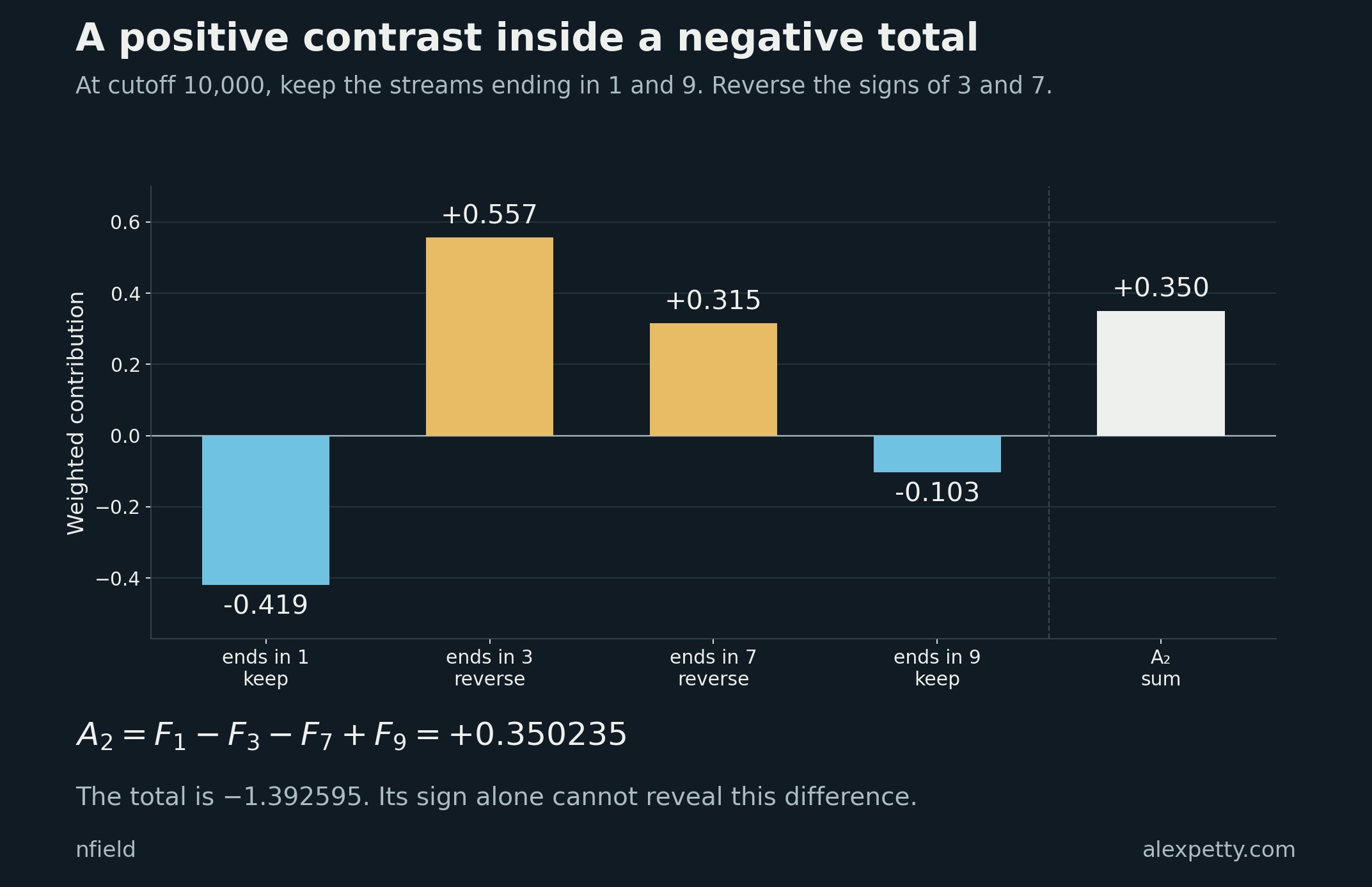
At ten thousand the primes ending in three and seven still supply the larger negative contribution, and the signed contrast lets us follow that imbalance without confusing it with the downward total. Whether the contrast stays positive, or settles at all, the finite sums cannot say. Every new cutoff adds primes, each with an exact deviation of its own, and what the four components do as the cutoff grows without bound is the question this leaves open.
Discussion
Sign in to join the discussion.