Petty's Notebook
ArticlesPapersnfieldAbout
Get notified when new posts are published. No spam, just math.
Alexander S. Petty  |  ©2009-2026
← Back
Origins

Geometries Hidden in the Number System
June 6, 20108 min read
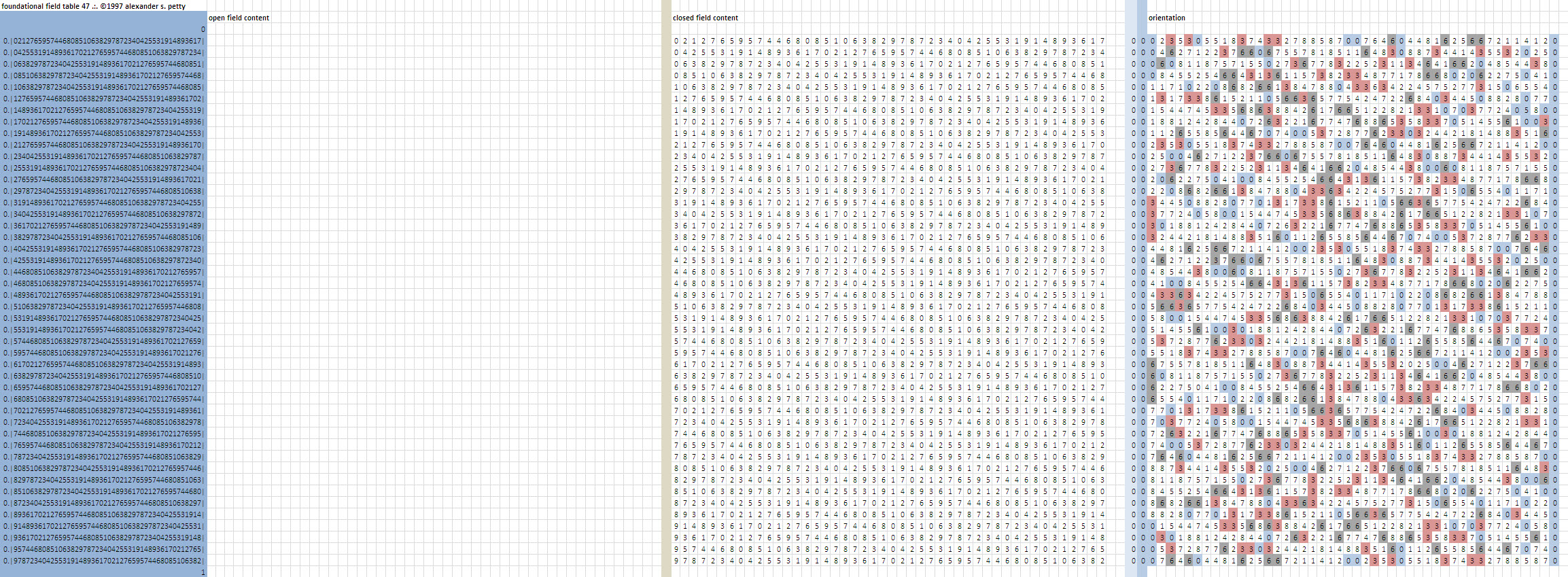
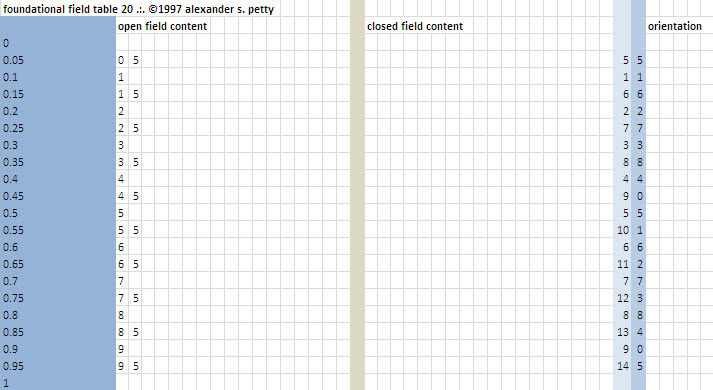
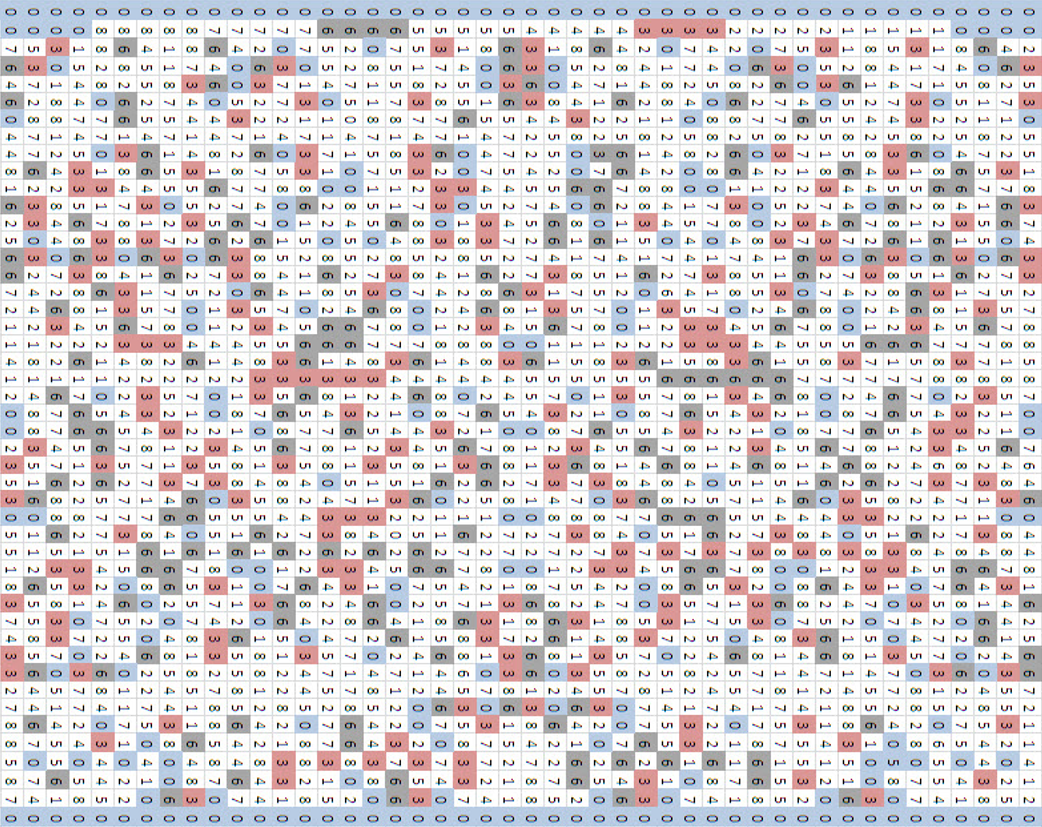
Original colored orientation panel from the table of forty-sevenths, turned sideways.
Every number has a geometry. Primes produce irreducible ones.

Write out the sevenths, one seventh through six sevenths, and they all use the same six digits, 142857, each starting in a different place. Thirteenths don’t do that. They split into two families of six, one built on 076923 and the other on 153846. Thirty-sevenths break into twelve little families of three, and forty-sevenths go the other way, putting all forty-six fractions into one long cycle.

Which primes put everything into a single cycle is an old question. Gauss worked through these periods in 1801. In 1927 Emil Artin guessed that infinitely many primes do it in base ten, and nobody has managed to prove that yet.

Those cycles were the sort of thing that kept me drawing. Long division seemed to unzip an integer into relationships I could inspect. I called the drawings field glyphs, and began collecting them. The aim was to see several related fractions at once, then use the tables to work out what I was looking at.

Six ways around the same path

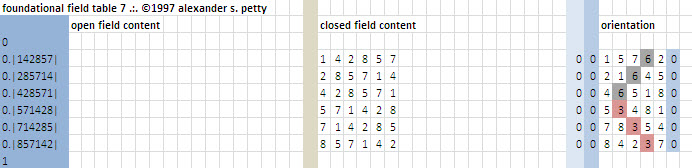
Here are the six interior sevenths. The bar marks the digits that repeat.

1/7=0.142857‾2/7=0.285714‾3/7=0.428571‾4/7=0.571428‾5/7=0.714285‾6/7=0.857142‾\begin{aligned} 1/7&=0.\overline{142857} & 2/7&=0.\overline{285714}\\ 3/7&=0.\overline{428571} & 4/7&=0.\overline{571428}\\ 5/7&=0.\overline{714285} & 6/7&=0.\overline{857142} \end{aligned}1/73/75/7​=0.142857=0.428571=0.714285​2/74/76/7​=0.285714=0.571428=0.857142​

Place the digits around a circle and join them in the order one, four, two, eight, five, seven, then back to one. All six rows follow the same path. Each starts at a different point.
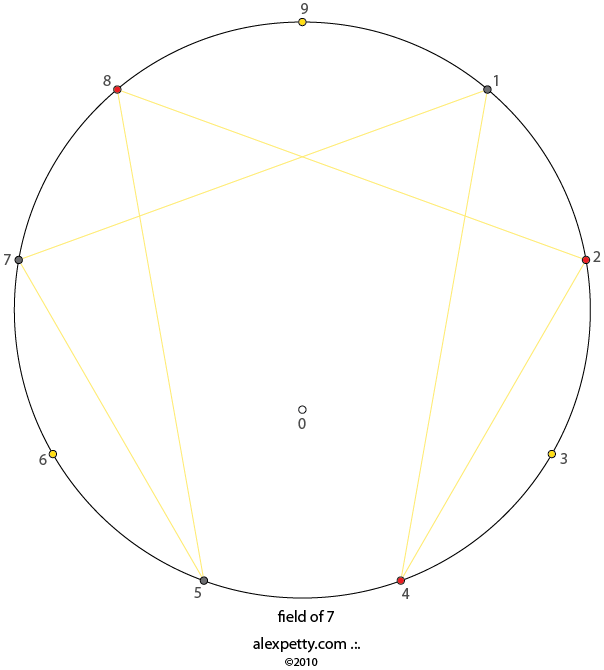
Original yellow glyph of seven connecting one, four, two, eight, five, and seven in a closed path.
Seven. Trace 1, 4, 2, 8, 5, 7, then return to 1.

The circle has nine positions, with nine at noon. Zero and nine occupy that same outer position because the display reduces numbers modulo nine. The small zero inside the original plates marks the origin. This is the arrangement introduced in The Circle of Nine.

The picture makes the shared route easy to see. The table preserves the order and number of visits, information that overlapping lines can hide. I needed both.

A repeated digit and a complete turn

For each denominator I assembled its fractions between zero and one. The field of twelve, for example, contains one twelfth through eleven twelfths. These sheets keep three records side by side.

Part of the original table Information recorded
Open field content Digits before repetition begins, or the whole terminating decimal
Closed field content Repeating digits carried through a return of their accumulated sum
Orientation Digit sums and their positions modulo nine
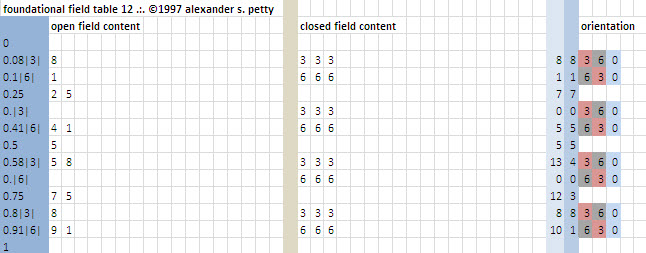
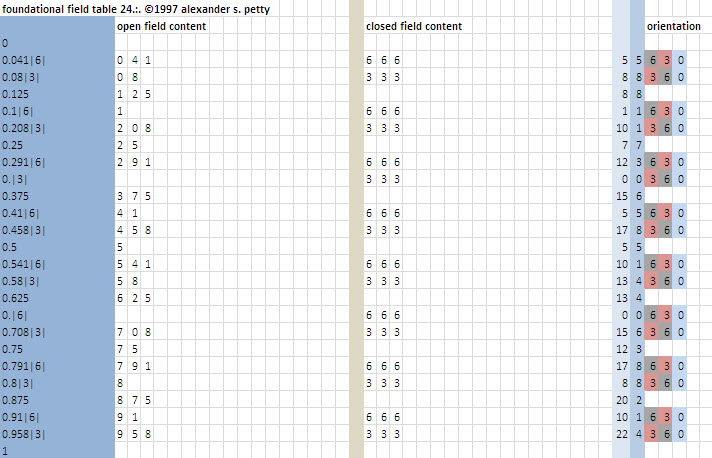
Original table of twelfths separating finite prefixes, repeated threes or sixes, and digit-sum orientation.
Twelfths. Finite digits on the left, repeating content in the middle, orientation on the right. Select the table to read the original.

Look at one twelfth, written 0.08|333| in the sheet. The pipes are my own notation. They hold a repeating cycle carried until its accumulated digit sum adds back up to zero modulo the base minus one, which in decimal means modulo nine. The leading 08 belongs to the open part. The cycle inside the pipes belongs to the closed part.

A single 3 already repeats, but one 3 does not bring the digit sum back to zero modulo nine. It takes three copies, which is why the pipes hold 333.

Digits accumulated Sum Position modulo nine
3 3 3
33 6 6
333 9 0

Those positions make the triangle in the drawing of three. Repeated sixes travel through six, three, and zero, visiting the same triangle in the opposite order.
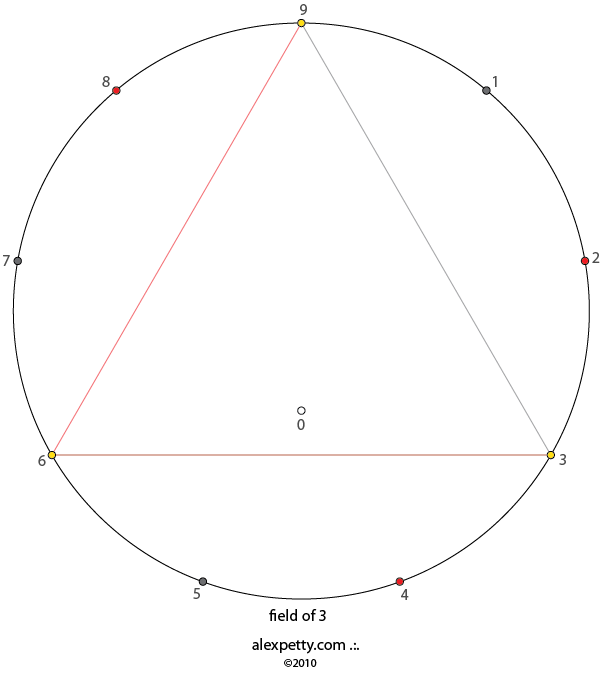
Original glyph of three with the triangle joining three, six, and nine in red and gray.
Three. Repeated threes and sixes traverse the triangle in opposite orders.

Seven’s glyph followed its digits directly. This triangle follows accumulated sums. The catalog uses both readings, so it matters which one we are tracing. For one seventh, the corresponding sums run through one, five, seven, six, two, and zero. They are recorded separately from the digits 142857.

The triangle also appears inside larger fields. Four twelfths and seven twenty-firsts are both one third. Those rows retain the familiar arithmetic while their neighbors add other paths. A recurring shape had given me something specific to look for in the fractions.

A whole in complementary parts

The symmetry has a simple source. One seventh and six sevenths add to one. So do two sevenths and five sevenths, or three sevenths and four sevenths. Every row has a partner across the unit interval.

In these purely repeating decimals, the partnership reaches right into the digits.

  142857
+ 857142
  ------
  999999

Each digit meets its complement to nine. On the circle, one and eight face each other across the vertical axis, as do two and seven, three and six, four and five. The reflection has an arithmetic reason. The two fractions still account for one whole.

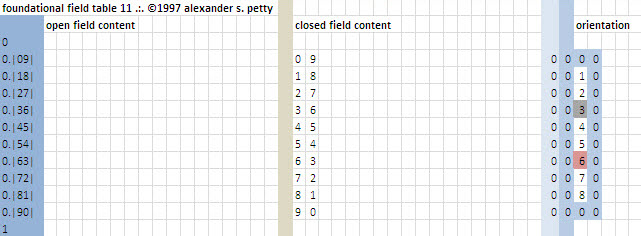
Eleven lays the complementary pairs almost bare. Its repeating words are 09, 18, 27, 36, 45 and their reversals. Thirteen arranges its fractions into two families of six rotations, represented by 076923 and 153846.
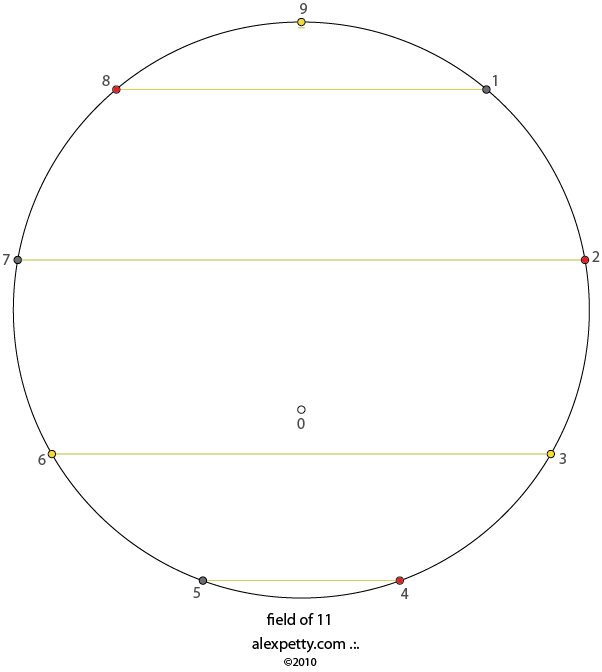
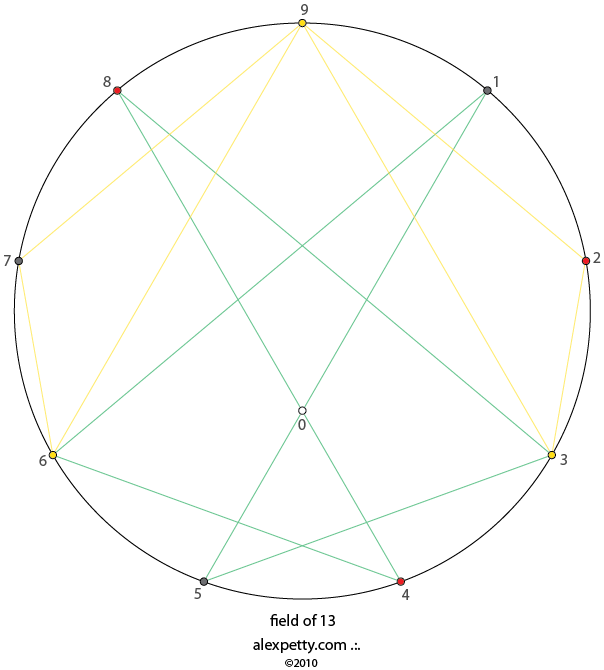
Original glyph of eleven with horizontal paths pairing one with eight, two with seven, three with six, and four with five.
Eleven. Complementary pairs span the circle. Zero and nine share the top position.
Original glyph of thirteen with yellow paths through nine, seven, six, two, and three, and a green crossing path.
Thirteen. Two families of six rotations, drawn in yellow and green.

The difference comes from long division. At each step, multiply the remainder by ten and take the new remainder after division by the denominator. At seven, all six nonzero remainders belong to one cycle. At eleven there are five cycles of length two. At thirteen there are two of length six.

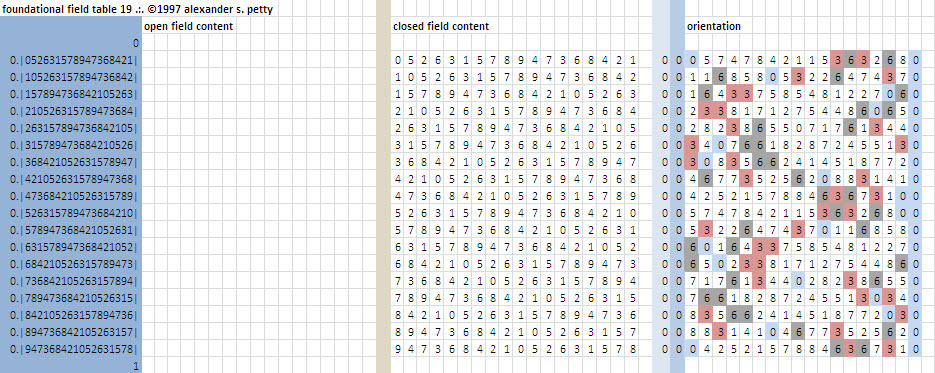
Being prime does not prescribe one kind of picture. Forty-seven has a single cycle of length forty-six, while thirty-seven has twelve cycles of length three. Both original tables are available below. The larger prime makes the longer repeating word, while the smaller one makes more separate families.

The base matters, too. These cycles come from multiplication by ten. The nine-position circle is a choice of display. Changing the base changes both pieces of the construction, a question I took up in The Effect of Base on Numeric Fields.

The fractions that finish

Four supplies a useful contrast. Its three interior fractions all terminate. Add the digits in each decimal and reduce the result modulo nine.

Fraction Digit sum Position
1/4 = 0.25 2 + 5 = 7 7
2/4 = 0.5 5 5
3/4 = 0.75 7 + 5 = 12 3

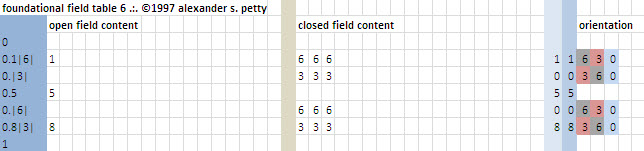
Read down the last column and join seven to five to three. That produces the open path in four’s glyph.
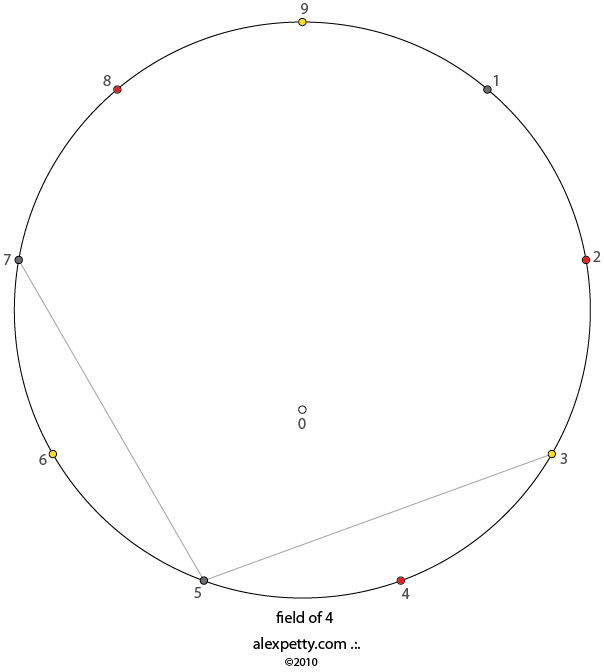
Original glyph of four with an open gray path from seven through five to three.
Four. The finite digit sums give the open path 7, 5, 3.

Here the path connects totals from successive fractions. There is no repeating tail to follow. Five gives a similar construction through two, four, six, eight. Eight runs through the positions eight down to two.

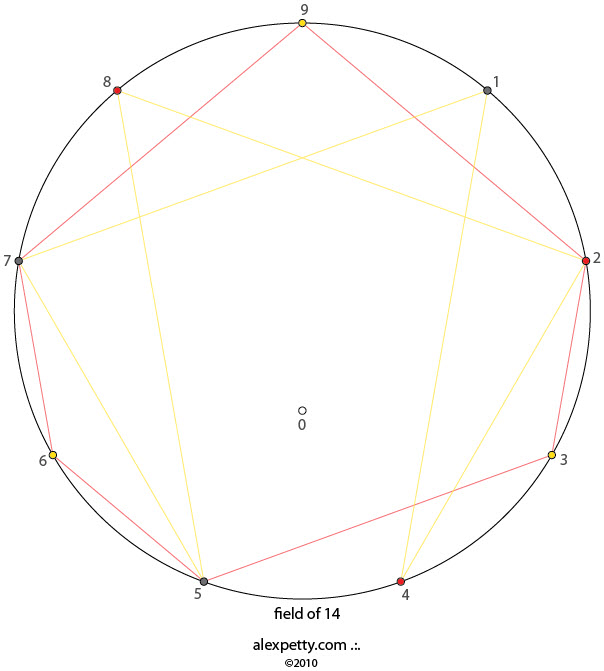
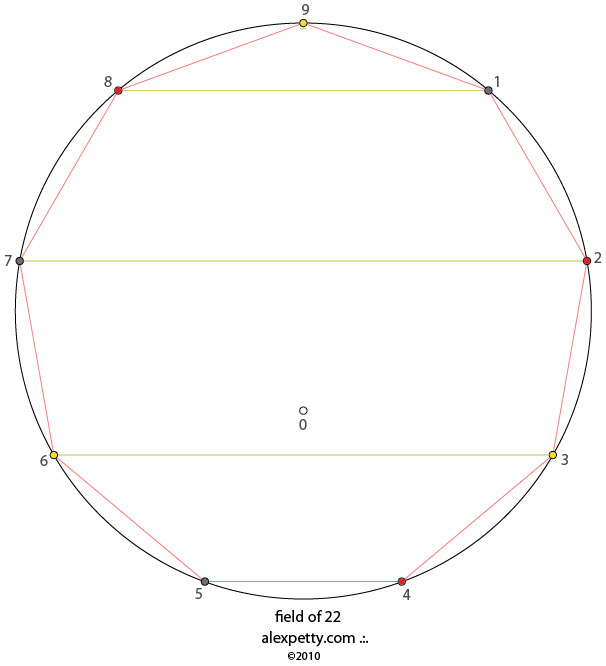
A reduced fraction terminates in decimal when its denominator has only the prime factors two and five. Fourteen and twenty-two therefore require a more careful description. They combine finite prefixes with recurring tails. In their drawings, seven’s repeating path and eleven’s complementary pairs remain recognizable beneath the added lines.

I called the open constructions the world of form. Alongside structural and polar, it was one of the names I used to organize the pictures. The distinctions that held up were more precise. Some digits precede a cycle, some belong to it, and some fractions finish altogether. The tables let me separate those cases.

Unity as a guiding question

Original seated silhouette inside a circle, beneath the words consciousness in unity with itself and oneness.
Unity and consciousness in the original artwork.

Unity was there from the beginning. I meant the whole before distinguishing its parts, and I connected that idea with consciousness, self and other, and the boundary through which a distinction becomes possible. The seated figure in the original artwork records that interest.

It guided my attention toward a mathematical question I could actually work on. When a whole is divided, what relationships between its parts must remain? Complementary fractions gave me one exact answer. The reciprocal relationships in The Golden Ratio gave me another way to pursue it.

Those questions remain with me. The later work counts agreement between digits, follows remainder cycles, and measures balances that I was first trying to see. Three and the Golden Ratio develops the fractional-field calculations. The Structure That Survives finds an exact reflection law in a later table of collision counts. The Clocks Beneath Collision Energy follows fixed reciprocal shares through moving remainder states.

I have better tools now, including nfield, and the pictures keep their place beside them. They hold several relationships in view while I decide which calculation to make next, the same job they did at the start.

Original plates and tables

All 58 original images are here and in the examples above. Open a group to compare the smaller previews. Select any image to inspect the original at full resolution, including the long table of forty-sevenths used for the cover.

Reading guides and the tables for the worked examples

The polarity guide supplies the original color convention. Red and gray distinguish the two directions, and yellow and green serve the prime paths. In the tables, red highlights three, gray six, and blue zero. The three source tables below correspond to the triangle, the sevenths, and the open path of four.
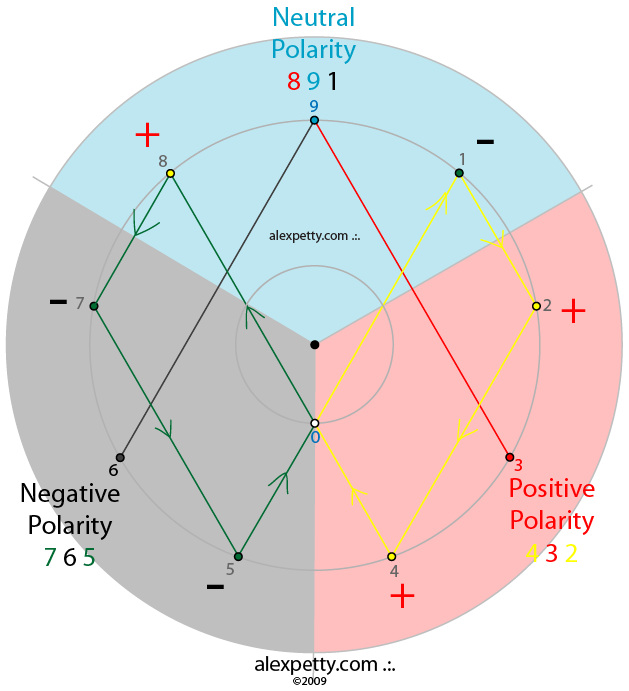

Original polarity guide with a nine-position circle, three shaded sectors, and colored directional paths.
The polarity convention from The Circle of Nine supplies the positions and directional colors used to read the catalog.
Original table of thirds with repeated threes and sixes and accumulated totals in the orientation columns.
The digit words have period one. Three repeated copies complete the return of their sums modulo nine.
Original table of sevenths showing six rotations of 142857 and a separate orientation calculation.
The middle block gives the digits. The right block accumulates them. For one seventh those totals are one, five, seven, six, two, zero.
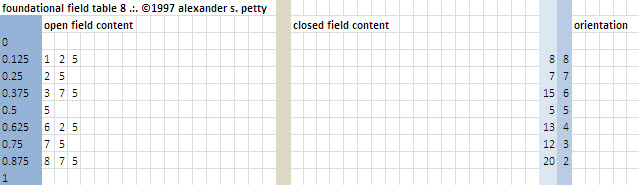
Original table of quarters with terminating digits 25, 5, and 75 and digit totals seven, five, and twelve.
The last column reduces twelve to three. Read seven, five, three down the rows to recover the path of four.
Thirds inside larger fields · 6, 12, 15, 21, 24

Compare the triangular paths, then inspect the finite prefixes and additional fractions in each table. The table of twelve is beside the reading guide above.
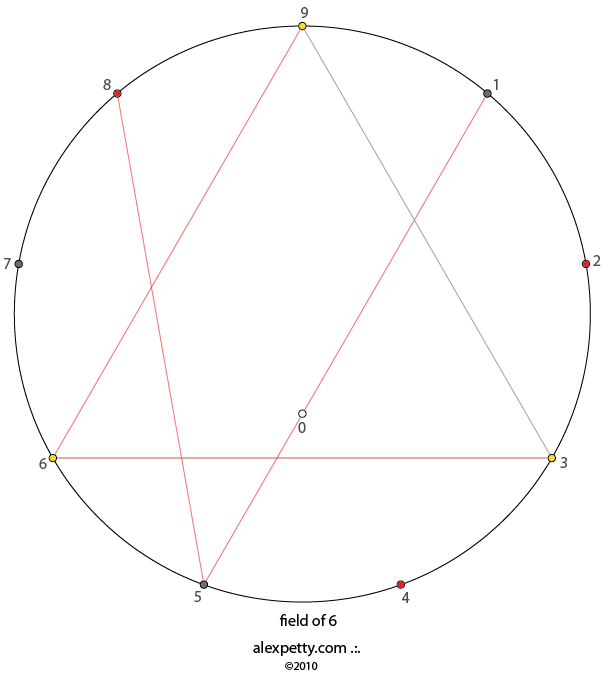
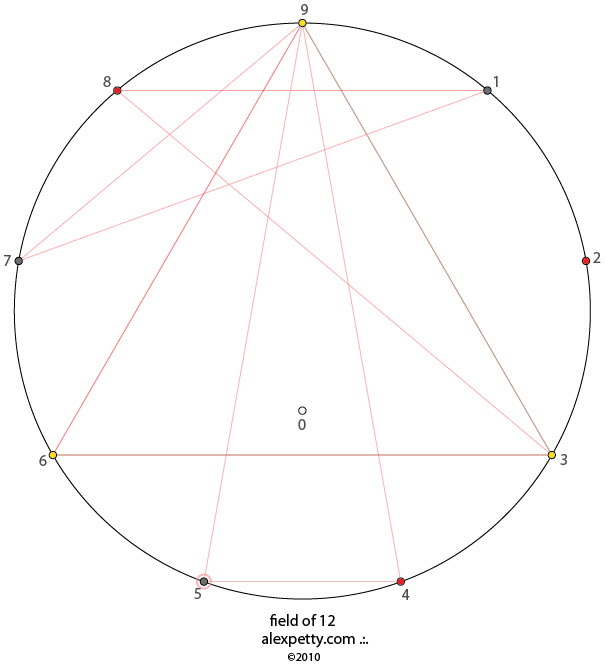
Original glyph of six containing the triangle of thirds and additional red lines through one, five, and eight.
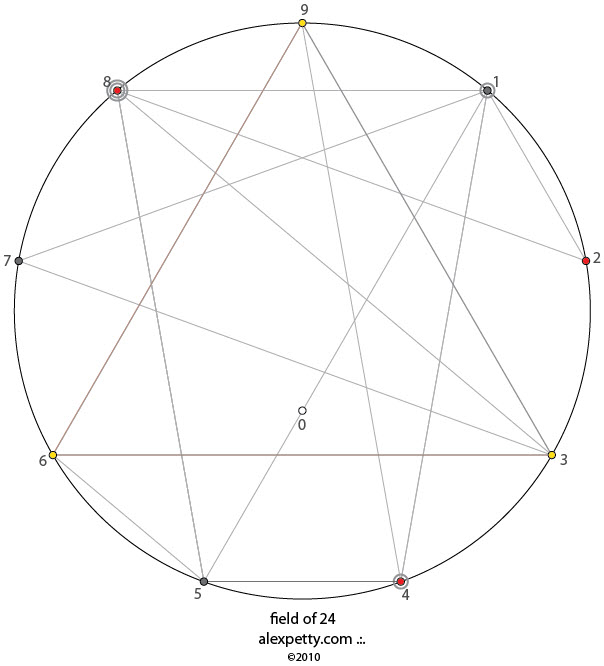
The field of six contains additional lines as well as the triangle. Compare the complete field with the simpler drawing of three.
Original glyph of twelve with the triangle of thirds and additional red connections between the outer positions.
Twelve retains the thirds and adds finite prefixes and terminating rows.
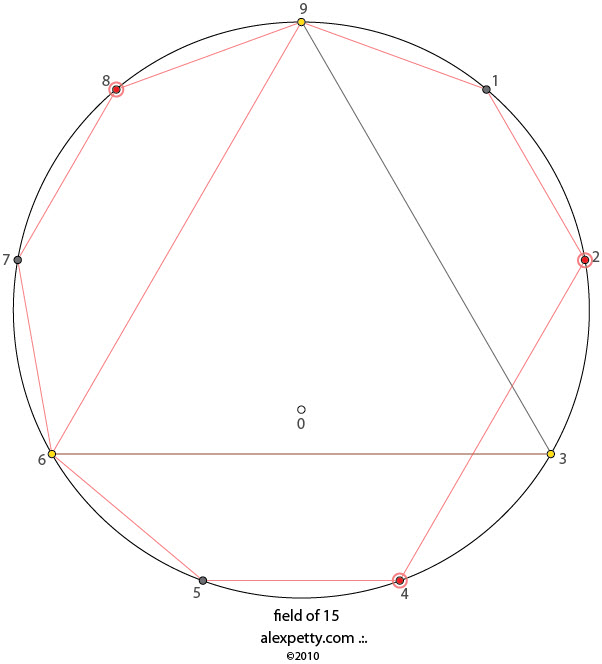
Original glyph of fifteen with the triangle of thirds and a red path near the circle's perimeter.
Fifteen adds a peripheral pattern around the recurring triangle.
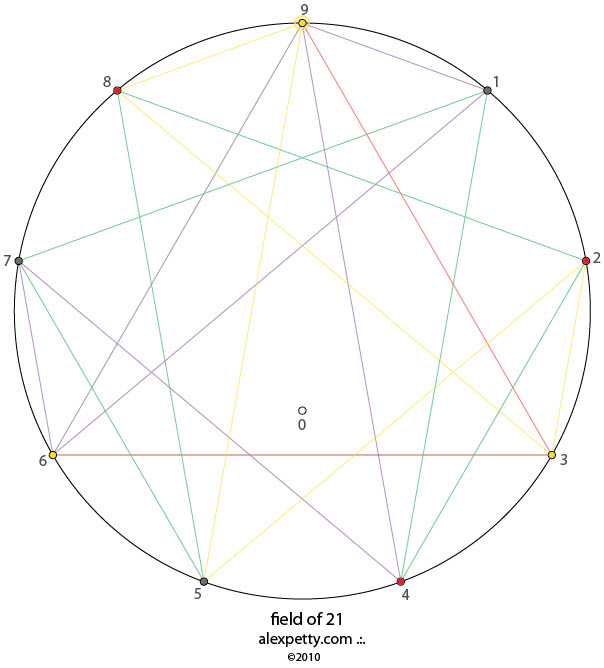
Original glyph of twenty-one combining the triangle of thirds with yellow and green paths.
Twenty-one places the familiar triangle within a larger collection of repeating paths.
Original glyph of twenty-four with gray paths over the same nine-position circle.
Twenty-four carries the additional finite content into a denser drawing.
Original table of sixths with finite prefixes one, five, and eight alongside repeated threes and sixes.
Six includes the thirds, two recurring decimals with finite prefixes, and the terminating half.
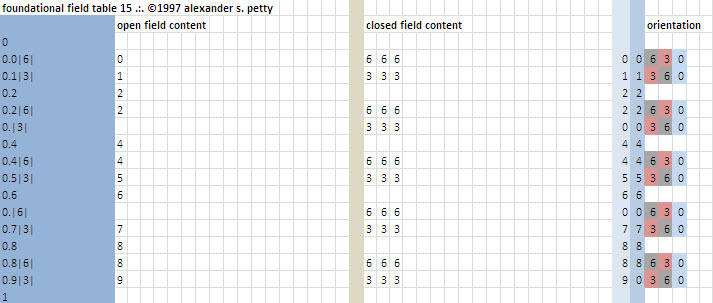
Original table of fifteenths with finite prefixes and repeated threes or sixes.
Fifteen combines terminating fifths with recurring fractions that have a finite leading digit.
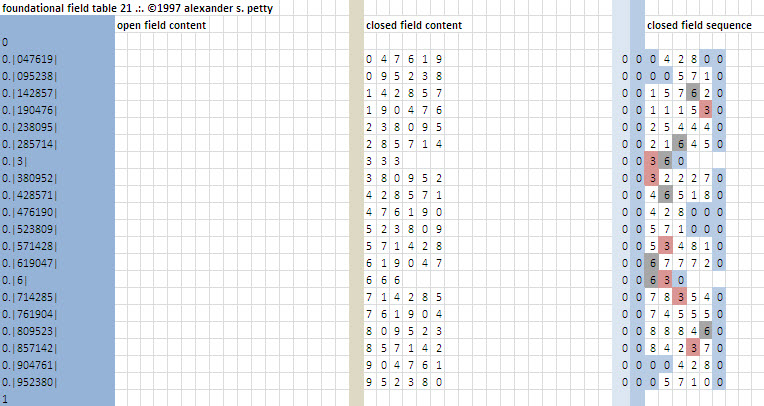
Original table of twenty-firsts with six-digit repeating words and the repeated thirds among them.
Rows seven and fourteen are the familiar thirds. The remaining rows carry the additional repeating words.
Original table of twenty-fourths showing finite prefixes, repeating threes and sixes, and reduced digit totals.
Twenty-four has longer finite prefixes than six or twelve. The repeating tails still consist of threes and sixes.
Ninths, eighteenths, and the harmonic table

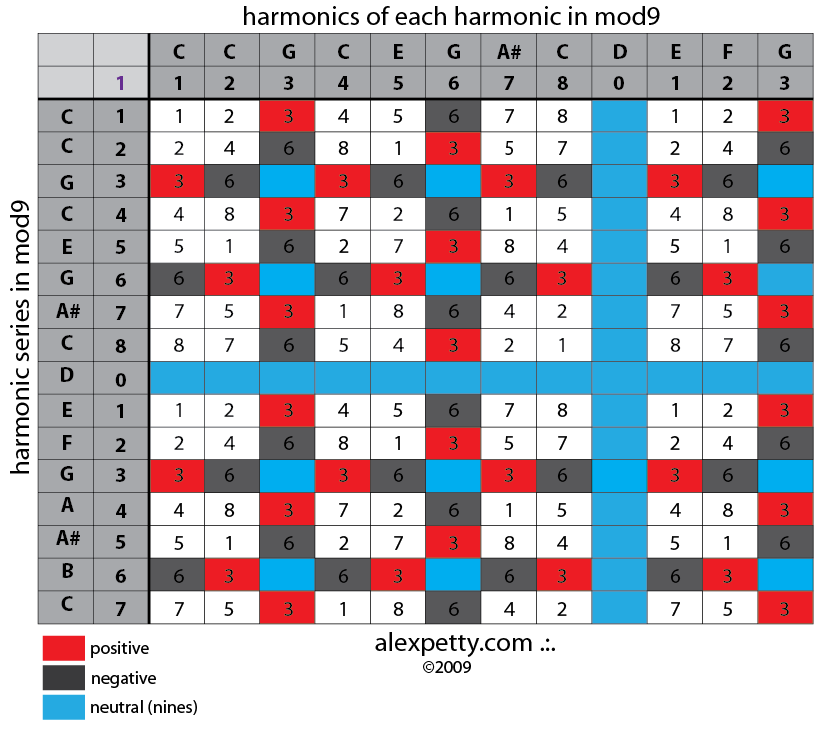
The ninths repeat single digits. Accumulating each digit produces multiplication modulo nine. The harmonic sheet applies the same arithmetic to harmonic indices, an inviting connection for me as a musician. The third harmonic of a fifth harmonic has index fifteen, which reduces to six. The pitch labels are a musical reading of that arithmetic.
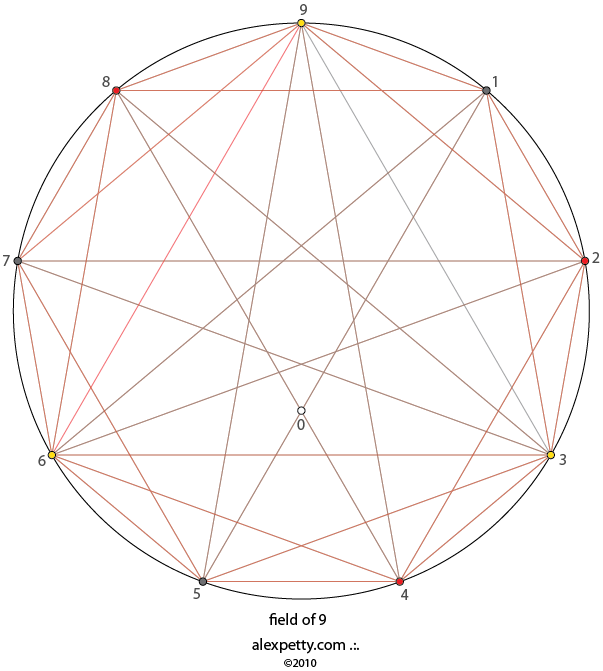
Original glyph of nine with intersecting red, gray, and brown paths between the outer positions.
Nine gathers the accumulated paths from its constant-digit fractions into one plate.
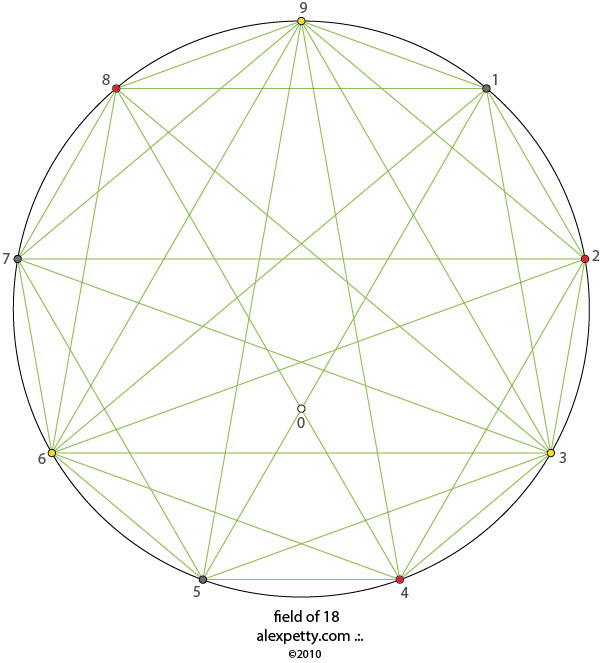
Original glyph of eighteen with dense overlapping paths in green and olive.
The original eighteen plate. Use its table to distinguish the leading digits from the accumulated repeating content.
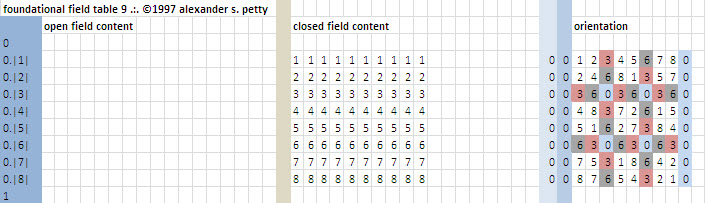
Original table of ninths with constant repeating digits and running totals modulo nine.
Repeated addition of each constant digit produces the multiplication-table pattern in the orientation columns.
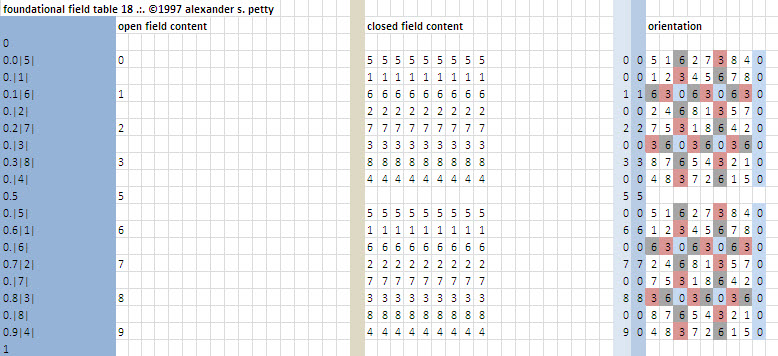
Original table of eighteenths with finite prefixes, constant repeating tails, and digit-sum columns.
Eighteen retains the ninths while introducing finite leading digits in the other rows.
Original harmonics-of-each-harmonic table with harmonic indices multiplied modulo nine and musical pitch labels.
Multiply the row and column harmonic indices, then reduce modulo nine. The colors highlight three, six, and zero.
Prime cycles · 11, 13, 17, 19, 23

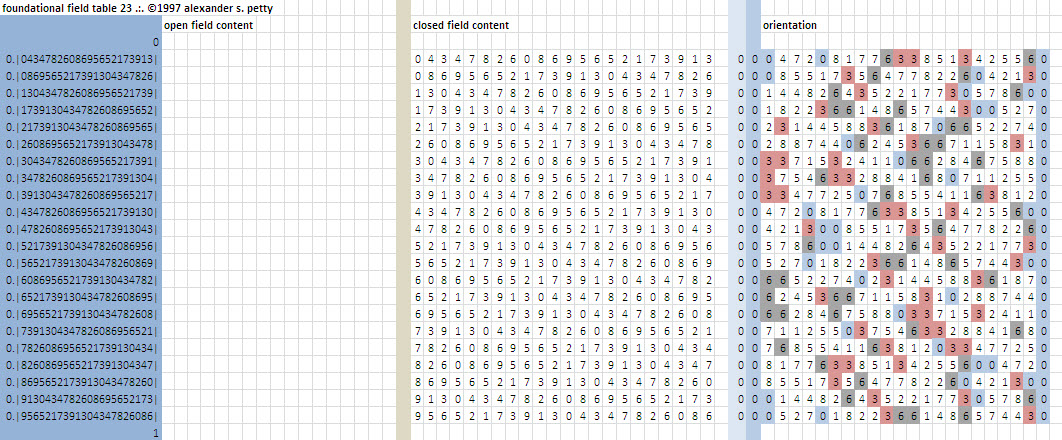
Eleven and thirteen split into several cycles. Seventeen, nineteen, and twenty-three each have one cycle, of lengths sixteen, eighteen, and twenty-two respectively. The tables retain every row behind the drawings.
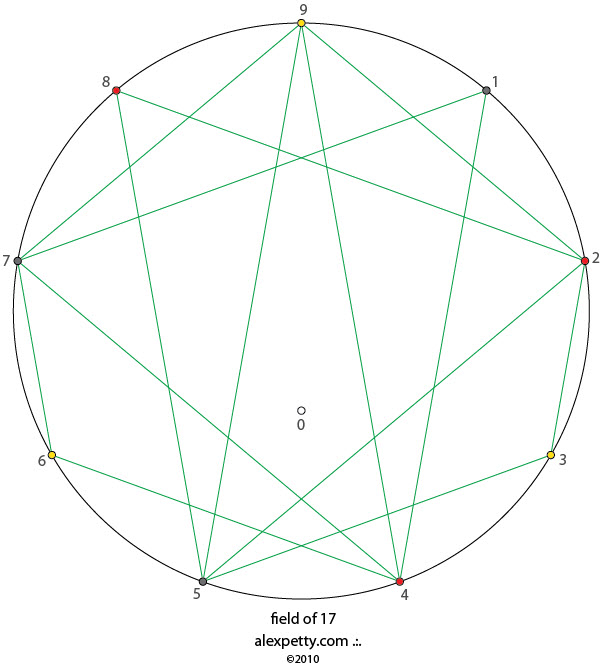
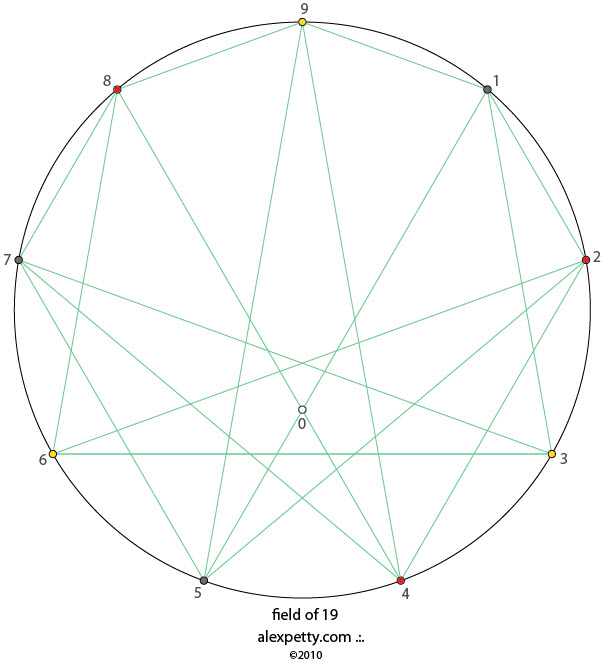
Original glyph of seventeen with crossing yellow, green, and olive paths on the nine-position circle.
The seventeen plate compresses the longer repeating word into paths between digit positions.
Original green glyph of nineteen with several intersecting chords.
The nineteen plate. The table retains the order and multiplicity that overlapping lines can conceal.
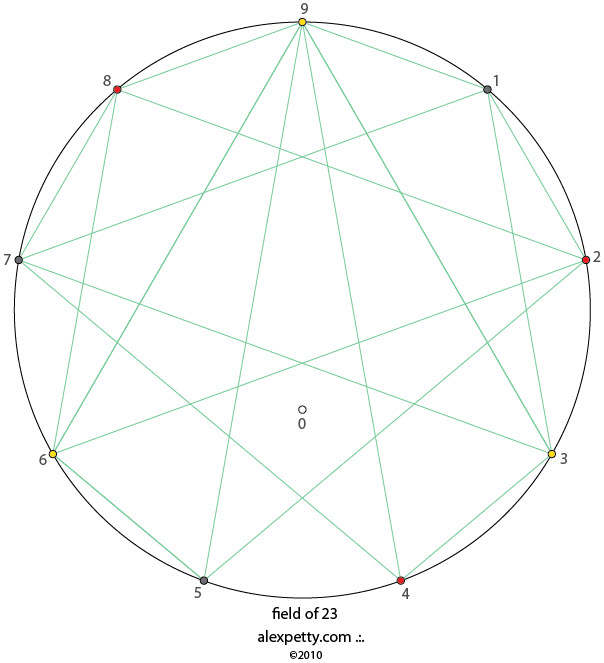
Original green glyph of twenty-three with overlapping paths between the same nine positions.
The twenty-three plate uses the same small set of digit positions for a longer repeating word.
Original table of elevenths with two-digit repeating words and orientation columns.
Eleven has ten nonzero starting remainders arranged in five cycles of length two.
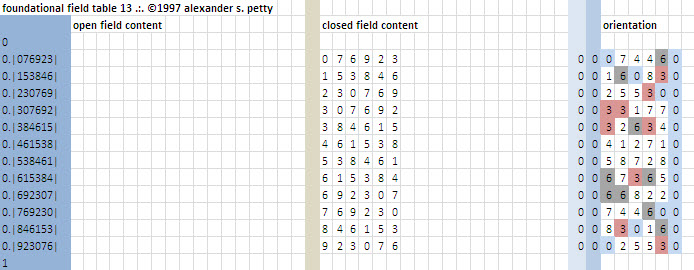
Original table of thirteenths with two families of six-digit repeating words.
Thirteen has two six-step remainder cycles. Rows from the two families are interleaved in the table.
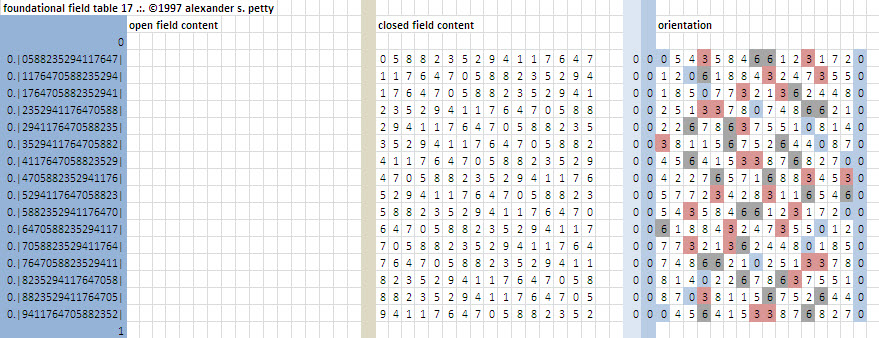
Original table of seventeenths with sixteen-digit repeating blocks and cumulative orientation values.
Seventeen has one remainder cycle of length sixteen. Its fractions provide all sixteen starting phases.
Original table of nineteenths with eighteen-digit repeating blocks.
Nineteen has one remainder cycle of length eighteen.
Original table of twenty-thirds with twenty-two-digit repeating blocks and orientation columns.
Twenty-three has one remainder cycle of length twenty-two.
Long prime tables · 29, 31, 37, 43, 47
Denominator Cycle length Number of cycles
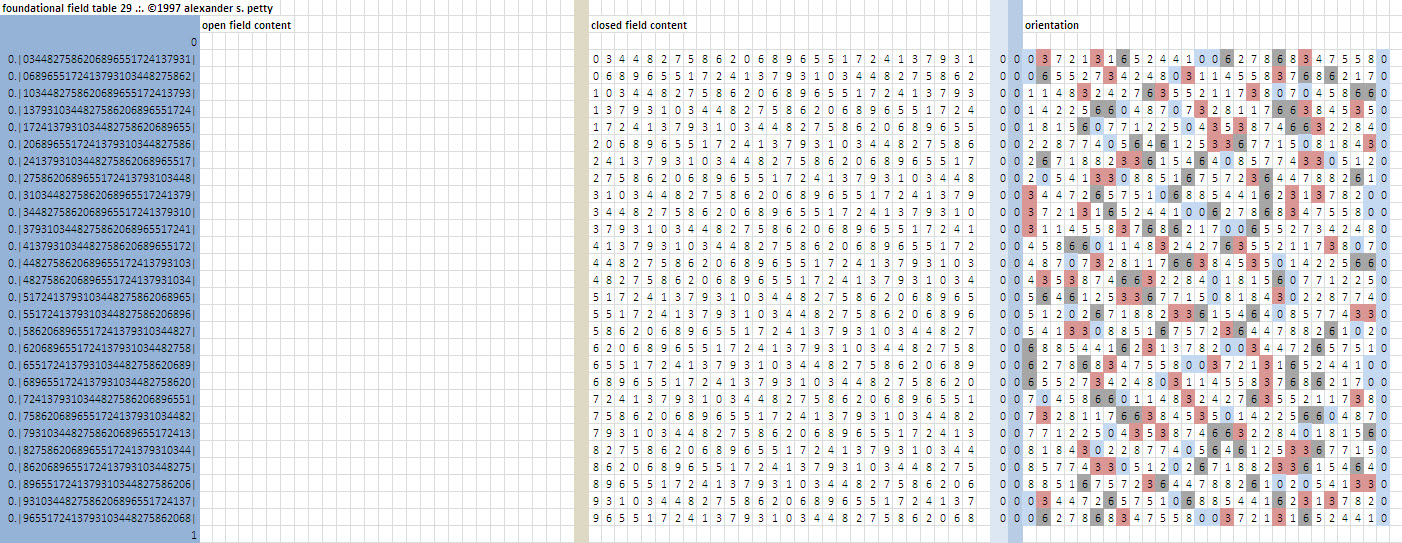
29 28 1
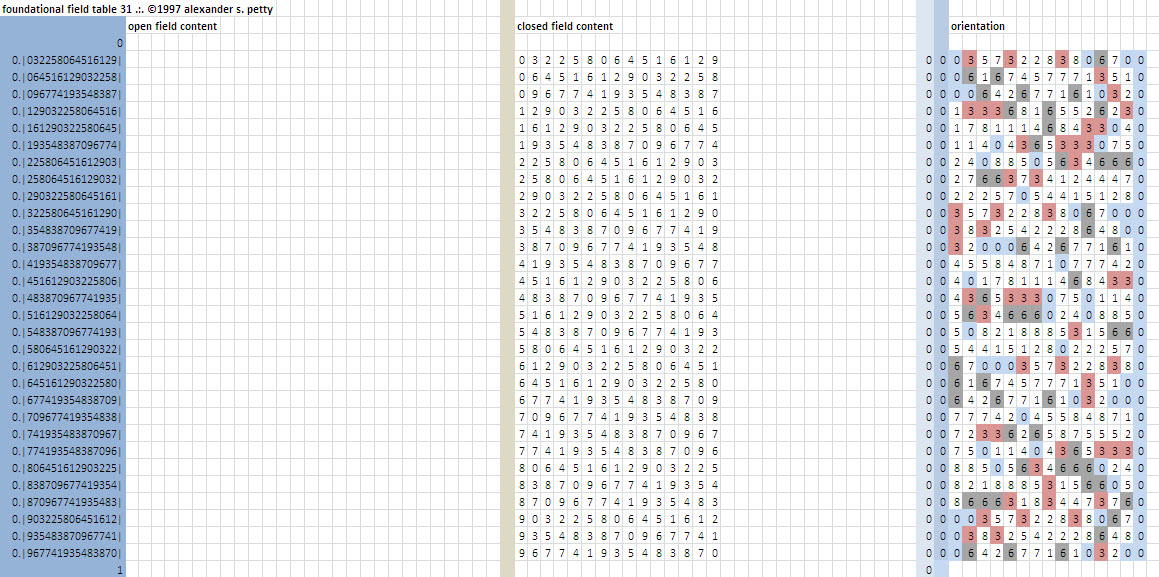
31 15 2
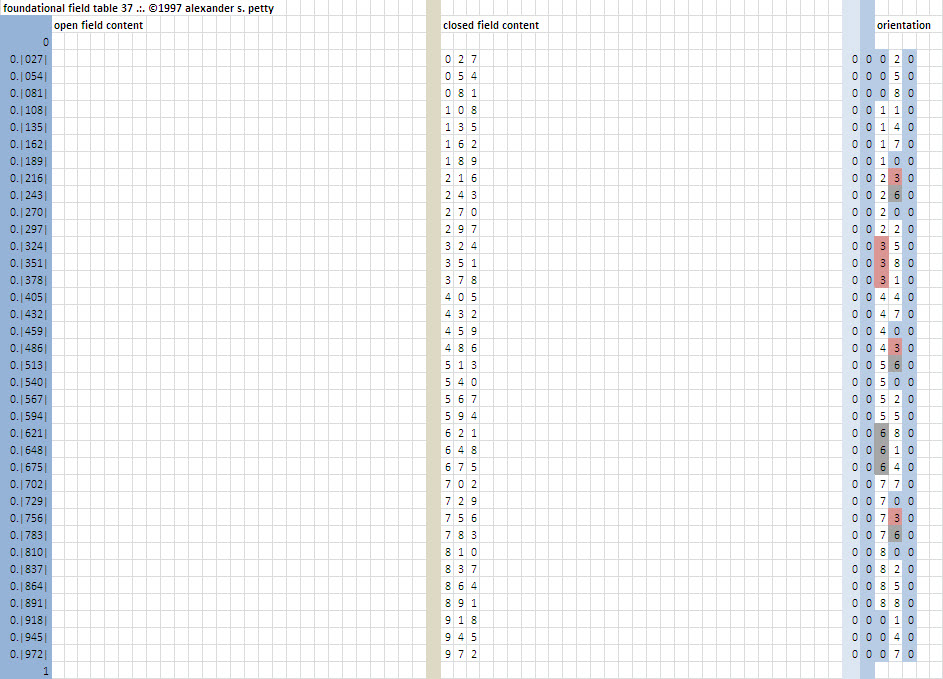
37 3 12
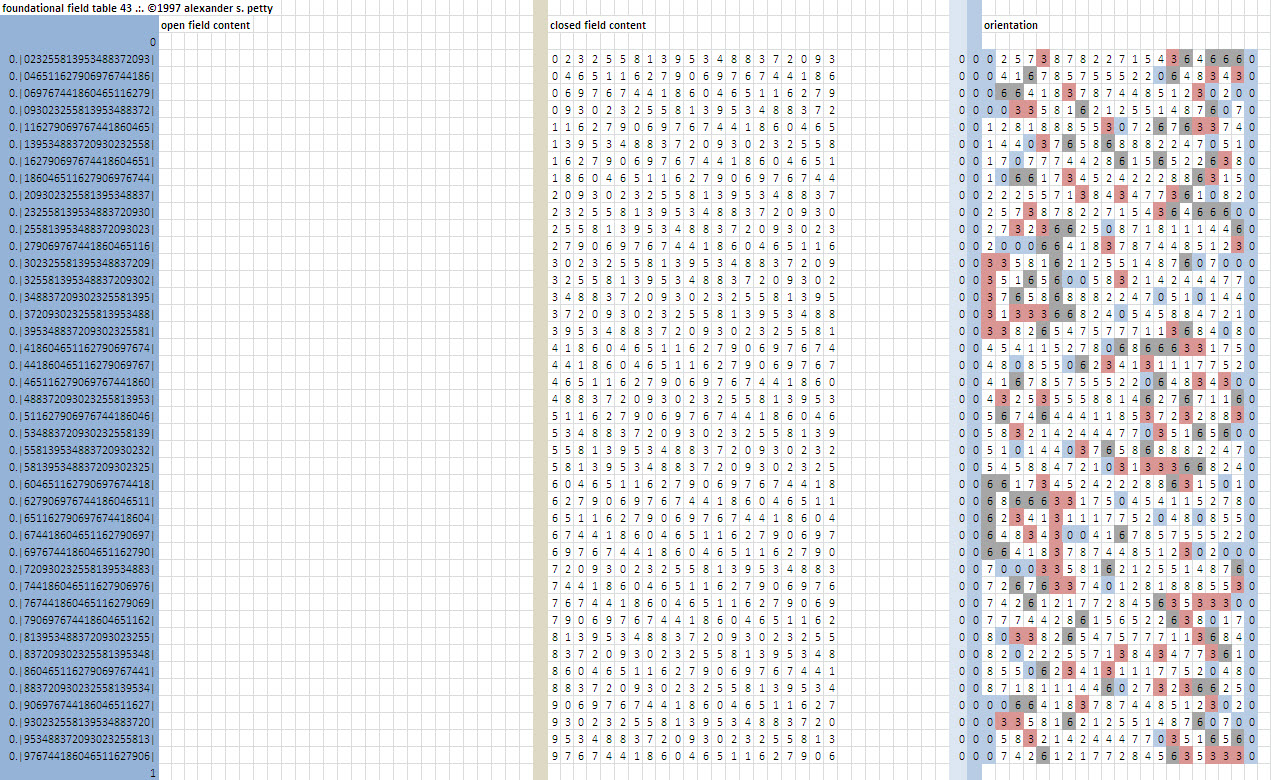
43 21 2
47 46 1
Original long table of twenty-ninths and their accumulated digit totals.
Twenty-nine has one remainder cycle of length twenty-eight. Open the original to read individual rows.
Original long table of thirty-firsts with recurring blocks and colored orientation values.
Thirty-one has two remainder cycles, each of length fifteen.
Original table of thirty-sevenths with short three-digit repeating blocks and a narrow orientation panel.
Thirty-seven splits its thirty-six interior fractions into twelve cycles of length three. The short blocks make a strong contrast with the neighboring tables.
Original long table of forty-thirds with recurring blocks and accumulated totals.
Forty-three has two remainder cycles, each of length twenty-one.
Original full table of forty-sevenths, with forty-six repeating rows and a colored orientation panel on the right.
Forty-seven has one cycle of length forty-six. The cover shows the orientation panel turned sideways. This complete sheet retains the decimals and repeating words beside it.
Finite and mixed fields · 5, 8, 10, 14, 16, 20, 22

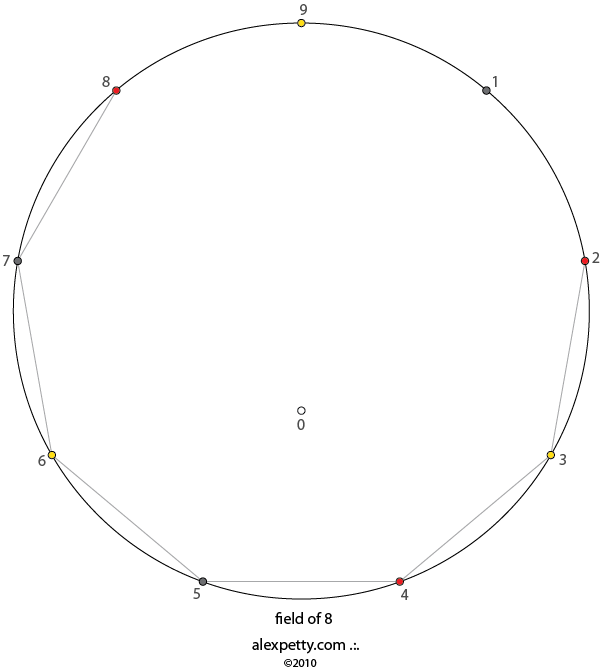
Five, eight, ten, sixteen, and twenty have only terminating fractions. Fourteen and twenty-two combine finite and repeating content. Compare fourteen with seven, and twenty-two with eleven.
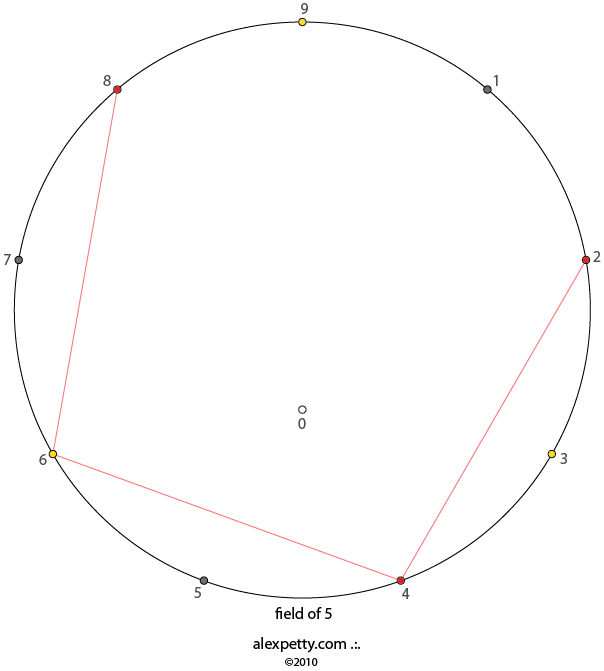
Original glyph of five with a red path joining two, four, six, and eight on the circle.
Five follows the finite digit totals through two, four, six, and eight.
Original glyph of eight with an open gray path passing through successive lower positions on the circle.
Eight connects those seven finite totals in order.
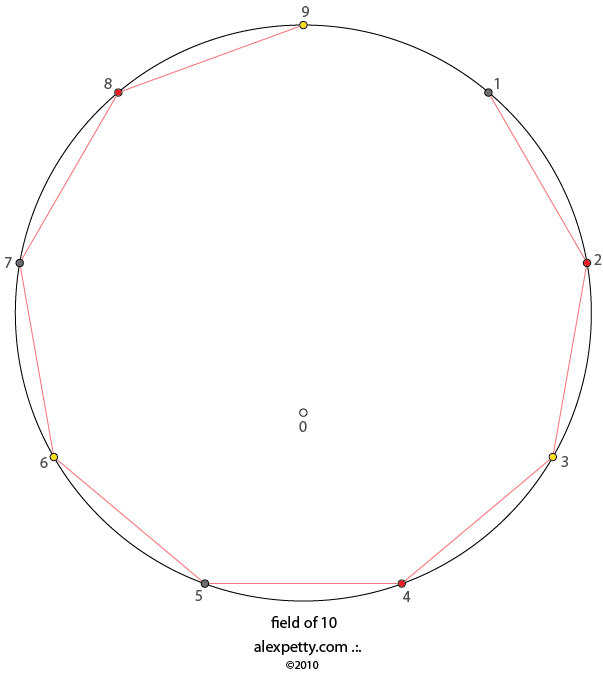
Original glyph of ten with a red path around the outer digit positions.
Ten places its finite rows around the perimeter.
Original glyph of fourteen combining a red outer path with the yellow repeating path of seven.
The yellow path of seven is recognizable inside the fourteen plate.
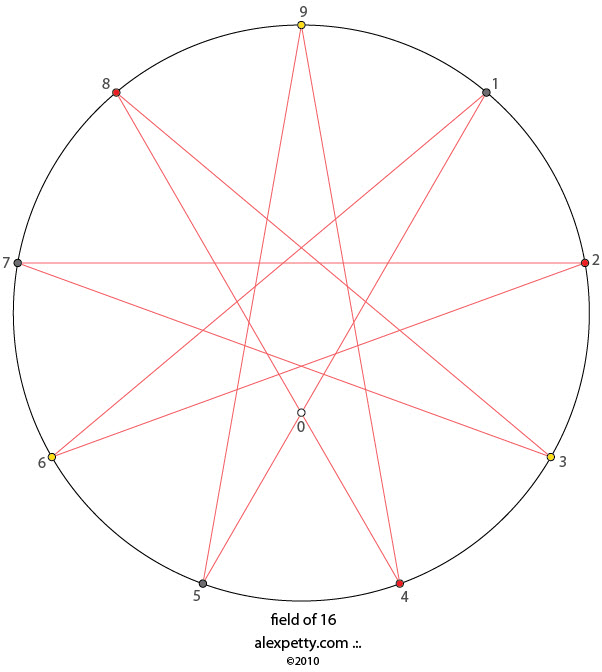
Original glyph of sixteen with an intersecting red path on the nine-position circle.
Sixteen produces crossings even though every decimal in its field terminates.
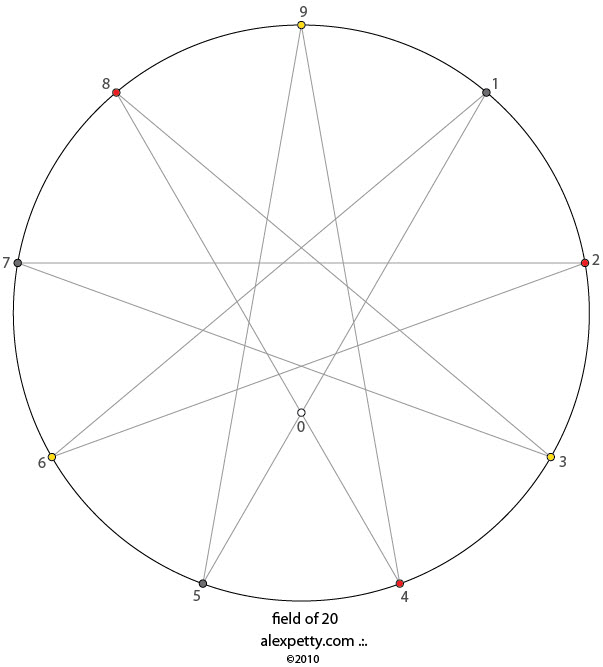
Original glyph of twenty with crossing gray paths.
The twenty plate gives another finite-content geometry on the same circle.
Original glyph of twenty-two combining a red peripheral path with yellow and green complementary pairs.
The horizontal pairings of eleven remain visible within the twenty-two plate.
Original table of fifths with terminating decimals in the open field and an empty closed field.
Five has four interior fractions. Their finite digits give two, four, six, and eight.
Original table of eighths with terminating decimals and reduced digit sums from eight down to two.
The finite sums reduce to eight, seven, six, five, four, three, two.
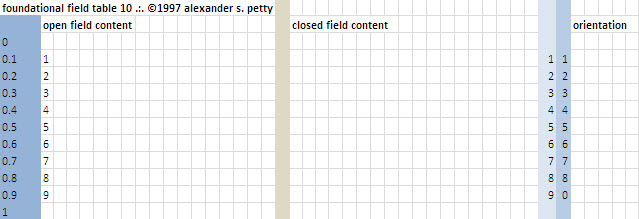
Original table of tenths with single terminating digits and no repeating content.
The interior tenths give the digits one through nine.
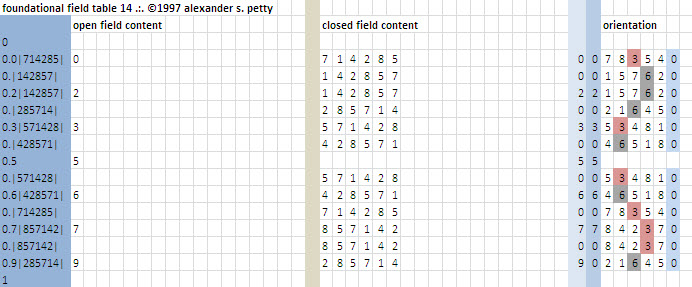
Original table of fourteenths with finite prefixes and the six-digit repeating family of seven.
Fourteen combines finite leading digits with rotations of the sevenths, and includes the terminating half.
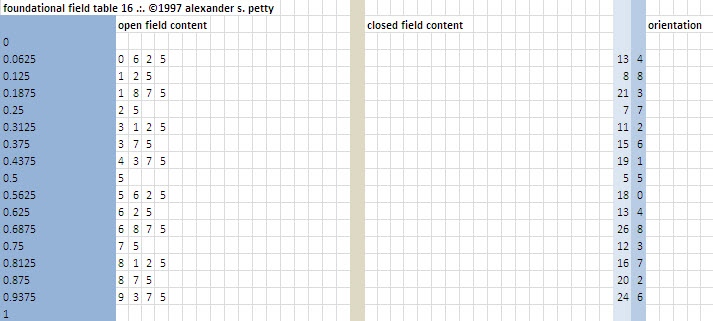
Original table of sixteenths with terminating decimal digits and their reduced sums.
All fifteen interior fractions terminate. Their reduced digit totals supply the finite path.
Original table of twentieths with terminating decimals and reduced digit totals.
Twenty also has an entirely terminating decimal field.
Original table of twenty-seconds with finite leading digits and the two-digit recurring pairs of eleven.
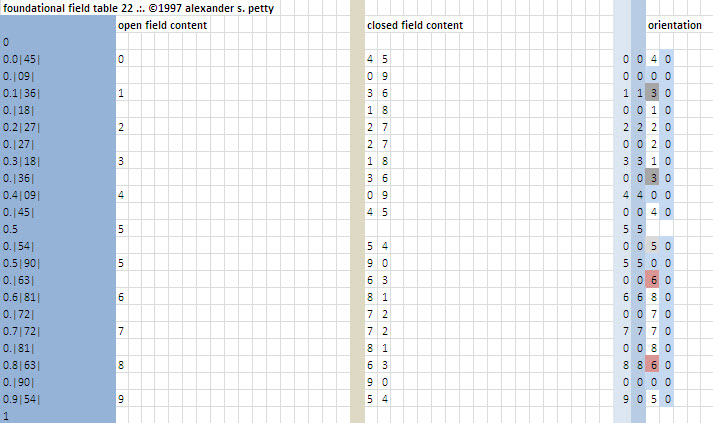
Twenty-two retains the repeating pairs of eleven and adds finite prefixes, along with the terminating half.
Doubling, growth, and return

The integers double without bound. Their positions modulo nine cycle through one, two, four, eight, seven, five, then one again. Magnitude keeps growing while the residue returns. These sheets show the two records together.
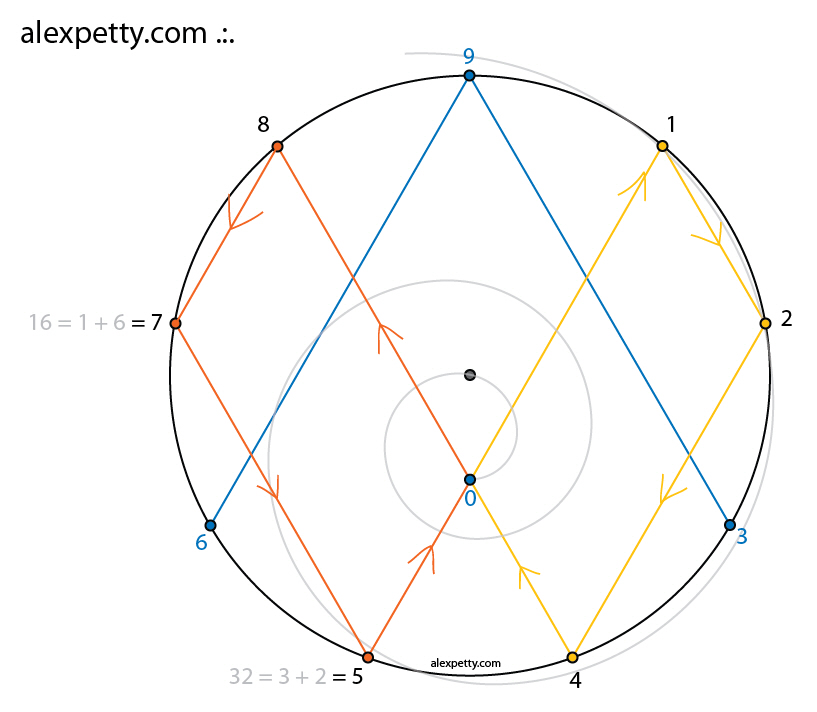
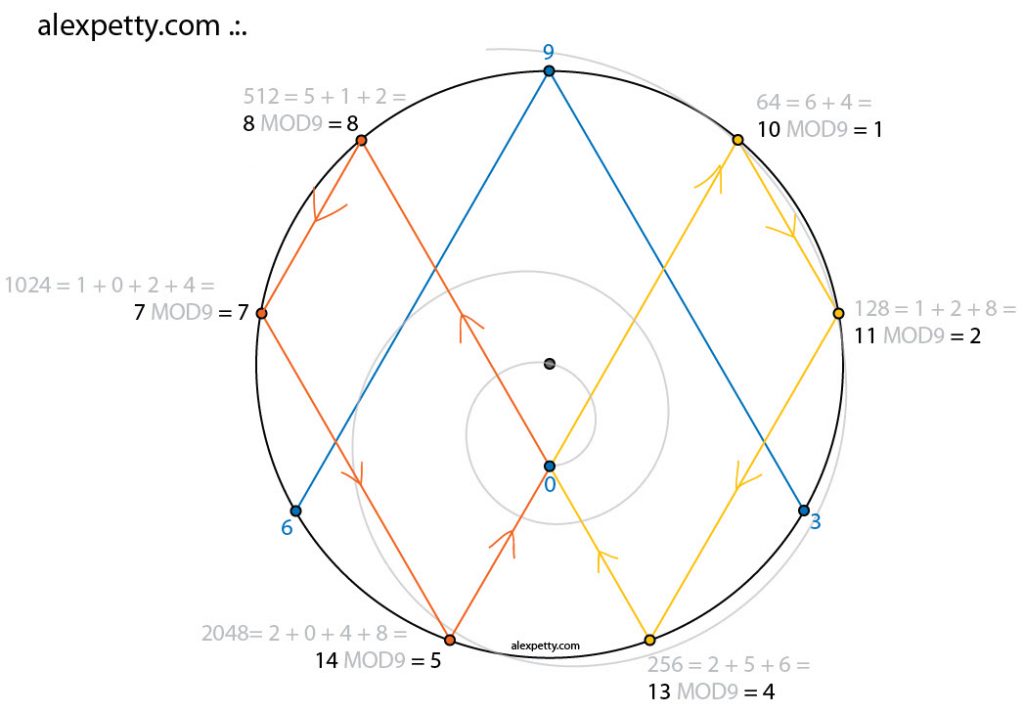
Original doubling diagram on the nine-position circle, with arrows and the reductions of sixteen and thirty-two.
Sixteen returns to seven modulo nine and thirty-two to five. The integers keep growing while their circular positions repeat.
Original extended doubling diagram marking powers through 512 and 1024 around the nine-position circle.
The extended sheet continues the same doubling calculation. The base fixes the reduction used to place each integer.
Unity, plurality, and the golden roots

These plates preserve the philosophical starting point of the catalog. The undivided circle represents unity. Superimposed radial constructions associated with one and two produce the paired lobes around the seated figure. I connected the midpoint 0.5 with a boundary between parts.

The appearance of one, two, and five in the expression for the golden ratio also caught my attention. The useful algebraic relationship is exact. The two roots, about 1.618 and −0.618, add to one, and the second is the negative reciprocal of the first. The associations helped me choose questions to pursue.

Original undivided circle labeled unity, with the author's original attribution.
The first plate leaves the interior undivided. Unity has a place in the catalog before any internal paths are introduced.
Original seated silhouette surrounded by superimposed red and gray radial constructions forming two lobes.
The superimposed constructions associated with one and two form the paired lobes.
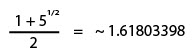
Original small equation showing the positive golden root, one plus the square root of five divided by two.
The positive root, shown at the small size of the original image.
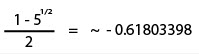
Original small equation showing the negative golden root, one minus the square root of five divided by two.
The second root is the negative reciprocal of phi.

First written in June 2010, and rewritten in September 2026 around the original drawings.

Share

Discussion

Sign in to join the discussion.

← All articles
← Previous: The Golden Ratio
Next: The Effect of Base on Numeric Fields →